The Corn Mother / First Woman Myth Meaning & Symbolism
A sacred being, often the First Woman, gives her body through death to become the first corn, establishing the cycle of life, death, and nourishment for her people.
The Tale of The Corn Mother / First Woman
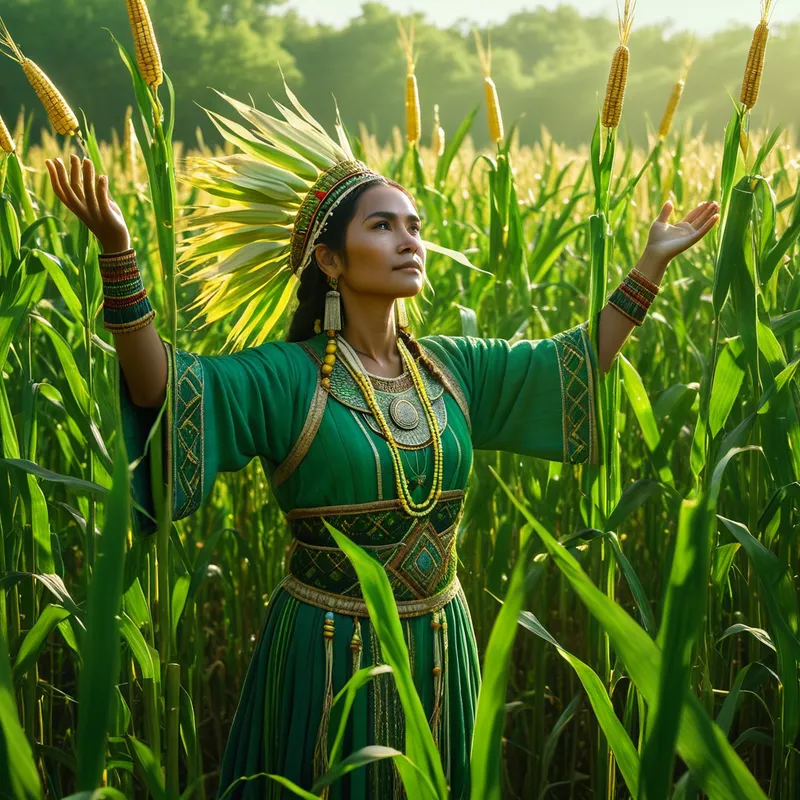
In the time before time, when [the world](/myths/the-world “Myth from Tarot culture.”/) was new and the people were hungry, she walked among them. She was known by many names, but her essence was one: the First Woman, the One Who Provides, the Sacred Visitor. Her skin held the warmth of the sun, her hair flowed like the black soil of [the river](/myths/the-river “Myth from Buddhist culture.”/) bottom, and her eyes held the deep knowing of [the earth](/myths/the-earth “Myth from Hindu culture.”/) itself.
The people loved her, for she taught them the ways of the plants and the seasons. Yet a great stillness settled over the land. The game grew scarce, the berries failed to fruit, and a hollow ache grew in every belly. The children grew thin and quiet. The First Woman saw their suffering, and a profound sorrow took root in her own heart. She walked away from the village, into the whispering stands of the wild grasses, and she prayed. She prayed to the spirits of the earth and sky until her voice was raw.
Then, she gave her instructions to those who followed her, her voice as steady as stone. “You must do as I say, for the life of our people. You must take my body. You must clear the land with fire. You must drag my flesh across the bare earth. Do not look upon me with pity, but with hope. For my love will not leave you.”
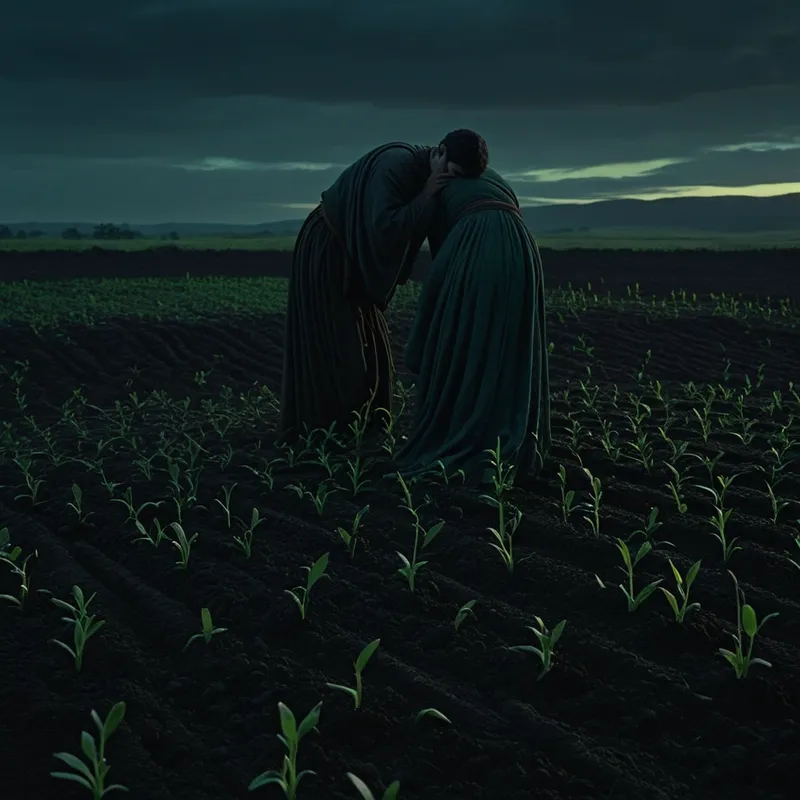
Her people wept, their cries a wind through the grass. But love demanded obedience. With hearts of lead, they did as she commanded. As they dragged her sacred form, a miracle began. Where her flesh touched the earth, the soil darkened, becoming rich and fragrant. Where her blood seeped into the ground, the earth trembled. They covered her, a living seed in [the womb](/myths/the-womb “Myth from Various culture.”/) of the world, and retreated under a sky heavy with stars and grief.
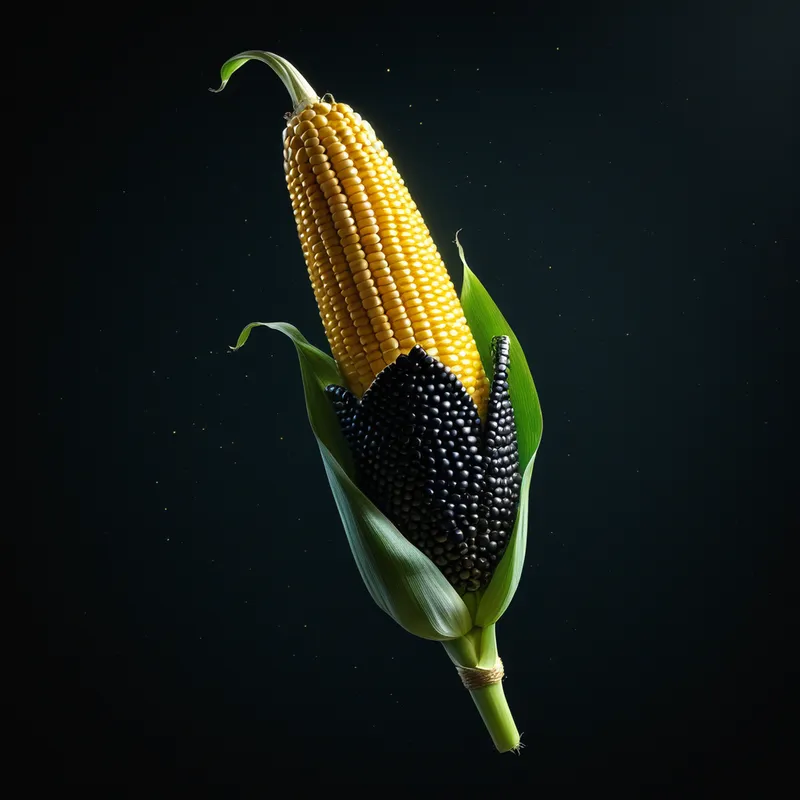
For four days, the world held its breath. On the fifth morning, a green light seemed to emanate from the place of her burial. The people approached and saw a sight that stopped their hearts. From the very soil where she lay, tall, graceful plants had sprung, clothed in green and crowned with tassels of gold. And upon the stalks grew strange, wondrous gifts: ears wrapped in silken husks. They peeled one back, and there, in perfect rows, were kernels the color of sunlight and sunset. They tasted, and it was not the taste of flesh, but of life itself—sweet, sustaining, and sacred. The First Woman was gone. And the Corn Mother was born, forever present, forever giving.
Cultural Origins & Context
This profound narrative exists in many forms across numerous Native American cultures, particularly among the Haudenosaunee (Iroquois), Cherokee, Mandan, and Pueblo nations. It is a foundational myth, often told during planting ceremonies, harvest festivals, and rites of passage. The storyteller was not merely an entertainer but a keeper of sacred law, an elder or spiritual leader who channeled the collective memory of the people. The myth’s function was multifaceted: it was an agricultural manual encoded in sacred story, a theological explanation for the origin of their staple food, and a powerful social contract. It taught that sustenance comes not from domination, but from a reciprocal, sacrificial relationship with the spiritual world. The Corn Mother was not a distant deity, but an intimate ancestor whose very substance became their daily bread, binding the people to the land in a covenant of gratitude and care.
Symbolic Architecture
At its core, the myth dismantles the Western [dichotomy](/symbols/dichotomy “Symbol: A division into two contrasting parts, often representing opposing forces, choices, or perspectives within artistic or musical expression.”/) between [life](/symbols/life “Symbol: The symbol of ‘Life’ represents a journey of growth, interconnectedness, and existential meaning, encompassing both the joys and challenges that define human experience.”/) and [death](/symbols/death “Symbol: Symbolizes transformation, endings, and new beginnings; often associated with fear of the unknown.”/), [spirit](/symbols/spirit “Symbol: Spirit symbolizes the essence of life, vitality, and the spiritual journey of the individual.”/) and matter. The Corn [Mother](/symbols/mother “Symbol: The symbol of ‘Mother’ represents nurturing, protection, and the foundational aspect of one’s emotional being, often associated with comfort and unconditional love.”/) embodies the ultimate [alchemy](/symbols/alchemy “Symbol: A transformative process of purification and creation, often symbolizing personal or spiritual evolution through difficult stages.”/): the [transmutation](/symbols/transmutation “Symbol: A profound, alchemical process of fundamental change where one substance or state transforms into another, often representing spiritual evolution or personal metamorphosis.”/) of individual, mortal [life](/symbols/life “Symbol: The symbol of ‘Life’ represents a journey of growth, interconnectedness, and existential meaning, encompassing both the joys and challenges that define human experience.”/) into collective, eternal nourishment.
The body is not a tomb, but a seed. Death is not an end, but a dispersal into a more generous form of life.
Psychologically, she represents the [Caregiver](/symbols/caregiver “Symbol: A spiritual or mythical figure representing nurturing, protection, and unconditional support, often embodying divine or archetypal parental energy.”/) [Archetype](/symbols/archetype “Symbol: A universal, primordial pattern or prototype in the collective unconscious that shapes human experience, behavior, and creative expression.”/) in its most absolute [expression](/symbols/expression “Symbol: Expression represents the act of conveying thoughts, emotions, and individuality, emphasizing personal communication and creativity.”/). Yet, she transcends it, for her care is not merely service—it is a literal becoming. She symbolizes the creative, nourishing principle of the [psyche](/myths/psyche “Myth from Greek culture.”/) itself—the part of us that can take our suffering, our experiences, even our perceived destruction, and compost it into something that feeds our growth. The act of being dragged represents the painful, often resisted process of bringing a sacred [truth](/symbols/truth “Symbol: Truth represents authenticity, honesty, and the quest for knowledge beyond mere appearances.”/) or a deep feeling (the “flesh”) into contact with the raw, unconscious ground of our being. The “clearing by fire” is the necessary destruction of old growth, of egoic attachments, to make [space](/symbols/space “Symbol: Dreaming of ‘Space’ often symbolizes the vastness of potential, personal freedom, or feelings of isolation and exploration in one’s life.”/) for the new.
The Dreamer’s Resonance
When this myth stirs in the modern dreamer, it often signals a profound somatic and psychological process of transformation through surrender. One might dream of a beloved figure dying and turning into a tree or garden. One might dream of being forced to bury something precious, only to find it has multiplied. There is a somatic signature here: a deep, often anxious tension in the gut or chest—the place of nourishment and emotion—followed by a visionary release.
The dreamer is encountering the archetypal mandate to let a part of their identity, a long-held role, or a cherished but outgrown way of being, “die” so that it can become a resource. It is the process of the overworked parent learning that self-sacrifice must transform into sustainable nurture, or the artist realizing their personal anguish must be processed into art that feeds others. The dream presents the terrifying, sacred equation: to give of your essence is to be dismantled. But from that dismantling, a more resilient and abundant form of life is born.

Alchemical Translation
The individuation journey modeled here is the opus contra naturam—the work against our instinct for self-preservation—in service of a greater, psychic wholeness. The modern ego, like the hungry people in the myth, often experiences a famine of meaning, a scarcity of authentic connection. It looks for external solutions. The Corn Mother’s path instructs otherwise.
The first alchemical stage is recognizing the famine within—the acknowledgment of a spiritual or emotional hunger that cannot be sated by old means. The second is the voluntary sacrifice: the conscious decision to offer up a part of [the self](/myths/the-self “Myth from Jungian culture.”/)—a grievance, a vanity, a comfort—to a process one does not fully control. This is the “dragging across the earth,” the humbling, often messy integration of a complex into the soil of the unconscious.
The goal of the work is not to save the individual ego, but to transform it into a vessel for a sustenance that serves the entire psychic community.
The burial is the period of incubation, the [nigredo](/myths/nigredo “Myth from Alchemical culture.”/) or dark night, where all seems lost. The final stage is the harvest: the realization that what was given up has not been lost but transmuted. The love that was a personal attachment becomes compassionate action. The pain that was a private wound becomes empathetic understanding. The individual identity, having passed through this death, is reborn not as a solitary figure, but as a source of nourishment, connected to a cycle much larger than itself. One becomes, in a psychological sense, both the people receiving the gift and the continuing presence of the Corn Mother—forever engaged in the sacred cycle of receiving, transforming, and giving.
Associated Symbols
Explore related symbols from the CaleaDream lexicon: