The Conference of the Birds Myth Meaning & Symbolism
A flock of birds undertakes a perilous quest to find their legendary king, only to discover a shocking truth that transforms them utterly.
The Tale of The Conference of the Birds
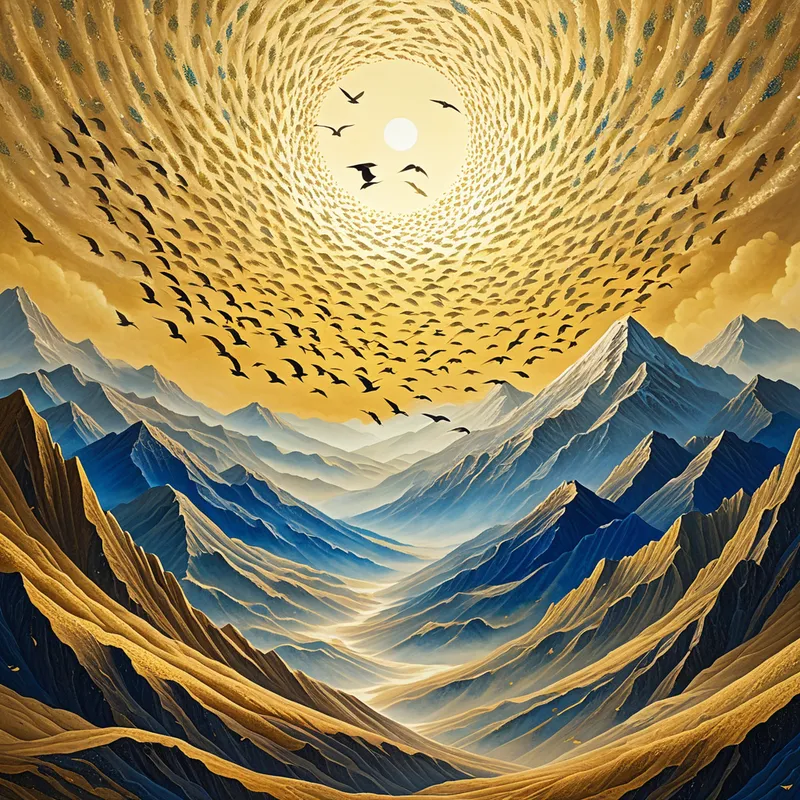
Listen, and let the tale unfold. In a time before memory, when [the world](/myths/the-world “Myth from Tarot culture.”/) was a tapestry of whispers and wonders, the birds of [the earth](/myths/the-earth “Myth from Hindu culture.”/) grew restless. A shadow of discontent had fallen upon them. They lived without a king, a sovereign to unite their disparate hearts and give purpose to their flight. From the soaring eagle to the chattering sparrow, a longing stirred—a deep, unnamed yearning for a center, for a truth to orbit.
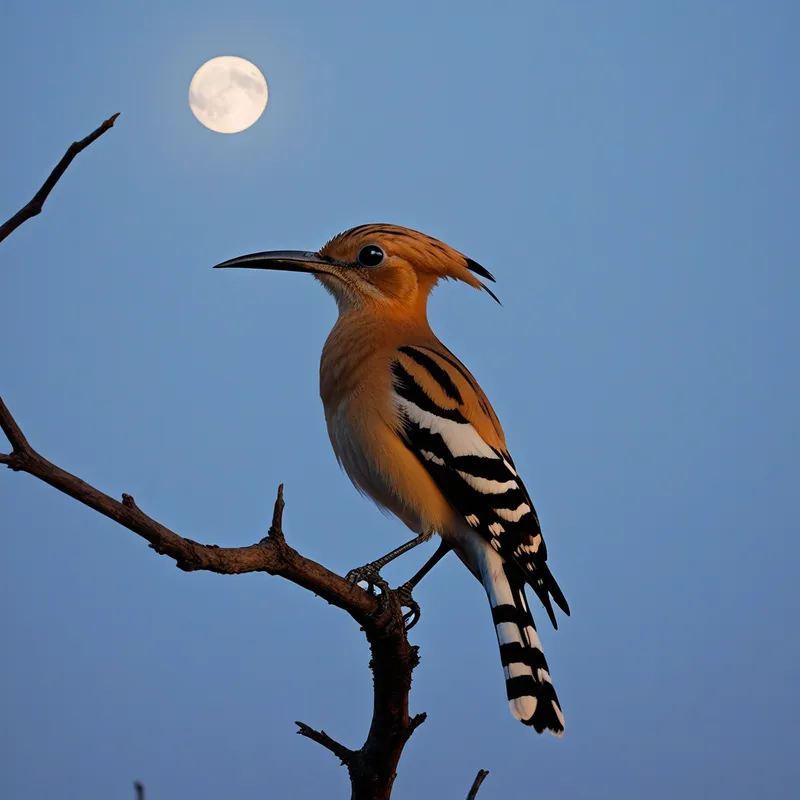
Then rose the Hoopoe, her crest a crown of conviction. She spoke of a legendary monarch, the Simorgh, who dwelt beyond the known world, atop the distant, shrouded peak of Mount Qaf. “He is the answer to our fragmentation,” she declared, her voice a clear bell in the anxious air. “But the path is the Valley of the Quest, and it is fraught with perils that will strip you bare.”
A great conference was called. The birds gathered, a riot of color and song, each representing a facet of the seeking soul. The nightingale pleaded his love for [the rose](/myths/the-rose “Myth from Persian culture.”/) was too consuming to leave. The parrot prized his caged beauty, his learned phrases. The proud peacock could not abandon his splendid tail. The duck clung to the comfort of her [water](/myths/water “Myth from Chinese culture.”/). One by one, they voiced their fears, their attachments, their perfectly reasonable excuses.
But the Hoopoe answered each with parables of piercing truth, unraveling their illusions. She spoke of love that is not possession, of beauty that is not vanity, of comfort that is a prison. Her words were a mirror, and in it, the birds saw not their feathers, but their fears. Moved, shamed, and ignited, a courageous assembly agreed to embark. Their journey was the soul’s ascension.
They traversed seven valleys, each a crucible. The Valley of Quest, where all certainty was lost. The Valley of Love, where reason burned to ash. The Valley of Knowledge, where what they knew became a weight to discard. The Valley of Detachment, where every worldly desire was relinquished. The Valley of Unity, where the many began to sense the one. The Valley of Bewilderment, where even understanding dissolved into awe. And finally, the Valley of Annihilation, where [the self](/myths/the-self “Myth from Jungian culture.”/), with all its stories and names, was utterly extinguished.
Of the thousands who began, only thirty—haggard, featherless, stripped of all identity—stumbled into the presence of the Simorgh’s court. They sought an audience with the king, but the chamberlain presented them only with a scroll. With trembling hearts, they looked upon it, and then into a polished celestial mirror. The revelation struck them like silent lightning. In [the mirror](/myths/the-mirror “Myth from Various culture.”/), they did not see a majestic, external king. They saw only themselves—thirty birds. And in that moment, the pun shattered: Si Morgh in Persian means “Thirty Birds.”
The king they sought was not a distant other, but the sublime totality of their own purified, annihilated, and reunited selves. The seeker and the sought were one.
Cultural Origins & Context
This epic allegory, Mantiq al-Tayr (The Speech of the Birds), was composed in the 12th century by the Persian Sufi poet Farid ud-Din Attar. It stands as a pinnacle of Persian mystical literature, written in a period when Islamic mysticism (Sufism) was flowering in the Persianate world, using the rich symbolic language of poetry to express ineffable spiritual truths.
Attar, himself an apothecary, understood the alchemy of symbols. He did not invent the myth of the Simorgh or the journey, but wove existing Persian mythological motifs into a coherent, breathtaking map of the Sufi path. The poem was transmitted orally and through manuscripts, often accompanied by exquisite miniatures depicting the valleys and the birds. Its societal function was dual: as sublime art that captivated the courtly elite, and as a profound teaching tool within Sufi circles (khanqahs), guiding disciples (murids) through the stages (maqamat) of spiritual development. It served as a mirror for society, reflecting the inner struggle behind the outer forms of faith and life.
Symbolic Architecture
The myth’s power lies in its layered [symbolism](/symbols/symbolism “Symbol: The use of symbols to represent ideas or qualities, often conveying deeper meanings beyond literal interpretation. In dreams, it’s the language of the unconscious.”/), a perfect [architecture](/symbols/architecture “Symbol: Architecture in dreams often signifies structure, stability, and the framing of personal identity or life’s journey.”/) of the [soul](/symbols/soul “Symbol: The soul represents the essence of a person, encompassing their spirit, identity, and connection to the universe.”/). Each [bird](/symbols/bird “Symbol: Birds symbolize freedom, perspective, and the connection between the earthly and spiritual realms, often representing the soul’s aspirations or personal growth.”/) represents a [human](/symbols/human “Symbol: The symbol of a human represents individuality, complexity of emotions, and social relationships.”/) [attitude](/symbols/attitude “Symbol: Attitude symbolizes one’s mental state, perception, and posture towards life, influencing emotions and actions significantly.”/) or neurosis: the nightingale is sentimental attachment; the [parrot](/symbols/parrot “Symbol: A parrot represents communication, adaptability, and the ability to mimic or reflect the voices around us.”/) is hollow mimicry and learned dogma; the peacock is spiritual pride; the [duck](/symbols/duck “Symbol: Ducks often symbolize adaptability, emotional balance, and the ability to navigate life’s challenges with grace and ease.”/) is complacent comfort. Their excuses are [the ego](/myths/the-ego “Myth from Jungian culture.”/)’s [defense](/symbols/defense “Symbol: A protective mechanism or barrier against perceived threats, representing boundaries, security, and resistance to external or internal challenges.”/) mechanisms.
The seven valleys are not physical stages but successive states of [consciousness](/symbols/consciousness “Symbol: Consciousness represents the state of awareness and perception, encompassing thoughts, feelings, and experiences.”/). They model a deconstructive process:
- [Quest](/symbols/quest “Symbol: A quest symbolizes a journey or search for purpose, fulfillment, or knowledge, often representing life’s challenges and adventures.”/), Love, [Knowledge](/symbols/knowledge “Symbol: Knowledge symbolizes learning, understanding, and wisdom, embodying the acquisition of information and enlightenment.”/): The initial burning away of worldly aims.
- [Detachment](/symbols/detachment “Symbol: A psychological or emotional separation from oneself, others, or reality, often indicating a need for self-protection, perspective, or spiritual growth.”/), Unity: The painful shedding of the [personality](/symbols/personality “Symbol: Personality in dreams often symbolizes the traits and characteristics of the dreamer, reflecting how they perceive themselves and how they believe they are perceived by others.”/).
- Bewilderment, Annihilation (Fana): The final, terrifying, and necessary [dissolution](/symbols/dissolution “Symbol: The process of breaking down, dispersing, or losing form, often representing transformation, release, or the end of a state of being.”/) where the individual self-concept dies.
The journey is not an acquisition, but a relentless subtraction. You do not find the Simorgh by adding wisdom, but by shedding the illusion of being the seeker.
The ultimate [symbol](/symbols/symbol “Symbol: A symbol can represent an idea, concept, or belief, serving as a powerful tool for communication and understanding.”/), the pun of Si Morgh, encapsulates the core mystical realization of non-duality. The divine, the ultimate [reality](/symbols/reality “Symbol: Reality signifies the state of existence and perception, often reflecting one’s understanding of truth and life experiences.”/), is not a separate entity “out there.” It is the fundamental ground of being that is realized when the egoic self is transcended. The [king](/symbols/king “Symbol: A symbol of ultimate authority, leadership, and societal order, often representing the dreamer’s inner power or external control figures.”/) is the reconciled, collective Self.
The Dreamer’s Resonance
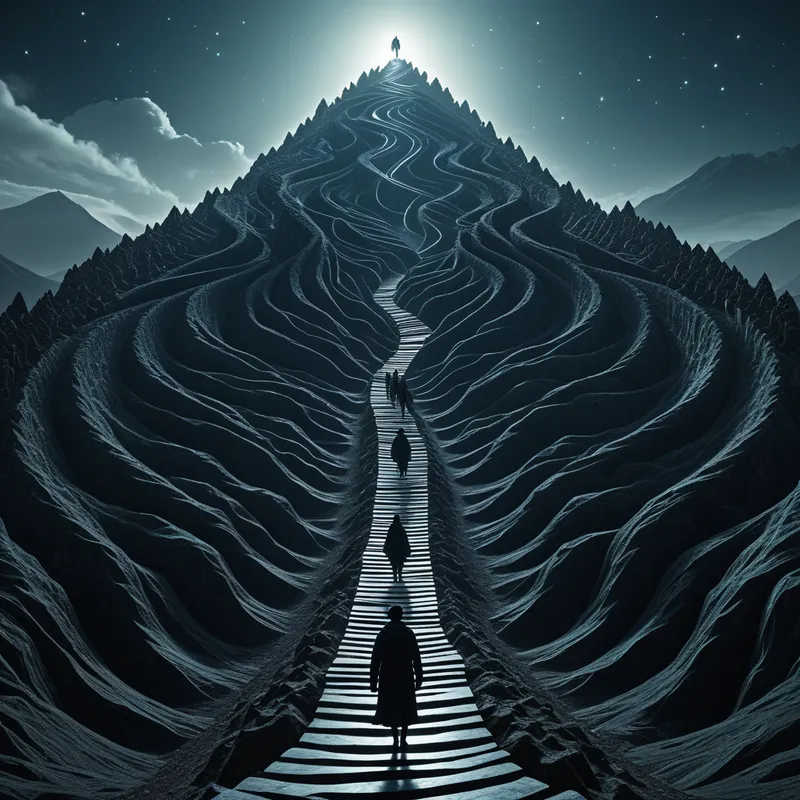
When this myth stirs in the modern unconscious, it often manifests not as a literal dream of birds, but as the pattern of the quest. You may dream of a relentless journey toward a vague but compelling goal—a summit, a light, a figure. You are part of a group that steadily dwindles. You lose belongings, clothes, even your name. The terrain shifts from familiar to surreal and abstract. There is often a profound somatic component: exhaustion, weightlessness, or the feeling of being stripped bare.
Psychologically, this dream pattern signals a deep process of individuation that has moved beyond early heroics into the territory of the Self. The ego is in the valleys of Detachment and Bewilderment. The dreamer is undergoing what feels like a crisis of meaning, a dissolution of old identities (career, relationships, self-image). It is the [psyche](/myths/psyche “Myth from Greek culture.”/)’s way of orchestrating a necessary death—not a physical one, but the death of who you thought you were. The anxiety in such dreams is the terror of annihilation, the very furnace in which the new consciousness is forged.
Alchemical Translation
For the modern individual, the myth is a manual for psychic alchemy. Our culture prizes accumulation—of wealth, status, experiences, even spiritual “achievements.” The Conference of the Birds inverts this. Its alchemical formula is [Solve et Coagula](/myths/solve-et-coagula “Myth from Alchemical culture.”/): dissolve and reconstitute.
First, you must Solve—dissolve. This is the painful, voluntary journey through the valleys. It means confronting your inner nightingale (clinging to a past love), your inner peacock (spiritual or intellectual arrogance), your inner duck (fear of leaving comfort). It is the therapy, [the shadow](/myths/the-shadow “Myth from Jungian culture.”/) work, [the dark night of the soul](/myths/the-dark-night-of-the-soul “Myth from Christian Mysticism culture.”/) where every prop is kicked away.
The prima materia for this alchemy is not base metal, but the inflated self. The fire is not in a furnace, but in the humiliation of the ego.
Then, and only then, can Coagula occur—the reconstitution. This is not a rebuilding of the old personality. It is the emergence of something entirely new: the realization of the Self. The thirty birds, annihilated, become the Simorgh. In psychological terms, the fragmented aspects of the psyche—[persona](/myths/persona “Myth from Greek culture.”/), shadow, anima/animus—cease to war and are integrated into a functioning whole. The center shifts from the ego to the Self.
You stop seeking a savior, a guru, or a perfect external answer. You realize the authority, the wisdom, the “kingdom” was within all along, but accessible only through the shared, humble, and annihilated journey. You become, at last, both [the pilgrim](/myths/the-pilgrim “Myth from Christian culture.”/) and the destination.
Associated Symbols
Explore related symbols from the CaleaDream lexicon: