The Concept of 'Samma Vayama' Myth Meaning & Symbolism
The myth of the warrior's vigilant effort against the inner armies of Mara, a story of psychic cultivation from the Buddhist tradition.
The Tale of The Concept of ‘Samma Vayama’
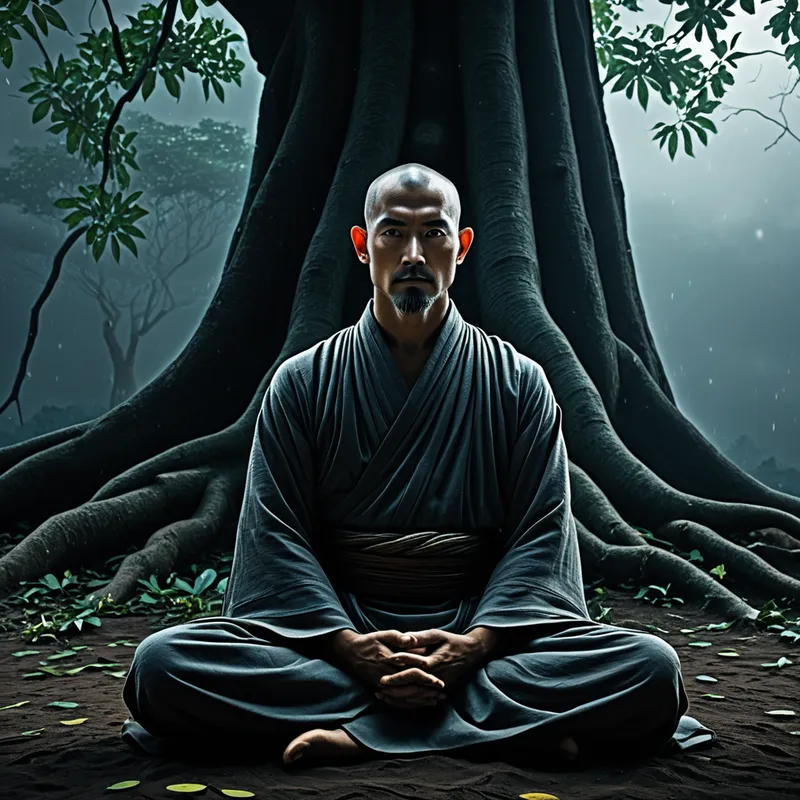
Listen. Before the first teaching was spoken, before the wheel was set in motion, there was a battlefield. Not of clashing steel and screaming horses, but of utter, profound silence. The air beneath the Bodhi tree was thick, not with monsoon humidity, but with the weight of a cosmos waiting.
Here sat the one who would be [the Buddha](/myths/the-buddha “Myth from Buddhist culture.”/), but he was not yet that. He was a warrior, clad only in the ragged armor of his resolve, seated upon the unshakable earth. Before him stretched not an army of men, but the fourfold legion of Mara. From the west came the horde of Desire, shimmering with seductive visions of pleasure and comfort, whispering of soft beds and forgotten homes. From the east marched the battalion of Discontent, a cold, grating host of doubt, fear, and existential weariness. From the north stormed the regiment of Hunger and Thirst, a desperate, clutching need. And from the south, most subtle and deadly, advanced the phalanx of Spiritual Pride, the intoxicating lure of believing the battle was already won.
The warrior did not draw a sword. He did not raise a shield. He simply set his awareness like an unbroken watchtower upon the citadel of his own mind. This was Samma Vayama. He felt the first arrows of lethargy—the desire to let the watchtower crumble, to sleep. With a breath, he aroused the will, the energy, the viriya, to guard the post. He felt the creeping vines of sensual desire try to pull his attention into dreamy fantasy. With a breath, he sustained the effort to cut them, to unroot them, to prevent their taking hold.
Then came the counter-attack: the inner critic, the voice of restless agitation, the fury of trying too hard, [the self](/myths/the-self “Myth from Jungian culture.”/)-laceration for not being perfect. The effort itself became a knot of tension. Here, the warrior did the most profound [thing](/myths/thing “Myth from Norse culture.”/): he relaxed the effort. He allowed the energy to flow without strain, he soothed the agitated mind, he cultivated a calm, persistent abiding. This, too, was part of the great effort—the effort to cease unskillful effort.
For nights uncounted, this was the dance. Not a violent clash, but a meticulous, moment-to-moment cultivation. He was a gardener of his own consciousness, pulling weeds as they sprouted, nurturing tender shoots of wholesome states, protecting the cleared ground. When Mara’s final challenge came—a demand for a witness to his right to claim the seat of enlightenment—the warrior did not call upon gods. He simply touched [the earth](/myths/the-earth “Myth from Hindu culture.”/). The earth itself, the patient, enduring ground of all his effort, roared its confirmation. The armies of Mara shattered like mist in dawn light, not because they were slain, but because the light of unwavering, right attention left no shadow for them to inhabit. The watchtower had become the entire horizon. The effort had become the natural state of being.
Cultural Origins & Context
This is not a myth of distant gods on Olympus, but the foundational psychological drama at the heart of the Buddhist path. The narrative is drawn from the Pali Canon, specifically the accounts of the Buddha’s night of awakening. It was not told to explain the cosmos, but to map the interior landscape of every practitioner. Passed down orally for generations by monks and nuns, it served as the ultimate “how-to” manual for the mind.
Its societal function was radical. In a world structured by caste and ritual, it declared that the ultimate battle, the only battle that truly mattered, was internal and universally accessible. It democratized heroism. The warrior under [the Bodhi tree](/myths/the-bodhi-tree “Myth from Buddhist culture.”/) was a model for the farmer tending his field with mindfulness, for the merchant conducting business with right intention. The myth of Samma Vayama provided the cultural script for the work of self-cultivation, framing the often tedious, frustrating work of meditation and ethical living as an epic, noble struggle. It was the story that gave meaning to the daily act of choosing attention over distraction, compassion over aversion.
Symbolic Architecture
The myth presents a complete symbolic [architecture](/symbols/architecture “Symbol: Architecture in dreams often signifies structure, stability, and the framing of personal identity or life’s journey.”/) for psychological [integration](/symbols/integration “Symbol: The process of unifying disparate parts of the self or experience into a cohesive whole, often representing psychological wholeness or resolution of internal conflict.”/). Mara is not an external devil, but the personified totality of the [shadow](/symbols/shadow “Symbol: The ‘shadow’ embodies the unconscious, repressed aspects of the self and often represents fears or hidden emotions.”/) and the Self. His armies represent the autonomous complexes—bundles of thought, [emotion](/symbols/emotion “Symbol: Emotion symbolizes our inner feelings and responses to experiences, often guiding our actions and choices.”/), and [memory](/symbols/memory “Symbol: Memory symbolizes the past, lessons learned, and the narratives we construct about our identities.”/)—that rise unbidden to seize control of the [psyche](/myths/psyche “Myth from Greek culture.”/).
Samma Vayama is the ego’s conscious, disciplined alignment with the Self’s intent toward wholeness. It is not the will to dominate the unconscious, but the will to relate to it with clarity and compassion.
The fourfold army maps onto fundamental psychological states: Desire (the libidinal pull of the unconscious), Discontent (the neurotic suffering of the divided psyche), [Hunger](/symbols/hunger “Symbol: A primal bodily sensation symbolizing unmet needs, desires, or emotional voids. It represents craving for fulfillment beyond physical nourishment.”/) (the insatiable egoic need for validation), and Spiritual Pride (the [inflation](/symbols/inflation “Symbol: A dream symbol representing feelings of diminishing value, loss of control, or expansion beyond sustainable limits in one’s life or psyche.”/) of [the ego](/myths/the-ego “Myth from Jungian culture.”/) that claims the achievements of the Self). The [Bodhi tree](/symbols/bodhi-tree “Symbol: The sacred fig tree under which Siddhartha Gautama attained enlightenment, symbolizing awakening, wisdom, and the interconnectedness of all life.”/) is the [axis](/symbols/axis “Symbol: A central line or principle around which things revolve, representing stability, orientation, and the fundamental structure of reality or consciousness.”/) mundi, the [connection](/symbols/connection “Symbol: Connection symbolizes relationships, communication, and bonds among individuals.”/) point between the personal struggle and the transpersonal goal of awakening. The touching of the [earth](/symbols/earth “Symbol: The symbol of Earth often represents grounding, stability, and the physical realm, embodying a connection to nature and the innate support it provides.”/) is the ultimate [symbol](/symbols/symbol “Symbol: A symbol can represent an idea, concept, or belief, serving as a powerful tool for communication and understanding.”/) of grounding, of [reality](/symbols/reality “Symbol: Reality signifies the state of existence and perception, often reflecting one’s understanding of truth and life experiences.”/)-testing, of finding [authority](/symbols/authority “Symbol: A symbol representing power structures, rules, and control, often reflecting one’s relationship with societal or personal governance.”/) not in abstraction but in embodied, experiential [truth](/symbols/truth “Symbol: Truth represents authenticity, honesty, and the quest for knowledge beyond mere appearances.”/).

The Dreamer’s Resonance
When this myth stirs in the modern dreamer, it rarely appears as an ancient monk under a tree. It manifests as the somatic experience of strain. One dreams of trying to hold a heavy door shut against a pressing crowd (preventing unwholesome states). One dreams of desperately pedaling a bicycle up an endless hill, muscles burning (arousing the will for the wholesome). One dreams of a cluttered room they must clean, where trash endlessly reappears (the ongoing nature of the work).
These dreams signal a critical phase of psychic reorganization. The ego is attempting to establish a new, more conscious relationship with powerful unconscious contents—perhaps a wave of repressed anger (an army of Discontent), or a compulsive behavior pattern (the horde of Desire). The fatigue in the dream is real; it is the exhaustion of the conscious mind attempting a task for which it was not designed to work alone. The myth reminds the dreamer that the effort must be wise, balanced, and sustained, not a frantic, ego-driven war of annihilation.

Alchemical Translation
The alchemy modeled here is the transmutation of raw, chaotic psychic energy (kilesas or defilements) into the refined gold of conscious awareness (viriya or spiritual power). It is the core process of individuation.
The first operation is [separatio](/myths/separatio “Myth from Alchemical culture.”/): the warrior under the tree must first distinguish himself from the swirling armies. He must recognize, “This desire is not me. This fear is not me.” This is the birth of the observing ego. The second is [solutio](/myths/solutio “Myth from Alchemical culture.”/): he does not fight the armies with their own weapons of hatred and violence, but “dissolves” their power by refusing to identify with them and by understanding their conditioned nature.
The supreme alchemical secret of this myth is that the prima materia, the base substance to be transformed, is the effort itself. The strained, ego-centric will must be dissolved and reconstituted as mindful, grounded persistence.
The final stage is coagulatio: the integration. The energy that was bound up in resistance, craving, and agitation is liberated and “coagulates” into the stable, embodied form of the awakened one. The effort does not disappear; it becomes as natural and effortless as the earth’s turning. The modern individual walks this path each time they consciously choose to pause before reacting in anger, to return their attention to the present moment, or to cultivate a kindness that does not seek reward. In these small, daily acts of Right Effort, the great battle under the Bodhi tree is re-fought and re-won, and the self is slowly, painstakingly, forged into something whole.
Associated Symbols
Explore related symbols from the CaleaDream lexicon: