The Communal Hearth Myth Meaning & Symbolism
An ancient tale of a sacred fire stolen for the community, forging the first village from isolation and illuminating the soul's need for shared warmth.
The Tale of The Communal Hearth
Listen. Before the first village, there was only the long, cold dark. People huddled in their separate caves, each family nursing its own meager flame, eyes turned inward, suspicious of the shadows beyond their own light. [The world](/myths/the-world “Myth from Tarot culture.”/) was a vast, whispering expanse of wind and beast, and the human heart was a small, flickering [thing](/myths/thing “Myth from Norse culture.”/).
Then came The Seeker. No one remembers their given name, for names were private things then. Some tales say they were the oldest, wearied by a lifetime of solitude. Others whisper they were the youngest, driven by a vision of a different way. They stood one evening, watching the last of their family’s fire die to ash, and felt not fear, but a profound, hollow yearning. They looked out across the valley and saw a dozen other tiny, lonely points of light, each ignorant of the other’s struggle.
“This is not how warmth should be,” they said to the empty air. And the air, for the first time, seemed to listen.
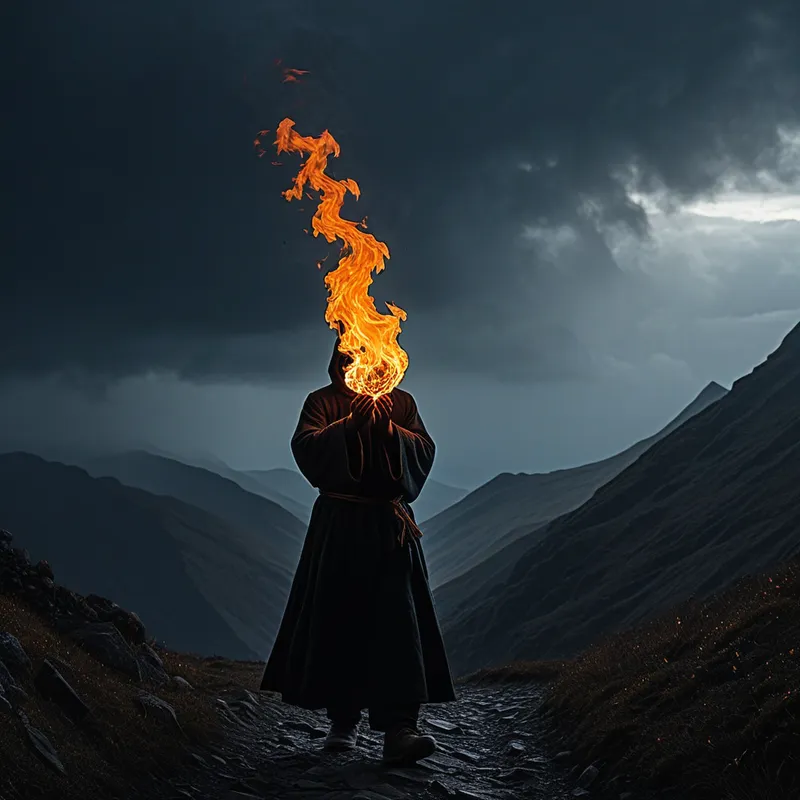
Their quest was not to a mountain of gods, but to the Heart of the World-Fire. It was a place of terror—a cleft in [the earth](/myths/the-earth “Myth from Hindu culture.”/) where the breath of the planet roared as flame, or a great tree perpetually burning from a strike of sky-fire. To approach was to feel one’s own smallness scoured away. The heat blistered skin; the light was a physical force. The Seeker did not steal from a deity. They bargained with the elemental itself. They offered their voice, their memory of solitude, their very breath into the roaring inferno. And in return, as they stood empty and ready to be consumed, a single, perfect coal—a seed of the primordial blaze—rolled to their feet.
The return was the true ordeal. The coal was life, but it was also a weighty responsibility that demanded constant, tender vigilance. They cupped it in clay and moss, fed it with their own breath, sheltered it with their body from rain and wind. They crossed rivers where the [water](/myths/water “Myth from Chinese culture.”/) hissed at their precious bundle. They evaded predators drawn to the strange, warm glow. With every step, the coal pulsed, not with the wild rage of its origin, but with a gentle, persistent promise.
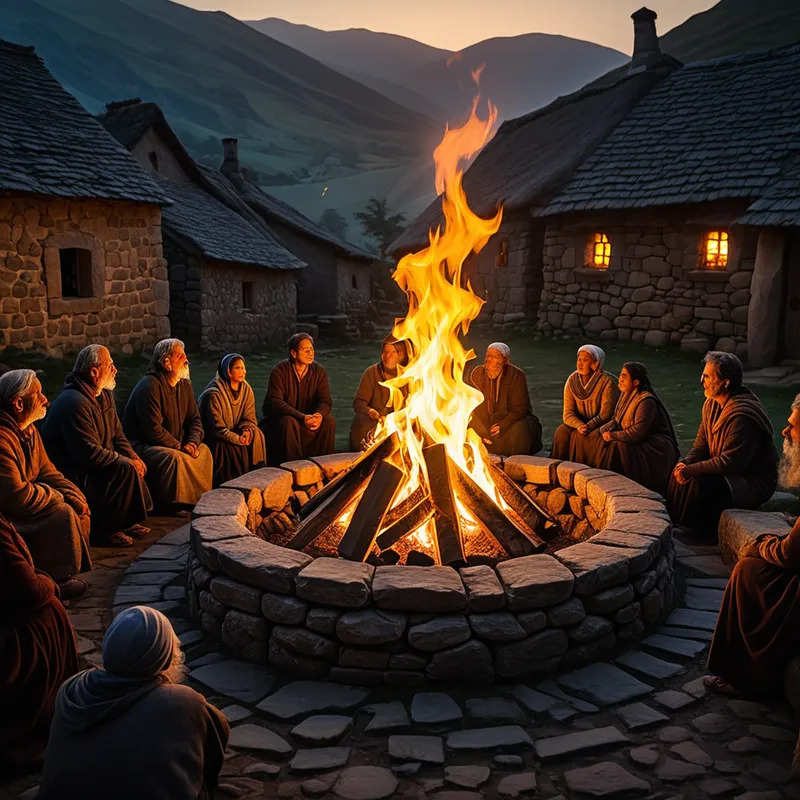
When The Seeker finally stumbled back into the circle of the known caves, they did not go to their own. Instead, with the last of their strength, they piled stones in the central clearing. They knelt, and with trembling hands, they placed the coal upon the earth and breathed life into it. A flame leapt up—not a private, hoarded thing, but a public, roaring beacon.
One by one, figures emerged from the dark mouths of the caves. They did not speak. They simply stood at the edge of the light, their faces awash in [the orange](/myths/the-orange “Myth from Chinese culture.”/) glow. Then, one brought a branch. Another, a log. A third, a piece of dried meat. They fed the fire together. They sat. And in the silence that was no longer empty, they shared the warmth. That night, the first stories were told not to the dark, but to another human face, illuminated by a common light. The village was born not from stone and wood, but from that shared circle of heat and light.
Cultural Origins & Context
The myth of the Communal Hearth is a foundational narrative found in fragments and echoes across countless pre-modern, agrarian, and tribal societies. It is a “various” myth not because it belongs to one culture, but because it articulates a universal human threshold: the transition from nomadic family units to settled communal life. It was likely told by elders during initiations, at seasonal gatherings, or at the very hearth it celebrates. Its function was ontological—it explained not just how the village came to be, but why it must persist. The myth was the psychic glue of the community, reinforcing that individual survival was inextricably linked to collective responsibility. [The hearth](/myths/the-hearth “Myth from Norse culture.”/) was the physical and spiritual center; [the law](/myths/the-law “Myth from Biblical culture.”/), the council, and the shared meal all radiated from its warmth. To let the hearth fire die was not a practical failure, but a symbolic collapse of the social cosmos.
Symbolic Architecture
Psychologically, the myth maps the [birth](/symbols/birth “Symbol: Birth symbolizes new beginnings, transformation, and the potential for growth and development.”/) of the social self from the [womb](/symbols/womb “Symbol: A symbol of origin, potential, and profound transformation, representing the beginning of life’s journey and the unconscious source of creation.”/) of isolated ego. The lonely cave-dweller represents the [psyche](/myths/psyche “Myth from Greek culture.”/) in a state of primal self-containment, where [energy](/symbols/energy “Symbol: Energy symbolizes vitality, motivation, and the drive that fuels actions and ambitions.”/) (fire) is hoarded for mere survival. The yearning of The [Seeker](/symbols/seeker “Symbol: A person actively searching for meaning, truth, or a higher purpose, often representing the dreamer’s own quest for identity or fulfillment.”/) is the first stirring of the relational instinct, a painful [awareness](/symbols/awareness “Symbol: Conscious perception of self, surroundings, or internal states. Often signifies awakening, insight, or heightened sensitivity.”/) that individuation without communion is a kind of living [death](/symbols/death “Symbol: Symbolizes transformation, endings, and new beginnings; often associated with fear of the unknown.”/).
The hearth is not merely a fire that warms many bodies; it is the crucible where the ‘I’ learns to become a ‘We’ without dissolving.
The [Heart](/symbols/heart “Symbol: The heart symbolizes love, emotion, and the core of one’s existence, representing deep connections with others and self.”/) of the World-Fire symbolizes the raw, undifferentiated libido or [life](/symbols/life “Symbol: The symbol of ‘Life’ represents a journey of growth, interconnectedness, and existential meaning, encompassing both the joys and challenges that define human experience.”/) force—powerful, dangerous, and impersonal. The Seeker’s “bargain” is an act of courageous ego-sacrifice; they offer their isolated [identity](/symbols/identity “Symbol: Identity represents the sense of self, encompassing personal beliefs, cultural background, and social roles.”/) to access a greater [source](/symbols/source “Symbol: The origin point of something, often representing beginnings, nourishment, or the fundamental cause behind phenomena.”/) of energy. The single coal they retrieve is this raw energy now made portable and communicable—instinct transformed into a shareable cultural force. The arduous [journey](/symbols/journey “Symbol: A journey in dreams typically signifies adventure, growth, or a significant life transition.”/) back is the process of nurturing this nascent [connection](/symbols/connection “Symbol: Connection symbolizes relationships, communication, and bonds among individuals.”/), protecting it from the “elements” of doubt, fear, and old habits. The final act of kindling the communal fire is the symbolic [moment](/symbols/moment “Symbol: The symbol of a ‘moment’ embodies the significance of transient experiences that encapsulate emotional depth or pivotal transformations in life.”/) of [projection](/symbols/projection “Symbol: The unconscious act of attributing one’s own internal qualities, emotions, or shadow aspects onto external entities, people, or situations.”/) made real: inner transformation catalyzing outer, social transformation.

The Dreamer’s Resonance
When this myth stirs in the modern dreamscape, it often manifests as potent, somatic imagery. You may dream of desperately protecting a small, precious flame in a vast, windy darkness. You might be in a large, cold house, searching room to room for the one working fireplace. Alternatively, you may find yourself in a vibrant, crowded party, yet feeling a piercing cold at your core, unable to get warm.
These dreams signal a process at [the threshold](/myths/the-threshold “Myth from Folklore culture.”/) of the psyche. The “cold” is the felt sense of isolation, alienation, or emotional withholding. The precious, fragile flame is a new, vulnerable capacity for connection or vulnerability that the dreamer is trying to integrate. The dream is an enactment of the Seeker’s journey, highlighting the somatic cost (the exhaustion, the fear of the flame going out) and the profound responsibility of carrying this warmth. It asks: What nascent empathy, creative spark, or longing for community are you nursing in your cupped hands? And what old “cave” of isolation are you afraid to leave to share it?

Alchemical Translation
The alchemy of the Communal Hearth is the transmutation of [prima materia](/myths/prima-materia “Myth from Alchemical culture.”/)—the leaden, heavy state of lonely self-sufficiency—into the gold of conscious, chosen belonging. The modern individuation journey often begins in the “cave” of the [persona](/myths/persona “Myth from Greek culture.”/), where we tend our socially acceptable fire. The Seeker’s call is the crisis that this is not enough; it is the depression, the anxiety, the midlife realization that one is connected yet deeply alone.
The quest is to willingly walk into the inferno of one’s own unconscious (the World-Fire) to retrieve not a personal trophy, but a seed of connection meant for the collective.
The “bargain” is the crucial stage: we must sacrifice the comforting, familiar identity of the “self-made” individual. We offer our pride, our illusion of total independence, to the transformative process. The coal we bring back is the reclaimed capacity for true intimacy, empathy, or creative expression that serves something larger than ourselves. The final, alchemical stage is not hoarding this treasure, but building the “hearth”—a practice, a relationship, a community, a work—where this transformed energy can be placed. We kneel and kindle it not for applause, but so others may gather, feed it, and find their own warmth reflected in its light. The individuated Self, in this myth, is not a solitary king on a mountain, but the humble, essential keeper of the flame that makes community—and thus, full humanity—possible.
Associated Symbols
Explore related symbols from the CaleaDream lexicon: