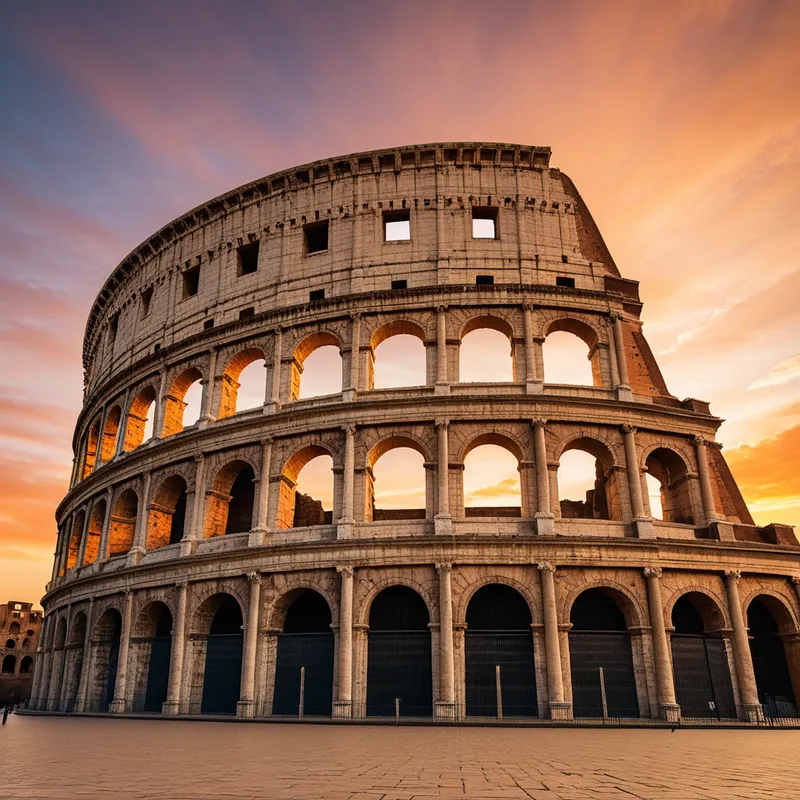
The Colosseum Myth Meaning & Symbolism
A sacred arena where the empire's glory and terror are ritually performed, binding the chaotic crowd to the divine order of the state through spectacle and sacrifice.
The Tale of The Colosseum
Hear now the tale not of a man, but of a stone beast that breathes. It did not rise from [the earth](/myths/the-earth “Myth from Hindu culture.”/) like a mountain, but was dreamed into being by an emperor’s will, a titan of travertine birthed from a tyrant’s drained lake. Its true name is the [Flavian Amphitheatre](/myths/flavian-amphitheatre “Myth from Roman culture.”/), but the people, in awe of a colossal statue that once stood guard, whispered a new name: the Colosseum.
On the day of its dedication, [the sky](/myths/the-sky “Myth from Persian culture.”/) itself was a bowl of polished lapis. The air thrummed. One hundred days of games were decreed. The great wooden gates groaned open, and the beast awoke. First came the procession, the pompa: trumpets blared, priests swung censers of myrrh, and statues of the gods were borne on litters, their marble eyes blind to the sand below. Then, the hunters and the hunted. Beasts from the edges of [the world](/myths/the-world “Myth from Tarot culture.”/)—lions with manes like sunfire, bears from the northern forests, giraffes whose necks were living question marks—paced [the labyrinth](/myths/the-labyrinth “Myth from Greek culture.”/) beneath the floor, smelling [the sky](/myths/the-sky “Myth from Persian culture.”/).
But the heart of the spectacle was the warrior. The gladiator. He entered not as a free man, but as a symbol. He marched to the Emperor’s podium, raised his sword, and cried, “Ave, Imperator, morituri te salutant!” — “Hail, Emperor, those who are about to die salute you!” The words were not a lament, but a ritual formula, a sacred contract.
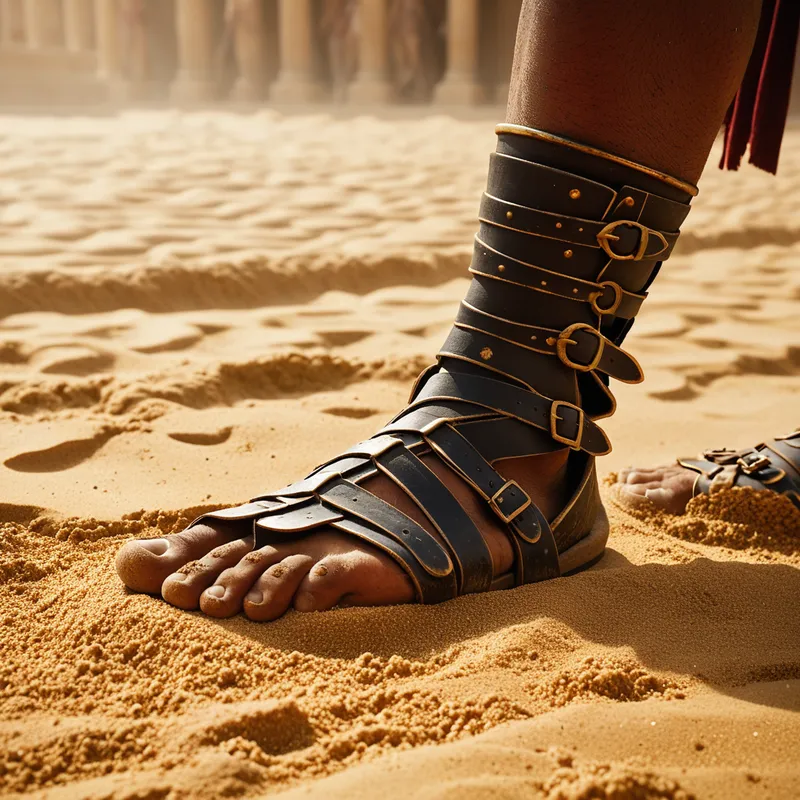
Then, the dance of death. The sand, the harena, drank the sweat and the blood. The clash of iron was a terrible music. The crowd was a single, roaring entity—a hundred-throated beast in the stands answering the stone beast that contained it. Thumbs turned down, a fate sealed. A victor stood over the fallen, looking up to the pulvinar. The decision of life or death rested not with the gods, but with the god-man on earth. A thumb turned upward, and mercy was granted. The warrior lived to fight again, his debt to order paid in blood. A thumb hidden, and the final, merciful stroke was given. Attendants dressed as Charon, [the underworld](/myths/the-underworld “Myth from Greek culture.”/)’s boatman, dragged the body away through the Gate of Death.
For one hundred days, this sacred violence repeated. The beast was fed. And when the last trumpet sounded, and the sand was raked smooth, a profound silence fell. The chaos had been channeled, the wildness of man and nature had been ritually slain, and the Pax Romana was reaffirmed. The Colosseum slept, its hunger sated, until the next spectacle. It stood not as a tomb, but as a beating heart of stone, where the empire’s lifeblood—both brutal and beautiful—was publicly circulated for all to see.
Cultural Origins & Context
The myth of the Colosseum is not preserved in a single epic poem but is inscribed in the very function of the structure and the detailed accounts of historians like Suetonius and Cassius Dio. Its “story” was performed, not read. Commissioned by Emperor Vespasian and completed by his son Titus in 80 AD, it was a masterstroke of political theater. Built on the site of Nero’s extravagant private lake, it physically transformed a symbol of tyrannical self-indulgence into the ultimate public venue.
The games (ludi) and gladiatorial combats (munera) were not mere entertainment; they were a religious and civic duty. They originated as funeral rites to honor the dead, a blood offering to accompany them to the afterlife. Under the Empire, this function expanded. The spectacle became a liturgy of state power, a demonstration of Rome’s dominion over chaos—both the chaos of nature (represented by the exotic beasts) and the chaos of human conflict (channeled into the regulated duel). The Emperor, as presiding priest and benefactor, displayed his divine-like capacity to provide both bread and circuses (panem et circenses), maintaining the cosmic and social order. The crowd’s participation—cheering, judging, witnessing—was an act of collective citizenship, binding them to the fate and favor of the ruler.
Symbolic Architecture
The [Colosseum](/symbols/colosseum “Symbol: An ancient Roman amphitheater symbolizing monumental human achievement, public spectacle, and the tension between civilization and violence.”/) is a monumental [symbol](/symbols/symbol “Symbol: A symbol can represent an idea, concept, or belief, serving as a powerful tool for communication and understanding.”/) of the [psyche](/myths/psyche “Myth from Greek culture.”/)’s need to create order from [chaos](/symbols/chaos “Symbol: In Arts & Music, chaos represents raw creative potential, uncontrolled expression, and the breakdown of order to forge new artistic forms.”/). Its elliptical form is not a circle, which is divine and perfect, but an oval, a shape of [tension](/symbols/tension “Symbol: A state of mental or emotional strain, often manifesting physically as tightness, pressure, or unease, signaling unresolved conflict or anticipation.”/) and focus, directing all [energy](/symbols/energy “Symbol: Energy symbolizes vitality, motivation, and the drive that fuels actions and ambitions.”/) toward the central [arena](/symbols/arena “Symbol: An arena symbolizes a space for competition, public scrutiny, or performing under pressure.”/)—the [omphalos](/myths/omphalos “Myth from Greek culture.”/), the world’s navel where [life](/symbols/life “Symbol: The symbol of ‘Life’ represents a journey of growth, interconnectedness, and existential meaning, encompassing both the joys and challenges that define human experience.”/) and [death](/symbols/death “Symbol: Symbolizes transformation, endings, and new beginnings; often associated with fear of the unknown.”/) decisions are made.
The arena is the crucible where the raw material of the instinctual self is sacrificed to forge the persona of civilization.
The hypogeum beneath the wooden [floor](/symbols/floor “Symbol: The floor in dreams often symbolizes the foundation of one’s life or psyche, representing stability, grounding, and the underlying structures of our experiences.”/) represents the [collective unconscious](/symbols/collective-unconscious “Symbol: The Collective Unconscious refers to the part of the unconscious mind shared among beings of the same species, embodying universal experiences and archetypes.”/)—a dark, chthonic [realm](/symbols/realm “Symbol: The symbol of ‘Realm’ often signifies the boundaries of one’s consciousness, experiences, or emotional states, suggesting aspects of reality that are either explored or ignored.”/) of caged beasts, hidden machinery, and waiting warriors. The arena [floor](/symbols/floor “Symbol: The floor in dreams often symbolizes the foundation of one’s life or psyche, representing stability, grounding, and the underlying structures of our experiences.”/) is [the threshold](/myths/the-threshold “Myth from Folklore culture.”/) of [consciousness](/symbols/consciousness “Symbol: Consciousness represents the state of awareness and perception, encompassing thoughts, feelings, and experiences.”/), where these hidden contents are made visible and must be confronted. The towering cavea (seating) is the superstructure of society, culture, and the observing ego, looking down upon the [drama](/symbols/drama “Symbol: Drama signifies narratives, emotional expression, and the exploration of human experiences.”/) of the primal self. The gladiator embodies the sacrificed part of the individual—the outlaw, the slave, the captive energy—whose ritualized destruction reaffirms the supremacy of the ruling principle, the Emperor [archetype](/symbols/archetype “Symbol: A universal, primordial pattern or prototype in the collective unconscious that shapes human experience, behavior, and creative expression.”/) within.
The “thumbs up” or “thumbs down” (pollice verso) [gesture](/symbols/gesture “Symbol: A non-verbal bodily movement conveying meaning, emotion, or intention, often symbolic in communication and artistic expression.”/) is a profound symbol of moral arbitration. It represents the [moment](/symbols/moment “Symbol: The symbol of a ‘moment’ embodies the significance of transient experiences that encapsulate emotional depth or pivotal transformations in life.”/) where raw [outcome](/symbols/outcome “Symbol: Outcome symbolizes the results of actions or decisions, often reflecting hopes, fears, and the consequences of choices.”/) (death) is transmuted into meaning ([justice](/myths/justice “Myth from Tarot culture.”/), mercy, honor) by [the authority](/symbols/the-authority “Symbol: A figure representing power, control, and societal structure, often embodying rules, leadership, or external judgment.”/) of the conscious mind. The entire complex is a [machine](/symbols/machine “Symbol: Machines in dreams often represent systems, control, and the mechanization of life, highlighting issues of productivity and efficiency.”/) for the [alchemy](/symbols/alchemy “Symbol: A transformative process of purification and creation, often symbolizing personal or spiritual evolution through difficult stages.”/) of violence into social [cohesion](/symbols/cohesion “Symbol: The quality of sticking together or forming a unified whole, often representing unity, strength, and integrity in dreams.”/).
The Dreamer’s Resonance
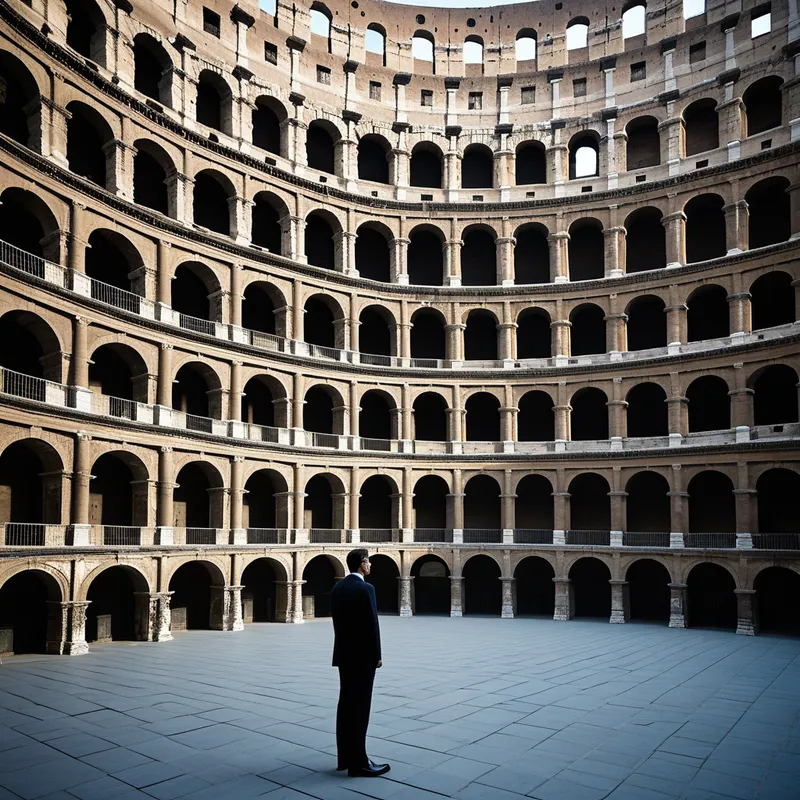
To dream of the Colosseum is to dream of being on trial in the theater of your own psyche. You may find yourself in a vast, circular space—a modern stadium, a corporate boardroom, or a stark empty plaza—that carries the emotional weight of the ancient arena. The feeling is one of profound exposure and performative anxiety.
Somatically, one might feel the “hot sand” of scrutiny underfoot, or the dry-mouthed dread of waiting in the “hypogeum” of the unconscious before a major life event. The dream often surfaces when one feels their raw, instinctual nature (anger, passion, fear, wild creativity) is in conflict with the demands of their social role or internalized authority (the “Emperor”). The roaring crowd represents the internalized voices of judgment—parents, peers, societal expectations—all watching and evaluating your every move. The dream asks: What part of you is being forced to fight for its life on this public stage? And who, or what, is playing the Emperor, holding the power of life and death over that vulnerable part?
Alchemical Translation
The individuation process modeled by the Colosseum myth is not about the hero’s journey outward, but the sacred spectacle inward. It is the psyche’s arduous work of bringing its hidden, chaotic, and often “beastly” contents into the arena of consciousness to be witnessed and integrated.
[The first stage](/myths/the-first-stage “Myth from Alchemical culture.”/) is the Descensus: acknowledging the hypogeum. One must venture into the underground of one’s own soul, to meet the caged “beasts” of repressed rage, shame, or desire, and the “gladiator” selves—the wounded, fighting parts of our personality we have enslaved.
The second stage is the Spectaculum: raising these contents into the light. This is the painful, conscious confrontation. In therapy, art, or deep reflection, we allow these inner figures to “fight it out” on the sand of our awareness. We observe the conflict between, say, our inner rebel and our inner ruler, without immediately taking sides.
The alchemical goal is not to slay the gladiator, but to grant him the missio—the honorable discharge. To integrate his strength, honor, and vitality into the service of the whole self.
The final stage is the Transformatio: the thumb of mercy. The conscious ego, playing the role of the wise Emperor (not a tyrant), must learn to grant mercy to the defeated aspects of [the self](/myths/the-self “Myth from Jungian culture.”/). It spares the useful energy and honors the sacrifice of outmoded patterns. This act transforms brute psychological suffering into meaningful experience. The chaotic energy that once threatened the psyche’s stability becomes a disciplined force that upholds a more authentic, self-authored order. The stone beast of rigid defense becomes, once more, a magnificent amphitheater where the full drama of the self can be safely, and sacredly, performed.
Associated Symbols
Explore related symbols from the CaleaDream lexicon: