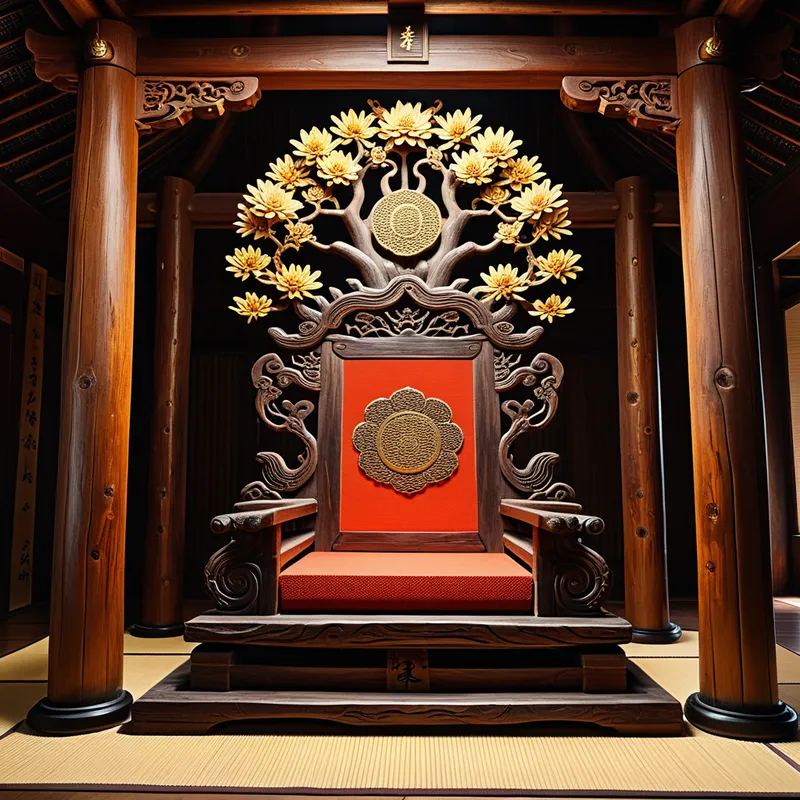
The Chrysanthemum Throne Myth Meaning & Symbolism
The myth of the Sun Goddess's descendant descending to earth, establishing an unbroken imperial line and the sacred, eternal authority of the Chrysanthemum Throne.
The Tale of The Chrysanthemum Throne
In the Age of the Gods, when [the world](/myths/the-world “Myth from Tarot culture.”/) was still soft and unformed, the heavens and [the earth](/myths/the-earth “Myth from Hindu culture.”/) were joined by a great bridge, the Ame-no-ukihashi. From the High Plain of Heaven, Amaterasu-Ōmikami ruled, her light bringing order and life to the land below. Yet, [the earth](/myths/the-earth “Myth from Hindu culture.”/) writhed in chaos, overgrown and untamed by the unruly spirits of the wild.
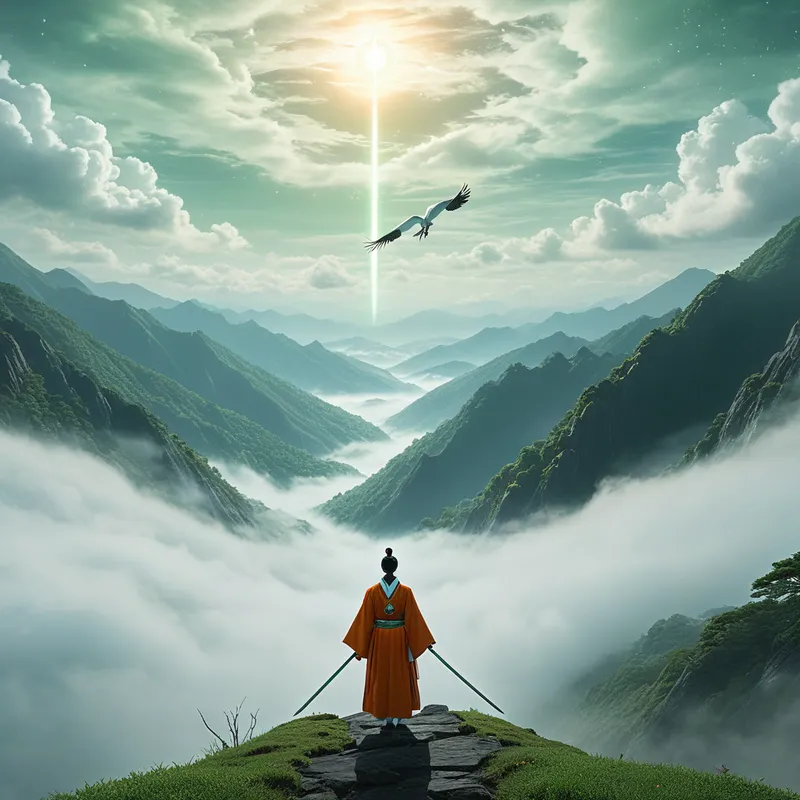
The celestial council decreed it must be pacified, brought under the benevolent rule of the sun’s lineage. Amaterasu entrusted this divine mandate to her grandson, the illustrious Ninigi-no-Mikoto. She bestowed upon him the Three Sacred Treasures: the [Kusanagi-no-Tsurugi](/myths/kusanagi-no-tsurugi “Myth from Japanese culture.”/), a blade of unrivaled power to quell rebellion; the Yata-no-[Kagami](/myths/kagami “Myth from Japanese culture.”/), a mirror of perfect truth and clarity to reflect the divine will; and the Yasakani-no-Magatama, a jewel of compassion to draw the hearts of the people.
With a solemn procession of deities, Ninigi descended from the floating bridge, parting the very clouds. He alighted upon the peak of Takachiho, and the mountain trembled to receive him. The air, thick with the scent of cedar and damp earth, grew still. Before him stretched the lush, green land of Ashihara no Nakatsukuni, beautiful yet wild. His mandate was not one of conquest by brute force, but of establishing harmony—musubi—between the celestial and the terrestrial.
He encountered the earthly deity, Ōkuninushi, who had cultivated the land. Through solemn oath and divine right, sovereignty was peacefully transferred. Ninigi, and later his mortal descendants, carried the sacred treasures into the fertile plains of Yamato. There, they built the first halls, performed the first rites, and planted the seeds of rice and rule. The throne they established was not merely a seat of power, but a sacred axis—the very point where the kami of heaven met the spirit of the land. It became the Chrysanthemum Throne, named for the imperial seal, a flower that blooms with radiant order, its petals a perfect mirror of the sun’s rays, enduring through all seasons. The covenant was sealed: for as long as the sun rises in the east and the chrysanthemum blooms, an unbroken line of Amaterasu’s blood would sit upon it, a living bridge between heaven and earth.
Cultural Origins & Context
This foundational narrative is not a single myth from a singular text, but the sacred bedrock of Japanese state mythology, crystallized in the 8th-century chronicles, the Kojiki (712 CE) and the Nihon Shoki (720 CE). Commissioned by the imperial court, these texts served a vital societal function: to legitimize the ruling Yamato clan by weaving their ancestry directly into the cosmic order. The storytellers were not bards in a tavern, but court scribes and ritualists, and the primary audience was the polity itself.
The myth provided the spiritual and political constitution for the ancient Japanese state. It answered profound questions of identity, authority, and order. Why do we rule? By what right? The answer was tennō (heavenly sovereign), a mandate rooted not in mere power but in divine descent and a sacred covenant with the land and its native spirits (kami). The Chrysanthemum Throne became the immutable symbol of this continuity, its endurance through historical upheavals a testament to the myth’s power to shape reality. It was perpetuated through elaborate accession rituals, most notably the Daijōsai, where the new emperor symbolically re-enacts Ninigi’s descent and communion with Amaterasu.
Symbolic Architecture
At its core, the myth is a profound [blueprint](/symbols/blueprint “Symbol: A blueprint represents the foundational plan or design for something, often symbolizing potential, structure, and the mapping of one’s inner self or future.”/) for the [psychology](/symbols/psychology “Symbol: Psychology in dreams often represents the exploration of the self, the subconscious mind, and emotional conflicts.”/) of legitimate [authority](/symbols/authority “Symbol: A symbol representing power structures, rules, and control, often reflecting one’s relationship with societal or personal governance.”/) and centered selfhood. The [Chrysanthemum](/symbols/chrysanthemum “Symbol: A flower symbolizing longevity, rejuvenation, and the cycle of life and death in spiritual traditions.”/) [Throne](/symbols/throne “Symbol: A seat of authority, power, and sovereignty, representing leadership, divine right, or social hierarchy.”/) is not just a political seat; it is the symbolic [axis](/symbols/axis “Symbol: A central line or principle around which things revolve, representing stability, orientation, and the fundamental structure of reality or consciousness.”/) mundi, the still point around which the [chaos](/symbols/chaos “Symbol: In Arts & Music, chaos represents raw creative potential, uncontrolled expression, and the breakdown of order to forge new artistic forms.”/) of the world is organized and made meaningful.
The true throne is not taken; it is received through a covenant with the divine, and its authority is maintained through harmony, not domination.
The Three Sacred Treasures represent the triune qualities of integrated sovereignty. The Kusanagi (Sword) symbolizes valor, discernment, and the power to cut through illusion and obstruction. The Yata-no-Kagami (Mirror) represents wisdom, self-[reflection](/symbols/reflection “Symbol: Reflection signifies self-examination, awareness, and the search for truth within oneself.”/), and truthful [perception](/symbols/perception “Symbol: The process of becoming aware of something through the senses. In dreams, it often represents how one interprets reality or internal states.”/)—the [ability](/symbols/ability “Symbol: In dreams, ‘ability’ often denotes a recognition of skills or potential that one possesses, whether acknowledged or suppressed.”/) to see things as they are, without [distortion](/symbols/distortion “Symbol: The alteration of form, sound, or perception from its original state, often creating unsettling or creative effects.”/). The Yasakani-no-Magatama (Jewel) embodies benevolence, [empathy](/symbols/empathy “Symbol: The capacity to understand and share the feelings of others, often manifesting as emotional resonance or intuitive connection in dreams.”/), and the attractive, unifying power of [compassion](/symbols/compassion “Symbol: A deep feeling of empathy and concern for others’ suffering, often involving a desire to help or alleviate their pain.”/). A true ruler—and by psychological extension, an individuated Self—must wield all three: the courage to act, the wisdom to see clearly, and the [heart](/symbols/heart “Symbol: The heart symbolizes love, emotion, and the core of one’s existence, representing deep connections with others and self.”/) to connect.
The Chrysanthemum itself, with its orderly rays bursting from a central core, is a perfect [mandala](/symbols/mandala “Symbol: A sacred geometric circle representing wholeness, the cosmos, and the journey toward spiritual integration.”/) of the solar [consciousness](/symbols/consciousness “Symbol: Consciousness represents the state of awareness and perception, encompassing thoughts, feelings, and experiences.”/). It represents the flowering of divine order in the earthly [realm](/symbols/realm “Symbol: The symbol of ‘Realm’ often signifies the boundaries of one’s consciousness, experiences, or emotional states, suggesting aspects of reality that are either explored or ignored.”/), [beauty](/symbols/beauty “Symbol: This symbol embodies aesthetics, harmony, and the appreciation of life’s finer qualities.”/) born of strict, natural [pattern](/symbols/pattern “Symbol: A ‘Pattern’ in dreams often signifies the underlying structure of experiences and thoughts, representing both order and the repetitiveness of life’s situations.”/), and [resilience](/symbols/resilience “Symbol: The capacity to recover quickly from difficulties, adapt to change, and maintain strength through adversity.”/) (it blooms in [autumn](/symbols/autumn “Symbol: A season symbolizing transition, harvest, and decay, representing life’s cycles between abundance and decline.”/), a time of maturity and decline). The unbroken line speaks to the eternal, transpersonal [aspect](/symbols/aspect “Symbol: A distinct feature, quality, or perspective of something, often representing a partial view of a larger whole.”/) of [the Self](/myths/the-self “Myth from Jungian culture.”/) that persists beyond the individual ego.
The Dreamer’s Resonance
When this mythic pattern stirs in the modern dreamer, it often signals a profound crisis or calling related to inner authority. To dream of a majestic, empty throne may reflect a vacuum of personal sovereignty—a feeling of being ruled by external demands, a weak ego, or unintegrated complexes. To dream of ascending such a throne, especially with anxiety, can point to the daunting responsibility of stepping into one’s own power, a “divine mandate” from the deeper Self that feels both awesome and terrifying.
Somatically, this might manifest as a tension in the solar plexus (the seat of personal power) or the spine (the central axis). The dreamer may be grappling with their right to exist fully, to “rule” their own life, to establish order in their personal chaos. Alternatively, dreaming of the sacred treasures—finding a mirror that shows a truer self, a jewel that glows with warmth, or a sword that feels strangely familiar—indicates the [psyche](/myths/psyche “Myth from Greek culture.”/) is offering the tools for this reclamation. The conflict is between the chaotic, “unruly spirit” realm of one’s untamed impulses or life circumstances and the call to establish a centered, harmonious, and legitimate inner governance.
Alchemical Translation
The journey of Ninigi is the archetypal map for the alchemical process of individuation—the psychological descent of the conscious ego to engage with and order the unconscious realm. We are all, in a sense, celestial grandchildren sent to pacify and cultivate the wild, fertile, and often chaotic landscape of our own inner world.
The descent of the heavenly grandchild is not a fall, but a sacred mission: to plant the banner of consciousness in the fertile soil of the instinctual self.
First, we must descend from the bridge (leave the high, idealized perch of pure spirit or naive innocence) and acknowledge the reality of our personal “earth”—our instincts, wounds, and shadow material (the unruly kami). The peaceful transfer of sovereignty from Ōkuninushi is critical; it represents not the eradication of the instinctual self, but a respectful negotiation and integration. [The ego](/myths/the-ego “Myth from Jungian culture.”/) does not conquer the unconscious; it forms a covenant with it.
The building of the hall and the planting of rice symbolize the daily, ritual work of building a coherent personality and cultivating the fruits of consciousness. The Three Treasures are the faculties we must develop and integrate: the Sword of discernment (critical thinking, boundaries), [the Mirror](/myths/the-mirror “Myth from Various culture.”/) of self-reflection (introspection, shadow-work), and the Jewel of compassion (self-acceptance, relatedness).
Finally, the Chrysanthemum Throne that results is the achieved Self. It is the stable, centered core of personality from which one rules one’s own life with legitimacy, wisdom, and benevolence. It is not narcissistic sovereignty, but a sovereignty in service to the greater whole of one’s being, a living bridge between [the divine spark](/myths/the-divine-spark “Myth from Gnostic culture.”/) of potential (heaven) and the messy, beautiful reality of embodied existence (earth). To sit upon this inner throne is to fulfill one’s own divine mandate to become uniquely, and wholly, oneself.
Associated Symbols
Explore related symbols from the CaleaDream lexicon: