The Christ Child Myth Meaning & Symbolism
The myth of a divine child born in obscurity, heralding a new age of spirit and challenging the powers of the world.
The Tale of The Christ Child
Listen. In the days when [the world](/myths/the-world “Myth from Tarot culture.”/) was a heavy cloak of iron and order, under a sky mapped by Roman roads and measured by Roman law, a whisper began. It was a whisper not of [the earth](/myths/the-earth “Myth from Hindu culture.”/), but of [the star](/myths/the-star “Myth from Tarot culture.”/)-dusted spaces between breaths. It spoke of a promise older than empires, a king not of gold or legion, but of spirit.
In a forgotten corner of a conquered land, in the town of Bethlehem, the fabric of reality grew thin. A young woman, Mary, heavy with a child not of mortal seed, journeyed with her betrothed, [Joseph](/myths/joseph “Myth from Biblical culture.”/). The town was swollen with souls for a census, a counting of the world’s subjects. But this child would be counted among them only to be uncountable. Finding no room among the bustling inns, they took shelter where the beasts of burden rested—a cave or a stable, smelling of hay, animal breath, and earth.
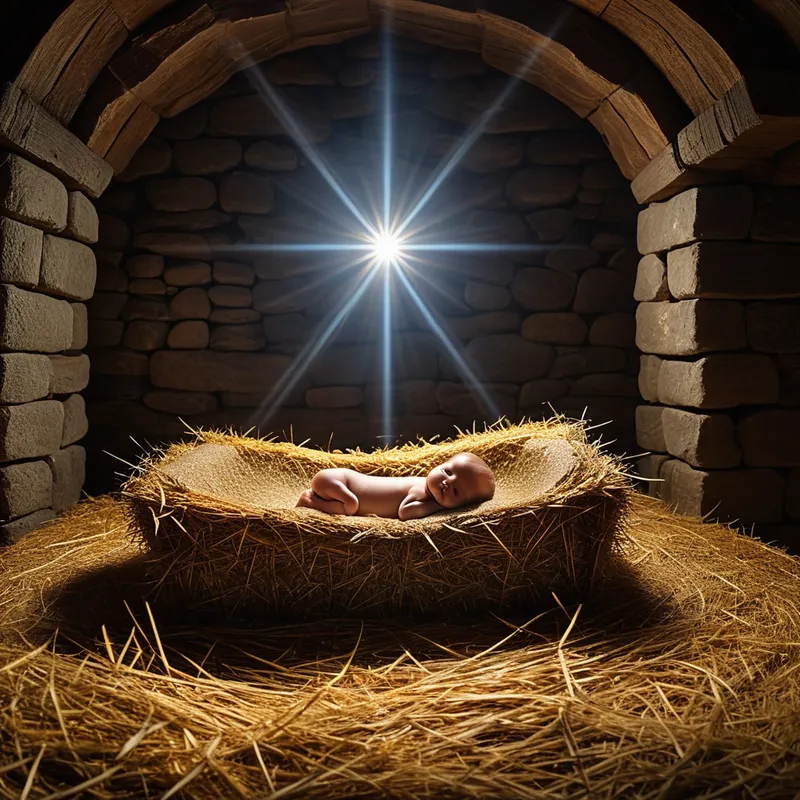
There, in that primal, humble sanctuary, the whisper became a cry. [The child](/myths/the-child “Myth from Alchemy culture.”/) was born. He was wrapped not in royal purple, but in simple cloths, and laid in a [manger](/myths/manger “Myth from Biblical culture.”/), a vessel of sustenance for creatures of the field. This was his first throne. Above, a star—a fierce, wandering point of light—pierced the common night, a signature in the heavens for those who could read it.
Far to the east, wise men, Magi who read the language of the cosmos, saw the sign. They followed, crossing deserts guided by that cold fire, seeking the one born “King of the Jews.” Their journey led them first to the seat of worldly power, the palace of Herod in [Jerusalem](/myths/jerusalem “Myth from Biblical culture.”/). Herod, a king of fear and stone, heard their quest and was deeply troubled. All Jerusalem trembled with him, for the arrival of a new king meant the shaking of an old order. With deceit in his heart, Herod bid [the Magi](/myths/the-magi “Myth from Christian culture.”/) find the child and report back, that he too might “pay him homage.”
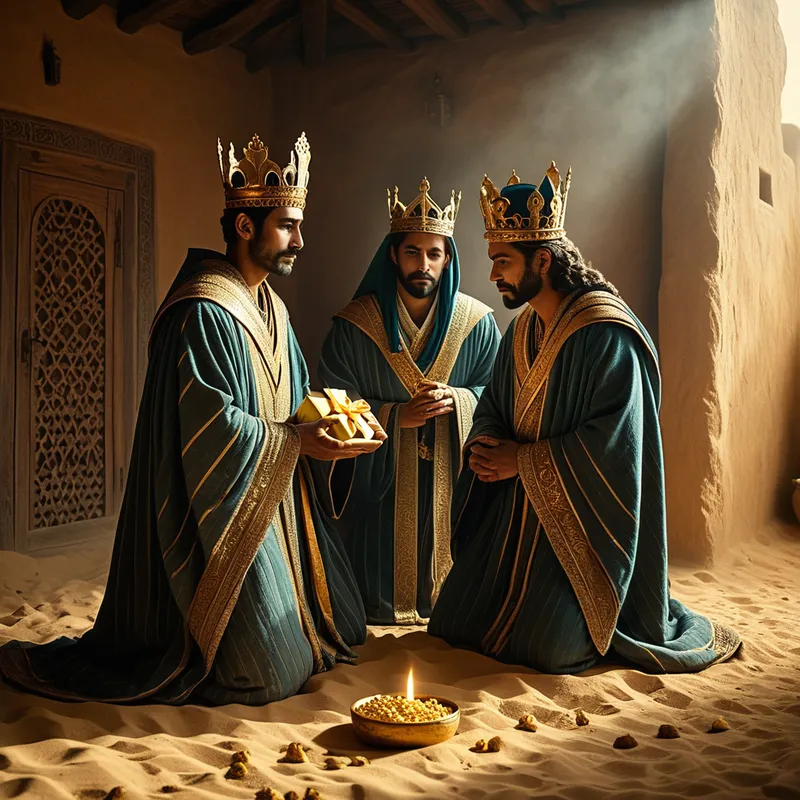
The star led them on, stopping over the place where the child was. Entering the humble house, they saw the young child with Mary his mother. Overcome, they fell down and worshipped him. Then, opening their treasures, they offered gifts fit for a paradox: gold for a king, frankincense for a god, and myrrh for a man who would die. Warned in a dream not to return to Herod, they departed by another way, their path irrevocably altered.
And in the fields nearby, under the same star-strewn sky, shepherds keeping watch over their flocks by night were visited by a terror of glory. The angel of the Lord stood before them, and the radiance of the Lord shone around them. They were sore afraid. But the angel said, “Fear not, for behold, I bring you good news of great joy which will be for all the people. For unto you is born this day in the city of David a Savior, who is Christ the Lord.” And suddenly, a multitude of the [heavenly host](/myths/heavenly-host “Myth from Biblical culture.”/) appeared, praising God. The shepherds, the lowly and the overlooked, became the first heralds. They hurried to see this [thing](/myths/thing “Myth from Norse culture.”/) that had come to pass, and finding the child just as told, they made known the saying, and all who heard it wondered.
But [the shadow](/myths/the-shadow “Myth from Jungian culture.”/) of Herod lengthened. Furious at being tricked by the Magi, he sent soldiers to Bethlehem to kill all male children two years and under. Yet again, a divine messenger intervened in a dream, warning Joseph. Under cover of night, he took the young child and his mother and fled into Egypt, a refuge from tyranny. The holy family became refugees, the salvific child hidden in a foreign land, until the death of the tyrant allowed a return. And so the story of the world’s turning began not with a legion, but with an infant’s breath in the straw, witnessed by angels, shepherds, and stars.
Cultural Origins & Context
The myth of the Christ Child is woven from threads of profound hope and political resistance within Second Temple Judaism. The narratives, found in the Gospels of Matthew and Luke, were not written as objective histories but as theological proclamations—“good news” or kerygma. They were crafted for early Christian communities, likely between 70-90 CE, living under Roman domination and often in tension with traditional Jewish authorities.
These communities told this story to answer fundamental questions: Who is [Jesus of Nazareth](/myths/jesus-of-nazareth “Myth from Christian culture.”/)? The myth answers: He is the fulfillment of ancient prophetic promises, the Davidic Messiah, yet in a radically unexpected form. His birth in Bethlehem fulfills prophecy (Micah 5:2), but his humble circumstances subvert expectations of a warrior-king. The inclusion of the Magi (Gentile astrologers) and the shepherds (social outcasts) signaled a universal message, breaking ethnic and social boundaries from the very start. The story functioned as an identity-forming narrative, assuring a persecuted minority that their savior was ordained by heaven itself, his life marked by divine favor and protection, even from the murderous intent of worldly rulers like Herod.
Symbolic Architecture
At its core, the Christ [Child](/symbols/child “Symbol: The child symbolizes innocence, vulnerability, and potential growth, often representing the dreamer’s inner child or unresolved issues from childhood.”/) is the [archetype](/symbols/archetype “Symbol: A universal, primordial pattern or prototype in the collective unconscious that shapes human experience, behavior, and creative expression.”/) of the [puer aeternus](/symbols/puer-aeternus “Symbol: The eternal youth archetype representing perpetual adolescence, divine child energy, and resistance to mature adulthood.”/) made manifest within a historical [framework](/symbols/framework “Symbol: Represents the underlying structure of one’s identity, emotions, or life. It signifies the mental or emotional scaffolding that supports or confines the self.”/). He represents the irruption of the divine into the mundane, the eternal into the temporal.
The child in the manger is the symbol of the nascent Self, the germ of wholeness, born not in the palace of the ego but in the forgotten stable of the unconscious.
The setting is profoundly symbolic. The manger signifies that this divine principle is the true nourishment for the [soul](/symbols/soul “Symbol: The soul represents the essence of a person, encompassing their spirit, identity, and connection to the universe.”/), offered in the most basic, animal-like (instinctual) part of our being. The [rejection](/symbols/rejection “Symbol: The experience of being refused, excluded, or dismissed by others, often representing fears of inadequacy or social belonging.”/) from the “inn” represents the conscious mind’s lack of [space](/symbols/space “Symbol: Dreaming of ‘Space’ often symbolizes the vastness of potential, personal freedom, or feelings of isolation and exploration in one’s life.”/) for this transformative potential; it must be born in the shadowy, humble quarters we ignore.
The gifts of the Magi encapsulate the [paradox](/symbols/paradox “Symbol: A contradictory yet true concept that challenges logic and perception, often representing unresolved tensions or profound truths.”/) of the incarnation: gold for sovereignty, [frankincense](/symbols/frankincense “Symbol: A sacred resin used historically in religious rituals and healing, symbolizing purification, spiritual connection, and divine offering.”/) for transcendence, and [myrrh](/symbols/myrrh “Symbol: A fragrant resin historically used in incense, perfumes, and embalming, symbolizing purification, sacrifice, and the sacred.”/) for immanent suffering and [death](/symbols/death “Symbol: Symbolizes transformation, endings, and new beginnings; often associated with fear of the unknown.”/). Together, they acknowledge the totality of the [human](/symbols/human “Symbol: The symbol of a human represents individuality, complexity of emotions, and social relationships.”/) experience this divine child will encompass. The [flight](/symbols/flight “Symbol: Flight symbolizes freedom, escape, and the pursuit of one’s aspirations, reflecting a desire to transcend limitations.”/) into Egypt recapitulates the ancient [pattern](/symbols/pattern “Symbol: A ‘Pattern’ in dreams often signifies the underlying structure of experiences and thoughts, representing both order and the repetitiveness of life’s situations.”/) of the [hero](/symbols/hero “Symbol: A hero embodies strength, courage, and the ability to overcome significant challenges.”/)-child threatened by the ruling power (like [Moses](/myths/moses “Myth from Biblical culture.”/)), suggesting that the new [consciousness](/symbols/consciousness “Symbol: Consciousness represents the state of awareness and perception, encompassing thoughts, feelings, and experiences.”/) must often undergo a [period](/symbols/period “Symbol: Periods in dreams can symbolize cyclical patterns, renewal, and the associated emotions of loss or change throughout life.”/) of [exile](/symbols/exile “Symbol: Forced separation from one’s homeland or community, representing loss of belonging, punishment, or profound isolation.”/) and hidden growth before it can return to transform its homeland.

The Dreamer’s Resonance
When the motif of the Christ Child appears in modern dreams, it seldom appears as a biblical literalist image. Rather, it manifests as a profound sense of new, vulnerable, yet potent possibility. One might dream of discovering a radiant, unknown infant in a dusty attic, a neglected garden shed, or even the backseat of one’s own car. This child is often peaceful, luminous, and inspires a feeling of awe and immense responsibility in the dreamer.
Psychologically, this signals the emergence of a new potential within the [psyche](/myths/psyche “Myth from Greek culture.”/)—the birth of the Self. It is a call to nurture what is most authentic and nascent. The conflict in the dream often revolves around protecting this child: from cold, from shadowy figures, or from one’s own neglect. This mirrors the inner struggle to value and safeguard one’s own developing wholeness against the “Herodian” forces of the [psyche](/myths/psyche “Myth from Greek culture.”/)—the cynical, rigid, or tyrannical aspects of [the ego](/myths/the-ego “Myth from Jungian culture.”/) that seek to eliminate vulnerability and mystery to maintain control. The dream is a somatic experience of hope and fragility, urging the dreamer to become both a humble shepherd and a wise guardian to this inner life.
Alchemical Translation
The myth of the Christ Child is a map for the alchemical process of individuation, beginning with the [nigredo](/myths/nigredo “Myth from Alchemical culture.”/). The “stable” is the [prima materia](/myths/prima-materia “Myth from Alchemical culture.”/)—the base, ignored, and humble contents of our unconscious psyche where [the great work](/myths/the-great-work “Myth from Alchemical culture.”/) begins. The divine conception is the infusion of a transpersonal element ([the Self](/myths/the-self “Myth from Jungian culture.”/)) into the personal life (Mary), a union of human and divine that feels like an annunciation, a fateful calling.
The journey to Bethlehem is the conscious ego’s difficult obedience to an inner imperative, often during a time of outer pressure and “census,” where one feels numbered and categorized by the world.
The birth itself is the albedo, the first gleaming of the filius philosophorum. This new consciousness is immediately threatened by the “Herod” within—the paranoid, status-quo-defending complex that would murder new life to preserve its own petty kingdom. The flight into Egypt is a necessary retreat, a protective incubation where the nascent Self is shielded from premature confrontation with the ego’s defenses.
For the modern individual, this myth models the process of recognizing and valuing the fragile, sacred core of one’s own being. It instructs us to make room for the miraculous not in the crowded inn of our social personas, but in the humble, animal truth of our instinctual and emotional ground. It demands we offer the gifts of our highest values (gold), our spiritual attention (frankincense), and our acknowledgment of suffering (myrrh) to this inner child. Ultimately, it promises that this hidden king, born in obscurity, is the true ruler of the inner world, destined to return from exile and transform the landscape of the soul.
Associated Symbols
Explore related symbols from the CaleaDream lexicon: