The Chosen Women Acllas Myth Meaning & Symbolism
The myth of women chosen for the Sun, weaving divinity into the empire's fabric through sacred service, sacrifice, and ultimate spiritual alchemy.
The Tale of The Chosen Women Acllas
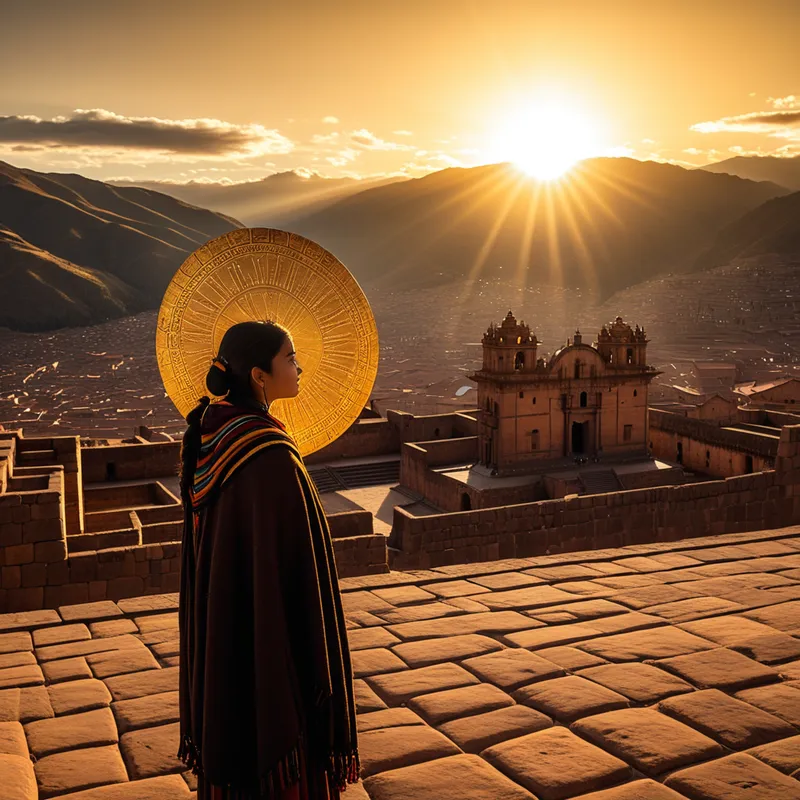
Listen. The breath of the altiplano is thin and sharp, carrying the scent of cold stone and distant snow. Above, Inti climbs the flawless vault of the sky, his gaze a tangible weight upon the land. In the ordered world of Tawantinsuyu, where every terrace, road, and heartbeat belongs to the Sapa Inca, a singular honor unfolds—a selection that is both a blessing and a severing.
The imperial inspectors move through the provinces, eyes like polished obsidian. They are not seeking warriors or tribute of grain, but a different kind of wealth: daughters. They watch girls at play, observe their grace at the riverside, note the deftness of their fingers. When the chosen one is marked, the air in the family compound stills. There is no refusal. The girl, perhaps ten or twelve winters old, is bathed, dressed in simple new garments, and given a handful of coca leaves. Her mother’s face is a mask of stone and pride; her father’s gaze is fixed on the distant apu. She is taken. This is not a kidnapping, but a harvesting. She has been seen by the divine eye of the state and plucked for a higher purpose. She is now an Aclla, “the Chosen One.”
Her journey is along the Qhapaq Ñan, the royal road, a stone artery pumping the lifeblood of the empire towards its heart: Cusco. She arrives at the Acllawasi, a complex of fine stone buildings near the Coricancha, the Golden Enclosure of the Sun. The gate closes behind her. The world she knew—the smell of her mother’s hearth, the laughter of siblings, the freedom of the hills—is gone, sealed away like a finished tale.
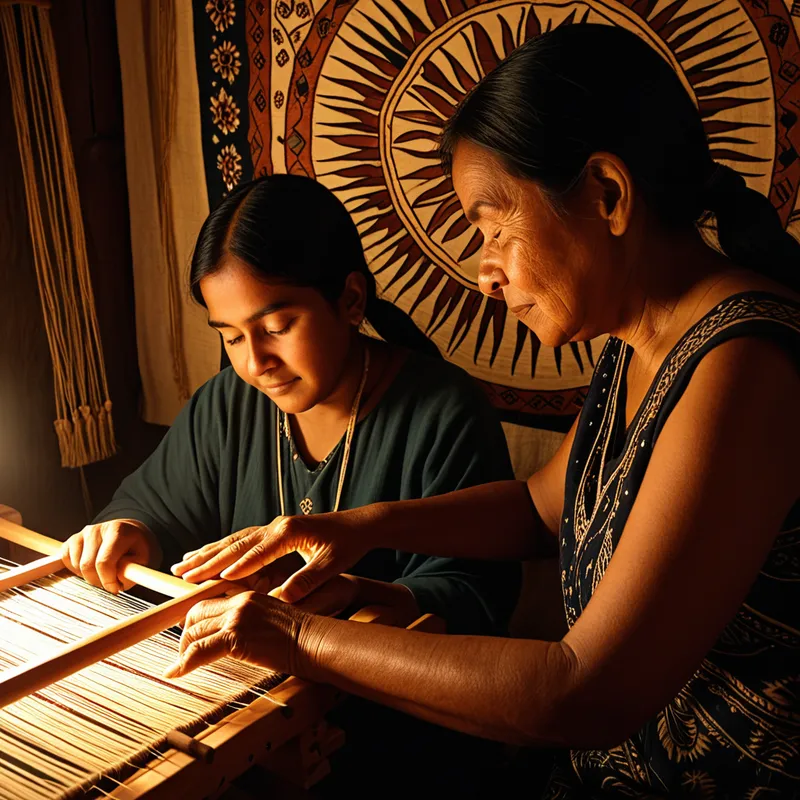
Inside, a new life begins, governed by the rhythm of the sun and the click of the loom. The Mama-Cuna, wise and severe, become her mothers now. They teach her the sacred arts: the precise, reverent brewing of chicha for the temples and the Sapa Inca; the intricate theology of the backstrap loom. Here, weaving is not craft, but prayer. Each thread of precious cumbi is a filament of devotion. As her fingers learn the patterns—the stepped diamonds of the chakana, the endless coils of the serpent—she is taught that she is weaving the very fabric of the cosmos, binding the earthly realm to the celestial. She weaves tunics for the Sapa Inca, making him a living icon of the Sun. She weaves offerings for the temples, each textile a silent hymn.
Years pass in this cloistered service. Some Acllas, deemed most perfect in skill and bearing, might be given as secondary wives to noblemen, forging political bonds with threads of cumbi. A rare few, the absolute pinnacle of the chosen, might be selected for the ultimate sacrifice: the Capacocha. For this, she would be adorned in unimaginable finery, fed sacred foods, and led high into the realm of the apus, to a frozen peak where her breath would become cloud and her life would be offered to ensure the sun’s return, the rains’ fall, the empire’s continuity. Her ending was not a death, but a translation—a merging with the mountain, a becoming of the very landscape she once served.
Thus lived the Acllas: chosen, secluded, sanctified. Their hands, never idle, spun and wove the visible and invisible threads that held the world of the Inca in perfect, sacred ayni. They were the human loom upon which the will of Inti was made manifest.
Cultural Origins & Context
The Acllas were not merely a mythological concept but a central, historical institution in the Inca Empire, a theocratic state where political power was inseparable from religious cosmology. The mythos surrounding them emerged from this fusion of divine mandate and social engineering. Their story was passed down not by bards around a fire, but through the state apparatus itself—by the quipucamayocs who noted their numbers and distributions, by the priests who orchestrated their rituals, and by the Mama-Cuna who instilled their purpose in each new generation.
Societally, the Acllawasi functioned as a powerful engine of imperial cohesion. It removed daughters from provincial lineages, neutralizing potential rival power bases while simultaneously honoring those families. It produced the ultimate luxury goods—sacred textiles and chicha—that were used to reward loyalty, display power, and appease the gods. Most profoundly, it created a living embodiment of purity and service to the Sun, a human reservoir of sacred energy that legitimized the Sapa Inca’s claim to divine descent. The Acllas were the ultimate caregivers of the empire’s spiritual and political body.
Symbolic Architecture
The myth of the Acllas is a profound allegory of conscious, chosen sacrifice in service of a greater order. It is not a myth of heroic battle or romantic quest, but of interior, disciplined transformation.
The chosen one is not a victim of fate, but the raw material for a sacred artifact. Her individuation is not toward personal freedom, but toward perfect, functional integration into a cosmic design.
The Selection represents the moment the psyche recognizes a call to a higher, often more demanding, order of consciousness. It is a severing from the personal, familial “province” of the ego. The Acllawasi is the temenos, the sacred enclosed space of incubation and training—the analyst’s office, the monastery, the artist’s studio, the disciplined routine where the old self is unraveled. The Loom is the central symbol of psychic synthesis. The Aclla does not choose the pattern (the archetypal order of the Self, represented by Inti and the Sapa Inca), but she must master the skill to manifest it. Her conscious work is to take the disparate threads of instinct, emotion, and thought (the raw wool) and weave them into a coherent, beautiful, and functional whole—the garment of a realized personality.
The potential for Capacocha is the ultimate symbol of this psychic process: the complete sublimation of the personal ego into the transpersonal Self. It is the point where the individual consciousness becomes so aligned with its central, ordering principle that it willingly “dies” to its separate existence to become a permanent, sustaining feature of the inner landscape.
The Dreamer’s Resonance
When this mythic pattern stirs in the modern dreamer, it often manifests as dreams of being selected for a special, daunting task; of entering cloistered, institutional spaces like schools, convents, or mysterious academies; or of mastering a meticulous, repetitive craft under a watchful, authoritative guide. Somatic sensations might include a feeling of being “plucked” or uprooted, a profound sense of isolation even within community, or a focused, almost meditative tension in the hands and fingers.
Psychologically, this signals a profound transition where a part of the psyche (often the anima, the inner feminine principle related to relatedness and connection) is being called into the service of a larger psychic order. The dreamer may be struggling with the sacrifice of personal desires, relationships, or freedoms for a long-term goal, a spiritual path, or a demanding creative vocation. There is a tension between the grief of the “provincial girl” left behind and the solemn pride of the “chosen woman” moving toward her purpose. The process is one of consecration—making sacred through discipline and sacrifice—which often feels like a loss before it is recognized as a transformation.
Alchemical Translation
The alchemy of the Aclla myth models the stage of coagulatio—the fixing of spirit into form—within the individuation journey. The initial separatio is the brutal, clean selection from the family and childhood identity. The solutio occurs within the Acllawasi, as the old self dissolves in the new routines, teachings, and isolation.
The work of individuation is not always a heroic journey outward, but often a sacred service performed inward, at the loom of the soul, where the threads of experience are woven into meaning.
The alchemical fire is the disciplined, daily practice—the weaving, the brewing. Through this focused, repetitive opus, the prima materia of raw potential (the young girl) is transmuted into the lapis, the philosophical stone, which here is not a solitary gem but a perfect, integrated tapestry. The Aclla’s ultimate fate—whether as a weaver, a wife, or a sacrifice—represents the different possible outcomes of this alchemy: becoming a vessel that sustains the inner order (the caregiver archetype in its purest form), forming a coniunctio or sacred marriage between different parts of the psyche, or achieving the ultimate unio mystica, where the individual ego is wholly subsumed into the experience of the Self. For the modern individual, this myth calls us to ask: What greater order (be it creative, spiritual, or ethical) am I being asked to serve? What personal freedoms must I willingly sacrifice at its loom? And can I find the sacred in that service, transforming duty into devotion?
Associated Symbols
Explore related symbols from the CaleaDream lexicon:
- Sun — The central ordering principle, the divine source of light, law, and life to which the Acllas’ entire existence is devoted and consecrated.
- Temple — The Acllawasi itself, a sacred enclosed space of incubation, discipline, and transformation, separate from the profane world.
- Weaving — The core activity of psychic synthesis, representing the conscious work of integrating disparate threads of experience, instinct, and duty into a coherent, beautiful whole.
- Sacrifice — The central theme of offering the personal self—its freedoms and desires—for the sustenance and order of a larger, transpersonal reality.
- Mountain — The ultimate destination of the Capacocha, representing the apex of spiritual attainment, a frozen eternity where the human merges with the enduring, sacred landscape.
- Order — The supreme value of Tawantinsuyu and the psychological goal; the state of perfect inner alignment and harmony the Aclla’s service upholds.
- Gold — The divine metal of Inti, symbolizing the incorruptible, solar value of the spirit and the ultimate refinement sought through sacred service.
- Chosen — The foundational state of being selected and set apart, which initiates the entire transformative journey, carrying both the burden of fate and the honor of purpose.
- Ritual — The precise, repetitive acts of weaving and brewing that form the daily liturgy of the Aclla, transforming mundane action into sacred communication.
- Cup — The vessel holding the sacred chicha, representing the Aclla’s role as a container and preparer of spiritual nourishment for the gods and the empire.
- Shadow — The repressed life of the provincial girl—personal love, familial connection, unchecked freedom—that is sequestered away in service to the solar consciousness.
- Goddess — The Aclla, in her perfected state, becomes a human vessel of the divine feminine principle, weaving the fabric of reality and embodying sacred care.