The Choice of Hercules Myth Meaning & Symbolism
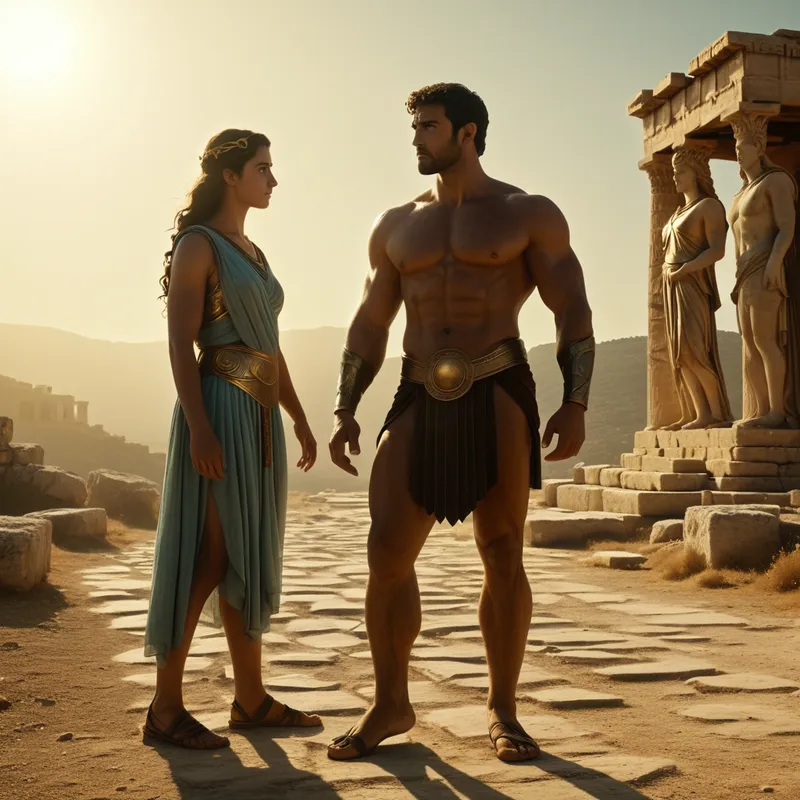
A young Hercules, at a lonely crossroads, is visited by two goddesses offering him two radically different paths for his life.
The Tale of The Choice of Hercules
The dust of the road was hot beneath his sandals, a fine, pale powder that rose in little ghosts with every uncertain step. He was a youth no longer, but a man not yet made, his form powerful but untempered, his spirit a storm of potential with no direction for its winds. The place was a lonely fork where one road, wide and well-trodden, curved away toward a distant city’s haze, and the other, steep and stony, climbed a rugged mountainside into clear, sharp air.
He stood there, paralyzed. The weight of his own strength felt like a burden. What was it for? To build? To break? To revel? To rule? The question hung in the still afternoon, unanswered.
Then, the air shimmered. Not with heat, but with presence. From the wide road came a figure, and the very dust seemed to part for her. She was beauty incarnate, but of a kind that soothes the senses into slumber. Her skin was the hue of ripe peaches, her robes sheer and dyed with twilight purples and deep wine reds. A crown of roses rested on her brow, and the scent of myrrh and spiced wine trailed her. She moved with a liquid grace, and her smile promised an end to all striving. “I am Hedone,” her voice was a melody, “but my friends call me Kakia. Walk with me. My path is soft and easy. You will taste every delight, recline on pillows of ease, and never know a moment’s want or weariness. Your strength will be for your own enjoyment alone.”
Her words were a balm, and the youth felt the temptation like a physical pull, a longing to lay down the ache of becoming.
But then, from the rocky path, another emerged. Where the first was soft, she was defined. Her posture was straight, her gaze clear and steady. She wore a simple, white chiton, her face unadorned yet radiant with a solemn dignity. Her hands, though graceful, showed the marks of use. “I am Arete,” she said, and her voice was like clear [water](/myths/water “Myth from Chinese culture.”/). “My road is not gentle. It is long, and it climbs. It requires all that you are and more. You will know sweat, and strain, and the loneliness of the heights. But if you walk with me, you will become who you are meant to be. Your strength will have purpose. You will earn the respect of gods and mortals, and a different kind of joy—one that comes not from taking, but from achieving.”
The youth, [Heracles](/myths/heracles “Myth from Greek culture.”/), looked from one to the other. The first goddess offered a life of sweet oblivion. The second offered a life of arduous meaning. [The crossroads](/myths/the-crossroads “Myth from Celtic culture.”/) was no longer just dirt and stone; it was the axis of a soul. He felt the seductive whisper of ease coil around his heart. Then he looked into the eyes of Arete and saw his own reflection, not as he was, but as he could be—honed, resolute, complete.
Without a word, he turned his back on the wide, inviting road. He set his foot upon the stony path and began to climb. He did not choose a life of grim austerity, but a life of significance. The choice was made. The hero’s journey, in that silent, dusty place, had truly begun.

Cultural Origins & Context
This profound parable is not found in the grand epic cycles of [Homer](/myths/homer “Myth from Greek culture.”/), but in the quieter, more philosophical tradition. It comes to us from the Athenian soldier, historian, and student of [Socrates](/myths/socrates “Myth from Greek culture.”/), Xenophon. In his work Memorabilia, he recounts the story as one told by the Sophist Prodicus, who used it as a moral teaching tool for young men. Its setting is distinctly [the world](/myths/the-world “Myth from Tarot culture.”/) of the Athenian citizen-soldier, the hoplite, for whom concepts of civic duty, personal excellence (arete), and self-mastery were paramount.
The myth functioned as a foundational narrative for the Greek ethical ideal of paideia—the holistic education and cultivation of the citizen. It was a story told not just to entertain, but to form character. It presented the central existential dilemma of a culture that prized both heroic glory and the enjoyment of life’s gifts. The “choice” framed this tension not as a vague philosophical problem, but as a visceral, personified encounter that every young man of standing was expected to navigate. It served as a cultural compass, pointing unequivocally toward the difficult path of virtue as the one that led to true honor and an immortal name.
Symbolic Architecture
At its [heart](/symbols/heart “Symbol: The heart symbolizes love, emotion, and the core of one’s existence, representing deep connections with others and self.”/), the myth is a map of the [psyche](/myths/psyche “Myth from Greek culture.”/)’s most fundamental conflict. It is not a [choice](/symbols/choice “Symbol: The concept of choice often embodies decision-making, freedom, and the multitude of paths available in life.”/) between “good” and “evil” in a simplistic sense, but between two modes of being, two ways of relating to one’s own [life](/symbols/life “Symbol: The symbol of ‘Life’ represents a journey of growth, interconnectedness, and existential meaning, encompassing both the joys and challenges that define human experience.”/) force.
Kakia represents the id, the primal, pleasure-seeking principle. She is the allure of the unconscious, of drifting with instinct and [appetite](/symbols/appetite “Symbol: Represents desire, need, and consumption in physical, emotional, or spiritual realms. Often signals unmet needs or excessive cravings.”/). Her [path](/symbols/path “Symbol: The ‘path’ symbolizes a journey, choices, and the direction one’s life is taking, often representing individual growth and exploration.”/) is the path of least [resistance](/symbols/resistance “Symbol: An object or tool representing opposition, struggle, or the act of pushing back against external forces or internal changes.”/), of identification with the [persona](/symbols/persona “Symbol: The social mask or outward identity one presents to the world, often concealing the true self.”/) of comfort and social ease. She promises a life without [shadow](/symbols/shadow “Symbol: The ‘shadow’ embodies the unconscious, repressed aspects of the self and often represents fears or hidden emotions.”/), because it is a life lived entirely on the surface.
Arete, in stark contrast, symbolizes the call of the Self. She is the embodiment of [the ego](/myths/the-ego “Myth from Jungian culture.”/)’s potential for discipline and conscious development. Her rocky path is the path of individuation—the difficult, often lonely process of differentiating oneself from the collective, of facing challenges, integrating [the shadow](/myths/the-shadow “Myth from Jungian culture.”/), and realizing one’s unique potential.
The crossroads is not a place in the world, but the eternal present moment of consciousness where will is exercised.
The [hero](/symbols/hero “Symbol: A hero embodies strength, courage, and the ability to overcome significant challenges.”/), [Hercules](/myths/hercules “Myth from Greek culture.”/), is the nascent ego itself, brimming with potential [energy](/symbols/energy “Symbol: Energy symbolizes vitality, motivation, and the drive that fuels actions and ambitions.”/) (his divine [strength](/symbols/strength “Symbol: ‘Strength’ symbolizes resilience, courage, and the ability to overcome challenges.”/)) but uncommitted. The myth dramatizes the critical [moment](/symbols/moment “Symbol: The symbol of a ‘moment’ embodies the significance of transient experiences that encapsulate emotional depth or pivotal transformations in life.”/) when the ego must choose between serving the unconscious drives or allying itself with the deeper, ordering principle of [the Self](/myths/the-self “Myth from Jungian culture.”/). The choice for Arete is the choice for [consciousness](/symbols/consciousness “Symbol: Consciousness represents the state of awareness and perception, encompassing thoughts, feelings, and experiences.”/), for taking [responsibility](/symbols/responsibility “Symbol: Responsibility in dreams often signifies the weight of duties and the expectations placed upon the dreamer.”/) for one’s own [destiny](/symbols/destiny “Symbol: A predetermined course of events or ultimate purpose, often linked to spiritual forces or cosmic order, representing life’s inherent direction.”/).
The Dreamer’s Resonance
When this mythic pattern stirs in the modern dreamer, it rarely appears as classical goddesses at a fork in a road. Instead, it manifests as a profound somatic and psychological tension at a life juncture.
You may dream of being offered two jobs: one glamorous, high-paying, but soul-numbing; the other humble, challenging, but strangely resonant with a deep calling. You may dream of two lovers: one exciting and chaotic, the other stable and demanding of your growth. The dream imagery might be two doors, two vehicles, or even two versions of yourself in a mirror. The somatic experience is key: a palpable pull in the gut toward the easier option, coupled with a strange, magnetic ache in the chest toward the harder one.
This is the psyche working through a crisis of orientation. The dream is not necessarily telling you which choice to make, but is forcing you to feel the quality of each path. It is making the unconscious valuation conscious. The anxiety, the paralysis, the visceral relief or dread upon choosing in the dream—these are the body’s intelligence mapping the psychic terrain of a real-life decision between comfort and calling, between [persona](/myths/persona “Myth from Greek culture.”/) and authenticity.

Alchemical Translation
The alchemical process mirrored in Hercules’s choice is the [nigredo](/myths/nigredo “Myth from Alchemical culture.”/)—the initial blackening, the first necessary separation. Before the gold of the integrated Self can be produced, the raw material of the personality must be confronted with its own duality and a fundamental choice must be made.
Choosing Arete is the act of committing to [the opus](/myths/the-opus “Myth from Alchemical culture.”/), [the great work](/myths/the-great-work “Myth from Alchemical culture.”/) of the soul. It is the vow to endure the heat and pressure of transformation. The “easy” path of Kakia is, alchemically, the path of refusing the work, of leaving [the prima materia](/myths/the-prima-materia “Myth from Alchemical culture.”/) in its base, unconscious state. It is stagnation disguised as satisfaction.
The labor of Hercules begins not with the slaying of the Nemean Lion, but with the quiet, internal victory at the crossroads. All subsequent trials are initiated by this one act of conscious alignment.
For the modern individual, this alchemical translation means recognizing that every significant life choice is a microcosm of the myth. Do we choose the path that promises to soothe our anxieties, or the path that demands we develop the strength to face them? The myth teaches that our “Hercules strength”—our vital energy, our time, our attention—is the philosopher’s stone. We can spend it on the immediate gratification of the senses (the solve, or dissolution, without purpose), or we can coagulate it, through discipline and difficult choice, into the lasting, golden structure of a meaningful life. The choice is not once and for all, but is renewed at every crossroads, in every moment we choose between what is easy and what is true.
Associated Symbols
Explore related symbols from the CaleaDream lexicon: