The Chariot Myth Meaning & Symbolism
A hero, crowned and armored, masters the opposing forces of the cosmos to guide a celestial chariot, embodying the triumph of directed will over chaos.
The Tale of The Chariot
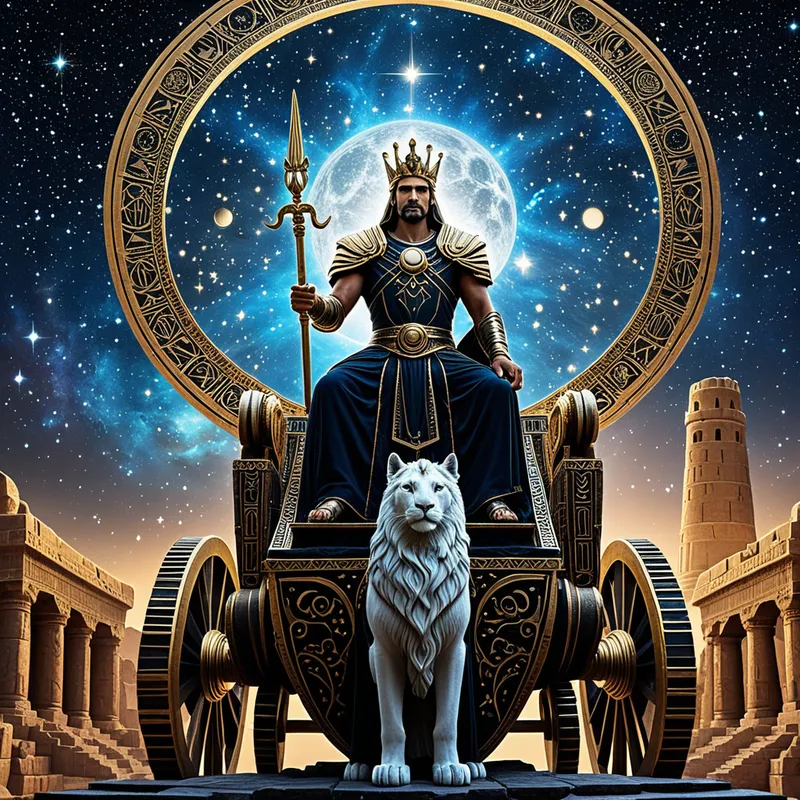
Hear now the tale of the Conqueror, the one who rides the storm of their own soul. The air is still, thick with the scent of ozone and crushed laurel. Before the walls of a city carved from moonlight and memory, a figure stands. He is crowned not by a king, but by an eight-pointed star, its light cold and certain. His armor is not of iron, but of conviction, polished to a mirror sheen.
At his back rests the vessel: a cubic chariot, a moving throne hewn from a single block of will. It is draped in a canopy of midnight blue, embroidered with silver stars. But this throne does not move of its own accord. Before it, harnessed in a tension so perfect it sings, are the twin sphinxes. One is the colour of sun-bleached bone, its eyes holding the fierce, clear light of noon. The other is the shade of a starless void, its gaze deep as a well of forgotten things. They do not look at each other. They look ahead, muscles coiled, one paw raised, forever on the verge of pulling the world apart.
The Conqueror does not mount. He becomes. He steps into the space between the beasts, and the very ground acknowledges his sovereignty. He takes the reins—not of leather, but of lived experience and unyielding choice. He does not force the beasts to be one. He does not beg them to be calm. He feels their primal urge to diverge, to rend, to flee in opposite directions and scatter his purpose to the winds. The conflict is the engine. The tension is the fuel.
And then, he speaks. Not with his voice, but with his spine, with the set of his jaw, with the unwavering focus in his eyes that sees the path through the chaos, not around it. He affirms their power, the white sphinx’s logic and the black sphinx’s instinct, and channels it forward. The chariot groans, then glides. It does not roll on wheels, but on the momentum of a decision made absolute. He passes the flowing river, symbol of unconscious emotion, and does not drown. He passes the sheltering trees, symbol of easy refuge, and does not stop. The city gates, his old boundaries, recede behind him. He is not fleeing. He is arriving, moment by moment, into a territory forged by his own integrated command. The victory is not over the beasts, but through them. The journey is the destination, and the driver is the driven.
Cultural Origins & Context
The image of The Chariot finds its roots not in a single folktale, but in a rich tapestry of esoteric thought that coalesced in the Hermetic Revival of the late 19th and early 20th centuries. While the earliest Tarot decks were Renaissance playing cards, the mythos of The Chariot as we understand it was largely crafted by secret societies like the Hermetic Order of the Golden Dawn. They acted as the myth-makers, weaving together threads from Kabbalah, Hermeticism, and astrology.
In this context, The Chariot was not merely a card but a living glyph in an initiatory system. Its story was passed down through meticulously crafted visual symbols and oral teachings within lodge rooms. Its societal function was transformative: it served as a map for the aspirant’s psyche, a model for achieving what they termed “the Knowledge and Conversation of the Holy Guardian Angel”—a state of aligned, authentic selfhood. The myth was a lesson in internal governance, teaching that true power arises from the sacred reconciliation of the conscious and unconscious minds.
Symbolic Architecture
The Chariot is a supreme symbol of the ego in its most potent and positive aspect: not as a tyrant, but as a skilled ruler and mediator. The cubic chariot represents the material world and the human body—a vehicle that is solid, defined, and capable of containing spirit. The canopy of stars signifies the higher, celestial influences guiding the journey.
The true master does not destroy the opposites but becomes the crucible in which they are held, and the conductor through which their power is directed.
The two sphinxes are the core of the mystery. They represent every fundamental duality: reason and intuition, conscious and unconscious, light and shadow, animus and anima. They are often colored black and white, yet they are not “good and evil.” They are complementary forces that naturally pull apart. The hero’s crown of stars marks him as guided by a higher, transpersonal purpose. His lack of explicit reins in many depictions underscores that his control is not brute force, but a subtle, unwavering authority of presence and will. He is the conscious principle that can hold the tension of opposites without being torn asunder, thereby creating a third, transcendent force: forward motion.
The Dreamer’s Resonance
When this myth stirs in the modern dreamer, it often manifests as dreams of powerful yet uncontrollable vehicles—a car whose brakes fail, a speeding train, a bicycle hurtling down a steep hill. Alternatively, one might dream of trying to steer two powerful animals in different directions, or of standing triumphant on a podium or at the helm of a ship. Somatically, the dreamer may awaken with a clenched jaw, tight shoulders, or a feeling of exhilarating exhaustion.
Psychologically, this signals a critical phase in the process of individuation. The dreamer is grappling with a major life conflict where two powerful aspects of their self or two compelling life paths seem irreconcilable. The dream reveals the immense energy bound up in this inner stalemate. The Chariot appears not to promise easy victory, but to pose the essential question: “Do you have the will to contain this conflict, to feel its full force, and to consciously direct its energy toward a chosen goal?” The anxiety in the dream is the friction of the unmastered opposites; the triumph is the nascent feeling of an emerging, sovereign self capable of the task.

Alchemical Translation
The alchemical process mirrored in The Chariot is albedo, the whitening, which follows the blackening (nigredo) of chaos and despair. Here, the disparate elements identified in the darkness are brought into a conscious, working relationship. The psyche’s raw, conflicting materials—our ambition and our compassion, our discipline and our creativity, our masculine and feminine energies—are the sphinxes.
Individuation is not the eradication of conflict, but the development of a chassis strong enough to carry it toward a horizon of one’s own choosing.
The alchemical “work” is the act of standing firm in the chariot-crucible. It is the daily, often grueling, practice of holding one’s contradictions in awareness without dissociating, numbing, or letting one side violently suppress the other. The “transmutation” occurs when this sustained tension ceases to be paralyzing and instead becomes generative. The directed will of the conscious mind (the Charioteer) harnesses the tremendous libidinal power of the unconscious (the sphinxes). The result is not a static “perfection,” but a dynamic, moving state of integrated being. The modern individual undergoing this process moves from being passively driven by inner and outer conflicts to becoming the active, authoritative driver of their own life’s journey, capable of navigating complexity with resolve and grace. The victory is in the mastery of direction, not in the annihilation of the forces that propel you.
Associated Symbols
Explore related symbols from the CaleaDream lexicon: