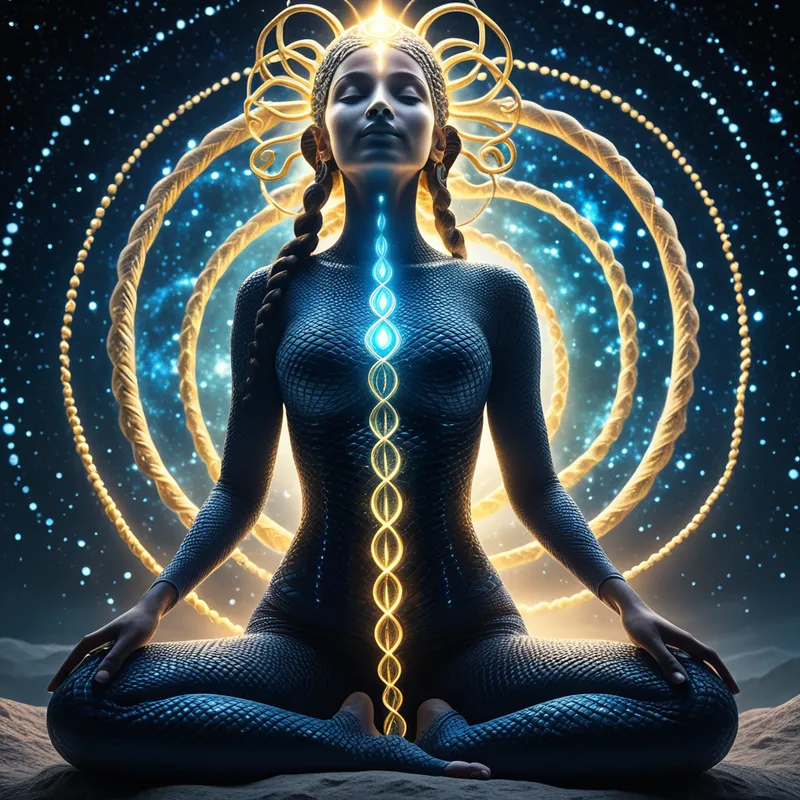
The Chakras as Cosmic Spiral Myth Meaning & Symbolism
A tale of the serpent goddess Kundalini ascending the spine, awakening the chakras in a cosmic spiral to unite consciousness with the divine.
The Tale of The Chakras as Cosmic Spiral
Listen. In the deep silence before the first word, there is a sleeping fire.
It rests at the root of the world, at the base of the great mountain that is the human form. Here, in the sacred cave of the pelvis, coiled three and a half times around a black lingam of potential, sleeps Kundalini. She is not a mere concept, but a Goddess—Kundalini Shakti—wrapped in the deep slumber of unmanifest creation. Her body is the brilliance of ten million suns, yet she dreams in darkness, her breath the slow pulse of untapped universes.
Above her, along the central pillar of the spine, the chakras wait like dormant lotuses. The first, Muladhara, is a lotus of four crimson petals, heavy with the scent of soil and stability. Higher, Svadhisthana churns like an orange sea. Manipura blazes with a yellow, digestive fire. At the heart, Anahata is an emerald-green vortex, stilled in anticipation. In the throat, Vishuddha holds a sphere of silent, violet sound. The brow, Ajna, is a twin-petaled lotus of indigo command. And at the crown, the thousand-petaled Sahasrara hangs inverted, a chalice waiting to be filled from below.
The call to awaken is not a shout, but a whisper—the sustained, pure vibration of the sacred syllable Aum. It is the breath of the yogi, the focused intent of the sage, the purified vessel of a life lived with discipline and devotion. This sound becomes a subtle heat, a gentle coaxing at the base of the spine.
The Goddess stirs.
With a sound like the unraveling of time itself, she uncoils. She is not a linear force but a spiraling ascent, a living helix of light. She rises not like an arrow, but like smoke from sacred fire, circling the central axis, the Sushumna. As she passes through each lotus, it is not merely opened; it is transmuted. The spiral of her movement drills into the core of each chakra, igniting its latent potential.
In Muladhara, the spiral grounds and stabilizes, turning earth into conscious foundation. In Svadhisthana, it swirls the waters of emotion into creative flow. In Manipura, it fans the digestive fire into the radiant flame of empowered will. The journey is perilous; blockages—the psychic knots of past karma and present attachment—can cause heat, tremors, visions. The aspirant must hold steady, a witness to the inner storm.
The climax is at the heart. Here, the ascending spiral of Shakti meets the descending spiral of consciousness, Shiva. In Anahata, they do not collide but begin to dance, their spirals intertwining. The ascent continues, now charged with this divine polarity—through the truth of Vishuddha, the vision of Ajna, and finally, into the waiting cup of Sahasrara.
The resolution is not an explosion, but a blissful dissolution. The serpentine spiral of the Goddess merges completely with the boundless space of Shiva. The thousand petals bloom, raining nectar. The individual drop of consciousness realizes it is the ocean. The spiral, having completed its sacred circuit, becomes a still point of perfect, radiant unity. The sleeper has awakened, within and without.

Cultural Origins & Context
This is not a myth with a single author or a specific historical battle. It is a darshana—a seen truth—that emerged from the deepest meditative experiences of the rishis and yogis of ancient India. Its earliest seeds are found in the esoteric dialogues of the Upanishads (c. 800-200 BCE), but its full, systematic expression crystallized in the medieval texts of Tantra and Yoga.
The myth was passed down through a potent combination of oral lineage (guru-shishya parampara) and encoded scripture. A guru would not merely recite the myth; they would guide the disciple to experience its stages through asanas, breath control (pranayama), and visualization. Texts like the Hatha Yoga Pradipika and the Shat-Chakra-Nirupana served as maps for this inner journey.
Societally, it functioned as a radical democratization of enlightenment. While Vedic rituals required specific social status, the path of Kundalini was an internal technology accessible to any sincere seeker, regardless of birth. It provided a complete psycho-cosmology, explaining everything from primal instincts (lower chakras) to divine union (crown chakra) within the microcosm of the human body.
Symbolic Architecture
The myth is a master symbol of the individuation process, mapping the evolution of consciousness from unconscious identification to transcendent awareness.
The spiral is the universe’s signature: from galaxies to DNA, it is the pattern of energy in motion, of growth that returns to its source transformed.
The sleeping Kundalini Shakti represents our latent wholeness, our unused psychic energy and creative potential, often buried under layers of conditioning and trauma (the “coils”). The spine is the axis mundi, the central pillar connecting the earthly (base) to the heavenly (crown). Each chakra is a stage of psychological development: security, sexuality, power, love, expression, intuition, and unity.
The ascent is not a rejection of the lower centers but their integration. One does not abandon the need for security (Muladhara) to reach love (Anahata); one transforms that need into a stable foundation from which unconditional love can grow. The “blockages” are our complexes, fears, and unresolved wounds. The union of Shakti and Shiva is the sacred marriage within, the reconciliation of dynamic life force (the psyche in motion) with static, witnessing consciousness (the Self).
The Dreamer’s Resonance
When this myth stirs in modern dreams, it signals a profound somatic and psychological awakening process already underway in the unconscious. One might dream of:
- Spirals, coils, or ascending staircases emerging from dark places, suggesting energy beginning to move from repressed zones.
- Serpents, not as threats, but as luminous, intelligent guides, representing healing instinct and transformative power.
- A column of light in the body or a feeling of energy rushing up the back, correlating to literal somatic sensations that can accompany psychological shifts.
- Lotuses blooming in sequence or colored lights aligning, indicating the sequential healing and activation of different aspects of the personality.
Such dreams often occur during life transitions, deep therapy, or after significant emotional releases. They are the psyche’s way of illustrating that a core, structural transformation is happening—an upgrade of the very “operating system” of the self. The dreamer is not just having a dream; they are dreaming the myth of their own evolution.
Alchemical Translation
The alchemical work modeled here is the opus contra naturam—the work against one’s current, fragmented nature—to achieve the unio mentalis, the union of the mind with the spirit. The process is one of psychic transmutation, where base elements of the personality are turned into gold.
The goal is not to escape the body, but to make the body so conscious that it becomes a vessel for the divine.
First, the Nigredo: confronting the “sleeping serpent” in the darkness of our unconscious, our repressed desires and primal energy. This is the shadow work of the lower chakras. Then, the Albedo: the purification as the energy ascends, clarifying emotion, refining the will, and opening the heart. The Citrinitas is the dawning of inner wisdom and intuition (Ajna). Finally, the Rubedo: the culmination in Sahasrara, the radiant red-gold of the philosopher’s stone, the realization of the Self.
For the modern individual, this myth instructs us that healing and wholeness are not additive but transformative. We don’t collect better traits; we awaken a spiraling energy that systematically reorganizes our entire being from the ground up. It teaches that our deepest spiritual aim and our most basic psychological health are the same journey—the sacred spiral ascent from fragmentation to unity, where the hero is not who we become, but who we always were, asleep at the root.
Associated Symbols
Explore related symbols from the CaleaDream lexicon: