The Celestial Hunt Myth Meaning & Symbolism
A cosmic hunter pursues a celestial elk across the sky, a chase born of broken taboo that etches the cycles of night, day, and the human soul onto the heavens.
The Tale of The Celestial Hunt
Listen. The wind across the taiga carries an old song, a story written in the turning of the stars. Before the World Tree held the sky aloft, when the first snows were still remembering their names, there was a hunter. He was not just a man of the earth, but a man of the sky, born under a portentous star, with eyes that could see the spirit in every beast and the path of every soul. His name was whispered with awe, for his arrow never missed, and his heart beat in time with the great pulse of the world.
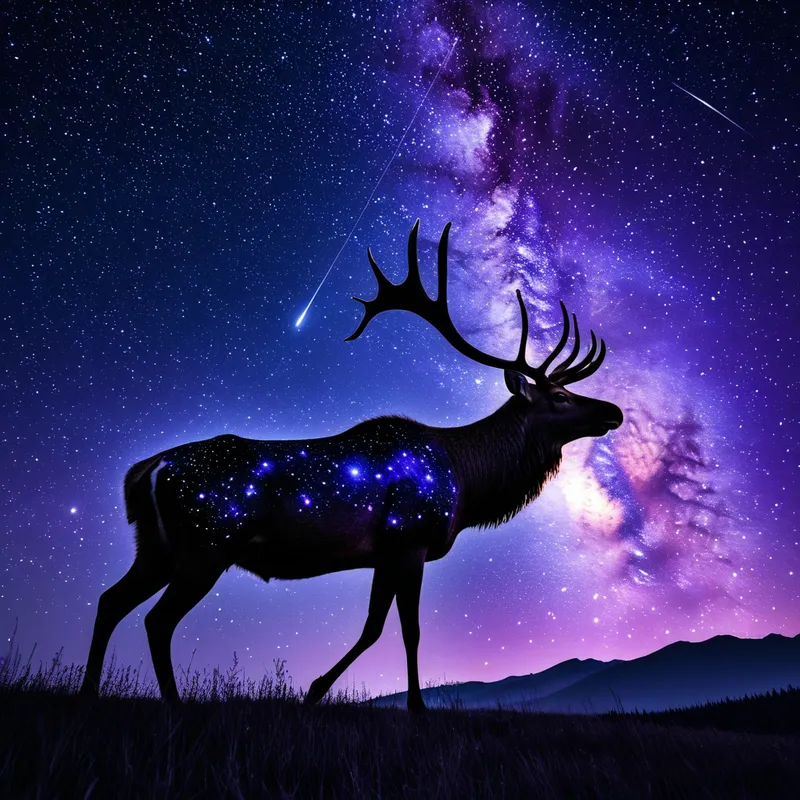
But the world’s greatest gifts are bound by its oldest laws. The First Law, given by the Tengri, was this: the Celestial Elk, whose antlers were woven from the threads of the Aurora and whose hooves struck sparks that became new stars, was sacred. It was the guardian of life’s balance, the living map of destiny. To hunt it was to unravel the cosmos.
The hunter knew this. He felt it in his bones. Yet, in his pride—or was it a deep, unnameable longing for the ultimate quarry?—he looked up. He saw the Elk, a magnificent silhouette of living night and silver light, grazing at the edge of the sky where it meets the endless steppe of stars. The sight pierced him deeper than any desire for meat or hide. It was a call to a contest beyond mortal comprehension.
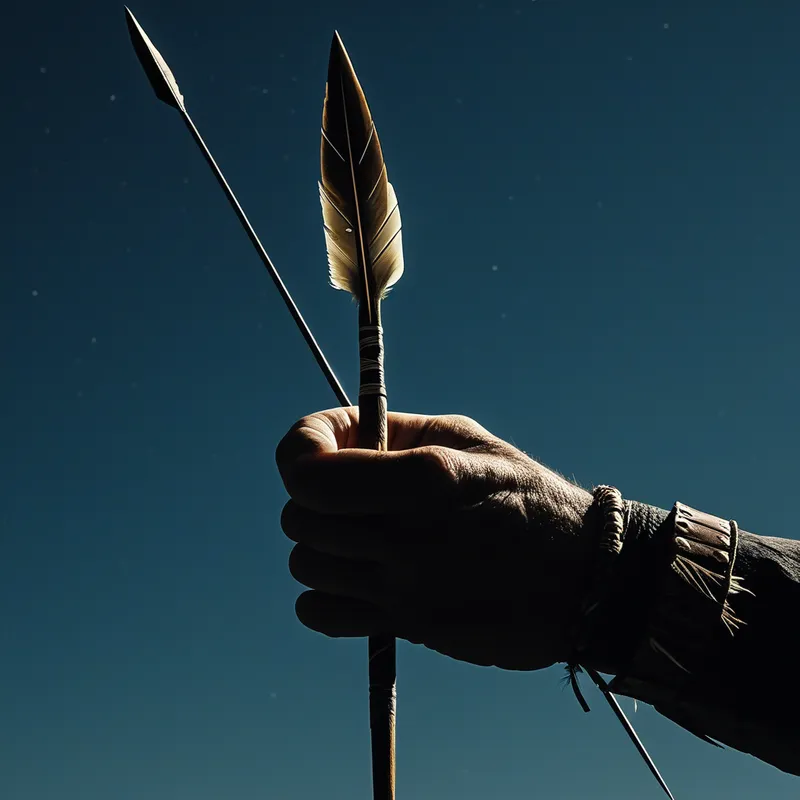
He took his bow, strung with the sinew of a thousand journeys, and nocked an arrow tipped with a shard of his own destiny. The air grew still. The fire in his hearth died to a single ember. He drew, and the bow creaked with the sound of a world bending. He released.
The arrow flew, a line of severed silence. It found its mark, not in flesh, but in the fabric of fate. A single, perfect drop of the Elk’s celestial Blood fell to the earth, blooming into a flower of impossible light. The Elk bellowed—a sound that cracked the vault of heaven—and fled, wounded, across the dome of the world.
And the hunter? The moment his arrow flew, the earth rejected him. The ground became like water beneath his feet. The sky reached down and pulled him up. He was caught in the wake of his own transgression, lifted into the endless chase. Now he runs, forever, across the star-strewn tundra of the night. He is the constellation we call the Hunter. His prey, the shimmering shape of the Elk, forever just beyond the arc of his next shot. They chase each other through eternity, the Elk’s wound bleeding the silver light of the moon, the hunter’s despair fueling the cold fire of the stars. This is the dance above us. This is the price of touching the divine.
Cultural Origins & Context
This myth, in its many variations, is the bedrock cosmology of numerous Indigenous peoples across Siberia—from the Evenki and Yakut to the Khanty and Nenets. It was not merely a story but a living map of the universe, told by shamans around crackling fires during the long, profound darkness of the polar winter. The shaman, the psychopomp of the community, would recite the hunt to explain the celestial mechanics: the rotation of the constellations, the cycle of night and day, the phases of the moon (that spilled celestial blood), and the eternal presence of the Aurora Borealis—the glittering trail of the cosmic chase.
Its societal function was multifaceted. It was a cautionary tale about hubris and the sacred laws of reciprocity with the spirit world. It explained the natural order, providing a narrative anchor in a vast, often unforgiving landscape. Most importantly, it modeled the shaman’s own journey: to pursue the elusive spirits (the Elk) across the otherworldly steppes of the upper world, risking everything to bring back healing or knowledge for the people, always mindful of the taboos that could strand him in the spirit world forever.
Symbolic Architecture
At its [heart](/symbols/heart “Symbol: The heart symbolizes love, emotion, and the core of one’s existence, representing deep connections with others and self.”/), The Celestial Hunt is a profound [allegory](/symbols/allegory “Symbol: A narrative device where characters, events, or settings represent abstract ideas or moral qualities, conveying deeper meanings through symbolic storytelling.”/) for the [soul](/symbols/soul “Symbol: The soul represents the essence of a person, encompassing their spirit, identity, and connection to the universe.”/)’s encounter with its own transcendent potential and the inevitable consequence of that awakening.
The Celestial Elk represents the ultimate objective of the spiritual [quest](/symbols/quest “Symbol: A quest symbolizes a journey or search for purpose, fulfillment, or knowledge, often representing life’s challenges and adventures.”/)—the Self, wholeness, or a state of divine grace. It is beautiful, numinous, and utterly other. It is the goal that once seen, can never be unseen, igniting an irresistible compulsion.
The Hunter embodies the heroic ego, the part of [consciousness](/symbols/consciousness “Symbol: Consciousness represents the state of awareness and perception, encompassing thoughts, feelings, and experiences.”/) that seeks to conquer, to achieve, to possess the sublime. His fatal shot is not an act of malice, but of [inflation](/symbols/inflation “Symbol: A dream symbol representing feelings of diminishing value, loss of control, or expansion beyond sustainable limits in one’s life or psyche.”/)—the belief that the transcendent can be captured by the instruments of the mundane world.
The wounding of the divine is the first, necessary step in the birth of individual consciousness. It is the separation that makes longing, and therefore seeking, possible.
The eternal [chase](/symbols/chase “Symbol: Dreaming of a chase often symbolizes avoidance of anxiety or confrontation, manifesting as fleeing from something threatening or overwhelming in one’s waking life.”/) itself is the core [symbol](/symbols/symbol “Symbol: A symbol can represent an idea, concept, or belief, serving as a powerful tool for communication and understanding.”/). It represents the dynamic [tension](/symbols/tension “Symbol: A state of mental or emotional strain, often manifesting physically as tightness, pressure, or unease, signaling unresolved conflict or anticipation.”/) of existence: striving and never fully attaining, the endless cycle of desire and partial fulfillment. The spilled [blood](/symbols/blood “Symbol: Blood often symbolizes life force, vitality, and deep emotional connections, but it can also evoke themes of sacrifice, trauma, and mortality.”/) becoming the [moon](/symbols/moon “Symbol: The Moon symbolizes intuition, emotional depth, and the cyclical nature of life, often reflecting the inner self and subconscious desires.”/) suggests that from this cosmic “injury” flows the reflected, softer light that illuminates our inner darkness—the light of [intuition](/symbols/intuition “Symbol: The immediate, non-rational understanding of truth or insight, often described as a ‘gut feeling’ or inner knowing that bypasses conscious reasoning.”/), dreams, and the unconscious.
The Dreamer’s Resonance
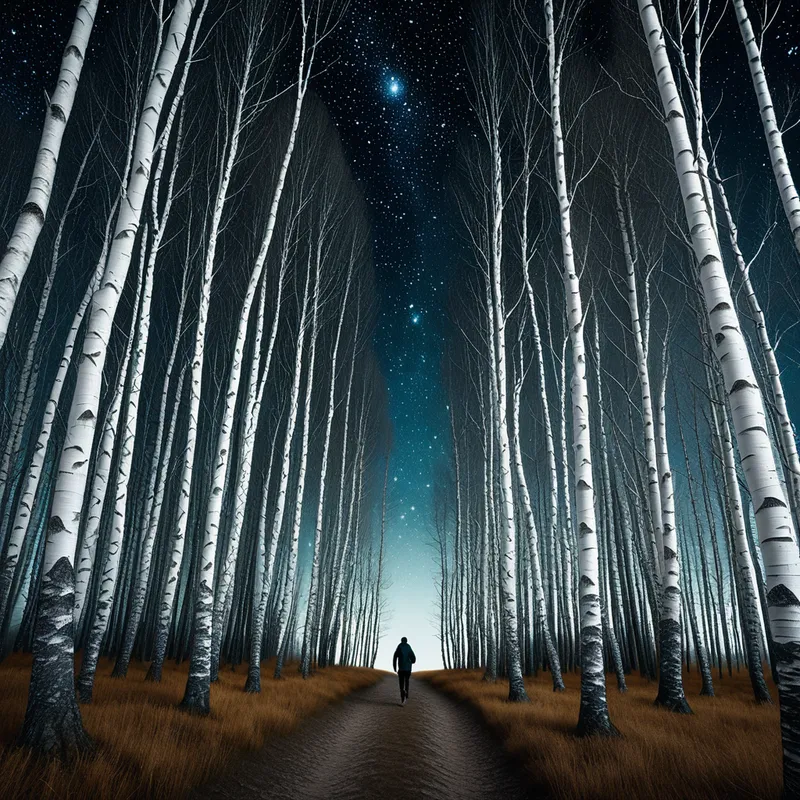
When this myth stirs in the modern unconscious, it often manifests as dreams of relentless pursuit. You may dream of chasing or being chased by a magnificent, elusive animal or a luminous figure. The terrain is vast—endless skies, frozen plains, star-fields. There is a somatic quality of breathless running, of muscles burning with eternal effort, yet the dream is charged not with terror, but with a poignant, awe-filled urgency.
This dream pattern signals that the psyche is engaged in a profound process of grappling with a “sacred taboo.” The dreamer is likely confronting a deep, inner calling—a talent, a truth, a spiritual yearning—that feels both magnificent and forbidden. To pursue it feels like breaking a fundamental, internalized law (often related to family, culture, or a limiting self-concept). The eternal chase in the dream reflects the psychic reality: having glimpsed this potential (the Elk), the ego cannot return to its old, unconscious state. It is now fated to pursue, even if full capture seems impossible. The dream is the soul’s enactment of its own cosmic drama, where the stakes are nothing less than one’s destiny.
Alchemical Translation
In the alchemical vessel of individuation, The Celestial Hunt maps the perilous and glorious process of psychic transmutation.
The hunter’s initial state is one of unconscious excellence. He is a master of his earthly domain (the persona), but he looks up. This is the nigredo, the first darkening: the call to adventure that disrupts comfortable competence. Drawing the bow is an act of will, a commitment to the quest, however foolhardy.
The release of the arrow is the critical moment of inflation and separatio. It is the ego attempting to forcibly integrate the Self, to “shoot” consciousness into the realm of the gods. This always fails and results in a wound—both to the divine image (the Elk) and to the ego (the hunter’s exile). In psychological terms, this is the painful realization that our conscious aims cannot master the unconscious; we can only wound it, causing it to retreat and making its contents flow into our lives in strange, symbolic forms (the moon/blood).
The eternal chase is not a punishment, but the alchemical coniunctio in its dynamic, living form. It is the sustained relationship between ego and Self.
The transformation lies in the chase itself. The hunter is not trying to kill the Elk; the myth implies the arrow was never meant for death, but for connection. The eternal pursuit becomes a sacred circuit. The ego (hunter) is continually refined by the pursuit of the Self (Elk), and the Self is kept active and engaged by the devoted attention of the ego. They create the cosmos between them. For the modern individual, the alchemical goal is not to “catch” wholeness, but to enter the chase wholeheartedly—to allow one’s life energy to be organized around this sacred pursuit, finding meaning not in possession, but in the profound, dynamic relationship with the mystery that guides us.
Associated Symbols
Explore related symbols from the CaleaDream lexicon:
- Hunter’s Call — The irresistible inner summons to pursue a transcendent goal, which once heard, alters the course of one’s destiny forever, as it did for the celestial hunter.
- Celestial Elk — The ultimate quarry of the spirit, representing the numinous Self, divine wholeness, and the beautiful, untamable objective of the soul’s deepest quest.
- Sky — The vast, cold, and magnificent realm of spirit, fate, and transcendent law where the mythic drama of the hunt eternally unfolds.
- Blood — The sacred life essence spilled from the wounded Elk, symbolizing the necessary sacrifice that fertilizes the world with reflected, intuitive light (the moon).
- Moon — The celestial body born from the Elk’s wound, representing the cyclical, reflective light of the unconscious that guides the night-time journey of the soul.
- Arrow — The focused will, intention, and skill of the ego launched toward a divine target, an act that simultaneously connects and severs, creating the central conflict.
- Star — The fixed points of light in the narrative of the chase, representing both destiny’s map and the cold, enduring nature of the cosmic pattern set in motion.
- Journey — The eternal, cyclical path across the heavens, embodying the core process of life as a pursuit with no earthly end, only profound movement.
- Fate — The inescapable cosmic law and consequence enacted by the hunter’s choice, weaving his action into the permanent tapestry of the universe.
- Sacrifice — The central act of the myth: the hunter sacrifices his earthly life, and the Elk sacrifices its inviolability, to birth a new, dynamic cosmic order.
- Bow of the Hunter — The instrument of human skill and aspiration, the tensioned vessel of potential that translates desire into world-altering action.
- Celestial Bridge — The invisible pathway across the heavens formed by the chase itself, connecting the human realm of action to the divine realm of essence.