The Cedar Forest Myth Meaning & Symbolism
The epic tale of Gilgamesh and Enkidu's perilous quest to slay the forest's monstrous guardian, Humbaba, a story of civilization versus the wild.
The Tale of The Cedar Forest
Hear now the tale of the forest at the edge of [the world](/myths/the-world “Myth from Tarot culture.”/), where the sun’s first light is born and the mountains hold up [the sky](/myths/the-sky “Myth from Persian culture.”/). It was a place not for men, but for gods. A realm of [Tiamat](/myths/tiamat “Myth from Mesopotamian culture.”/)’s ancient breath, where the cedars grew so tall their tops pierced the belly of heaven, and their roots drank from the waters of the deep. Their fragrance was the perfume of eternity, and their wood was the bone of [the earth](/myths/the-earth “Myth from Hindu culture.”/), reserved for the temples of the divine.
In the radiant, walled city of Uruk, a king stirred with a restless fire. [Gilgamesh](/myths/gilgamesh “Myth from Mesopotamian culture.”/), two-thirds god and one-third man, had built all that could be built and conquered all that could be conquered within the realm of order. Yet a hollow wind blew through his spirit. His dreams were haunted by a falling star, a great axe—omens he could not decipher. To his wild-hearted brother, Enkidu, forged from clay and [the wilderness](/myths/the-wilderness “Myth from Biblical culture.”/) itself, he spoke his torment: “My name is not yet etched upon [the foundation stone](/myths/the-foundation-stone “Myth from Mesopotamian culture.”/) of the earth! Let us travel to the forbidden Cedar Forest. Let us slay its demon guardian, [Humbaba](/myths/humbaba “Myth from Mesopotamian culture.”/), and cut down the mighty trees. We will achieve a fame that outlasts the stars.”
The elders of Uruk trembled and pleaded. The sun god, Shamash, was consulted. He granted his favor, but the price was whispered on [the wind](/myths/the-wind “Myth from Various culture.”/). The journey was a descent into the belly of the world. For days and nights counted in scores, they crossed desolate mountains and rivers of death, guided only by Shamash’s burning disk. The air grew thin and cold. Then, the scent reached them—a green, resinous, overwhelming perfume that made the heart ache with its purity. They had arrived.
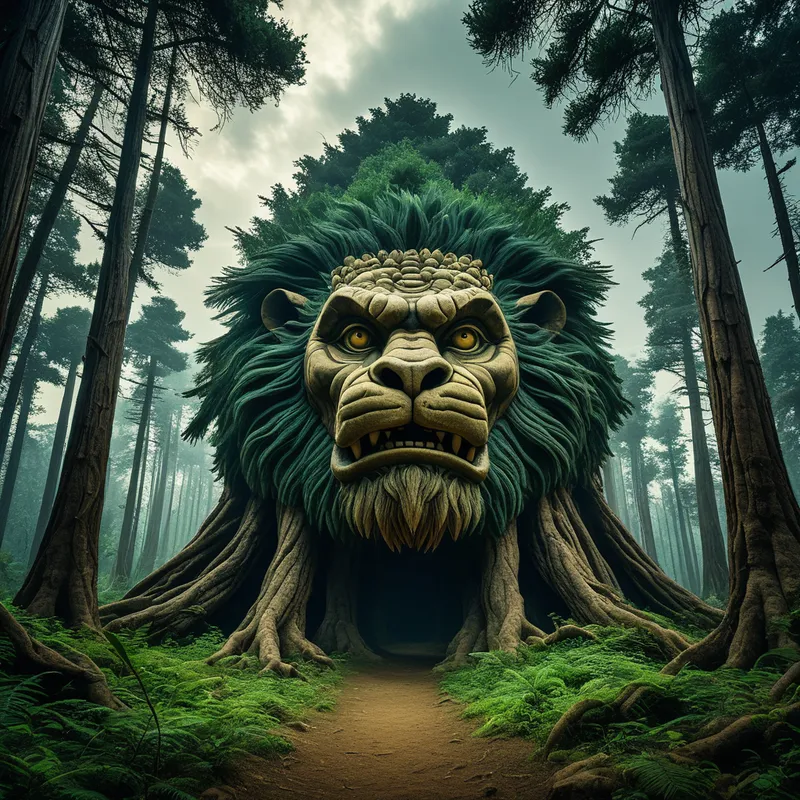
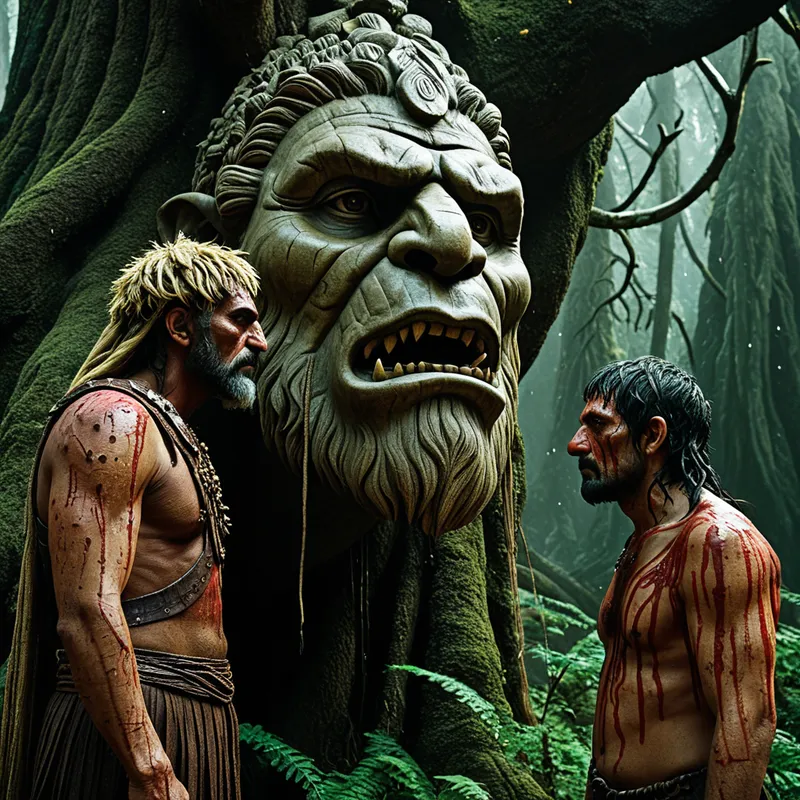
The forest was a living cathedral of shadow and piercing light. Silence reigned, a silence so profound it roared in the ears. Then, the silence broke. It began as a distant rumble, like stone grinding against stone, and coalesced into a voice that was not a voice, but the forest itself speaking. “Who has come to steal the teeth of the earth? Who disturbs the sleep of Enlil?” Humbaba revealed himself not as a beast separate from the woods, but as the woods made flesh and fury. His face was a [labyrinth](/myths/labyrinth “Myth from Various culture.”/) of coiled intestines, his roar the crash of falling timber, his breath the hot mist of the deep ravines. He wore the seven terrors as a cloak, auras of dread that paralyzed the soul.
Gilgamesh faltered, the hero-king frozen by a primordial fear. It was Enkidu, the man who knew the language of wild things, who shouted the courage back into his friend’s heart. “Remember your pride, O King of Uruk! Attack!” With Shamash summoning great winds to bind the monster, they fought. It was not a battle of strength alone, but of will against the ancient, untamed essence of the world. Axes bit into sacred bark and monstrous flesh alike. Finally, Humbaba lay subdued, his terrible power ebbing. In a moment of shocking intimacy, the monster pleaded for his life, his voice now that of a trapped, ancient spirit. But urged by Enkidu, fearing the fickleness of the gods, Gilgamesh severed the head from the body.
The victory was silent, bathed in the cold light filtering through the branches they had come to claim. They felled the tallest cedars, fashioned a great gate for [the temple](/myths/the-temple “Myth from Jewish culture.”/) of Enlil in Nippur, and made a raft of the mighty trunks. As they set sail down the Euphrates, Humbaba’s colossal head was lashed to the prow, a trophy and a testament. But the fragrance of cedar now smelled of blood, and [the river](/myths/the-river “Myth from Buddhist culture.”/)’s current seemed to pull them not toward home, but toward a destiny written in the tears of the gods.
Cultural Origins & Context
This story forms the core of Tablet II through V of the Standard Babylonian version of the Epic of Gilgamesh, inscribed on clay tablets in cuneiform script around the 7th century BCE. It is, however, a narrative with far deeper roots, likely originating in Sumerian oral traditions a millennium earlier. The epic was not mere entertainment; it was a foundational text, recited by scribes and perhaps performed during festivals. It functioned as a mirror for Mesopotamian civilization, exploring the tensions between the urban, agricultural order of the city-state (Uruk) and the chaotic, potent wildness beyond its walls (the Cedar Forest, often associated with the Lebanon or Zagros mountains). The quest for eternal fame (šuma) was a driving cultural force, a means to cheat the bleak Mesopotamian [underworld](/myths/underworld “Myth from Greek culture.”/), Irkalla. The myth also served a theological purpose, justifying the long-distance trade of precious cedar wood from distant lands for the construction of divine abodes, framing a commercial and imperial necessity as a heroic, god-sanctioned endeavor.
Symbolic Architecture
The [Cedar](/symbols/cedar “Symbol: Aromatic wood symbolizing purification, protection, and sacred connection, often associated with spiritual cleansing and enduring strength.”/) [Forest](/symbols/forest “Symbol: The forest symbolizes a complex domain of the unconscious mind, representing both mystery and potential for personal growth.”/) is the ultimate [symbol](/symbols/symbol “Symbol: A symbol can represent an idea, concept, or belief, serving as a powerful tool for communication and understanding.”/) of the numinous—the wholly other, the sacred and terrifying [realm](/symbols/realm “Symbol: The symbol of ‘Realm’ often signifies the boundaries of one’s consciousness, experiences, or emotional states, suggesting aspects of reality that are either explored or ignored.”/) of the unconscious that exists beyond [the ego](/myths/the-ego “Myth from Jungian culture.”/)’s tidy domain. It is the untamed [psyche](/myths/psyche “Myth from Greek culture.”/) in its primordial state.
The guardian is not separate from the forest; the fear is not separate from the treasure. To claim one, you must confront the other.
Humbaba is the personification of the [Shadow](/symbols/shadow “Symbol: The ‘shadow’ embodies the unconscious, repressed aspects of the self and often represents fears or hidden emotions.”/) in its most colossal, archetypal form. He is not merely evil; he is the protector of a sacred, pre-conscious wholeness. His seven terrifying auras represent the layered, paralyzing defenses of the unconscious when approached with arrogance or brute force. Gilgamesh, the heroic ego, seeks to conquer this realm to aggrandize himself. Enkidu represents the instinctual, embodied self—the part of us still connected to [nature](/symbols/nature “Symbol: Nature symbolizes growth, connectivity, and the primal forces of existence.”/), which can interpret the dreams (the omens) and find the courage when the ego falters. Their partnership is crucial; [consciousness](/symbols/consciousness “Symbol: Consciousness represents the state of awareness and perception, encompassing thoughts, feelings, and experiences.”/) cannot integrate the [depths](/symbols/depths “Symbol: Represents the subconscious, hidden emotions, or foundational aspects of the self, often linked to primal fears or profound truths.”/) alone. The felling of the cedars is a profound act of desacralization and appropriation, bringing the raw [material](/symbols/material “Symbol: Material signifies the tangible aspects of life, often representing physical resources, desires, and the physical world’s influence on our existence.”/) of the wild (unconscious potential) into the service of cultural and spiritual [construction](/symbols/construction “Symbol: Construction symbolizes creation, building, and the process of change, often reflecting personal growth and the need to build a solid foundation.”/) (the [temple gate](/symbols/temple-gate “Symbol: A threshold between the mundane and sacred, representing spiritual transition, initiation, or the boundary between conscious awareness and deeper mysteries.”/)). Yet, the act is also a violation, carrying the seeds of future tragedy, as the killing of a sacred [guardian](/symbols/guardian “Symbol: A protector figure representing safety, authority, and guidance, often embodying parental, societal, or spiritual oversight.”/) must.
The Dreamer’s Resonance
When this myth stirs in the modern dreamer, it signals a call to a necessary, perilous journey into the overgrown territories of [the self](/myths/the-self “Myth from Jungian culture.”/). Dreaming of an immense, dark forest one feels compelled to enter mirrors the soul’s readiness to confront what has been walled off. The feeling is not of peaceful wandering, but of a fateful quest.
The somatic experience is key: the crushing weight of silence, the intoxicating yet suffocating scent, the paralysis of awe and dread. This is the body registering the psychic encounter with the numinous. A monstrous presence in the dream—often a composite being or a force felt rather than seen—is your personal Humbaba. It guards a profound resource: perhaps your innate creativity, your wild vitality, or a buried trauma. The dream may present a “companion”—an aspect of yourself (like Enkidu) that is more resilient, instinctual, or supportive. This dream pattern marks the beginning of a profound psychological process: the ego, having exhausted its known resources, must now petition the deeper Self (symbolized by the aid of Shamash, the illuminating consciousness) and venture into the shadowlands to claim a new level of personal authority and substance.
Alchemical Translation
The myth models the alchemical opus, [the great work](/myths/the-great-work “Myth from Alchemical culture.”/) of individuation. Gilgamesh’s restless ennui is the [nigredo](/myths/nigredo “Myth from Alchemical culture.”/), the initial blackening, the sense of meaninglessness that propels the seeker. The journey to the forest is the arduous [separatio](/myths/separatio “Myth from Alchemical culture.”/), leaving the known world (the [persona](/myths/persona “Myth from Greek culture.”/)) behind.
The slaying of the guardian is not a victory of light over dark, but the painful, necessary dissolution of an old structure of consciousness that guarded a secret.
The confrontation with Humbaba is the fiery calcinatio and [solutio](/myths/solutio “Myth from Alchemical culture.”/)—the burning and dissolving of the ego’s defenses by the terrifying heat and fluidity of the unconscious. To succeed, Gilgamesh must temporarily become the monster he fights, embracing a ferocity he once reserved for civilized conquest. This is the paradoxical coincidentia oppositorum, the union of opposites (king/wildman, ego/shadow) in the heat of battle.
The felling of the cedars and the crafting of the temple gate represent the coagulatio and sublimatio. The raw, unconscious material (the towering trees) is cut down to size, shaped, and elevated into a structure that serves a higher purpose—a gateway to the divine (Enlil’s temple). This is the integration of [the shadow](/myths/the-shadow “Myth from Jungian culture.”/)’s power into the personality, creating a conduit between the ego and the Self. The modern individual undergoes this alchemy when they face a deep-seated fear or complex, not to annihilate it, but to wrest from it the vital energy and insight it holds captive. The resulting “gate” is a newfound capacity—perhaps resilience, authentic expression, or spiritual connection—that stands as a permanent, sacred artifact within the psyche, forged in the forest of trial. The tragedy that follows in the epic reminds us that this work is cyclical, not final, and each integration begets a new, deeper challenge.
Associated Symbols
Explore related symbols from the CaleaDream lexicon: