The Cauldron of Inspiration Myth Meaning & Symbolism
A myth of the divine cauldron of poetic wisdom, guarded by dark goddesses, won through sacrifice to transform raw experience into inspired art.
The Tale of The Cauldron of Inspiration
Listen now, and let the fire’s shadow tell the tale. In the time before memory hardened into history, in the mist-shrouded Otherworld of the Tuatha Dé Danann, there existed a treasure beyond all treasures. It was not gold, nor a weapon of invincible might. It was the Coire Ansic, the Cauldron of the Dagda, the Undry Cauldron that never ran dry. But a greater wonder still was the Coire Érmai, the Cauldron of Inspiration, born from the breath of nine muses, forged in the stars, and given into the keeping of the goddess of wisdom herself.
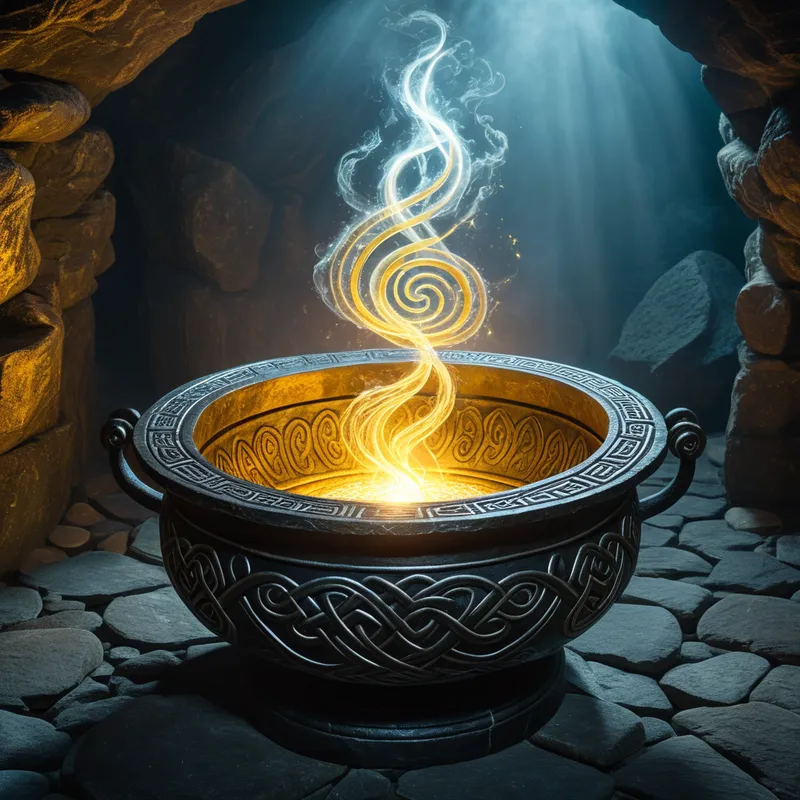
This cauldron did not hold food, but the very essence of imbas. It rested not in a sunlit hall, but in the dark, damp depths of the north, in the land of Muirias, guarded by three fierce sisters: the goddess of the land, the goddess of battle, and the goddess of prophecy. Their faces were like carved stone, their eyes pools of still water reflecting endless night. The cauldron itself was cold iron, etched with spirals that led the eye inward to oblivion. It was empty, and yet it was full—waiting.
The seeker was not a warrior king, but a poet. His name was Fionn mac Cumhaill, or in an older breath, Gwion Bach. He came not with an army, but with a hunger—a hollow in his spirit that only the true word could fill. He had knowledge, yes, and craft. But he sought the source, the wellspring from which all craft flows.
The path was a descent. He left the green world behind, following the song of a hidden stream into a cave mouth that breathed cold air. The guardians emerged from the stone itself. They did not speak, but their silence was a question sharper than any spear: What will you pay? The old lore was clear. The cauldron would not give its gift to the casual, the proud, or the whole. It demanded a price that was also a transformation.
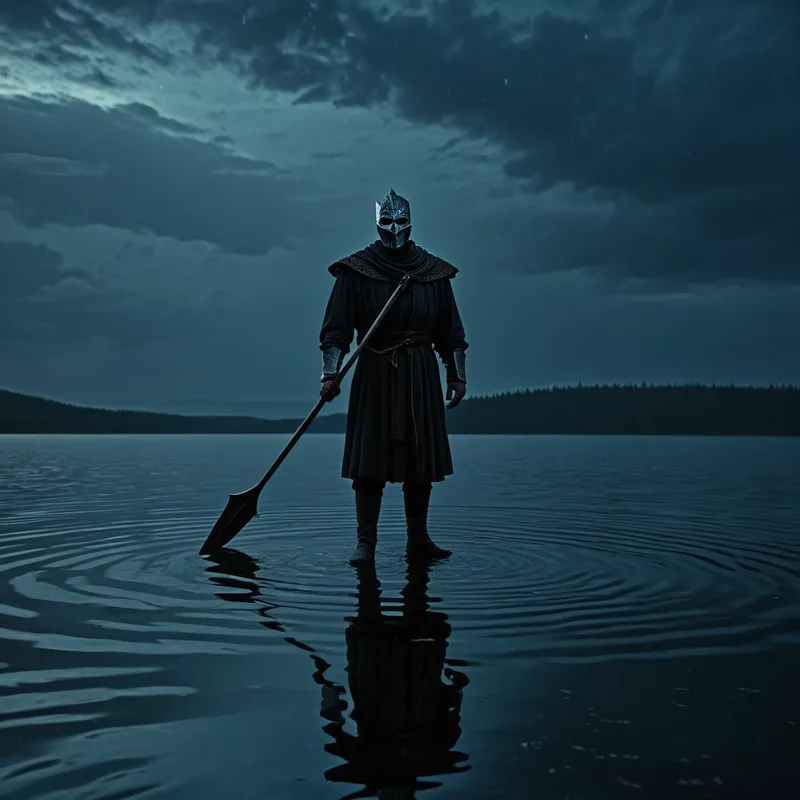
The poet offered his most prized possession: his crafted wisdom, his stored verses. The cauldron remained dark. He offered his strength, his sight, his years. Still, darkness. Then, understanding dawned like a cold sunrise. He must offer not what he had, but what he was. He must offer his very form, his certainty, his defined self. Taking the cold iron spear—the symbol of his focused will and piercing intellect—he did not turn it outward, but inward, towards the reflection of his own soul in the black waters of the cavern pool.
He cast the spear into the water, shattering his own image. In that moment of symbolic death, the guardians stirred. One approached, not with a weapon, but with the empty cauldron. From the shattered pool, she scooped not water, but a single, dark, bitter drop—the essence of his sacrifice, his broken ego. She let it fall into the cauldron.
And it began to boil.
Not with heat, but with a cold, seething light. Vapors, luminous and intoxicating, rose from the void within. The guardians gestured. The poet, now hollowed out, now a vessel himself, leaned over the rim. He did not drink with his mouth, but inhaled the vapor. It filled him—a fire that froze, a light that blinded into vision. The bitter drop of his sacrifice, transformed in the alchemy of the cauldron, became the sweet, terrible, and boundless gift of imbas. He did not gain more knowledge; he became a conduit for the voice of the world itself. He staggered from the cave, reborn, his old self dead, his new tongue speaking truths he did not know he knew. The cauldron, behind him, was empty once more, waiting for the next worthy soul to pay the price.
Cultural Origins & Context
This mythic pattern, most famously preserved in the Welsh tale of Gwion Bach and the Cerridwen’s cauldron, and echoed in the Irish traditions of the Coire Ansic and the Coire Fhornais, was not mere entertainment. It was the sacred technology of the filid and bards. These stories were the maps of their own initiation.
The cauldron myth served a critical societal function: it encoded the process of legitimate inspiration. In an oral culture where poetry was law, history, magic, and social glue, the source of the poet’s authority had to be transcendent. It could not come from mere talent or study; it had to be won from the divine, often from the chthonic, feminine powers of the land and the unconscious (represented by the guardian goddesses). The myth validated the poet’s role as a mediator between the human community and the chaotic, creative forces of the Otherworld. It said that true speech requires a prior, profound silence—a sacrifice of the personal to the transpersonal.
Symbolic Architecture
The Cauldron of Inspiration is the ultimate symbol of the transformative vessel. It is not a tool, but a womb and a tomb. Its emptiness is its potential; it must be filled by the seeker’s own essence.
The cauldron does not contain inspiration; it is the alchemical crucible where the base lead of personal experience is transmuted into the gold of universal truth.
The Guardian Goddesses represent the autonomous, often fearsome, aspects of the unconscious psyche that hoard creative potential. They are the resistant material of life, trauma, shadow, and raw instinct that seems hostile to conscious intention. They are not evil, but rigorous. They demand a right relationship.
The Spear Cast Into the Water is the pivotal act of ego-sacrifice. The spear—direction, will, penetration—is the hero’s defining tool. To cast it away, or to turn it upon one’s own reflected self-image, symbolizes the surrender of conscious control, the breaking of the persona. The water is the unconscious; to shatter one’s reflection upon it is to offer one’s known identity back to the source from which it came.
The Bitter Drop is the distilled essence of that sacrifice: the pain of limitation, the taste of failure, the acknowledgment of one’s own smallness and mortality. This is the prima materia, the worthless thing that alone can begin the great work.
The Inhaled Vapor represents inspired knowledge that is not “learned” but incorporated. It bypasses the intellect to saturate the entire being. This is imbas: a wisdom that shines forth because the vessel has been made empty, then sanctified by a sacred ordeal.
The Dreamer’s Resonance
When this myth stirs in modern dreams, it signals a profound psychic process underway. To dream of a cauldron—whether a kitchen pot boiling over, a ceremonial vessel, or a vast, landscape-sized bowl—is to dream of a containing process at the limits of one’s capacity.
The somatic experience is often one of pressure, heat, or chaotic churning in the gut or chest. Psychologically, the dreamer is in a state of “cooking.” Raw, undigested life material—a grief, a creative block, a period of intense stress or change—is being subjected to a slow, transformative fire within the psyche’s own vessel. Dreams of guardians (stern figures, locked doors, impassable terrain) reflect the inner resistance to this process, the part of us that fears the dissolution required for renewal.
Dreams of being forced to drink a bitter brew or of finding a precious drop in a vast emptiness speak directly to the myth’s core transaction. The dream-ego is being presented with the necessary, unpalatable truth or feeling it must “ingest” and transform to move forward. The myth manifests in dreams not as a literal story, but as the felt pattern of creative or spiritual crisis: containment, sacrifice, and breakthrough.

Alchemical Translation
For the modern individual, the path of the cauldron is the archetypal journey of the individuation. It models how we turn the lead of our suffering, confusion, and mundane experience into the gold of meaning, purpose, and authentic expression.
The first stage is Containment. We must find or create a vessel—therapy, meditation, journaling, a trusted relationship, an artistic practice—that can hold the chaotic contents of our psyche without spilling over or shattering. This is the establishment of the temenos, the sacred space for the work.
The second is Sacrifice of the Ego. This is the most difficult phase, mirrored by the casting of the spear. It involves surrendering our cherished self-image, our “shoulds,” our defensive narratives. It is allowing our old identity to be broken by the truth of what we feel. We must offer up our “bitter drop”—the humiliation, the loss, the envy, the rage we wish to disown.
The cauldron’s magic is that it does not reject the bitter drop, but requires it. The poison, consciously held and submitted, becomes the precise medicine.
The third is Transmutation. This occurs in the dark, without conscious effort. It is the mysterious work of the Self. Our contained sacrifice, held in the vessel of attention, slowly changes state. Grief becomes compassion. Rage becomes boundaried strength. Confusion becomes the recognition of a deeper pattern.
The final stage is Inspiration. This is not euphoria, but a sober, grounded clarity. The vapor that rises is insight—not an answer from outside, but the emergent property of the completed inner process. We “speak” from a new place, not from the ego’s opinion, but from the integrated wisdom of the whole psyche. We become, for a time, a clear vessel through which life, in its complexity, can express itself. And then the cycle begins again, for the cauldron is ever-empty, ever-ready, calling us to deeper and deeper layers of the work of becoming whole.
Associated Symbols
Explore related symbols from the CaleaDream lexicon: