
The Castle of Maidens Myth Meaning & Symbolism
A knight journeys to a castle where maidens are held captive, confronting a shadowy guardian to restore balance and freedom.
The Tale of The Castle of Maidens
Hear now a tale not of Camelot’s bright court, but of a place hidden in [the world](/myths/the-world “Myth from Tarot culture.”/)’s deep sigh, where the land’s heart beats slow and secrets lie thick as the forest moss. It is the tale of the Castle of Maidens.
In the wild marches beyond Logres, where the paths forget themselves and the sun filters through leaves like green-gold coins, there stood a castle. It was fair to behold—towers of pale stone piercing [the sky](/myths/the-sky “Myth from Persian culture.”/), banners of no known house hanging limp in the still air. Yet a silence clung to it, a silence that was not peace, but a held breath. For within its high walls and echoing halls were held captive sixty fair maidens, or so the whispers said. They were not prisoners of iron chains, but of a deeper, more terrible magic: a wasting enchantment that leeched the joy from their eyes and the song from their throats. Each year, the tale went, the Knight of the Black Axe would come, and the most beautiful among them would be taken, never to be seen again. The castle was a beautiful tomb, its gardens untended, its music stilled.
Into this haunted quiet rode a knight. Perhaps it was Sir Percivale, his heart still tender from [the grail](/myths/the-grail “Myth from Arthurian culture.”/)’s near-miss. Or perhaps it was [Sir Galahad](/myths/sir-galahad “Myth from Arthurian culture.”/), drawn by a light visible only to the pure. He felt the wrongness in the air—the scent of flowers undercut by the tang of fear. From a high window, a pale face looked down, eyes wide with a hope too long deferred.
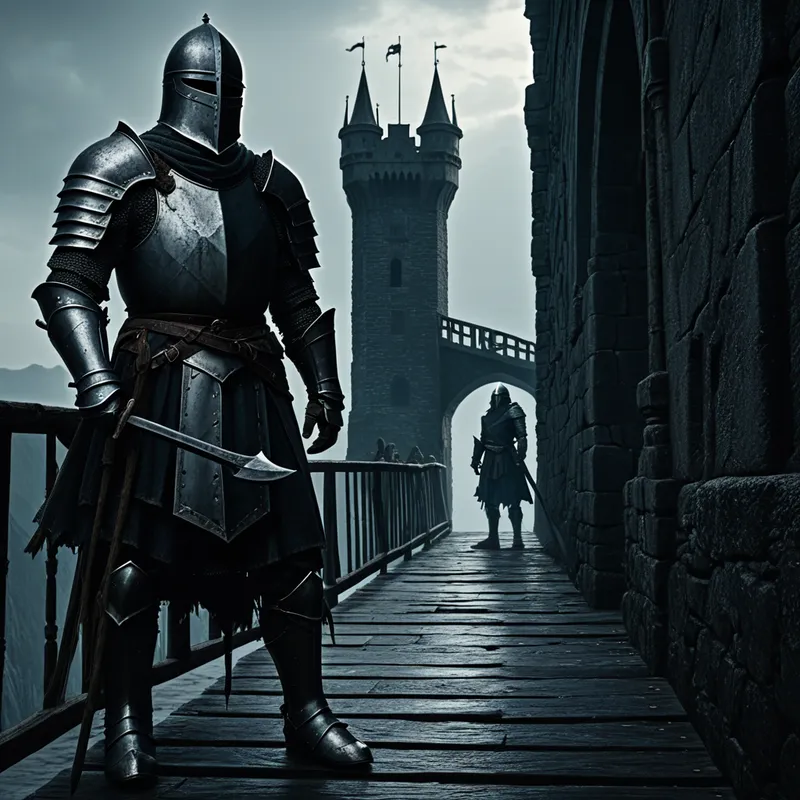
The guardian was no ordinary foe. He emerged from the castle gate like a piece of the coming night given form. His armor was black and scored, his visor down. In his hands he bore a great axe, its edge seeming to drink the light. No words were exchanged; only the challenge of his presence, blocking the narrow bridge that was the only way across the churning, dark waters of the moat. The fight was not a glorious tournament clash, but a desperate, grinding struggle. The knight fought not for glory, but for the sigh he had heard on [the wind](/myths/the-wind “Myth from Various culture.”/), for the faces at the window. Blow after blow rang out, until finally, with a cry that was part anguish and part [triumph](/myths/triumph “Myth from Roman culture.”/), the knight landed a stroke that sent the Black Axe tumbling from numb hands and the dark guardian crashing to the stones.
As the fallen knight lay still, a change swept through the castle like a sudden, clean wind. The oppressive silence shattered. The gates, which had groaned shut for years, swung open of their own accord. And from within came the maidens, not as wraiths, but as women restored, their steps light, their laughter like the ringing of silver bells. The enchantment was broken. [The shadow](/myths/the-shadow “Myth from Jungian culture.”/) that had fed on their captivity was dispelled. The knight stood amidst their gratitude, the taste of iron and victory in his mouth, watching as the castle of sighs became, once more, a place where life could dwell. He had not won a treasure, but had returned one to the world.
Cultural Origins & Context
The Castle of Maidens is not a single, fixed story from a specific text, but a potent narrative motif that weaves through the vast tapestry of Arthurian romance. It appears in various forms in the works of Chrétien de Troyes, in the sprawling Vulgate Cycle, and in Sir [Thomas](/myths/thomas “Myth from Christian culture.”/) Malory’s seminal Le Morte d’Arthur. This very fluidity speaks to its archetypal power; it was a story-shape that bards and writers instinctively returned to, adapting it to frame the virtues of different knights.
In the feudal, chivalric world that produced these tales, the motif served a clear social function: it was the ultimate validation of the knightly ideal. The knight errant existed to protect the vulnerable, and what greater vulnerability could there be than the captivity of innocent maidens, the very symbols of purity, future, and social continuity? Their rescue reaffirmed the cosmic and social order. Furthermore, the castle itself, a place of order and civilization turned to a prison, represented a profound perversion of the ideal court. By liberating it, the knight-hero didn’t just save individuals; he healed a piece of the realm itself, restoring a pocket of chaos back to its rightful state of harmonious rule.
Symbolic Architecture
Beneath its chivalric surface, the myth constructs a profound map of the [psyche](/myths/psyche “Myth from Greek culture.”/). The Castle is not merely a building; it is the Self in a state of [fragmentation](/symbols/fragmentation “Symbol: The experience of breaking apart, losing cohesion, or being separated into pieces. Often represents disintegration of self, relationships, or reality.”/) and siege. The captive maidens represent vital, living aspects of the [soul](/symbols/soul “Symbol: The soul represents the essence of a person, encompassing their spirit, identity, and connection to the universe.”/)—creativity, [intuition](/symbols/intuition “Symbol: The immediate, non-rational understanding of truth or insight, often described as a ‘gut feeling’ or inner knowing that bypasses conscious reasoning.”/), [emotion](/symbols/emotion “Symbol: Emotion symbolizes our inner feelings and responses to experiences, often guiding our actions and choices.”/), spontaneity, the [anima](/symbols/anima “Symbol: The feminine archetype within the male unconscious, representing soul, creativity, and connection to the inner world.”/) in its plural, potential form—that have been walled off from conscious [life](/symbols/life “Symbol: The symbol of ‘Life’ represents a journey of growth, interconnectedness, and existential meaning, encompassing both the joys and challenges that define human experience.”/).
The captive maiden is the soul’s potential, waiting not for a savior, but for recognition.
The [Knight](/symbols/knight “Symbol: The knight symbolizes honor, chivalry, and the pursuit of noble causes, reflecting the ideal of the noble warrior.”/) of the Black Axe is the shadowy [guardian](/symbols/guardian “Symbol: A protector figure representing safety, authority, and guidance, often embodying parental, societal, or spiritual oversight.”/) of this psychic [prison](/symbols/prison “Symbol: Prison in dreams typically represents feelings of restriction, confinement, or a lack of freedom in one’s life or mind.”/). He is not a mere [villain](/symbols/villain “Symbol: A character representing opposition, moral corruption, or suppressed aspects of self, often embodying fears, conflicts, or societal threats.”/), but the personification of a tyrannical, rigid [aspect](/symbols/aspect “Symbol: A distinct feature, quality, or perspective of something, often representing a partial view of a larger whole.”/) of [consciousness](/symbols/consciousness “Symbol: Consciousness represents the state of awareness and perception, encompassing thoughts, feelings, and experiences.”/)—perhaps hyper-rationality, frozen [trauma](/symbols/trauma “Symbol: A deeply distressing or disturbing experience that overwhelms the psyche, often manifesting in dreams as unresolved emotional wounds or psychological injury.”/), or a crushing inner critic—that believes it “protects” by isolating and controlling. His black axe symbolizes the brutal, cleaving force that severs [connection](/symbols/connection “Symbol: Connection symbolizes relationships, communication, and bonds among individuals.”/) and denies [integration](/symbols/integration “Symbol: The process of unifying disparate parts of the self or experience into a cohesive whole, often representing psychological wholeness or resolution of internal conflict.”/). The [knight](/symbols/knight “Symbol: The knight symbolizes honor, chivalry, and the pursuit of noble causes, reflecting the ideal of the noble warrior.”/)-errant, therefore, is not an external [hero](/symbols/hero “Symbol: A hero embodies strength, courage, and the ability to overcome significant challenges.”/) but the emerging conscious ego, compelled by a sense of inner lack (the [prima materia](/myths/prima-materia “Myth from Alchemical culture.”/) of the [quest](/symbols/quest “Symbol: A quest symbolizes a journey or search for purpose, fulfillment, or knowledge, often representing life’s challenges and adventures.”/)) to confront this internal tyrant. The battle on the bridge is the critical inner conflict where old, defensive structures must be challenged and overthrown for new life to flow.

The Dreamer’s Resonance
When this myth stirs in the modern dreamscape, it signals a powerful process of reclamation in the dreamer’s psyche. To dream of a beautiful yet oppressive castle, mansion, or institution is to encounter the “Castle of Maidens” complex. The somatic experience is often one of weight, constriction in the chest, or a feeling of being watched in a place that should be safe.
Psychologically, this dream pattern emerges when aspects of [the self](/myths/the-self “Myth from Jungian culture.”/) have been held captive—by outdated life scripts, by professional identities that stifle creativity, by relational patterns that forbid certain emotions. The maidens may appear as forgotten childhood passions, neglected talents, or suppressed feelings (especially those culturally coded as “feminine”: vulnerability, receptivity, nurturing). The dream is a report from the unconscious: a vital part of the inner community is suffering, and its liberation is necessary for wholeness. The dream may not show the rescue, but the haunting image of the castle itself is the call to adventure.
Alchemical Translation
The myth of the Castle of Maidens is a perfect allegory for the Jungian process of individuation, framed as an alchemical operation. The initial state is one of [separatio](/myths/separatio “Myth from Alchemical culture.”/): the soul’s qualities are fragmented and imprisoned. The knight’s journey is the [nigredo](/myths/nigredo “Myth from Alchemical culture.”/), [the dark night of the soul](/myths/the-dark-night-of-the-soul “Myth from Christian Mysticism culture.”/), where one must traverse the wild forest of the unconscious (confusion, depression) to reach the site of the problem.
The confrontation with the Black Axe is the crucial mortificatio or [putrefactio](/myths/putrefactio “Myth from Alchemical culture.”/)—the death of the old, rigid attitude that has ruled the inner castle. This is not a destruction of the self, but of the pathological complex governing it.
Liberation is not the absence of a guardian, but the transformation of guardianship from tyranny into stewardship.
With the tyrant’s fall, the process of [solutio](/myths/solutio “Myth from Alchemical culture.”/) begins: the frozen, captive energies (the maidens) are released, flowing back into the personality. The castle, the structure of the self, is not destroyed but purified and repopulated. This is the albedo, the whitening, where what was dark and leaden becomes luminous. The integrated self is not a solitary king, but a vibrant court where all aspects—the warrior, the maiden, the sage—coexist in harmony. The knight completes his quest not by leaving with a prize, but by enabling the castle to function as it was meant to: as a vessel for life, a true and integrated Self.
Associated Symbols
Explore related symbols from the CaleaDream lexicon: