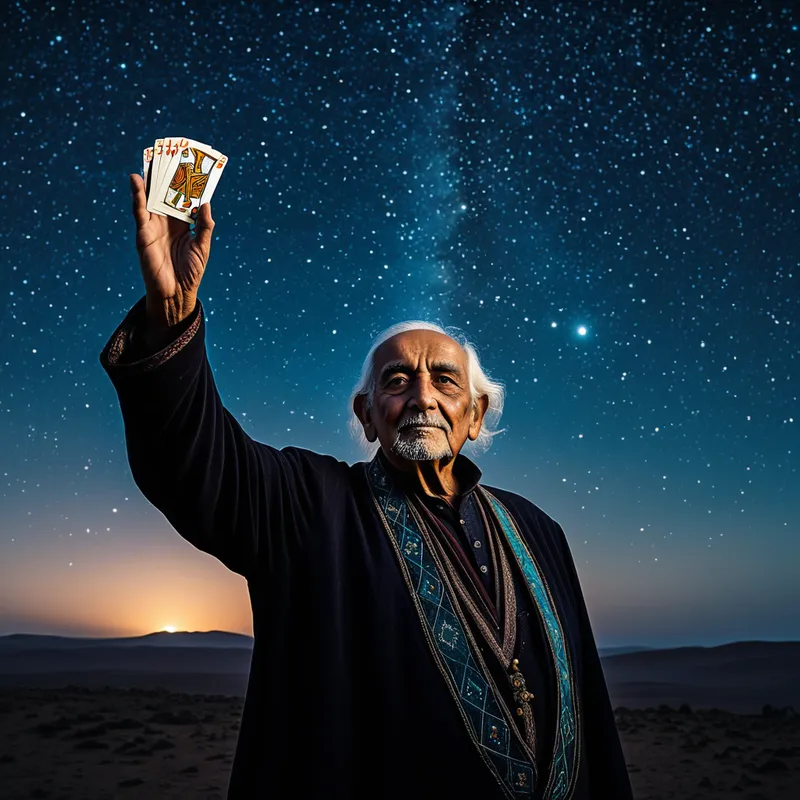
The Cards Myth Meaning & Symbolism
A myth of the first Romani, who traded his memories for a deck of cards that holds the fate of all who wander.
The Tale of The Cards
Listen, and I will tell you of the time before the roads were many, when [the world](/myths/the-world “Myth from Tarot culture.”/) was a vast and silent place, and the first of our people walked it alone.
His name is lost, as all true names are, but we know his nature. He was the first to feel the ache in the feet that begs for movement, the first whose eyes grew weary of a single horizon. He wandered, a solitary soul between the rooted kingdoms of [the earth](/myths/the-earth “Myth from Hindu culture.”/), belonging to none. He carried with him only the weight of his memories: the scent of his mother’s hair, the warmth of a hearth he built with his own hands, the sound of a lover’s laugh now silenced by distance. These treasures were his world, and their weight was [the anchor](/myths/the-anchor “Myth from Christian culture.”/) that both sustained and burdened him.
One evening, as the sun bled into the hills, he came to a place that was no place—a crossroads where the shadows of four paths bled into one another. There, seated on a stone that seemed both ancient and newly formed, was a figure. Some say it was an old woman with eyes like smoked glass. Others whisper it was a traveler even older than time, with no face at all. This being held nothing in its hands, yet its fingers moved as if shuffling an invisible deck.
“You carry a heavy load, wanderer,” the figure said, its voice the sound of wind through dry reeds.
“I carry my life,” the man replied, his hand unconsciously touching his heart.
“A life is a story. Too many stories, and a man cannot move. Too few, and he is not a man at all. I offer an exchange. Give me the substance of your memories—their taste, their touch, their color. I will take their weight. In return, I will give you a tool to hold their essence, a map to see their patterns.”
[The wanderer](/myths/the-wanderer “Myth from Taoist culture.”/) felt a terror colder than winter. To give up the feel of a beloved’s hand? The true sound of a lost song? It was a kind of death. But he looked at the endless road ahead, felt the crushing loneliness of his unshared past, and a desperate hope kindled. “What tool? What map?”
From the empty air, the figure produced a packet of stiff, blank leaves. “These are not yet The Cards. They are possibilities. For every memory you surrender, a card will be born. It will not hold the pain of the loss, nor the sweetness that aches. It will hold the truth of it. The pattern. And with these patterns, you may see the patterns of others. You may speak of what might be, for you have lived what was.”
A great stillness fell. The wanderer, tears cutting paths through the dust on his cheeks, began. He reached into his mind and pulled forth the memory of his first home—the clay walls, the thatched roof. As he offered it, it condensed in his palm like a drop of molten silver, then vanished. Upon the top blank leaf, an image bloomed: a sturdy tower. Next, the memory of his love. The agony of parting became a shimmering thread he severed. On the next leaf appeared the figures of a man and a woman, forever turned from one another. So it went, through the long night. His childhood joy became a sun. A betrayal became a sword. A journey became a wheel.
By dawn, the packet was a thick deck of vivid, whispering cards. The figure was gone. The wanderer stood, feeling terrifyingly light, hollowed out. He could not recall the melody of his mother’s lullaby, but when he looked at the card with [the star](/myths/the-star “Myth from Tarot culture.”/), he knew its meaning: hope in darkness. He could not feel his lover’s kiss, but the card of the lovers spoke of union and choice.
He returned to his people, who saw the emptiness in his eyes and the powerful deck in his hands. He could not tell them stories of his past, but he could lay out the cards and tell the story of their lives. He saw the patterns of their joys and sorrows reflected in the symbols born from his own sacrifice. He became the first to read the fate in the shuffle, the first to see that every life is a story told with the same symbols, rearranged. And so, the wandering did not end; it became the condition. The memories were gone, but their architecture remained, a gift and a curse for all who would follow the road: the price of seeing clearly is the loss of holding dearly.
Cultural Origins & Context
The myth of The Cards exists in the oral traditions of various Romani groups across Europe. It is not a singular, canonical text but a resonant narrative pattern, told around caravan fires and during family gatherings, often by elders to younger members learning the art of drabaripé (fortune telling). Its primary tellers were traditionally the phuri daj (old mothers) and respected card readers.
Its societal function is multifaceted. Firstly, it is an etiological myth, explaining the sacred origin of cartomancy within Romani culture, framing it not as a mere trick but as a profound, painful legacy. Secondly, it serves as a foundational narrative for a people historically defined by movement and diaspora. The myth validates the “orphan” state—the feeling of being unmoored from a fixed past or homeland—and transforms it into a source of power and insight. The wanderer’s sacrifice mirrors the collective experience of cultural memory loss through persecution and migration, while the cards become the portable, symbolic repository of that identity. The story teaches that wisdom comes not from possessing roots, but from understanding the patterns of the road itself.
Symbolic Architecture
At its [heart](/symbols/heart “Symbol: The heart symbolizes love, emotion, and the core of one’s existence, representing deep connections with others and self.”/), the myth is about the [alchemy](/symbols/alchemy “Symbol: A transformative process of purification and creation, often symbolizing personal or spiritual evolution through difficult stages.”/) of [memory](/symbols/memory “Symbol: Memory symbolizes the past, lessons learned, and the narratives we construct about our identities.”/) into meaning. The wanderer’s personal, somatic memories—the “heavy load”—represent the literal, historical self. They are concrete but paralyzing. The Cards represent the symbolic, archetypal self. They are abstract but liberating.
The individual must die to his personal history so that the universal pattern within it may be born.
The central sacrifice is thus a profound psychological [operation](/symbols/operation “Symbol: An operation signifies a process of change or transformation that often requires deliberate effort and planning.”/): the [dissolution](/symbols/dissolution “Symbol: The process of breaking down, dispersing, or losing form, often representing transformation, release, or the end of a state of being.”/) of the complex (the charged, personal memory) into the [archetype](/symbols/archetype “Symbol: A universal, primordial pattern or prototype in the collective unconscious that shapes human experience, behavior, and creative expression.”/) (the neutral, universal [symbol](/symbols/symbol “Symbol: A symbol can represent an idea, concept, or belief, serving as a powerful tool for communication and understanding.”/)). The [Tower](/symbols/tower “Symbol: The tower symbolizes protection, aspirations, and isolation, representing both stability and the longing for higher achievement.”/) is not his lost home; it is the archetype of sudden downfall and [revelation](/symbols/revelation “Symbol: A sudden, profound disclosure of truth or insight, often through artistic or musical means, that transforms understanding.”/). The Lovers are not his lost union; they are the [archetype](/symbols/archetype “Symbol: A universal, primordial pattern or prototype in the collective unconscious that shapes human experience, behavior, and creative expression.”/) of [relationship](/symbols/relationship “Symbol: A representation of connections we have with others in our lives, often reflecting our emotional state.”/) and [choice](/symbols/choice “Symbol: The concept of choice often embodies decision-making, freedom, and the multitude of paths available in life.”/). The wanderer exchanges attachment for [insight](/symbols/insight “Symbol: A sudden, deep understanding of a complex situation or truth, often arriving unexpectedly and illuminating hidden connections.”/), sentiment for signification. He becomes the first [psychopomp](/myths/psychopomp “Myth from Greek culture.”/), guiding others by reading the archetypal patterns that underlie their personal struggles.
The [crossroads](/symbols/crossroads “Symbol: A powerful spiritual symbol representing a critical decision point where paths diverge, often associated with fate, transformation, and life-altering choices.”/) setting is the classic symbol of [fate](/symbols/fate “Symbol: Fate represents the belief in predetermined outcomes, suggesting that some aspects of life are beyond human control.”/) and [decision](/symbols/decision “Symbol: A decision in a dream reflects the choices one faces in waking life and can symbolize the pursuit of clarity and resolution.”/). The faceless figure is the [trickster](/symbols/trickster “Symbol: A boundary-crossing archetype representing chaos, transformation, and the subversion of norms through cunning and humor.”/)-guide of the unconscious, offering a brutal, transformative bargain. The resulting [emptiness](/symbols/emptiness “Symbol: Emptiness signifies a profound sense of void or lack in one’s life, often related to existential fears, loss, or spiritual quest.”/) in the wanderer is not nihilistic; it is the [tabula rasa](/myths/tabula-rasa “Myth from Alchemical culture.”/) necessary for true objectivity, the hollow [reed](/symbols/reed “Symbol: A flexible plant symbolizing resilience, adaptability, and vulnerability. It bends without breaking, representing survival through yielding.”/) through which [the wind](/myths/the-wind “Myth from Various culture.”/) of the [collective unconscious](/symbols/collective-unconscious “Symbol: The Collective Unconscious refers to the part of the unconscious mind shared among beings of the same species, embodying universal experiences and archetypes.”/) can sound.
The Dreamer’s Resonance
When this myth activates in the modern [psyche](/myths/psyche “Myth from Greek culture.”/), it often manifests in dreams of profound loss paired with unexpected gain. One might dream of their childhood home dissolving like sand, only to find a book of intricate, glowing symbols in its place. Or dream of emptying a suitcase filled with precious, fading photographs into a river, watching them turn into a school of shimmering fish that form constellations in the [water](/myths/water “Myth from Chinese culture.”/).
Somatically, this process can feel like a strange dissociation—a “lightness” that borders on grief. It is the psyche working to decouple identity from literal narrative. The dreamer is undergoing a necessary depersonalization. The emotional charge (the affect) is being drained from specific memories so that their underlying structure can be seen. This is often a prelude to a major life transition—a career change, the end of a relationship, a spiritual awakening—where one must stop defining oneself by “what happened to me” and start understanding oneself through “what pattern am I living?”
Alchemical Translation
The myth of The Cards is a perfect model for the Jungian process of individuation, specifically the stage of sacrificium, the sacred sacrifice. For the modern individual, the “wanderer” is [the ego](/myths/the-ego “Myth from Jungian culture.”/), burdened by its personal history—its traumas, triumphs, and fixed self-concepts.
The alchemical work is not to forget the past, but to incinerate its literal form in the inner fire, leaving behind only the pure salt of its meaning.
The “exchange” at [the crossroads](/myths/the-crossroads “Myth from Celtic culture.”/) is the critical moment in therapy or deep reflection when we stop reliving our stories and start interpreting them. We sacrifice the narrow, subjective truth (“My father abandoned me”) for the archetypal truth (engaging with the Father Wound). This is immensely painful, for it feels like losing the very evidence of our existence. Yet, it is only by giving up the content of our memory that we gain access to its context within the larger human drama.
The resulting “deck” is the newly formed symbolic life. The individual no longer reacts purely from personal hurt or pride but can respond from a place of pattern recognition. They see their own “Tower” moments not as unique catastrophes, but as part of a universal cycle of destruction and revelation. They hold their “Cup” of emotions not as a overflowing, personal vessel, but as one connected to the great sea of human feeling. They become, like the first wanderer, a reader of fate—not by predicting external events, but by deciphering the internal, archetypal script they are living. The wandering continues, but the path is no longer blind; it is illuminated by the symbols born from their own courageous sacrifice.
Associated Symbols
Explore related symbols from the CaleaDream lexicon: