The Cap of Hades Myth Meaning & Symbolism
The myth of the magical helmet that grants invisibility, used by heroes to navigate the underworld and confront hidden truths.
The Tale of The Cap of Hades
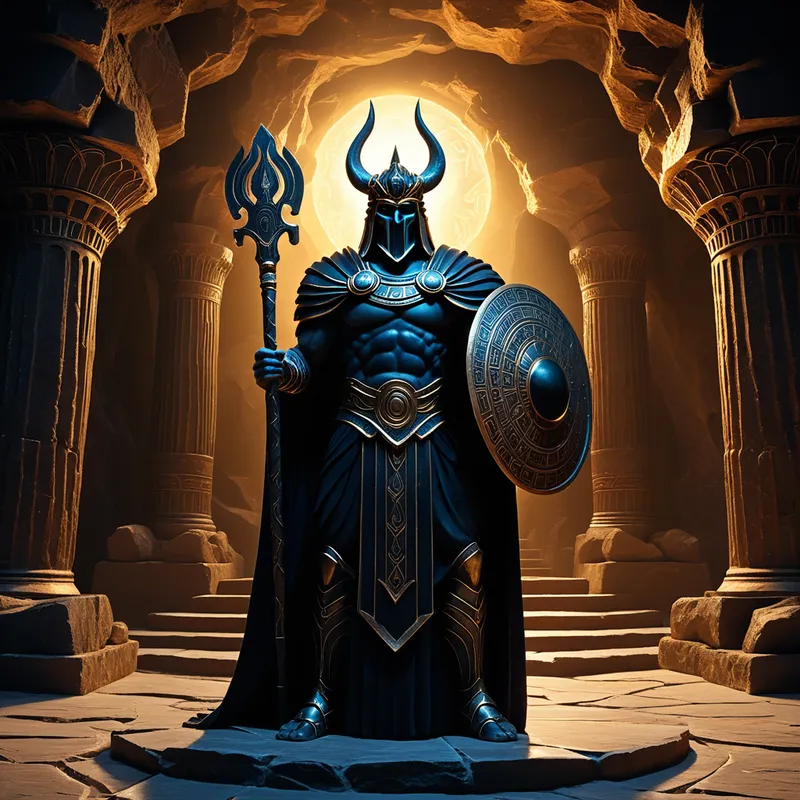
Listen, and hear a tale not of light, but of the profound dark from which all light is born. In the deep, echoing halls beneath [the world](/myths/the-world “Myth from Tarot culture.”/), where the rivers Cocytus and [Lethe](/myths/lethe “Myth from Greek culture.”/) whisper their cold songs, rules a king who sees all that is unseen. This is [Hades](/myths/hades “Myth from Greek culture.”/), lord of the departed, keeper of the fertile dark. His wealth is not gold that glitters, but the silent, teeming richness of the roots of things. And among his treasures, forged in the first smithies of the cosmos, is a wonder and a terror: the Cap of [Hades](/myths/hades “Myth from Greek culture.”/).
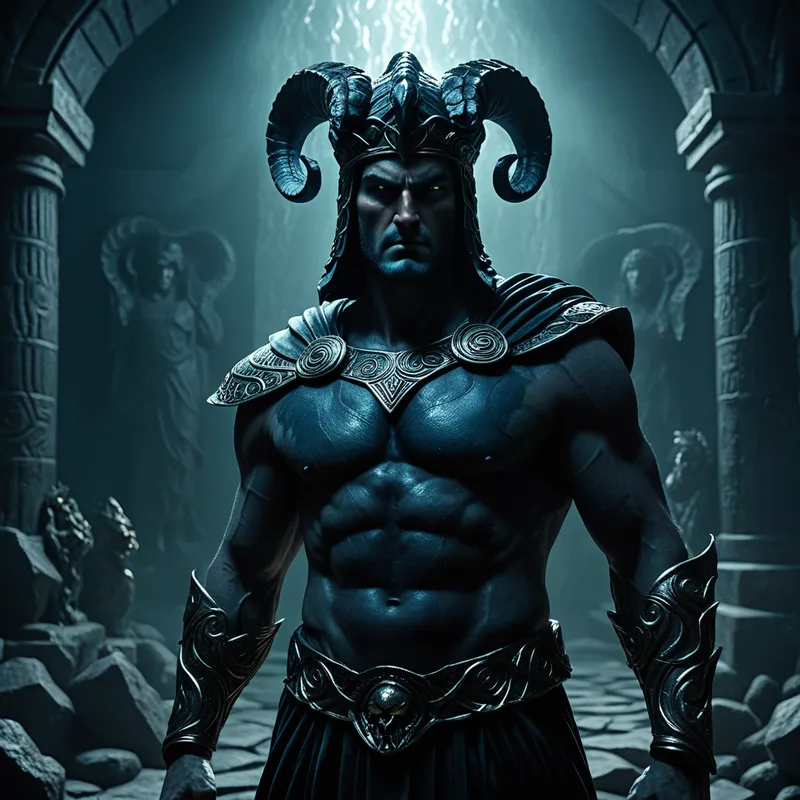
It is not a crown for display. It is a weapon of the unseen war. Fashioned of dark bronze and shadow-stuff, it does not shine. It drinks the light. To wear it is to become a vacancy, a breath in a silent room, a thought unspoken. It is the right of [the underworld](/myths/the-underworld “Myth from Greek culture.”/)’s king to move unseen among his silent subjects.
But the cap’s story is woven into the tales of those who walk in the sun. It was [Hermes](/myths/hermes “Myth from Global/Universal culture.”/), the quick-silver god, who first brought it into the tales of heroes. He knew the paths between worlds. When the maiden-goddess Artemis could not be found, it was [Hermes](/myths/hermes “Myth from Global/Universal culture.”/), shrouded in the cap’s darkness, who slipped into the deepest groves and found her. The cap was a tool for finding what was lost.
Its great saga, however, belongs to a son of Zeus, born of a tragic fate: [Perseus](/myths/perseus “Myth from Greek culture.”/). His quest was impossible—to bring back the head of the Gorgon [Medusa](/myths/medusa “Myth from Greek culture.”/). To even gaze upon her was death. He stood, a mortal, on [the threshold](/myths/the-threshold “Myth from Folklore culture.”/) of the world’s end, armed with a mirrored shield and a heart full of dread. His guides, the gods, did not give him a sword of lightning, but a map to the hidden. They sent him to the Graeae, crones who knew [the way](/myths/the-way “Myth from Taoist culture.”/). And from the [nymphs](/myths/nymphs “Myth from Greek culture.”/) of the west, he received the tools of the unseen war: winged sandals, a magical sack, and the dark, whispering Cap of Hades.
Imagine the moment. In the grey, petrified wastes where Medusa dwelt, surrounded by the stone statues of men and beasts, Perseus clasped the cold bronze to his brow. The world did not go black. Instead, he vanished from it. He became a secret, a silence moving through a landscape of perpetual scream. Using the reflection in his shield, he saw the monster. She, the once-beautiful cursed one, could not see him. He was a void where a hero should be. In that moment of absolute concealment, he struck. The deed was done not in a blaze of glory, but in the profound quiet of invisibility. The cap did not make him a warrior; it made him a ghost, an agent of an unseen [justice](/myths/justice “Myth from Tarot culture.”/). Later, he would use this same power of absence to escape the wrath of Medusa’s sisters, slipping through their clutching claws like mist.
And so the cap returned to the dark treasury, its power lent, not given. It waited. It was there when the cunning [Hephaestus](/myths/hephaestus “Myth from Global/Universal culture.”/) ensnared his wife Aphrodite and her lover Ares in a net of finest chains—a trap witnessed by the gods because [Hephaestus](/myths/hephaestus “Myth from Global/Universal culture.”/) had shrouded the scene in the cap’s invisibility, making private shame a public spectacle. Even the great Athena wore it in the thunderous chaos of the Trojan War, her divine form disappearing as she moved through the carnage to guide her favored heroes. The cap was the great equalizer, the gift of the depths that allowed gods and mortals alike to navigate the realms of danger, shame, and war by stepping outside the visible field of conflict.
Cultural Origins & Context
This myth finds its breath in the oral traditions of ancient Greece, passed down by bards and poets like [Homer](/myths/homer “Myth from Greek culture.”/) and Hesiod. It is not a standalone fable but a potent narrative device woven into larger epics. The Cap of Hades, or the Helm of Darkness, is what folklorists call a “magical donor object.” It originates not from the bright Olympus, but from the chthonic, earthy power of the [underworld](/myths/underworld “Myth from Greek culture.”/). This is critical. In the Greek worldview, Hades’ realm was not merely a place of punishment, but the ultimate source of fertility and wealth (from Plouton, another name for Hades, meaning “the rich one”). The cap, therefore, is a piece of underworld technology.
Its societal function was multifaceted. On one level, it explained and magnified the heroic deeds of figures like Perseus, providing a plausible (within the mythic logic) reason for surviving an impossible task. On a deeper level, it reinforced a cultural understanding of power. True power was not always brute force; it could be cunning, stealth, and the strategic use of concealment. The cap symbolized the advantage gained by understanding and utilizing the hidden aspects of reality—the unseen motives, the secret paths, the private shames. It was a narrative tool that allowed heroes to temporarily wield a god’s own power of occlusion, bridging the human and divine through an artifact of the ultimate “other” place.
Symbolic Architecture
The Cap of [Hades](/symbols/hades “Symbol: Greek god of the underworld, representing death, the unconscious, and hidden aspects of existence.”/) is one of mythology’s most profound symbols of the [psyche](/myths/psyche “Myth from Greek culture.”/). It does not represent mere hiding or cowardice. It represents the conscious, willful engagement with invisibility as a state of being and a mode of [perception](/symbols/perception “Symbol: The process of becoming aware of something through the senses. In dreams, it often represents how one interprets reality or internal states.”/).
To don the Cap of Hades is to step into the perspective of the unconscious itself—to see without being seen, to observe the raw patterns of life from a place of profound interiority.
First, it is the [Helm](/symbols/helm “Symbol: A helm represents leadership, control, and protection, often symbolizing authority, direction, and responsibility in navigating life’s challenges.”/) of the Unconscious. Hades is the [lord](/symbols/lord “Symbol: The symbol of ‘Lord’ represents authority, mastery, and control, along with associated power dynamics in relationships.”/) of all that is buried: memories, instincts, repressed desires, and the forgotten dead of our personal [history](/symbols/history “Symbol: History in dreams often represents the dreamer’s past experiences, lessons learned, or unresolved issues that continue to influence their present.”/). His cap grants access to this [realm](/symbols/realm “Symbol: The symbol of ‘Realm’ often signifies the boundaries of one’s consciousness, experiences, or emotional states, suggesting aspects of reality that are either explored or ignored.”/). In psychological terms, it is the [symbol](/symbols/symbol “Symbol: A symbol can represent an idea, concept, or belief, serving as a powerful tool for communication and understanding.”/) of introspection taken to its extreme. One becomes invisible to the outer world to become hyper-visible to the inner world. Perseus does not fight Medusa face-to-face; he uses a [reflection](/symbols/reflection “Symbol: Reflection signifies self-examination, awareness, and the search for truth within oneself.”/) and the power of concealment. This is the classic model of engaging the [shadow](/symbols/shadow “Symbol: The ‘shadow’ embodies the unconscious, repressed aspects of the self and often represents fears or hidden emotions.”/)—not through direct, ego-driven confrontation, but through indirect, symbolic means (the mirrored [shield](/symbols/shield “Symbol: A symbol of protection, defense, and boundaries, representing personal security, resilience, and the need to guard against external threats or emotional harm.”/)) while the conscious ego is temporarily suspended (invisibility).
Second, it is the [Cloak](/symbols/cloak “Symbol: A garment that conceals identity, protects from elements, or signifies authority and transformation in dreams.”/) of Neutral Observation. When Athena or Hermes uses it, they move through conflicts without being drawn into the partisan fray. The cap allows one to witness the dynamics of a [situation](/symbols/situation “Symbol: The ‘situation’ symbolizes the junction between the subconscious and conscious realms, often reflecting the current challenges or dynamics in the dreamer’s waking life.”/)—a war, a [betrayal](/symbols/betrayal “Symbol: A profound violation of trust in artistic or musical contexts, often representing broken creative partnerships or artistic integrity compromised.”/)—without the distorting filter of one’s own visible [presence](/symbols/presence “Symbol: Presence in dreams often signifies awareness or acknowledgment of something significant in one’s life.”/) and the reactions it provokes. It is the symbol of achieving psychological objectivity, of seeing the [system](/symbols/system “Symbol: A system represents structure, organization, and interrelated components functioning together, often reflecting personal or social order.”/) of which you are a part from a detached vantage point.
Finally, it is the Gift of [the Shadow](/myths/the-shadow “Myth from Jungian culture.”/) [King](/symbols/king “Symbol: A symbol of ultimate authority, leadership, and societal order, often representing the dreamer’s inner power or external control figures.”/). The power does not come from [the ego](/myths/the-ego “Myth from Jungian culture.”/) ([Olympus](/symbols/olympus “Symbol: In Greek mythology, Mount Olympus is the divine home of the gods, representing ultimate power, perfection, and spiritual transcendence.”/)) but from the deep, often feared, parts of [the self](/myths/the-self “Myth from Jungian culture.”/) (the [Underworld](/symbols/underworld “Symbol: A symbolic journey into the unconscious, representing exploration of hidden aspects of self, transformation, or confronting repressed material.”/)). Integrating our “Hades” [aspect](/symbols/aspect “Symbol: A distinct feature, quality, or perspective of something, often representing a partial view of a larger whole.”/)—our [capacity](/symbols/capacity “Symbol: A measure of one’s potential, limits, or ability to contain, process, or achieve something, often reflecting self-assessment or external demands.”/) for darkness, silence, and [depth](/symbols/depth “Symbol: Represents profound layers of consciousness, hidden truths, or the unknown aspects of existence, often symbolizing introspection and existential exploration.”/)—grants us this unique power. The cap suggests that our greatest strengths for navigating certain ordeals are not found in our social [persona](/symbols/persona “Symbol: The social mask or outward identity one presents to the world, often concealing the true self.”/), but in our [connection](/symbols/connection “Symbol: Connection symbolizes relationships, communication, and bonds among individuals.”/) to the [interior](/symbols/interior “Symbol: The interior symbolizes one’s inner self, thoughts, and emotions, often reflecting personal growth, vulnerabilities, and secrets.”/), chthonic realms of the psyche.
The Dreamer’s Resonance
When the motif of the Cap of Hades appears in modern dreams, it rarely manifests as a literal helmet. Instead, the dreamer experiences the state it confers. You may dream of walking through your workplace or a family gathering completely unnoticed, a silent witness to conversations and dramas. You might find a room in your house you never knew existed, a hidden chamber. Or you may possess an object—a ring, a cloak, a simple hood—that, when used, makes the world blur and people look through you.
These dreams signal a critical psychological process: the ego’s necessary withdrawal for the purpose of internal reconnaissance. The conscious, performing self is stepping back. This often occurs during periods of overwhelm, identity crisis, or deep introspection. The somatic feeling is one of cool detachment, of being a “ghost in the machine” of your own life.
The dream of invisibility asks: What part of you needs to retreat from the visible arena to observe, to listen, to gather intelligence from the depths? What conflict are you trying to navigate not by fighting, but by understanding from a hidden vantage?
It is not a dream of escape, but of strategic retreat. The anxiety in such dreams comes from the fear of being permanently unseen, of losing one’s social self. The gift is the realization that you have an inner sanctum, a place of profound privacy and power from which you can observe the patterns of your life without immediate interference.

Alchemical Translation
The myth of the Cap of Hades provides a precise model for a critical phase of individuation: the [nigredo](/myths/nigredo “Myth from Alchemical culture.”/), or blackening. This is the descent into the “underworld” of the psyche, where all certainties dissolve and the ego feels lost, invisible, and without form. The alchemical goal is not to escape this state but to master its conditions.
The modern individual undertaking this work must first Seek the Nymphs of the West—that is, find the guiding insights (therapy, meditation, art, nature) that provide the “tools” for the descent. These are the practices that grant the ability to move in the inner realms (winged sandals), to contain what is found (the magical sack), and to temporarily suspend identification with the [persona](/myths/persona “Myth from Greek culture.”/) (the cap).
Then, one must Don the Cap and Face [the Gorgon](/myths/the-gorgon “Myth from Various culture.”/). This is the heart of shadow work. Using reflection (journaling, dialogue, creative expression) instead of direct, moralizing confrontation, we observe our own “Medusa”—the petrifying fears, the shameful desires, the traumatic memories that have turned parts of our psyche to stone. We do this from a place of conscious invisibility, meaning we quiet the ego’s judgments and defenses to see the shadow clearly.
The alchemical secret is that the power to integrate the shadow comes from the shadow realm itself. By willingly entering the state of nigredo (invisibility, dissolution), we gain the precise tool needed to transform its contents.
Finally, the process involves Returning the Cap. The power of invisibility is a temporary, operational state. The goal of individuation is not to live as an unseen ghost, but to return to the community of the self and the world, integrated and whole, having used the underworld’s gift to perform a necessary task. The cap goes back to Hades, but the knowledge and the transformed self remain. We learn that sometimes, to become more fully visible and authentic, we must first master the courage to disappear—not out of fear, but as a deliberate, sacred strategy for reclaiming the hidden wealth of our own depths.
Associated Symbols
Explore related symbols from the CaleaDream lexicon: