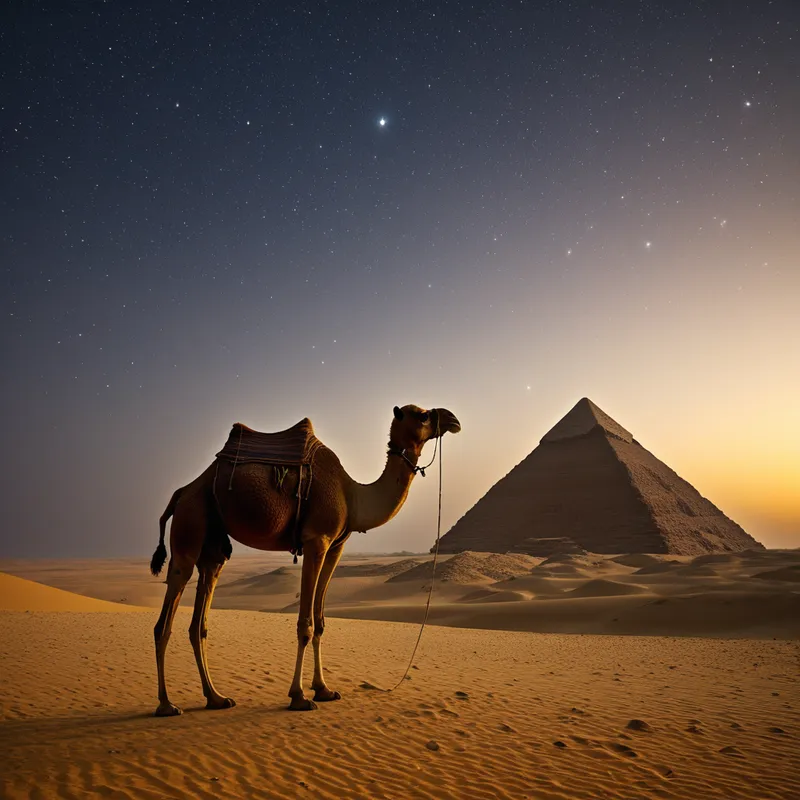
The Camel in Caravans Myth Meaning & Symbolism
A myth of a camel bearing the sun's weight, whose silent endurance and sacrifice forge the path for all journeys, embodying the soul's burden and purpose.
The Tale of The Camel in Caravans
Hear now, and let your spirit travel back to the time when [the world](/myths/the-world “Myth from Tarot culture.”/) was younger, and [the desert](/myths/the-desert “Myth from Biblical culture.”/) was the first and last truth. Before the great Ra sailed his barque across the dome of heaven, there was a stillness. The sands were unmarked, and the stars were silent witnesses to a great problem. The sun, that blazing heart of Nun, was too mighty, too searingly potent, to be borne aloft by [the sky](/myths/the-sky “Myth from Persian culture.”/) itself. The vault of Nut would crack; the spine of [the world](/myths/the-world “Myth from Tarot culture.”/) would break.
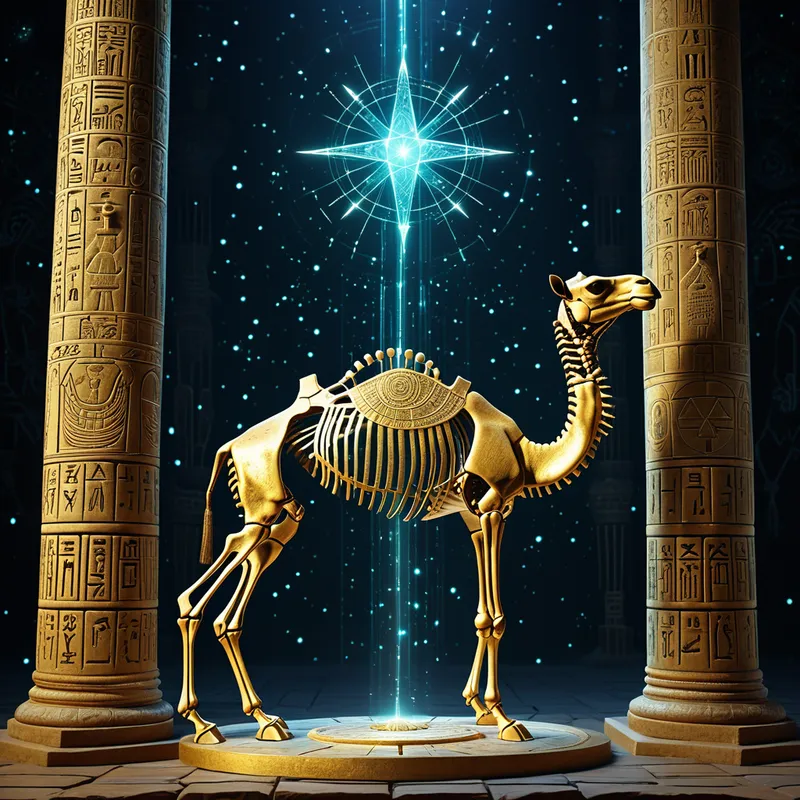
In the deep, silent places where the desert meets the memory of [water](/myths/water “Myth from Chinese culture.”/), a form stirred. It was not a god of glittering procession, but a spirit of the in-between. From the essence of endurance itself, from the patience of stone and the resilience of the acacia root, the gods fashioned a being. They called it the Great Camel. Its body was shaped from the red-gold of the eastern cliffs, its eyes held the deep, knowing darkness of a water-well, and its hump was not of fat, but of condensed, willing strength.
[Thoth](/myths/thoth “Myth from Global/Universal culture.”/) spoke the words of binding, and Isis wove a net of unseen power. Together, they lowered the nascent, pulsing sun—not yet the sovereign disk, but a molten, struggling heart of light—onto the back of the Great Camel. The air hissed. The sands at its feet turned to glass. The Camel did not cry out. It absorbed the searing weight into its very being, its golden hide smoking, its legs trembling but not buckling.
And so the first journey began. Not a journey from here to there, but the Journey that makes all journeys possible. The Great Camel took its first, monumental step. With each placement of its broad, splayed foot, the desert floor firmed. A path was not walked; it was born from the meeting of unbearable weight and unyielding earth. Its breath became [the wind](/myths/the-wind “Myth from Various culture.”/) that cools the night traveler; its falling sweat, the rare and precious dew. It walked the length of what would become the world, a living, suffering foundation for Ra’s voyage. It carved [the river](/myths/the-river “Myth from Buddhist culture.”/) of the sky with its plodding certainty.
As the first dawn approached, the weight began to change. The molten heart cooled and rose, lighter, becoming [the Solar Barque](/myths/the-solar-barque “Myth from Egyptian culture.”/). The Camel’s task was complete, but not without cost. As the sun lifted from its back for the first time, the Great Camel did not vanish. It dissolved into the fabric of the land. Its bones became the mountain ranges that guide the stars. Its spirit fractured into a thousand thousand echoes, entering every camel that would ever be born, every beast of burden that would ever lower its head to bear a load for others. It left behind the first caravan route, not as tracks in sand, but as a song of endurance sung into the stones, a silent pact between the bearer and the borne.
Cultural Origins & Context
This myth, while not recorded in the canonical texts like the Book of the Dead, lives in the oral tradition of the desert traders and caravan masters of ancient Egypt’s periphery. It is a myth of the liminal spaces—of the trade routes between Kush and the oases, where the camel was not merely a tool, but a partner in survival. Told around flickering fires under the vast, cold blanket of the desert night, it served a crucial societal function.
It was a narrative of justification and sanctification. The often brutal necessity of loading these animals with immense burdens was framed not as cruelty, but as participation in a primordial, sacred drama. The camel driver was not a master, but a priest of the journey, guiding a fragment of the divine bearer. The myth explained the camel’s legendary endurance and its seemingly preternatural ability to find paths in trackless waste—it was remembering its first, world-shaping walk. This story bonded human and animal in a shared, cosmic purpose, transforming a commercial caravan into a ritual re-enactment of the first dawn, ensuring the “sun” of their goods—and their lives—would safely cross the desert of chaos.
Symbolic Architecture
At its core, the myth presents a profound [archetype](/symbols/archetype “Symbol: A universal, primordial pattern or prototype in the collective unconscious that shapes human experience, behavior, and creative expression.”/) of foundational sacrifice. The [Camel](/symbols/camel “Symbol: A symbol of endurance, survival, and journey through harsh conditions, representing the ability to carry burdens across difficult terrain.”/) is the ultimate [prima materia](/myths/prima-materia “Myth from Alchemical culture.”/) of the [psyche](/myths/psyche “Myth from Greek culture.”/)—the raw, enduring substance that agrees to bear the unbearable so that [consciousness](/symbols/consciousness “Symbol: Consciousness represents the state of awareness and perception, encompassing thoughts, feelings, and experiences.”/) (Ra) may [dawn](/symbols/dawn “Symbol: The first light of day, symbolizing new beginnings, hope, and the transition from darkness to illumination.”/).
The soul’s first contract is not with glory, but with gravity. It agrees to be the ground so that the light may have something to shine upon.
The Camel represents the somatic and instinctual [body](/symbols/body “Symbol: The body in dreams often symbolizes the dreamer’s self-identity, personal health, and the relationship they have with their physical existence.”/) that carries the fiery, often oppressive, [weight](/symbols/weight “Symbol: Weight symbolizes burdens, responsibilities, and emotional loads one carries in life.”/) of the emerging Self. Its [journey](/symbols/journey “Symbol: A journey in dreams typically signifies adventure, growth, or a significant life transition.”/) is not toward a goal, but is the goal—the very act of bearing creates the [path](/symbols/path “Symbol: The ‘path’ symbolizes a journey, choices, and the direction one’s life is taking, often representing individual growth and exploration.”/) (Maat) where [none](/symbols/none “Symbol: The absence represented by ‘none’ can signify emptiness, potential, or a yearning for substance.”/) existed. The sun is not a [passenger](/symbols/passenger “Symbol: A passenger often represents dependence or a feeling of being guided by others in life’s journey.”/) but a process; the burning burden gradually transforms, through the Camel’s endurance, into something navigable and ordered. Psychologically, this symbolizes [the ego](/myths/the-ego “Myth from Jungian culture.”/)’s necessary burden: to contain and transport the brilliant, chaotic energies of the unconscious until they can be structured and released as conscious [identity](/symbols/identity “Symbol: Identity represents the sense of self, encompassing personal beliefs, cultural background, and social roles.”/) and [purpose](/symbols/purpose “Symbol: Purpose signifies direction, meaning, and intention in life, often reflecting personal ambitions and core values.”/).
The Dreamer’s Resonance
When this myth stirs in the modern dreamscape, it rarely appears as a literal camel. Instead, the dreamer becomes the Camel. They dream of carrying an immense, hot, crushing weight—a boulder, a dying star, a collapsing building—across an endless, arid landscape. The somatic feeling is one of profound, weary compression in the chest and shoulders, a literal bearing of the burden.
This dream pattern signals a critical phase of psychological endurance. The “sun” being carried is often a nascent life stage, a repressed talent, a grief, or a responsibility that feels too brilliant and too heavy to integrate. The desert is the felt experience of emotional and psychic aridity that accompanies such a load. The dream is not about finding a way to put the burden down, but about the transformative process of carrying it. The dreamer is in the middle of their primordial journey, forging the very path of their future character through present endurance. The tears of the Camel in the story manifest as a profound, wordless sadness or resilience in the dreamer’s waking life—a sense of being crucially necessary yet utterly alone in the task.
Alchemical Translation
The alchemical journey of individuation mirrors the Camel’s caravan precisely. It begins with the [nigredo](/myths/nigredo “Myth from Alchemical culture.”/), the blackening: the acceptance of the crushing, solar weight of one’s own totality, the heat of unexpressed potential or unresolved shadow.
The crucible is not the fire, but the back that chooses to stand under it. Transmutation occurs in the space between the burden and the bearing.
The Camel’s silent, plodding journey is the albedo, the whitening—the long, patient, often monotonous work of integration. Each step is a sublimation, where the base instinct (the beast of burden) slowly spiritualizes the chaotic material (the molten sun). The moment the sun lifts as the Barque is the [rubedo](/myths/rubedo “Myth from Alchemical culture.”/), the reddening or dawn of the conscious, autonomous Self. The Camel’s dissolution is key; the ego-structure that bore the burden does not become the king. It sacrificially transforms into the supporting world—the integrated psyche’s stable landscape of memory, habit, and resilience.
For the modern individual, the myth instructs that the path to self-realization is not seized through heroic conquest, but grown through humble, steadfast carrying. Our most daunting burdens—of trauma, expectation, or calling—are not obstacles to our journey. They are the sacred weights that, borne with conscious endurance, alone have the power to create the path beneath our feet and eventually become the light that guides us. We are, each of us, both the Camel forging [the way](/myths/the-way “Myth from Taoist culture.”/) and the Ra being carried toward the dawn.
Associated Symbols
Explore related symbols from the CaleaDream lexicon: