
The Cailleach Myth Meaning & Symbolism
The ancient Celtic goddess of winter, stone, and sovereignty, a primordial force of creation, destruction, and the deep, dreaming earth.
The Tale of The Cailleach
Listen, and let [the wind](/myths/the-wind “Myth from Various culture.”/) carry you back to a time before time was measured. [The world](/myths/the-world “Myth from Tarot culture.”/) was raw, a canvas of rock and rain. In the north, where [the sea](/myths/the-sea “Myth from Greek culture.”/) gnaws at the land and the mountains are the bones of giants, she walked. They called her The Cailleach.
Her breath was the first frost, her footsteps the settling of mountains. She was ancient when the first oak was an acorn. With a staff of blackthorn, she would stride across the land, and where she struck [the earth](/myths/the-earth “Myth from Hindu culture.”/), lochs formed in the hollows. She would gather her apron, woven from the shadows of clouds, and from it she would scatter boulders, building the cairns and peaks that scratch the belly of [the sky](/myths/the-sky “Myth from Persian culture.”/). The red deer were her cattle, the wolf her companion. She was the sculptor of the land itself, a force of terrible, deliberate creation.
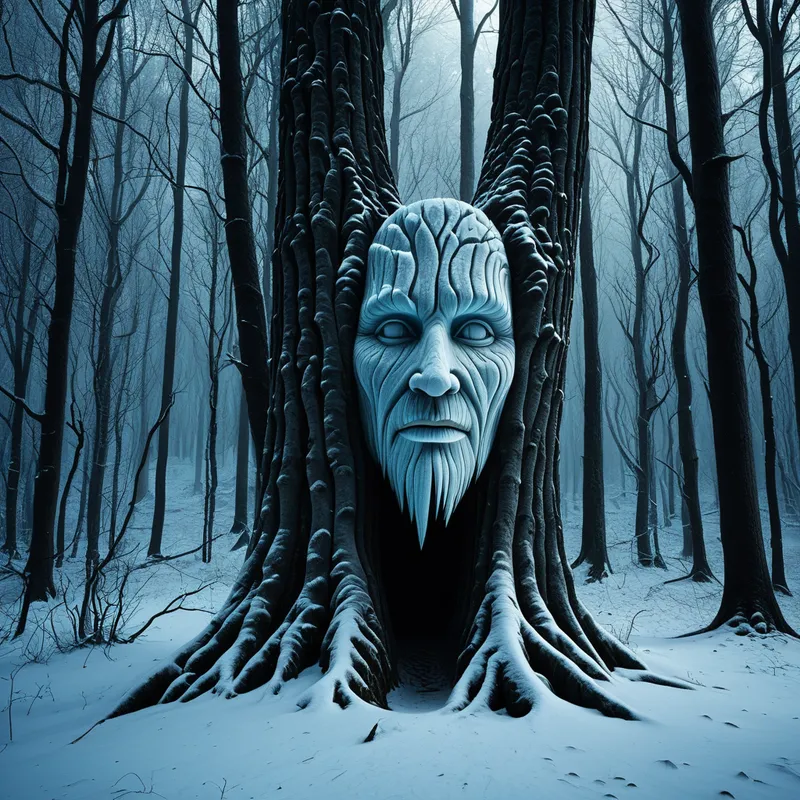
As the sun weakened and the days grew thin, her power waxed full. She was Winter incarnate. She would fly across the land on the back of a wolf, and her cloak, spread wide, was the blizzard that blanketed the world in silence and sleep. She froze the rivers with a glance, locked the life of the earth in a deep, dreaming slumber. In her right hand she held the staff that brought the killing frost; in her left, she cradled a single, dormant seed, warm against her stony palm.
But the wheel turns. The young, bright god of spring, the Bride, would stir in her captivity. A contest, ancient and eternal, would begin. Some say the Cailleach, in her great age, would journey to a magical well atop the highest mountain. There, she must drink the waters of renewal before the first dawn of spring. If she succeeds, winter holds sway for another season. But if she is delayed, if the light catches her, she is transformed.
And so it happens. As the first, fragile beam of the spring sun touches the well’s surface, the old goddess stumbles. The staff of blackthorn falls from her grasp, taking root where it lands. Her cloak of storm and granite softens, becoming a mantle of green moss and budding flowers. The ancient, stony visage melts away, and from the form of [the crone](/myths/the-crone “Myth from Celtic culture.”/) steps the maiden, the Bride, radiant and new. The Cailleach is not dead. She has gone into the stone, into the deep heart of the mountain, to sleep and gather her strength while the world blooms above her. She is the deep, dreaming earth, waiting to be cold and sovereign once more.
Cultural Origins & Context
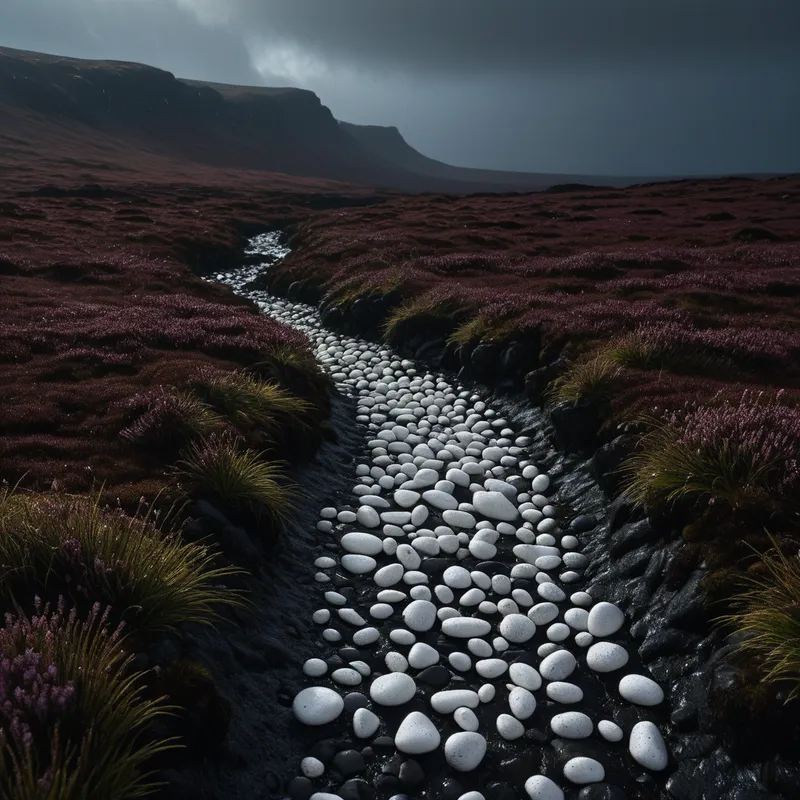
The figure of the Cailleach is not from a single, codified text, but from the living breath of Gaelic oral tradition—the stories told in Scottish, Irish, and Manx bothies during the long, dark nights. She is a genius loci of the highest order, a personification of the specific, rugged landscapes of the Celtic fringe. Her myths were the explanations for the very shape of the land: this mountain range is her discarded apron-load of stones; that loch formed where her staff struck the ground.
She functioned as a divine calendar. Her reign began at [Samhain](/myths/samhain “Myth from Celtic culture.”/) and ended at Imbolc, the feast of Bride. This cyclical battle was not mere entertainment; it was a cosmological map that helped a pastoral people understand and endure the harsh, existential reality of winter. She was the reason for the season—a necessary, fearsome, and ultimately generative force. To know her stories was to know the land, the weather, and one’s place within a world alive with ancient, conscious power.
Symbolic Architecture
The Cailleach is the [archetype](/symbols/archetype “Symbol: A universal, primordial pattern or prototype in the collective unconscious that shapes human experience, behavior, and creative expression.”/) of the ultimate, unyielding [reality](/symbols/reality “Symbol: Reality signifies the state of existence and perception, often reflecting one’s understanding of truth and life experiences.”/) principle. She represents the raw, unadorned [truth](/symbols/truth “Symbol: Truth represents authenticity, honesty, and the quest for knowledge beyond mere appearances.”/) of existence: time consumes all, [winter](/symbols/winter “Symbol: Winter symbolizes a time of reflection, introspection, and dormancy, often representing challenges or a period of transformation.”/) follows harvest, [death](/symbols/death “Symbol: Symbolizes transformation, endings, and new beginnings; often associated with fear of the unknown.”/) is part of [life](/symbols/life “Symbol: The symbol of ‘Life’ represents a journey of growth, interconnectedness, and existential meaning, encompassing both the joys and challenges that define human experience.”/). She is the psychological embodiment of the [Shadow](/symbols/shadow “Symbol: The ‘shadow’ embodies the unconscious, repressed aspects of the self and often represents fears or hidden emotions.”/) in its most primordial form—not personal failings, but the impersonal, cosmic forces of [entropy](/symbols/entropy “Symbol: In arts and music, entropy represents the inevitable decay of order into chaos, often symbolizing creative destruction, impermanence, and the natural progression toward disorder.”/), decay, and necessary [dissolution](/symbols/dissolution “Symbol: The process of breaking down, dispersing, or losing form, often representing transformation, release, or the end of a state of being.”/) that terrify [the ego](/myths/the-ego “Myth from Jungian culture.”/).
She is the wisdom that comes not from light, but from depth; not from growth, but from essential, stony being.
Her staff is the [axis](/symbols/axis “Symbol: A central line or principle around which things revolve, representing stability, orientation, and the fundamental structure of reality or consciousness.”/) of this world, the tool of sovereign will that shapes reality. Her transformation into the [Bride](/symbols/bride “Symbol: A bride symbolizes new beginnings, commitment, and the transition into a partnership or a new phase in life.”/) is the core [mystery](/symbols/mystery “Symbol: An enigmatic, unresolved element that invites curiosity and exploration, often representing the unknown or hidden aspects of existence.”/): within the deepest, coldest, most “dead” state lies the seed of its own opposite. The crone and the maiden are not two goddesses, but two faces of one divine, cyclical process. She symbolizes the terrifying yet essential truth that for new life to emerge, the old must not just change, but must undergo a symbolic death, a return to the elemental state of [stone](/symbols/stone “Symbol: In dreams, a stone often symbolizes strength, stability, and permanence, but it may also represent emotional burdens or obstacles that need to be acknowledged and processed.”/) and sleep.
The Dreamer’s Resonance
When the pattern of the Cailleach stirs in modern dreams, it signals a profound encounter with the bedrock of the [psyche](/myths/psyche “Myth from Greek culture.”/). To dream of a vast, ancient, stony woman; of being lost in a frozen, yet strangely beautiful landscape; of finding a single warm seed in a world of ice—these are encounters with the numinous Shadow.
This is not about personal neurosis, but about confronting a life phase that feels frozen, barren, or harshly limiting. The somatic feeling is often one of deep cold, heaviness, or immobility—a psychic winter. The psyche is forcing a confrontation with what must be allowed to die, to go dormant, or to be accepted as unchangeable granite fact. The dreamer is being initiated into the wisdom of winter: the necessity of retreat, conservation, and the profound creativity that can only occur in the quiet, dark incubation of the soul’s deep places. It is a call to sovereignty over one’s own inner landscape, however bleak it may currently appear.
Alchemical Translation
The myth of the Cailleach is a perfect map for the alchemical stage of [nigredo](/myths/nigredo “Myth from Alchemical culture.”/). This is the first, and often most dreaded, phase of individuation: the confrontation with the primal shadow, the descent into the “black sun” of depression, meaninglessness, or existential winter. The ego, identified with the bright, growing world of summer and [persona](/myths/persona “Myth from Greek culture.”/), must face its dissolution.
The process modeled is one of psychic transmutation through full immersion. One does not fight the winter; one must become winter for a time. One must allow the old structures, identities, and fervent growth (the psychic summer) to be frozen and stripped away, to see what essential, stony self remains. This is the “staff” of the Cailleach—the discovery of an unshakable, inner axis of being amidst the storm.
The alchemical gold is found not by avoiding the leaden weight of despair, but by submitting to its crushing pressure until the seed of light within it is revealed.
The transformation at the well is the culmination: the albedo (whitening) that follows the nigredo. After fully dwelling in the cold, dark, stony truth of oneself, a new consciousness can dawn—not as the obliteration of the old, but as its integration. The Bride who emerges is not a naive innocence, but an innocence earned, a vitality that knows and contains the wisdom of the crone. The modern individual undergoing this process moves from fearing the winter of the soul to recognizing it as the sovereign, creative, and necessary ground of all true renewal.
Associated Symbols
Explore related symbols from the CaleaDream lexicon: