The Cù Sìth Myth Meaning & Symbolism
A spectral hound of immense size, guardian of the Otherworld's gate, whose howl is a death knell and whose presence marks the ultimate threshold.
The Tale of The Cù Sìth
Listen, and let the peat-smoke carry you. Not to the warm hearth, but out, out into the mòinteach when [the moon](/myths/the-moon “Myth from Tarot culture.”/) is full and fat, painting the heather in silver and bone. This is the hour when the veils thin. This is the domain of the Cù Sìth.
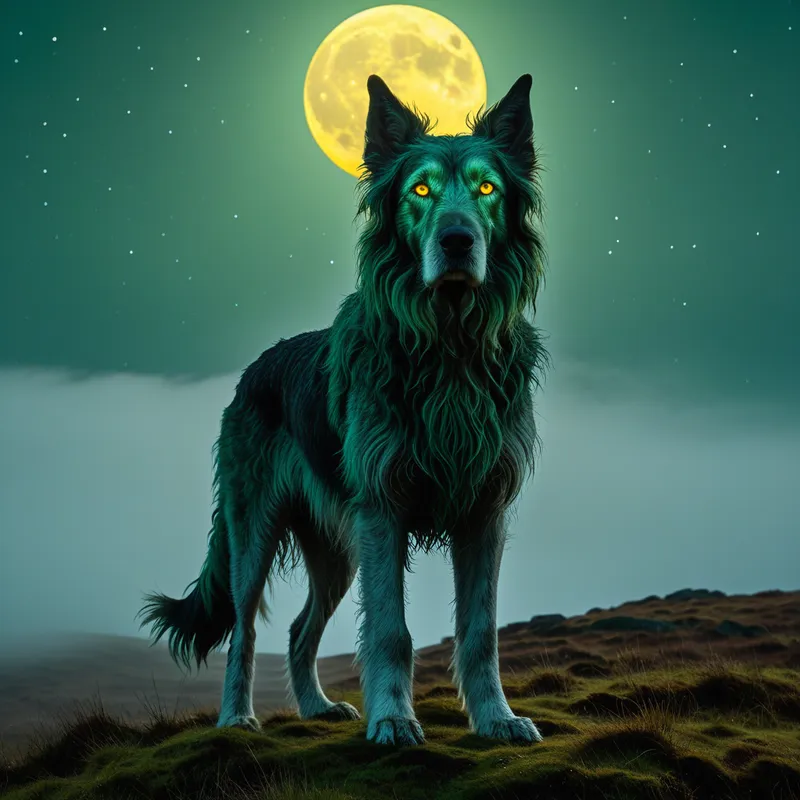
It moves not as a beast of earth and blood, but as a piece of the night given form and intent. Larger than the tallest pony, its coat is not black, but the deep, mossy green of forgotten forest pools, tangled and wild. Its paws are the size of a man’s head, and they make no sound, not even on the crispest frost. But its eyes… its eyes are lanterns of a cold, phosphorescent yellow, seeing through [the mist](/myths/the-mist “Myth from Celtic culture.”/) and through the flesh to the spirit within.
The story is not of its birth, for it was never born. It is of its purpose. It is the silent warden of the borders, the living gate between [the world](/myths/the-world “Myth from Tarot culture.”/) of the living and the Sìth. It does not hunt for meat, but for souls poised on the cusp.
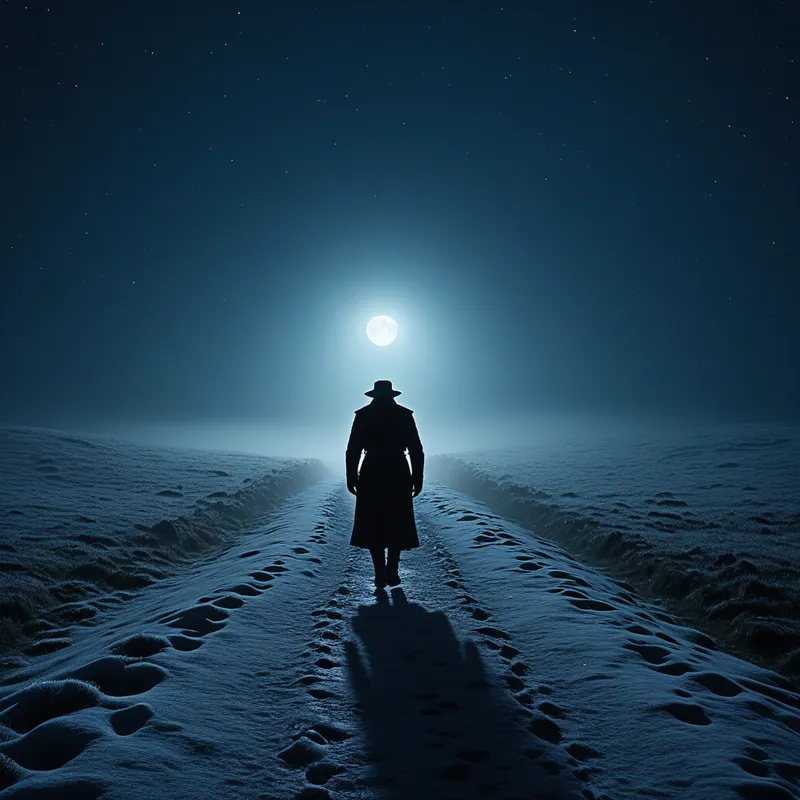
A traveler, brave or foolish, finds himself on the old path as the last light dies. The air grows still, too still; the crickets fall silent. Then it comes—a sound that freezes the marrow. Three barks, carried on [the wind](/myths/the-wind “Myth from Various culture.”/). The first is distant, a warning from the far hills. The second is closer, a promise from the next glen. The third… the third is at your shoulder, a breath of ice against your neck. To hear that third bark is to have your name called. It is an invitation you cannot refuse. The great green shadow emerges from the mist, and to look into those lantern eyes is to see the path you must now walk, not of your choosing, but of your destiny. It does not attack; it merely presences. Its silent escort is absolute. It leads the chosen, the fated, or the doomed across the final threshold, into the rolling green hills that are not hills, but the gates of [the Otherworld](/myths/the-otherworld “Myth from Celtic culture.”/) itself.
Cultural Origins & Context
The Cù Sìth is a creature of the Gaelic imagination, specifically rooted in the Highlands and Islands of Scotland. It belongs not to the grand [pantheon](/myths/pantheon “Myth from Roman culture.”/) of Celtic gods like the Dagda, but to the rich, localized stratum of the Aos Sìth. These stories were not written in illuminated manuscripts but carried on the breath of crofters, fishers, and shepherds. Told by the fireside, they served as both entertainment and profound social technology.
The myth functioned as a sophisticated map of the psychological and physical landscape. It codified danger: don’t wander the moors at night, especially during the féill when the walls between worlds are thin. It explained the unexplainable—the sudden death of a healthy person, a mysterious disappearance, or the uncanny feeling of being watched in the wild. The Cù Sìth was the embodiment of the land’s ultimate authority, a reminder that humanity inhabited a world shared with powerful, inscrutable forces. It was a story that cultivated respect—for the boundaries of the community, for the power of the untamed land, and for the mystery of death itself.
Symbolic Architecture
Psychologically, the Cù Sìth is a masterful [symbol](/symbols/symbol “Symbol: A symbol can represent an idea, concept, or belief, serving as a powerful tool for communication and understanding.”/) of the [Shadow](/symbols/shadow “Symbol: The ‘shadow’ embodies the unconscious, repressed aspects of the self and often represents fears or hidden emotions.”/), not as personal evil, but as the ultimate threshold [guardian](/symbols/guardian “Symbol: A protector figure representing safety, authority, and guidance, often embodying parental, societal, or spiritual oversight.”/). Its green fur connects it to the vegetative, cyclical world of [life](/symbols/life “Symbol: The symbol of ‘Life’ represents a journey of growth, interconnectedness, and existential meaning, encompassing both the joys and challenges that define human experience.”/), [death](/symbols/death “Symbol: Symbolizes transformation, endings, and new beginnings; often associated with fear of the unknown.”/), and [rebirth](/symbols/rebirth “Symbol: A profound transformation where old aspects of self or life die, making way for new beginnings, growth, and renewal.”/)—a natural process that is beautiful, necessary, and utterly indifferent to individual [human](/symbols/human “Symbol: The symbol of a human represents individuality, complexity of emotions, and social relationships.”/) desire.
The guardian of the threshold is not a monster to be slain, but a truth to be recognized. Its howl is the sound of an inevitable ending, which is also the prerequisite for any true beginning.
It represents the psychic function that enforces necessary endings. The three barks map a psychological process: the first is the distant [intuition](/symbols/intuition “Symbol: The immediate, non-rational understanding of truth or insight, often described as a ‘gut feeling’ or inner knowing that bypasses conscious reasoning.”/) of an ending (a [relationship](/symbols/relationship “Symbol: A representation of connections we have with others in our lives, often reflecting our emotional state.”/), a [career](/symbols/career “Symbol: The dream symbol of ‘career’ often represents one’s ambitions, goals, and personal identity in a professional context.”/), an [identity](/symbols/identity “Symbol: Identity represents the sense of self, encompassing personal beliefs, cultural background, and social roles.”/)). The second is the undeniable approach of change. The third is the [moment](/symbols/moment “Symbol: The symbol of a ‘moment’ embodies the significance of transient experiences that encapsulate emotional depth or pivotal transformations in life.”/) of existential confrontation, where the old self must be surrendered. The Cù Sìth does not kill; it escorts. It is the personified pressure of a [psyche](/myths/psyche “Myth from Greek culture.”/) that has outgrown its current form, compelling a transition the conscious mind may desperately resist.
The Dreamer’s Resonance
When the Cù Sìth pads into modern dreams, it rarely appears as a literal green hound. Its presence is more atmospheric. You may dream of being pursued not by a monster, but by a profound, enveloping silence. You may be in a familiar place—your office, your home—that has become eerily liminal, filled with a mist that carries the scent of damp earth and ancient stone.
The somatic experience is key: a chilling dread, a freezing in place, the feeling of being marked. This is the dream-ego encountering a non-negotiable psychic truth. The dream is signaling that a period of life is conclusively over. You are being “called in.” This can relate to the end of an illusion, the death of a long-held self-image, or the culmination of a karmic pattern. The terror is not of annihilation, but of the dissolution required for transformation. The dream asks: What are you clinging to that life itself is asking you to release? What threshold are you being silently, implacably escorted toward?
Alchemical Translation
The alchemical journey, or individuation, is a series of deaths and rebirths. The Cù Sìth myth models the crucial first stage of this process: [nigredo](/myths/nigredo “Myth from Alchemical culture.”/). This is the confrontation with the shadowy, inevitable truths we spend our lives avoiding.
To integrate the Cù Sìth is not to conquer death, but to consent to it—to willingly follow the guide into the dark, trusting that the Otherworld it guards is not a void, but the womb of the next self.
The modern individual’s “heroic” task is not to fight this spectral guardian, but to heed its call. The rising action is the internal resistance, the panic, the denial. The resolution is the moment of surrender—the realization that the path ahead, though terrifying, is the only one that leads forward. The psychic transmutation occurs in the walking. By accepting the escort of this inner [psychopomp](/myths/psychopomp “Myth from Greek culture.”/), we allow the obsolete parts of our personality to die so that essential, more authentic aspects can be born. We cross from the known land of our old identity into the fertile, unknown hills of the Sìth—which, in psychological terms, is the richer, more complete territory of [the Self](/myths/the-self “Myth from Jungian culture.”/). The howl becomes not a knell, but a summons to wholeness.
Associated Symbols
Explore related symbols from the CaleaDream lexicon: