The Burial Chamber Myth Meaning & Symbolism
A soul's perilous journey through the underworld, facing judgment and transformation within the sacred tomb to achieve eternal life.
The Tale of The Burial Chamber
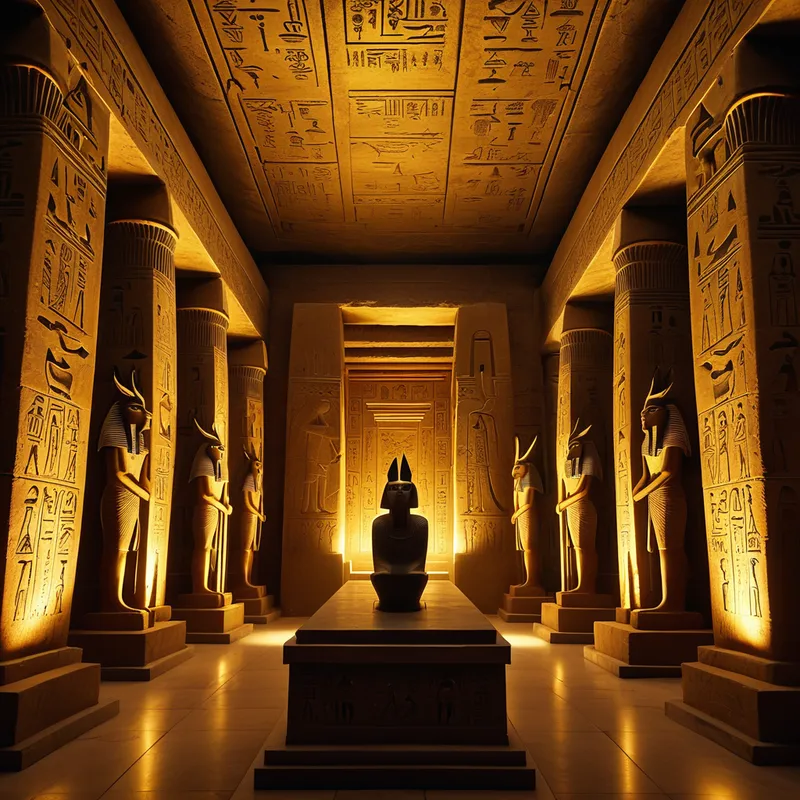
Hear now the tale not of stone and dust, but of the spirit’s great voyage. It begins not with a breath, but with the last exhalation. The Ka departs the still body, and the Ba takes flight, a bird of gold and lapis seeking the western horizon where the sun dies each night.
[The world](/myths/the-world “Myth from Tarot culture.”/) narrows to a corridor of utter black. The air is not air, but the weight of [the earth](/myths/the-earth “Myth from Hindu culture.”/) itself, cool and silent. Before the soul stretches the Duat, a river of night pierced by strange stars. The soul is a traveler in a land without maps, drawn forward by a longing deeper than memory—the longing for the Field of Reeds.
But the path is guarded. At the first of many gates stands a demon with the head of a crocodile and the body of a lion, its voice the grind of stone. “Who passes?” it demands. The soul must speak its true name, a name known only to itself and the gods, a sound that vibrates with the essence of its lived life. This is repeated, gate after terrifying gate, each guardian more monstrous, each demand more precise. The soul’s knowledge of its own sacred texts—the spells and declarations from the Book of the Dead—is its only torch in the consuming dark.
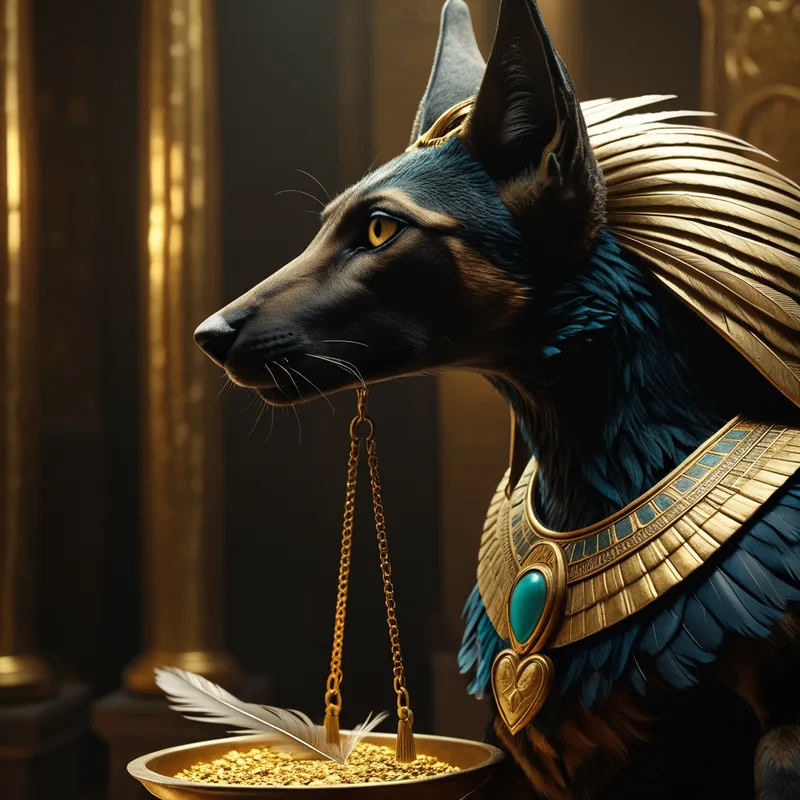
The journey culminates in the vast, silent [Hall of Ma’at](/myths/hall-of-maat “Myth from Egyptian culture.”/). Here, in a stillness that swallows sound, stands Anubis, guide of the dead. With infinite care, he takes the soul’s heart—not the physical organ, but the seat of its conscience, heavy with every deed, every lie, every kindness. He places it upon the golden pan of a scale. Upon the other, he sets the [Feather of Ma’at](/myths/feather-of-maat “Myth from Egyptian culture.”/), the weight of perfect truth.
All hangs in the balance. The soul recites the Negative Confession: “I have not caused pain. I have not caused tears. I have not stolen. I have not told lies.” The heart must not betray them. If it is heavier than the feather, it is cast to the floor where the Devourer, the beast Ammit, waits to consume it, ending existence forever.
But if the scales balance… a profound peace descends. The ibis-headed god [Thoth](/myths/thoth “Myth from Global/Universal culture.”/) records the verdict. Then, the soul is led before the enthroned [Osiris](/myths/osiris “Myth from Global/Universal culture.”/), lord of the peaceful dead, his green skin the color of rebirth. He grants the final transformation. The Akh, the effective, shining spirit, is born. The burial chamber is no longer a tomb, but a womb. The soul emerges, not into the world it left, but into the eternal, radiant Field of Reeds, whole and perfected.
Cultural Origins & Context
This was not a single story told around a fire, but a meticulously detailed roadmap for the most critical transition imaginable. Its origins are woven into the very fabric of the Egyptian worldview, emerging from the Predynastic period and crystallizing in the [Pyramid Texts](/myths/pyramid-texts “Myth from Egyptian culture.”/) of the Old Kingdom (c. 2400-2300 BCE), the oldest known religious writings in the world. These spells, carved into the burial chambers of pharaohs, were later democratized in the Coffin Texts of the Middle Kingdom and the iconic Book of the Dead papyri of the New Kingdom, placed in the tombs of any who could afford them.
The myth was performed, not merely recited. The entire funerary rite—from mummification (a physical replication of Osiris’s restoration) to the “Opening of the Mouth” ceremony—was a ritual enactment of this journey. Priests played the roles of the gods, and the tomb itself was architecturally designed as a machine for resurrection, its paintings and texts providing the necessary tools and passwords. Its societal function was dual: it offered a concrete hope for life beyond death, structuring grief and providing existential comfort, while simultaneously enforcing a powerful moral code. To live a life in accordance with [Ma’at](/myths/maat “Myth from Egyptian culture.”/) was the only way to ensure a favorable judgment.
Symbolic Architecture
The [burial](/symbols/burial “Symbol: A symbolic act of laying something to rest, often representing closure, transformation, or the release of past burdens.”/) [chamber](/symbols/chamber “Symbol: A private, enclosed space representing the inner self, hidden aspects, or a specific stage in life’s journey.”/) myth is a profound [allegory](/symbols/allegory “Symbol: A narrative device where characters, events, or settings represent abstract ideas or moral qualities, conveying deeper meanings through symbolic storytelling.”/) for the [structure](/symbols/structure “Symbol: Structure in dreams often symbolizes stability, organization, and the framework of one’s life, reflecting how one perceives their environment and personal life.”/) of the [psyche](/myths/psyche “Myth from Greek culture.”/) and the ordeal of self-confrontation. The Duat is not a geographical place, but the [landscape](/symbols/landscape “Symbol: Landscapes in dreams are powerful symbols representing the dreamer’s emotional state, personal journey, and the broader context of life situations.”/) of the unconscious—dark, unknown, and populated by the contents we have repressed or forgotten. The perilous [journey](/symbols/journey “Symbol: A journey in dreams typically signifies adventure, growth, or a significant life transition.”/) is the descent into one’s own [depths](/symbols/depths “Symbol: Represents the subconscious, hidden emotions, or foundational aspects of the self, often linked to primal fears or profound truths.”/).
The tomb is the crucible of the soul, where the dross of the persona is burned away in the silent fire of self-judgment.
The guardians at the gates represent the specific, often terrifying, complexes and defenses that block self-[knowledge](/symbols/knowledge “Symbol: Knowledge symbolizes learning, understanding, and wisdom, embodying the acquisition of information and enlightenment.”/). To pass them, one must speak one’s “true name”—the authentic self, stripped of social masks. The central, terrifying [moment](/symbols/moment “Symbol: The symbol of a ‘moment’ embodies the significance of transient experiences that encapsulate emotional depth or pivotal transformations in life.”/) of the weighing is the ultimate psychological [event](/symbols/event “Symbol: An event within dreams often signifies significant life changes, transitions, or emotional milestones.”/): the confrontation with one’s own [shadow](/symbols/shadow “Symbol: The ‘shadow’ embodies the unconscious, repressed aspects of the self and often represents fears or hidden emotions.”/). The [heart](/symbols/heart “Symbol: The heart symbolizes love, emotion, and the core of one’s existence, representing deep connections with others and self.”/) contains the unvarnished record of a [life](/symbols/life “Symbol: The symbol of ‘Life’ represents a journey of growth, interconnectedness, and existential meaning, encompassing both the joys and challenges that define human experience.”/)—the good and the evil, the kindness and the cruelty. Ammit symbolizes the psychic annihilation that awaits if one’s moral failings ([guilt](/symbols/guilt “Symbol: A painful emotional state arising from a perceived violation of moral or social standards, often tied to actions or inactions.”/), [shame](/symbols/shame “Symbol: A painful emotion arising from perceived failure or violation of social norms, often involving exposure of vulnerability or wrongdoing.”/), unresolved [trauma](/symbols/trauma “Symbol: A deeply distressing or disturbing experience that overwhelms the psyche, often manifesting in dreams as unresolved emotional wounds or psychological injury.”/)) are so great they overwhelm the possibility of [integration](/symbols/integration “Symbol: The process of unifying disparate parts of the self or experience into a cohesive whole, often representing psychological wholeness or resolution of internal conflict.”/). Balancing the scale is the act of acknowledging one’s faults without being destroyed by them, of taking full [responsibility](/symbols/responsibility “Symbol: Responsibility in dreams often signifies the weight of duties and the expectations placed upon the dreamer.”/). Osiris, who was himself murdered and restored, represents the [archetype](/symbols/archetype “Symbol: A universal, primordial pattern or prototype in the collective unconscious that shapes human experience, behavior, and creative expression.”/) of [the Self](/myths/the-self “Myth from Jungian culture.”/) that can integrate [death](/symbols/death “Symbol: Symbolizes transformation, endings, and new beginnings; often associated with fear of the unknown.”/) and emerge transformed. The Field of Reeds is the state of [psychic wholeness](/symbols/psychic-wholeness “Symbol: A state of complete integration between conscious and unconscious aspects of the psyche, representing spiritual unity and self-realization.”/), or individuation, where the fragmented parts of [the self](/myths/the-self “Myth from Jungian culture.”/) are reunited in a new, harmonious order.
The Dreamer’s Resonance
When this mythic pattern stirs in modern dreams, it signals a profound initiation into the depths of the psyche. To dream of being in a dark, confined space—a basement, a tunnel, a sealed room—often evokes the burial chamber. It is a somatic experience of containment and pressure, reflecting a psychological process where the conscious ego is being stripped of its familiar supports.
Dreams of being judged by a faceless tribunal, of having one’s actions meticulously reviewed, or of desperately searching for a lost document or password mirror the trial in the Hall of Ma’at. The dreamer is undergoing an unconscious moral and existential audit. A dream of a scale, or of something being weighed, points directly to this internal evaluation of worth, guilt, and authenticity. The terror of these dreams is the terror of being truly seen, not by others, but by the uncompromising eye of one’s own conscience. This is not pathology, but a critical stage of shadow-work, where the contents of [the personal unconscious](/myths/the-personal-unconscious “Myth from Jungian Psychology culture.”/) are being brought to the surface for integration or release.
Alchemical Translation
The alchemical process mirrored in this myth is the [nigredo](/myths/nigredo “Myth from Alchemical culture.”/)—the blackening, the descent into the prime matter, the encounter with the caput mortuum (death’s head). The burial chamber is the sealed alchemical vessel where this dissolution occurs. [The ego](/myths/the-ego “Myth from Jungian culture.”/), identified with the worldly [persona](/myths/persona “Myth from Greek culture.”/), must “die” for the Self to be realized.
The journey through the Duat is the soul’s own opus, its great work of turning the lead of a mortal life into the gold of a realized spirit.
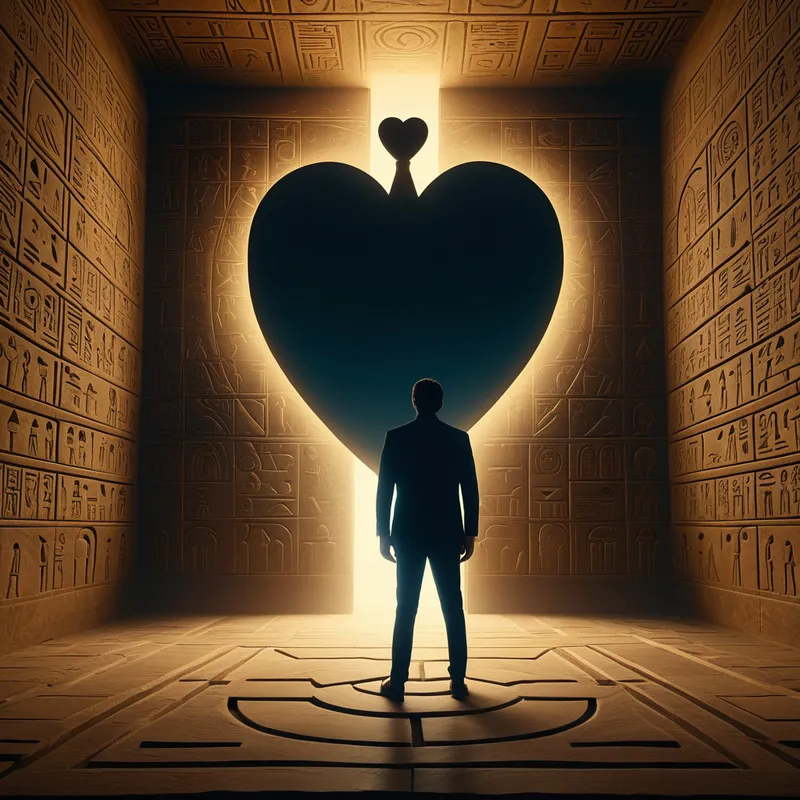
The modern individual’s “burial chamber” is any liminal space of breakdown, depression, or profound loss—[the dark night of the soul](/myths/the-dark-night-of-the-soul “Myth from Christian Mysticism culture.”/). This is not a failure, but the necessary first phase of transmutation. The “[weighing of the heart](/myths/weighing-of-the-heart “Myth from Egyptian culture.”/)” translates to the painful, honest inventory of one’s life: acknowledging failures, traumas, and harmful patterns without denial or self-flagellation. To “balance the scale” is to achieve a state of radical self-acceptance, where one’s shadow is acknowledged as part of the whole, not as a monster to be destroyed. This integration is the alchemical albedo (whitening), the purification.
Finally, the appearance of Osiris symbolizes the [rubedo](/myths/rubedo “Myth from Alchemical culture.”/) (reddening), the emergence of the new, conscious personality centered on the Self. The individual does not return to their old life but is reborn into a new relationship with it. They inhabit their own “Field of Reeds”—a life lived with greater authenticity, purpose, and inner unity, having made the perilous round-trip journey to the center of their own being and back. The myth teaches that wholeness is not given, but earned in the silent, sacred chamber of one’s own deepest reckoning.
Associated Symbols
Explore related symbols from the CaleaDream lexicon: