The Bull of Heaven Myth Meaning & Symbolism
The goddess Ishtar sends a celestial beast to punish Gilgamesh, unleashing a cosmic battle that tests the limits of human defiance against divine order.
The Tale of The Bull of Heaven
Hear now the tale of the Bull that fell from the sky, a story carved in the clay of memory, whispered by the winds of the Euphrates. In the great walled city of Uruk, where the ziggurat scraped the belly of the firmament, there ruled a king. His name was Gilgamesh, two parts god and one part man, whose strength shook the gates and whose pride was a towering thing. By his side stood Enkidu, his brother forged in wilderness and friendship, a bond stronger than bronze.
The air in Uruk was thick with the scent of cedar and sacrifice. From her celestial palace, Ishtar, whose desires were as fierce as her wrath, cast her gaze upon the king. She descended, robes like the sunset, and offered him the throne of the underworld itself—a marriage of mortal and divine. But Gilgamesh, remembering the fate of all her past lovers—the shepherd turned wolf, the gardener imprisoned in stone—recoiled. He spoke not with diplomacy, but with the brutal honesty of the hero. He listed her betrayals, called her love a ruinous tempest, a door that leads only to dust.
Silence fell, deeper than any temple vault. Then, a sound like a mountain cracking. Ishtar’s fury was not a mere emotion; it was a cosmic event. She ascended to the high heaven, to the throne of her father, Anu. Tears of rage, hot as molten silver, fell before him. “Father,” she cried, “Gilgamesh has heaped insults upon me! Give me the Bull of Heaven, that I may trample him into the mud of his arrogance! If you refuse, I will shatter the doors of the Netherworld and raise the dead to outnumber the living!”
Anu, heavy with the weight of cosmic order, warned her. The Bull’s release would bring seven years of famine, the land would starve. But Ishtar, in her divine petulance, had prepared stores. With a sigh that stirred the constellations, Anu placed the celestial tether in her hand.
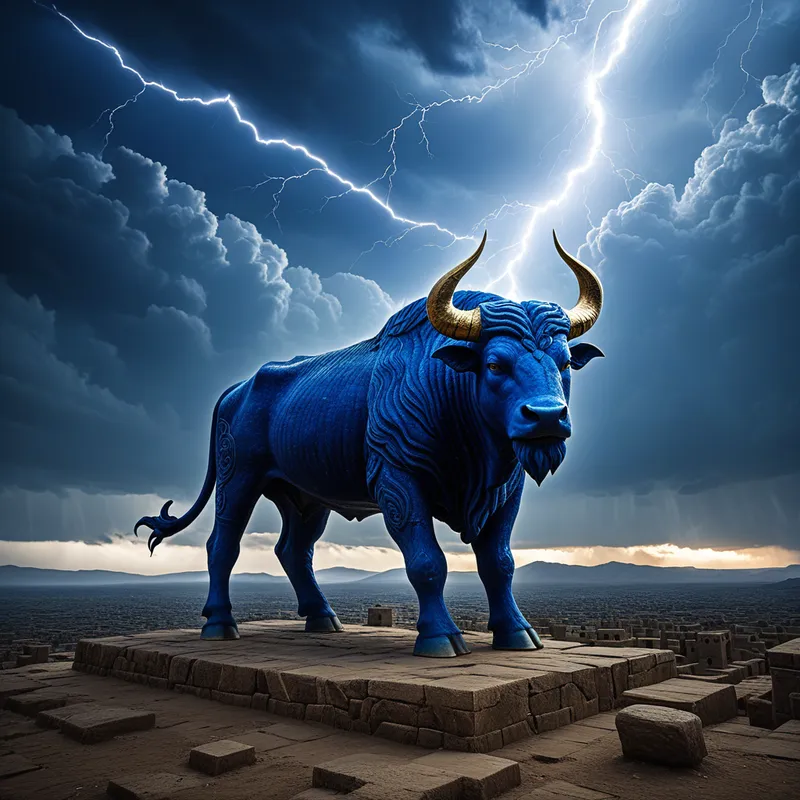
Then it came. Not with a roar, but with a pressure, a sucking of air from the lungs of every creature in Mesopotamia. The sky tore. Through the rent descended the Bull of Heaven. It was not flesh, but a manifestation of celestial wrath—its hide the deep blue of polished lapis, its breath a sirocco that withered the fields. With its first bellow, a chasm opened in the earth, swallowing hundreds of Uruk’s men. With its second, the river itself recoiled.
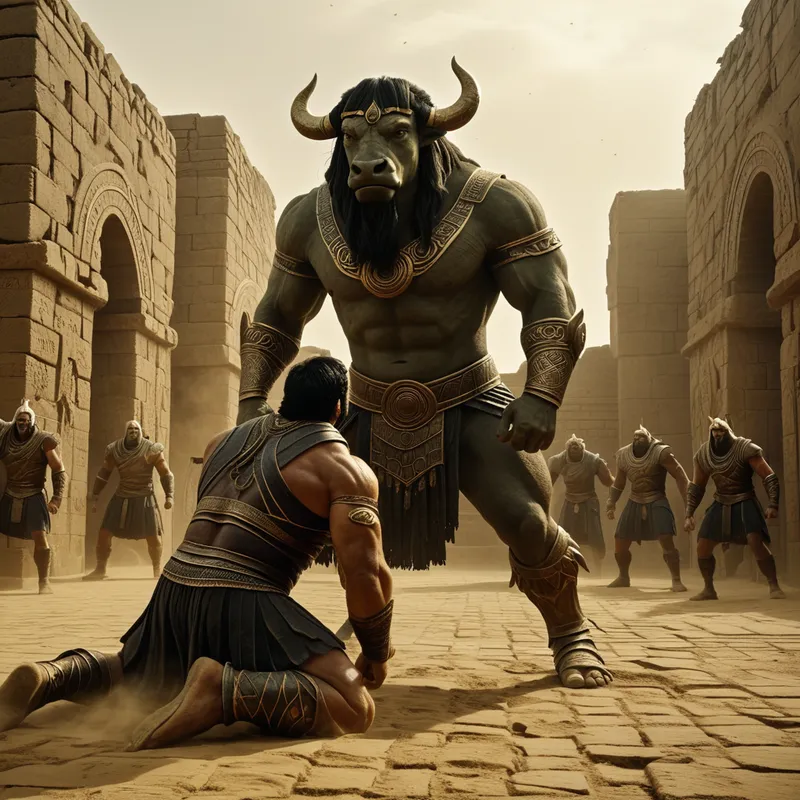
But Gilgamesh and Enkidu did not cower. The hero-king called to his brother, his voice cutting through the panic. “We who have faced the monster Humbaba shall not falter now!” Enkidu, the wild one who understood the language of beasts, saw the pattern in the Bull’s charge. As the celestial beast lowered its head, horns like crescent moons aimed to gore the king, Enkidu seized its tail, the coarse hairs burning his hands. He twisted with the force of a river current, slowing the beast for a heartbeat. That was all Gilgamesh needed. He leapt, not away, but onto the storm, driving his sword deep behind the Bull’s horn, into the nexus of its celestial life.
The Bull crashed to the earth, a fallen mountain. The tremor shook the foundations of Ishtar’s temple. From the ramparts, the goddess wailed a curse. But Enkidu, in a final act of defiance, tore a mighty thigh from the carcass and hurled it toward her. “Were I able to reach you,” he shouted, “I would do to you as we have done to this Bull!”
The beast was slain. The people of Uruk emerged, gathering around the colossal corpse. But as Gilgamesh washed his hands in the Euphrate, and as the priests admired the horns—hollow, each holding a measure of oil fit for a god—a cold shadow fell upon Enkidu’s heart. The victory was too complete, the insult too grave. The gods would not let this stand.
Cultural Origins & Context
This episode is the pivotal climax of Tablet VI of the Epic of Gilgamesh, a masterpiece inscribed on twelve clay tablets in Akkadian cuneiform. The epic’s origins are Sumerian, but it was the Babylonian scribes, particularly during the reign of the Kassite dynasty, who compiled and standardized the narrative we know today. It was not mere entertainment; it was a foundational text, recited by skilled narrators likely in temple courtyards or royal courts, serving as a meditation on the limits of kingship, the nature of friendship, and humanity’s fraught relationship with the divine.
The Bull of Heaven itself is a potent symbol drawn from the Mesopotamian cosmological imagination, where celestial bodies were often conceived as divine, living entities. The bull was an ancient symbol of potency, storm, and kingship across the Near East. By having Gilgamesh slay this divine emblem, the story explores a terrifying question: what happens when the divinely-ordained king, the shepherd of the people, directly challenges the very source of his mandate? The myth functioned as a cautionary tale about the dangers of hubris, even for semi-divine heroes, while simultaneously celebrating the audacious spirit that defines human civilization against the raw, untamed forces of nature and fate.
Symbolic Architecture
The [Bull](/symbols/bull “Symbol: The bull often symbolizes strength, power, and determination in many cultures.”/) of [Heaven](/symbols/heaven “Symbol: A symbolic journey toward ultimate fulfillment, spiritual transcendence, or connection with the divine, often representing life’s highest aspirations.”/) is far more than a [monster](/symbols/monster “Symbol: Monsters in dreams often symbolize fears, anxieties, or challenges that feel overwhelming.”/). It is the embodied consequence of transgressing a sacred [boundary](/symbols/boundary “Symbol: A conceptual or physical limit defining separation, protection, or identity between entities, spaces, or states of being.”/). Ishtar’s proposal represents a [fusion](/symbols/fusion “Symbol: The merging of separate elements into a unified whole, often representing integration of self, relationships, or conflicting aspects of identity.”/) of realms—mortal and divine, [human](/symbols/human “Symbol: The symbol of a human represents individuality, complexity of emotions, and social relationships.”/) and cosmic. Gilgamesh’s [rejection](/symbols/rejection “Symbol: The experience of being refused, excluded, or dismissed by others, often representing fears of inadequacy or social belonging.”/) is not just personal; it is a [defense](/symbols/defense “Symbol: A protective mechanism or barrier against perceived threats, representing boundaries, security, and resistance to external or internal challenges.”/) of a separate, [human](/symbols/human “Symbol: The symbol of a human represents individuality, complexity of emotions, and social relationships.”/) order. The [Bull](/symbols/bull “Symbol: The bull often symbolizes strength, power, and determination in many cultures.”/), therefore, is the unleashed [chaos](/symbols/chaos “Symbol: In Arts & Music, chaos represents raw creative potential, uncontrolled expression, and the breakdown of order to forge new artistic forms.”/) of a violated divine principle.
To insult a goddess is to disturb the cosmic ecology; the Bull is the resulting psychic hurricane, the natural world revolting against human arrogance.
Psychologically, the Bull represents the eruptive power of the repressed [Shadow](/symbols/shadow “Symbol: The ‘shadow’ embodies the unconscious, repressed aspects of the self and often represents fears or hidden emotions.”/), but on a collective scale. Ishtar’s spurned love, her chaotic and destructive aspects, are disowned and thrown back at her. The Bull is that rejected [energy](/symbols/energy “Symbol: Energy symbolizes vitality, motivation, and the drive that fuels actions and ambitions.”/) returning with catastrophic force. Gilgamesh and Enkidu represent the conscious ego and its instinctual ally (the [Animus](/symbols/animus “Symbol: In Jungian psychology, the masculine inner personality in a woman’s unconscious, representing logic, action, and spiritual guidance.”/) or [brother](/symbols/brother “Symbol: In dreams, a brother often symbolizes kinship, support, loyalty, and shared experiences, reflecting the importance of familial and social bonds.”/)-[shadow](/symbols/shadow “Symbol: The ‘shadow’ embodies the unconscious, repressed aspects of the self and often represents fears or hidden emotions.”/)), attempting to control a primal, archetypal [fury](/symbols/fury “Symbol: An intense, overwhelming rage that consumes the dreamer, often representing suppressed anger or a primal emotional eruption.”/) they themselves have provoked. Their victory is pyrrhic; they conquer the [symptom](/symbols/symptom “Symbol: A physical or emotional sign indicating an underlying imbalance, distress, or message from the unconscious mind.”/) (the Bull) but deepen the core conflict with the archetypal [realm](/symbols/realm “Symbol: The symbol of ‘Realm’ often signifies the boundaries of one’s consciousness, experiences, or emotional states, suggesting aspects of reality that are either explored or ignored.”/) (the gods), setting the stage for the tragedy of Enkidu’s [death](/symbols/death “Symbol: Symbolizes transformation, endings, and new beginnings; often associated with fear of the unknown.”/).
The Dreamer’s Resonance
When this myth stirs in the modern dreamer, it often manifests not as a literal bull, but as an overwhelming, impersonal force threatening to demolish one’s psychological “city.” It could be a tidal wave, a looming bureaucratic verdict, or a figure of immense, silent authority. The somatic experience is one of profound dread and pressure in the chest—the “bull in the china shop” of one’s carefully constructed life.
This dream pattern signals that the dreamer has, perhaps unknowingly, committed an act of profound psychological defiance. They may have rejected a deeply internalized “divine” demand—a parental expectation, a societal rule, or a core belief about who they must be. The Bull is the backlash of that entire internal system, the terrifying chaos that seems to arise when one says “no” to a foundational authority. The dream asks: What sacred law did you break? And are you, like Gilgamesh, prepared for the devastating, yet ultimately transformative, consequences of your own authenticity?

Alchemical Translation
The slaying of the Bull of Heaven is a critical, if brutal, stage in the alchemy of individuation. It represents the necessary, violent separation from a possessive, devouring aspect of the Anima/Animus (Ishtar). The hero must reject a seductive but identity-dissolving merger (the marriage offer) to establish the integrity of the Self. The ensuing battle is the psychic tumult of this separation.
The gold is not in the victory, but in the hollow horn—the vessel of sacred oil. The triumph must be ritualized, its power contained, or it becomes mere slaughter.
Gilgamesh’s initial error is one of inflation; he believes the conquered power is his to wield without cost. The true alchemical work begins with Enkidu’s subsequent dream-vision of the gods condemning him to death. This is the nigredo, the dark night of the soul that follows hubris. The Bull’s power must be integrated, not just defeated. Its horns, transformed into libation vessels, hint at this possibility: raw divine rage can be transmuted into a measured, sacred offering. For the modern individual, this myth models the painful process of facing the catastrophic consequences of one’s own growth, accepting the necessary loss (the death of Enkidu, the old brotherhood with the unconscious), and beginning the lonely, humbled journey toward wisdom (Gilgamesh’s quest for immortality, which ultimately fails but transforms him).
Associated Symbols
Explore related symbols from the CaleaDream lexicon:
- Bull — The celestial beast itself, symbolizing unleashed divine wrath, untamed natural force, and the catastrophic consequences of transgressing sacred boundaries.
- Raging Bull — The active, destructive manifestation of the Bull archetype, representing blind fury, unstoppable momentum, and the psyche in a state of violent revolt.
- Hero — Embodied by Gilgamesh, representing the conscious ego’s audacious, often hubristic, struggle to assert human will and order against overwhelming archetypal forces.
- Goddess — Represented by Ishtar, symbolizing the awesome, capricious, and potentially devouring power of the feminine archetype when her sovereignty is challenged.
- Heaven — The domain from which the Bull is released, representing the realm of divine order, cosmic law, and the ultimate source of authority and retribution.
- Chaos — The state invoked by the Bull’s rampage, representing the dissolution of order, the return of primal terror, and the fertile void that follows the shattering of old structures.
- Sacrifice — The unintended consequence of the battle, prefiguring Enkidu’s death; the necessary price paid for defying the gods and for the expansion of consciousness.
- Pride — The fatal flaw of Gilgamesh, the hubris that invites divine punishment but also fuels the heroic journey of self-definition.
- Thunder — The audible manifestation of the Bull’s power, representing shocking, disruptive force and the voice of the angry heavens.
- Shadow — Represented by both Enkidu and the Bull; the instinctual, wild, and disowned aspects of the self that must be engaged, both as ally and adversary.
- Death — The ultimate resolution of the conflict, which begins with the Bull’s slaughter and culminates in Enkidu’s demise, forcing the confrontation with mortality.
- Dream — The medium through which the consequences are revealed, as Enkidu’s fatal illness is foretold in a vision, linking the mythic event to the inner world of prophecy and fate.