The Buffalo Roads Myth Meaning & Symbolism
A sacred myth of the Great Plains where the Buffalo People offer themselves to humanity, creating the spiritual roads of life and sustenance.
The Tale of The Buffalo Roads
In the time before time, when [the earth](/myths/the-earth “Myth from Hindu culture.”/) was soft and [the sky](/myths/the-sky “Myth from Persian culture.”/) was close, the People walked with empty bellies and hollow hearts. The land was vast, a sea of whispering grass under a relentless sun, but it offered little. The children grew thin, their cries carried away by [the wind](/myths/the-wind “Myth from Various culture.”/). The elders’ stories grew faint, for a story cannot live in a body that is starving.
Then, from the place where [the world](/myths/the-world “Myth from Tarot culture.”/) curves, they came.
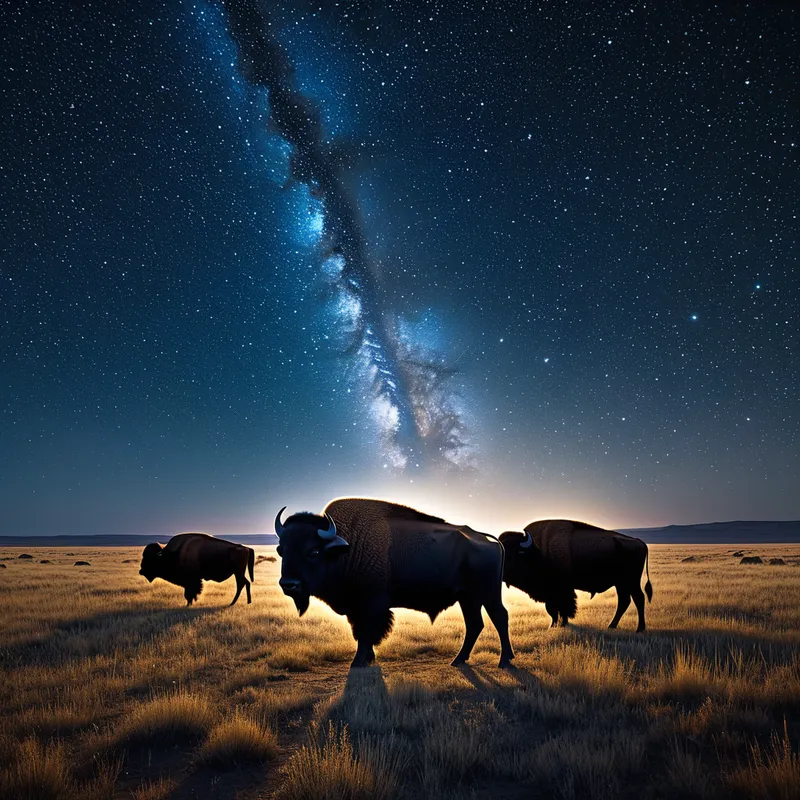
First, it was a trembling in the ground, a deep drumbeat felt in the chest before it was heard by the ear. Then, a dark line appeared on [the horizon](/myths/the-horizon “Myth from Various culture.”/), a living storm. The Buffalo People arrived. Not a herd, but a nation. Mountains of muscle and hide, crowned with crowns of horn, their eyes holding the patience of stone and the wisdom of thunder. They did not charge; they flowed, a river of life across the prairie.
A young hunter, his spirit worn thin by failure, stood before them. He raised his bow, but his hands shook not with fear, but with a sudden, overwhelming understanding. To shoot was not an act of conquest, but an impossible question posed to the universe.
The lead bull, a creature whose shoulders blotted out the sun, stepped forward. It did not lower its head to fight. It looked at [the hunter](/myths/the-hunter “Myth from African culture.”/), and in that gaze was an offer. A covenant. The bull stamped its hoof once, and where it struck, the grass did not crush—it glowed with a soft, subterranean light. It stamped again, and again, tracing a path. Then, it turned its broad side to the hunter and waited.
The arrow flew. It was not the hunter’s skill, but the bull’s consent, that guided its path. The great being fell with a sigh that was not of pain, but of profound release. As its spirit left its body, a miraculous [thing](/myths/thing “Myth from Norse culture.”/) happened. The glowing path from its hoofprints ignited into a radiant road, a vein of golden light stretching from its body back to the horizon, and from its body forward to the People’s camp.
And from its flesh, more than meat spilled forth. From its body came warmth for the fire, sinew for the bow, hide for the lodge, bone for the tool. The People were fed, clothed, and sheltered. But they were given more: a story. They saw that the buffalo did not simply die. It journeyed. Its spirit walked that glowing road back into the heart of the starry night, to a green, endless pasture beneath the Hanging Road—[the Milky Way](/myths/the-milky-way “Myth from Greek culture.”/).
They understood then. The buffalo were not prey. They were pilgrims on a sacred circuit. The roads they walked—the Buffalo Roads—were the very arteries of the world. They chose to walk one road that ended at the hunter’s arrow, so that their gift could travel another road into the heart of the People, sustaining the circle. The hunt became a holy ceremony, the kill a solemn acceptance of a cosmic gift. The buffalo’s return to the starry pastures promised its own renewal, and thus, the renewal of all life.
Cultural Origins & Context
This myth, in its many variations, is the bedrock spiritual narrative of numerous Plains nations, including the Lakota, Blackfoot, Cheyenne, and Pawnee. It is not a mere story of origin for the hunt; it is the origin of a sacred, reciprocal relationship that defined existence on the [Great Plains](/myths/great-plains “Myth from Native American culture.”/). The myth was the core theology enacted in the Sun Dance and embodied in every buffalo hunt.
It was passed down not just in winter lodges by storytellers, but in the very rituals of life. The preparation of the hunt, the prayers offered to the animal’s spirit, the meticulous use of every part of its body—these were lived chapters of the myth. Its societal function was absolute: it encoded the laws of ecological balance, spiritual humility, and profound gratitude. It taught that survival was not taken, but received through participation in a conscious, sacred exchange. The myth was the map, and the culture was the territory it described.
Symbolic Architecture
At its [heart](/symbols/heart “Symbol: The heart symbolizes love, emotion, and the core of one’s existence, representing deep connections with others and self.”/), the myth dismantles the [paradigm](/symbols/paradigm “Symbol: A fundamental model or framework in arts and music that shapes creative expression, perception, and cultural understanding.”/) of [predator](/symbols/predator “Symbol: Represents primal fears, survival instincts, and internal threats. Often symbolizes aggressive impulses or external pressures.”/) and prey, replacing it with the [archetype](/symbols/archetype “Symbol: A universal, primordial pattern or prototype in the collective unconscious that shapes human experience, behavior, and creative expression.”/) of the sacred donor and the responsible recipient. The Buffalo People represent the ultimate [Caregiver](/symbols/caregiver “Symbol: A spiritual or mythical figure representing nurturing, protection, and unconditional support, often embodying divine or archetypal parental energy.”/) [archetype](/symbols/archetype “Symbol: A universal, primordial pattern or prototype in the collective unconscious that shapes human experience, behavior, and creative expression.”/) of the natural world. They are the incarnate generosity of the [cosmos](/symbols/cosmos “Symbol: The entire universe as an ordered, harmonious system, often representing the totality of existence, spiritual connection, and the unknown.”/), a self-renewing [source](/symbols/source “Symbol: The origin point of something, often representing beginnings, nourishment, or the fundamental cause behind phenomena.”/) that asks not for subservience, but for conscious partnership.
The Buffalo Road is the path of meaning itself—the route by which raw substance (flesh, life) is transformed into culture, spirit, and continuity.
The “roads” are the critical [symbol](/symbols/symbol “Symbol: A symbol can represent an idea, concept, or belief, serving as a powerful tool for communication and understanding.”/). They are the invisible connections that bind [spirit](/symbols/spirit “Symbol: Spirit symbolizes the essence of life, vitality, and the spiritual journey of the individual.”/) to matter, sacrifice to sustenance, [death](/symbols/death “Symbol: Symbolizes transformation, endings, and new beginnings; often associated with fear of the unknown.”/) to [rebirth](/symbols/rebirth “Symbol: A profound transformation where old aspects of self or life die, making way for new beginnings, growth, and renewal.”/). They represent the directed flow of [life](/symbols/life “Symbol: The symbol of ‘Life’ represents a journey of growth, interconnectedness, and existential meaning, encompassing both the joys and challenges that define human experience.”/) force. The hunter’s [arrow](/symbols/arrow “Symbol: An arrow often symbolizes direction, purpose, and the pursuit of goals, representing both the journey and the destination.”/) is not a [weapon](/symbols/weapon “Symbol: A weapon in dreams often symbolizes power, aggression, and the need for protection or defense.”/) of destruction, but a [ritual](/symbols/ritual “Symbol: Rituals signify structured, meaningful actions carried out regularly, reflecting cultural beliefs and emotional needs.”/) tool that opens a [gateway](/symbols/gateway “Symbol: A threshold between states, representing transition, opportunity, or initiation into new phases of life or consciousness.”/), allowing the [life](/symbols/life “Symbol: The symbol of ‘Life’ represents a journey of growth, interconnectedness, and existential meaning, encompassing both the joys and challenges that define human experience.”/) force of the buffalo to travel from the physical [plane](/symbols/plane “Symbol: Dreaming of a plane often symbolizes a desire for freedom, adventure, and new possibilities, as well as transitions in life.”/) onto the spiritual road back to the stars, and simultaneously, onto the physical road into the [community](/symbols/community “Symbol: Community in dreams symbolizes connection, support, and the need for belonging.”/). The myth is a masterclass in symbolic [alchemy](/symbols/alchemy “Symbol: A transformative process of purification and creation, often symbolizing personal or spiritual evolution through difficult stages.”/): [death](/symbols/death “Symbol: Symbolizes transformation, endings, and new beginnings; often associated with fear of the unknown.”/) is the necessary catalyst for the [transmutation](/symbols/transmutation “Symbol: A profound, alchemical process of fundamental change where one substance or state transforms into another, often representing spiritual evolution or personal metamorphosis.”/) of biological [life](/symbols/life “Symbol: The symbol of ‘Life’ represents a journey of growth, interconnectedness, and existential meaning, encompassing both the joys and challenges that define human experience.”/) into cultural and spiritual vitality.
The Dreamer’s Resonance
When this myth stirs in the modern dreamer, it often surfaces not as a literal buffalo, but as a profound somatic sense of receiving a gift you did not earn. You may dream of a vast, benevolent presence offering you something essential—a key, a nourishing food, a source of warmth. The conflict in the dream arises from your own hesitation, your feeling of being unworthy, or your fear of the responsibility such a gift entails.
Psychologically, this signals a crucial moment in relating to your own inner resources and the resources of the world. The “hollow heart” of the myth’s opening is the dreamer’s own feeling of existential or creative hunger. The arriving buffalo represent the [psyche](/myths/psyche “Myth from Greek culture.”/)’s innate, abundant potential for self-sustenance and generativity. The dream asks: Can you accept that you are meant to be nourished? Can you participate in the cycle without guilt or greed? The anxiety in such dreams often mirrors the hunter’s tremble—the awe and terror of stepping into a covenant of reciprocal living, where receiving a great gift obligates you to honor it fully.

Alchemical Translation
For the modern individual navigating a world of extraction and scarcity mindset, the myth of the Buffalo Roads is a blueprint for psychic transmutation. It models the stage of Individuation where one learns to engage with the world not as a consumer, but as a ceremonial participant.
The first alchemical stage is Recognizing the Gift (the arrival of the herd). This is the dawning awareness that what you need for your growth—inspiration, love, insight, energy—is not something you must violently seize or desperately chase. It is a presence that offers itself, often from the deep, instinctual layers of the psyche (the buffalo from the world’s curve).
The crucial, transformative fire is the stage of Conscious Acceptance (the hunter’s arrow). This is the most difficult psychic act: to actively, humbly, and ritually accept sustenance. It means killing the inner voice that says “I don’t deserve this,” or “I must achieve this entirely on my own.” It is the sacrifice of [the ego](/myths/the-ego “Myth from Jungian culture.”/)’s isolation. You must “kill” the gift in its raw, overwhelming form to metabolize it into usable soul-stuff.
The final transmutation is not in getting what you want, but in becoming a road yourself—a conduit through which the gift you received flows into the world in a new form.
Finally, there is Becoming the Road (the glowing paths). The integrated individual does not hoard the nourishment. They understand that their creativity, their care, their work, becomes one of those glowing Buffalo Roads. Your output—your art, your leadership, your simple acts of integrity—becomes the path by which the cosmic “life force” you accepted travels onward to nourish your personal world (your relationships, projects, community). You complete the circle. You are no longer just the hungry hunter or the grateful villager; you become part of the sacred infrastructure of giving and receiving, ensuring the continuous flow that sustains the soul of your world.
Associated Symbols
Explore related symbols from the CaleaDream lexicon: