
The Brooch of Morgan le Fay Myth Meaning & Symbolism
A magical brooch, stolen and reclaimed, becomes a symbol of Morgan le Fay's contested power and the dangerous allure of possessing another's soul.
The Tale of The Brooch of Morgan le Fay
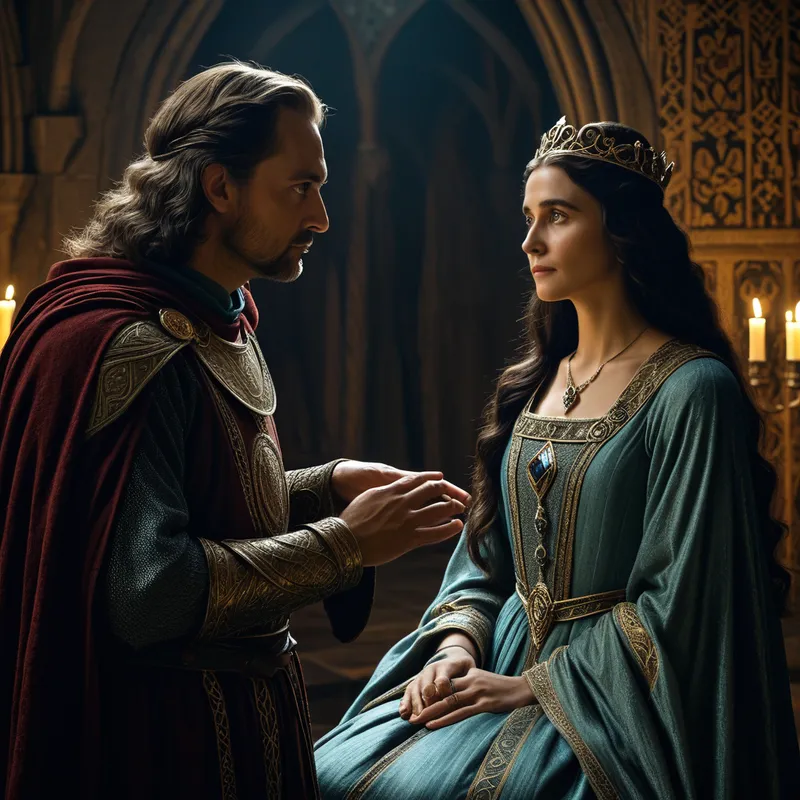
Listen, and hear a tale not of a shining knight, but of a shadowed queen and the soul she wore upon her breast. In the mist-wrapped isle of Avalon, where apple blossoms fall like snow onto still waters, dwelled Morgan le Fay. Sister to a king, priestess of forgotten rites, her power was not in a sword, but in the deep, green knowledge of root and star. And of her many crafts, most precious was a brooch.
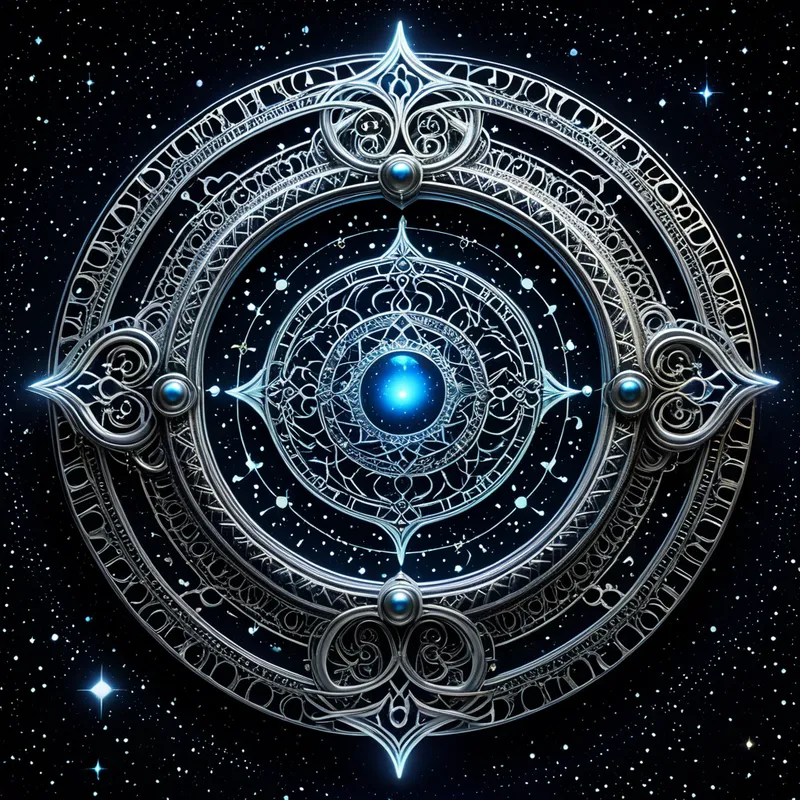
Forged not in mortal fire but in the cold light of the waning moon, it was a masterwork of silver, intricate as a spider’s web at dawn. At its heart lay a gem, dark as a pool in a forest at midnight, yet within it swam captured light, the very essence of her sovereignty. To wear it was to be cloaked in her authority, a charm of protection and command. It was her sigil, the anchor of her formidable will.
But shadows breed in courts as they do in forests. In Camelot, a knight named Sir Accolon, entangled in Morgan’s designs against her brother Arthur, dared more than most. Driven by ambition or perhaps a love twisted by enchantment, he committed the profound violation. He stole the brooch. Not from a locked chest, but from her very person, a theft not of metal but of identity. The moment it left Avalon, a chill entered the world. Morgan felt its absence like a severed limb, a silent scream in the substance of her magic.
Accolon, emboldened by his prize, fled to Camelot. He believed the brooch’s power now his to wield. He thought it a mere tool, a key to favor. He did not understand it was a covenant, a living knot tied to one spirit alone. At a great feast, hoping to curry ultimate favor, he presented the stolen treasure to Queen Guinevere. The court gasped at its beauty. Guinevere, innocent of its provenance, fastened it to her gown. And the world tilted.
For in that moment, the enchantment turned. The protective charm, severed from its mistress’s will, became a curse. A profound, creeping malaise descended upon the Queen. Her vitality drained, her thoughts grew clouded, her very life force seemed to ebb with each passing hour, drawn into the dark heart of the gem. Camelot fell under a pall of silent dread. The brilliant court was shadowed by a sickness no physician could name, a theft of spirit.
Word, carried on the whispers of spirits and the rustling leaves, came to Avalon. Morgan’s wrath was not a fire, but a glacier—slow, immense, and utterly relentless. She did not raise an army. She wielded a deeper magic: the law of return. The brooch, singing its lonely, twisted song in the halls of Camelot, was a beacon to her. Through mirror and scrying pool, she watched. She waited. And then, with the inevitability of tide reclaiming shore, she acted.
Guinevere, now faint and fading, was walking in a sun-dappled garden when a figure emerged from between the apple trees. It was Morgan, not as a invading foe, but as a force of nature incarnate. Her gaze went not to the terrified queen, but to the brooch at her breast. She spoke no spell of fire and lightning. She uttered a word of claiming, a syllable older than the stones of Britain. The brooch’s clasp sprang open of its own accord. It flew from Guinevere’s gown, not through the air, but through a fold in the world itself, and came to rest cold and final in Morgan’s outstretched palm.
As her fingers closed around it, the gem flared once—a dark, triumphant light. The connection was restored. The sickness lifted from Guinevere as suddenly as a veil removed. Color returned to her cheeks, clarity to her eyes. Morgan, without a further glance, turned and faded back into the green embrace of the garden, as if she had been a dream of the trees themselves. The brooch was home. The balance, forever altered, was restored.
Cultural Origins & Context
The tale of the brooch is a thread woven into the vast, contradictory tapestry of the Arthurian cycle. It appears most notably in the 15th-century Middle English Le Morte d’Arthur by Sir Thomas Malory, a compilation and reinterpretation of older French and Welsh romances. Morgan le Fay herself is a figure of immense transformation, evolving from a benevolent Celtic healer-goddess figure (like the Welsh Modron) into the complex, often villainous enchantress of later chivalric tradition.
This myth functioned in a society deeply concerned with loyalty, sovereignty, and the proper channels of power. The brooch’s theft and recovery is not a simple adventure; it is a political and metaphysical drama. It was told in courts to warn of the dangers of overreaching ambition (Accolon’s folly) and the sacred, dangerous nature of a ruler’s—or a divine woman’s—regalia. For a medieval audience, it underscored a fundamental truth: certain powers are not transferable. They are inherent, earned, or bestowed by a cosmic order, and to steal them is to invite cosmic realignment, often with catastrophic personal consequences. The storyteller, whether a bard or a cleric copying manuscripts, used it to explore the tension between the masculine, structured world of Camelot and the feminine, wild, and magical world of Avalon that constantly impinges upon it.
Symbolic Architecture
The Brooch of Morgan le Fay is far more than jewelry. It is a symbolic vessel for the animating principle of the anima in its most potent, undiluted, and autonomous form.
The brooch is the crystallized self, an objectification of soul-force that can be admired, coveted, stolen, or worn, but never truly owned by another.
Morgan represents the archetypal Sorceress or Dark Goddess—the part of the psyche that operates outside collective, patriarchal rules. Her brooch is her sovereignty: her right to rule her own inner domain, her unique magic, her self-containment. Sir Accolon symbolizes the heroic ego that, in its quest for power and status, believes it can appropriate the depths (the feminine, the unconscious, the intuitive) as a tool for its own ends. This is a foundational psychological error.
Guinevere’s poisoning is the critical lesson. When the detached, autonomous power of the soul is worn innocently or ignorantly (by the conscious personality that is not its source), it becomes toxic. It drains life rather than enhances it. The conscious mind cannot healthily host a power source it does not understand and to which it has no authentic claim. The resulting malaise is the depression, ennui, and loss of vitality that comes from living out of alignment with one’s own deep nature.
The Dreamer’s Resonance
To dream of such a brooch—especially one that is stolen, lost, or whose wearing brings sickness—signals a critical phase in what Jung called the reclamation of the soul. The dreamer is likely experiencing a profound sense of personal disempowerment, a feeling that their vital energy, creativity, or authentic voice has been hijacked. This may manifest somatically as chronic fatigue, a feeling of being “drained,” or psychically as a lack of motivation and a foggy sense of identity.
The dream is diagnosing a leak in the psyche. The “thief” could be an internal complex (an inner Accolon of ambition or people-pleasing) or an external situation (a job, relationship, or social role) that demands the dreamer wear a “false self” to survive. The act of the brooch being taken back by its rightful owner in the dream is a powerful, compensatory image from the unconscious. It represents the psyche’s innate movement toward wholeness, forcibly retrieving projected or stolen power and returning it to the core Self. The dreamer may wake with a sense of unease, but also with a cryptic message: what part of you have you given away that must now be reclaimed, no matter how dramatic the retrieval?

Alchemical Translation
The myth models the alchemical process of separatio and reunio applied to the Self. The initial state is wholeness (Morgan with her brooch in Avalon). Theft represents the necessary, if painful, separatio—the fragmentation where a core part of the Self is split off, often by trauma, socialization, or ambition. This exiled power then circulates in the “court” of the conscious personality (Guinevere wearing it), where it causes sickness because it is out of context.
The healing is not in integration as gentle assimilation, but in reclamation as a forceful, sovereign act. The Self must often confront the ego and take back what belongs to it.
The culmination is Morgan’s retrieval. This is the reunio, the alchemical marriage where the conscious ego (represented here by the court of Camelot) is forced to witness its own powerlessness and must submit to the authority of the deeper Self. The brooch’s return to Avalon signifies the reintegration of this sovereign power into the inner sanctum, the citadel of the soul. For the modern individual, the “alchemical translation” is the journey from allowing one’s essential magic to be stolen by the demands of the outer world (career, family, society) to the often-solitary, fierce work of calling it back. It is the moment we stop trying to heal the “sickness” caused by living falsely and instead, like Morgan, turn inward, utter the word of claiming, and take back what is ours. The cure is not adjustment, but revolution from within.
Associated Symbols
Explore related symbols from the CaleaDream lexicon: