The Bridge of San Luis Rey Myth Meaning & Symbolism
A sacred bridge tests a hero's faith, revealing the invisible threads of destiny woven by the divine and the human heart.
The Tale of The Bridge of San Luis Rey
Listen, and hear the whisper of the wind through the high passes. In the time when the world was young and the mountains still spoke with the voice of [Viracocha](/myths/viracocha “Myth from Incan culture.”/), there existed a chasm of such profound depth it was said to cleave the world soul in two. It lay between the peaks of Apu Sinakara and Apu Ausangate, a gash of pure shadow where condors feared to fly. The people of the valley below lived in the chasm’s long, cold twilight, their songs muted, their fields starved of the sun’s full kiss. They were a people divided from their own destiny.
The Inti shone upon both peaks, but his light could not bridge the void. The people prayed, their offerings of perfect maize and coca leaves carried away by the relentless wind. In answer, not a voice, but a vision came to the Villac Umu. He saw, in the heart of a lightning strike, a bridge not of stone or wood, but of will and witness. It would be the Chaka San Luis Rey, a sacred test. It would appear not for all, but for the one whose camac was woven with the threads of a greater fate.
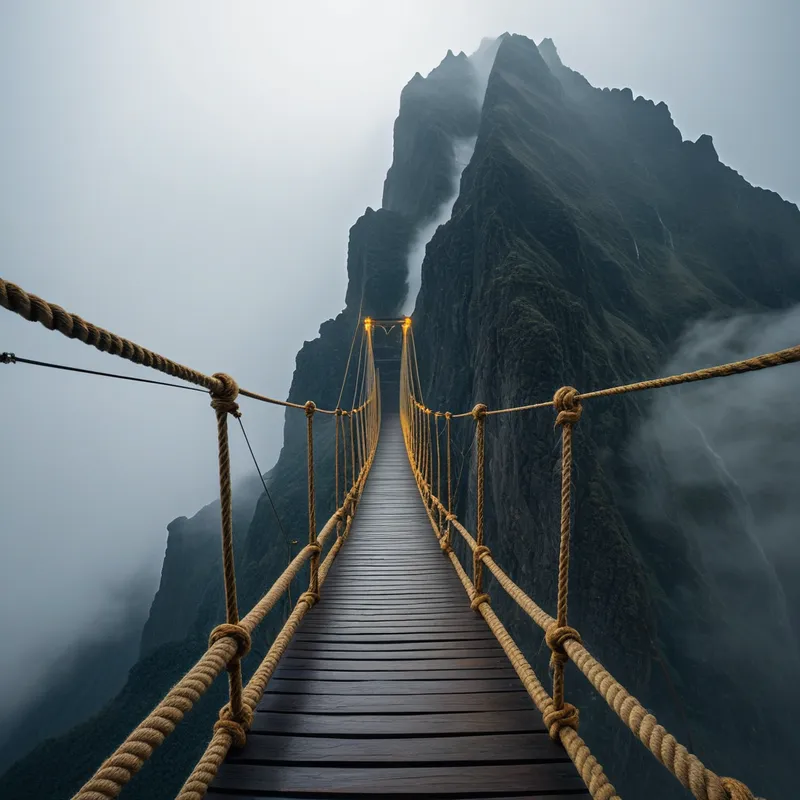
That one was a young woman named K’uychi, whose name meant “rainbow.” She was not a warrior, but a weaver of qompi, her fingers understanding the language of thread. One dawn, stained with the blood of a newly risen sun, the chasm was no longer empty. Where there had been only howling air, there now stretched a bridge of shimmering, golden ichu ropes and planks of polished illapa stone. It was terrifyingly slender, singing a low, haunting note in the wind. It led not to the opposite peak, but vanished into a swirl of cloud and light.
The Villac Umu spoke, his voice the sound of grinding tectonic plates: “The bridge is a question made by Pachamama and Inti. It asks of your faith. To cross is to trust the path the gods have woven for you alone. The void below is not emptiness; it is the face of the unknown Pacha.”
K’uychi approached. The bridge felt neither solid nor ephemeral. With each step, the world she knew—the smell of earth, the voices of her family—faded, replaced by the deafening silence of the heights. Halfway across, the bridge trembled. The planks beneath her feet became like q’espi glass, showing not her reflection, but visions: paths untaken, fears unborn, the skeletal shadow of her own demise in the abyss. The wind screamed accusations. This was the trial—to see the totality of one’s destiny, the beautiful and the terrible, and to walk it anyway.
She did not look away. She poured her fear into her breath, her doubt into the rhythm of her steps. She remembered the weave of her textiles, how a single thread is weak, but bound in ayni, it creates strength and beauty. She understood the bridge was that sacred reciprocity between her solitary courage and the divine intent. With a final step into the blinding cloud, she did not find stone, but solid, sun-warmed earth. The bridge vanished behind her. Before her lay not the opposite peak, but a new, verdant valley bathed in golden light, a direct gift from Inti. The chasm behind her remained, but the people now saw it not as a division, but as a sacred space that had been crossed. The bridge was gone, but the possibility of crossing was forever etched into the soul of the world.
Cultural Origins & Context
The myth of the Chaka San Luis Rey is believed to originate from the oral traditions of the Qosqo region, later refined and integrated into the state-sanctioned cosmological narratives of Tawantinsuyu. It was not a common folktale but a specialized teaching myth, likely recounted by Amautas and the Villac Umu during rites of passage or in the training of potential spiritual and administrative leaders.
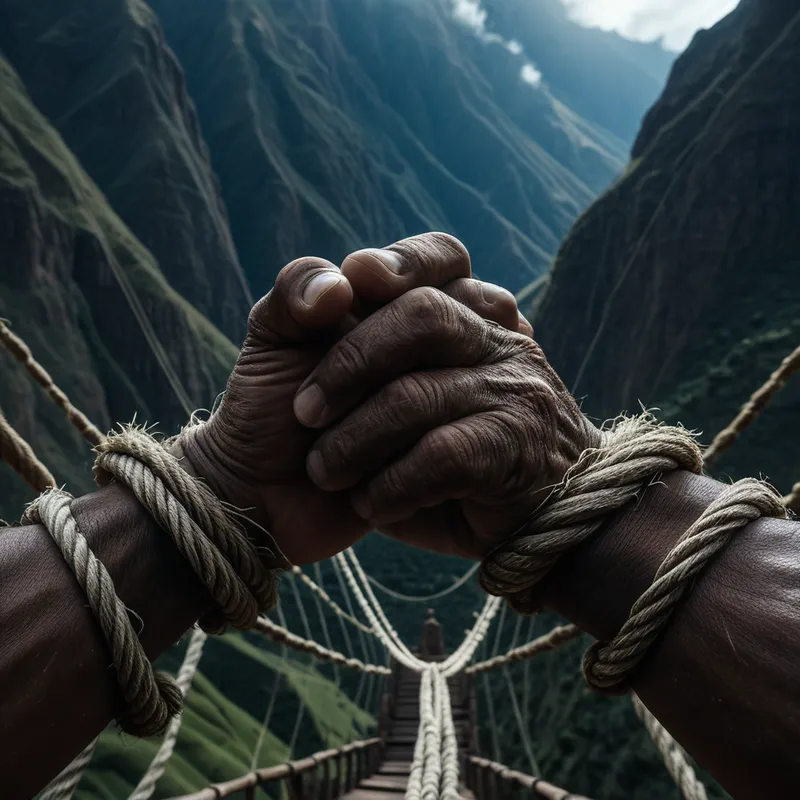
Its societal function was multifaceted. On one level, it reinforced the Incan worldview of a Tinkuy—a universe held in balance by sacred, often challenging, connections. The perilous bridge mirrored the Inca’s own astounding engineering feats, like the rope bridges across the Apurímac, transforming physical achievement into spiritual metaphor. More profoundly, it addressed the concept of personal Watan within the collective Tawantinsuyu. The myth taught that one’s destined path (Watan) is a collaboration between the individual’s will and the divine order, a bridge that appears only when the soul is prepared for the terrifying and illuminating journey across the abyss of the unknown.
Symbolic Architecture
At its core, the bridge is the ultimate [symbol](/symbols/symbol “Symbol: A symbol can represent an idea, concept, or belief, serving as a powerful tool for communication and understanding.”/) of the Tinkuy—the fraught, fertile point of [connection](/symbols/connection “Symbol: Connection symbolizes relationships, communication, and bonds among individuals.”/) between opposites: known and unknown, [human](/symbols/human “Symbol: The symbol of a human represents individuality, complexity of emotions, and social relationships.”/) and divine, fear and [faith](/symbols/faith “Symbol: A profound trust or belief in something beyond empirical proof, often tied to spiritual conviction or deep-seated confidence in people, ideas, or outcomes.”/), individual [destiny](/symbols/destiny “Symbol: A predetermined course of events or ultimate purpose, often linked to spiritual forces or cosmic order, representing life’s inherent direction.”/) and cosmic order.
The bridge does not span a physical space, but a psychic one. It is the moment of decision where the soul’s narrative must either dissolve into chaos or be rewoven into a new, more conscious pattern.
The [chasm](/symbols/chasm “Symbol: A deep fissure in the earth representing a profound division, transition, or psychological gap between states of being.”/) represents the unintegrated aspects of the Self, the collective [shadow](/symbols/shadow “Symbol: The ‘shadow’ embodies the unconscious, repressed aspects of the self and often represents fears or hidden emotions.”/), and the terrifying freedom of pure potentiality. K’uychi’s profession as a weaver is critical; she is an [archetype](/symbols/archetype “Symbol: A universal, primordial pattern or prototype in the collective unconscious that shapes human experience, behavior, and creative expression.”/) of the [consciousness](/symbols/consciousness “Symbol: Consciousness represents the state of awareness and perception, encompassing thoughts, feelings, and experiences.”/) that can actively participate in weaving its own [fate](/symbols/fate “Symbol: Fate represents the belief in predetermined outcomes, suggesting that some aspects of life are beyond human control.”/) from the threads provided by the gods (the unconscious). The transparent, mirror-like planks are the ruthless [clarity](/symbols/clarity “Symbol: A state of mental transparency and sharp focus, often representing resolution of confusion or attainment of insight.”/) of self-confrontation required for any genuine transformation. The bridge’s disappearance after the crossing signifies that the true transformation is internal; the external symbol is no longer needed once the psychic [integration](/symbols/integration “Symbol: The process of unifying disparate parts of the self or experience into a cohesive whole, often representing psychological wholeness or resolution of internal conflict.”/) is complete.
The Dreamer’s Resonance
When this myth pattern surfaces in modern dreams, it signals a profound crossroads in the dreamer’s individuation process. To dream of standing before a vast, fragile bridge is to stand at the threshold of a major life transition—a career change, the end of a relationship, a spiritual awakening—where the known world is receding and the new one is not yet formed.
The somatic experience in the dream is key: the vertigo in the pit of the stomach, the weakness in the knees, the sound of the wind. This is the body registering the death of an old psychological structure. The dream may present the bridge as impossibly long, broken, or swaying violently. This reflects the ego’s resistance and terror. If the dreamer finds themselves crossing, even hesitantly, it indicates a nascent, courageous engagement with the unconscious process. The appearance of the bridge in a dream is the psyche’s own Watan calling, presenting the necessary, terrifying, and ultimately healing path across one’s personal abyss.
Alchemical Translation
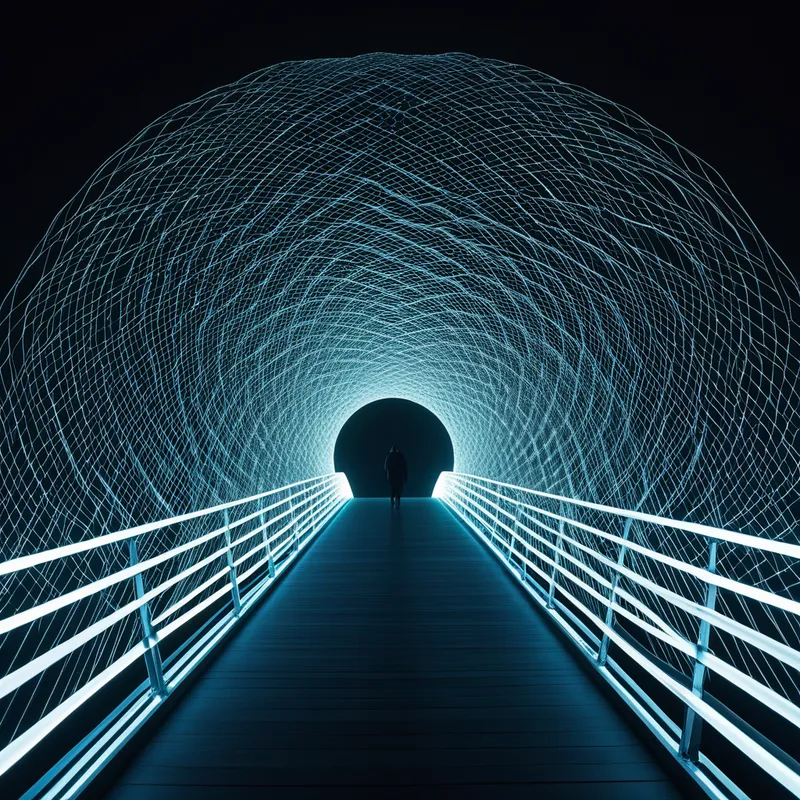
The myth models the alchemical individuation process with stunning precision. The initial state is one of separation (the divided people in shadow). The call to adventure is the appearance of the bridge—the nigredo, or dark night of the soul, made manifest.
The crossing is the alchemical ablutio and coniunctio happening simultaneously. One is purified by the terrifying wind of truth and conjoined with one’s own deeper destiny.
K’uychi’s steady progress represents the conscious ego (the weaver) enduring the dissolution of its old form (the transparent planks showing her fears) and holding steady. This is the sacred tension of the vas in the alchemical vessel. She does not fight the visions but integrates them, moving from a state of passive suffering to active participation in her own fate.
The arrival in the new, sun-drenched valley is the rubedo, the reddening—the achievement of a new, more authentic, and illuminated state of being. The vanished bridge signifies that the process is complete; the tool of crisis has been internalized as wisdom. For the modern individual, the myth teaches that our most profound crises are the sacred bridges offered to us. Our task is not to wait for safe passage, but to find the weaver within who can walk the trembling, illuminating path of self-becoming, trusting that the other side holds not just safety, but a more whole and radiant world.
Associated Symbols
Explore related symbols from the CaleaDream lexicon:
- Bridge — The central archetype of connection and transition, representing the perilous and necessary path between two states of being, consciousness, or destiny.
- Destiny — The hidden pattern or thread (Watan) that the bridge makes visible, challenging the individual to consciously walk its path.
- Abyss — The terrifying void of the unknown, the unintegrated unconscious, and the fertile ground of all potential that must be crossed for growth.
- Mountain — The sacred, immovable reality of the challenge or spiritual peak (Apu) that the seeker must connect with or ascend towards.
- Light — The illuminating consciousness of Inti that both reveals the bridge and awaits as the reward on the other side of the trial.
- Fear — The elemental wind that tests the bridge’s stability, representing the ego’s natural resistance to dissolution and change.
- Journey — The core narrative of the myth, framing the crossing not as a single event but as an archetypal process of transformation.
- Vision — The reflective, often frightening clarity provided by the bridge’s planks, forcing a confrontation with one’s own psyche and possible futures.
- Sacrifice — The offering of the old self, its securities and illusions, required to gain passage across the divine threshold.
- Rainbow — Echoing the hero’s name, it symbolizes the bridge as a covenant between heaven and earth, a fleeting, beautiful, and miraculous connection.
- Stone — The solid, enduring aspect of the divine will (illapa) that provides the foundation for the journey, even when the path feels fragile.
- Skybridge Walkway — A modern evocation of the myth’s essence: an exposed, awe-inspiring pathway through the realm of spirit and vast perspective.