The Bridge of Judgment Myth Meaning & Symbolism
A soul's journey across a perilous, hair-thin bridge, judged by wrathful deities, to face the ultimate mirror of its own karmic deeds.
The Tale of The Bridge of Judgment
Listen, and hear of the journey that awaits all who shed the mortal coil. This is not a tale of a distant land, but of the landscape of the soul itself, in the breathless interval between one life and the next.
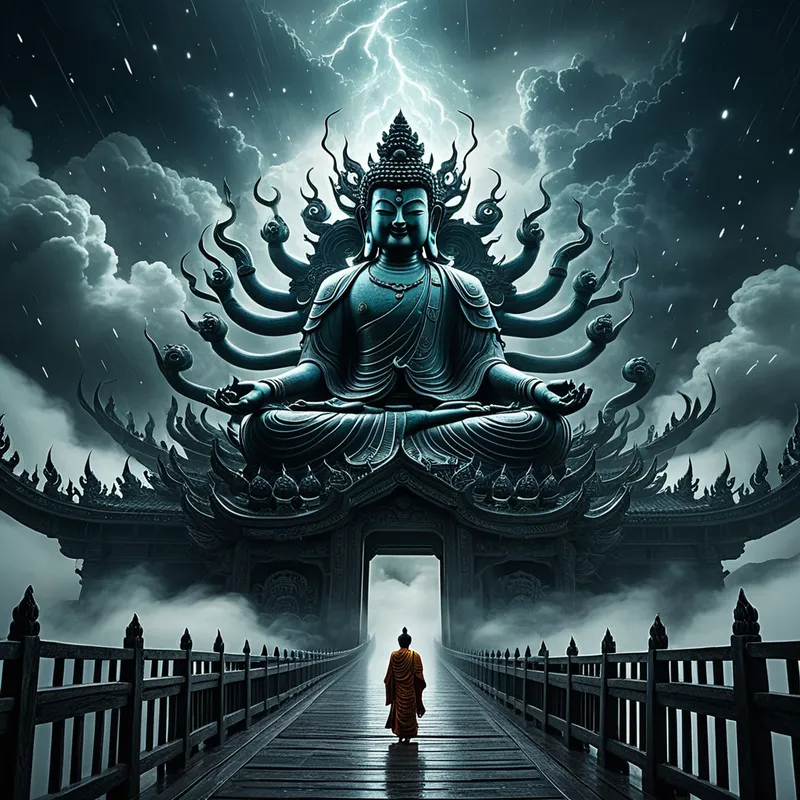
[The world](/myths/the-world “Myth from Tarot culture.”/) of solid earth and sky has fallen away. You are adrift in the Bardo, a windswept plain of consciousness where thought is the only terrain. Here, there is no sun, only a cold, phosphorescent glow. No sound, save for the whispering of your own lifetimes. Before you, stretching into a horizon of howling mist, lies the Chinvat Bridge.
To the virtuous soul, it appears broad as a king’s highway, paved with light, leading swiftly to peaceful realms. But to you, whose heart is a ledger of mixed deeds, it reveals its true nature: a bridge finer than a single hair, sharper than a razor’s edge. It spans an abyss so deep it drinks the light, from which rise the muffled roars of unseen beasts and the chilling scent of regret.
You are not alone on this precipice. From the swirling mists emerge the Dharmapalas. They are the Guardians of [the Law](/myths/the-law “Myth from Biblical culture.”/), their forms a terrifying symphony of divine fury. Their skin is the blue of a thundercloud at midnight, their eyes burn like coals. They bear crowns of skulls and wield flaming swords, hooks, and nooses. Their faces are contorted in wrath, yet in their deepest gaze flickers an unnerving, implacable compassion. They do not hate you. They are the manifestation of the law you yourself authored.
The Lord of Death, Yama, stands at the bridge’s head. In one hand he holds a mirror that reflects not your face, but the luminous and shadowed tapestry of your every action, word, and thought—your [karma](/myths/karma “Myth from Hindu culture.”/). In his other hand, he holds black and white pebbles, the weights of your deeds.
There is no trial, no pleading. The bridge itself is the judge. As you place a trembling foot upon that impossible filament, it reacts to the essence of your being. For a soul heavy with malice, greed, or deceit, the hair-bridge narrows further, becoming a searing blade. [The abyss](/myths/the-abyss “Myth from Kabbalistic culture.”/) yawns, and [the shadow](/myths/the-shadow “Myth from Jungian culture.”/)-beasts of your own creation—your anger given form, your lies given teeth—leap to drag you down into the whirlpools of suffering, toward a rebirth shaped by that very darkness.
But for the soul who steps with the weight of compassion, generosity, and awareness, the bridge steadies, widens, becomes a path of radiant silk. The wrathful deities roar, but it is a roar of [triumph](/myths/triumph “Myth from Roman culture.”/), a fierce blessing that parts the mists to reveal luminous fields and the compassionate faces of Bodhisattvas. The crossing is not a punishment, but a revelation. The bridge does not cast you down; it merely shows you who, in your deepest heart, you have already chosen to be.

Cultural Origins & Context
This powerful imagery finds its most detailed expression in the Bardo Thödol. This text is not a scripture describing an external afterlife, but a manual intended to be read aloud to a dying or recently deceased person. It is a guidebook for navigating the bardo, a psychological landscape of [projection](/myths/projection “Myth from Alchemical culture.”/) and opportunity.
The myth served a profound societal and pedagogical function. In cultures across the Himalayas, from Tibet to Mongolia, it was a central narrative for ethical living. It was told by lamas, depicted in vibrant, terrifying thangka paintings, and performed in ritual dances. Its purpose was not to instill fear for fear’s sake, but to cultivate mindfulness (smriti) and moral responsibility. By vividly illustrating the consequences of one’s actions (karma), it provided a framework for understanding suffering and happiness not as random events, but as the natural fruit of seeds sown by [the self](/myths/the-self “Myth from Jungian culture.”/). It externalized the internal process of conscience, making the abstract law of cause and effect viscerally real.
Symbolic Architecture
The Bridge of Judgment is a masterful [symbol](/symbols/symbol “Symbol: A symbol can represent an idea, concept, or belief, serving as a powerful tool for communication and understanding.”/) of the critical point of self-confrontation. It represents the [moment](/symbols/moment “Symbol: The symbol of a ‘moment’ embodies the significance of transient experiences that encapsulate emotional depth or pivotal transformations in life.”/) of [truth](/symbols/truth “Symbol: Truth represents authenticity, honesty, and the quest for knowledge beyond mere appearances.”/) that lies between cause and effect, between [action](/symbols/action “Symbol: Action in dreams represents the drive for agency, motivation, and the ability to take control of situations in waking life.”/) and consequence.
The bridge is not crossed at death; it is crossed with every moral choice. It is the razor’s edge of conscience that separates integrity from corruption in the human heart.
The Dharmapalas are not external punishers, but the [psyche](/myths/psyche “Myth from Greek culture.”/)’s own archetypal enforcers of wholeness. Their terrifying [wrath](/symbols/wrath “Symbol: Intense, often destructive anger representing repressed emotions, moral outrage, or survival instincts.”/) is the fierce [energy](/symbols/energy “Symbol: Energy symbolizes vitality, motivation, and the drive that fuels actions and ambitions.”/) of the superego and the unconscious combined—the part of us that will not tolerate self-deception. They are the [shadow](/symbols/shadow “Symbol: The ‘shadow’ embodies the unconscious, repressed aspects of the self and often represents fears or hidden emotions.”/) in its divine, transformative [aspect](/symbols/aspect “Symbol: A distinct feature, quality, or perspective of something, often representing a partial view of a larger whole.”/), demanding accountability. Yama’s mirror is the ultimate symbol of self-[reflection](/symbols/reflection “Symbol: Reflection signifies self-examination, awareness, and the search for truth within oneself.”/). It shows the [soul](/symbols/soul “Symbol: The soul represents the essence of a person, encompassing their spirit, identity, and connection to the universe.”/) not what it pretended to be, but what it actually is—the sum total of its psychic [energy](/symbols/energy “Symbol: Energy symbolizes vitality, motivation, and the drive that fuels actions and ambitions.”/), for good or ill. The [abyss](/symbols/abyss “Symbol: A profound void representing the unconscious, the unknown, or a spiritual threshold between existence and non-existence.”/) below is the unconscious itself, the [realm](/symbols/realm “Symbol: The symbol of ‘Realm’ often signifies the boundaries of one’s consciousness, experiences, or emotional states, suggesting aspects of reality that are either explored or ignored.”/) of unintegrated [shadow](/symbols/shadow “Symbol: The ‘shadow’ embodies the unconscious, repressed aspects of the self and often represents fears or hidden emotions.”/) [material](/symbols/material “Symbol: Material signifies the tangible aspects of life, often representing physical resources, desires, and the physical world’s influence on our existence.”/), repressed desires, and karmic latencies waiting to pull [the ego](/myths/the-ego “Myth from Jungian culture.”/) back into identification with its own darkness.
The Dreamer’s Resonance
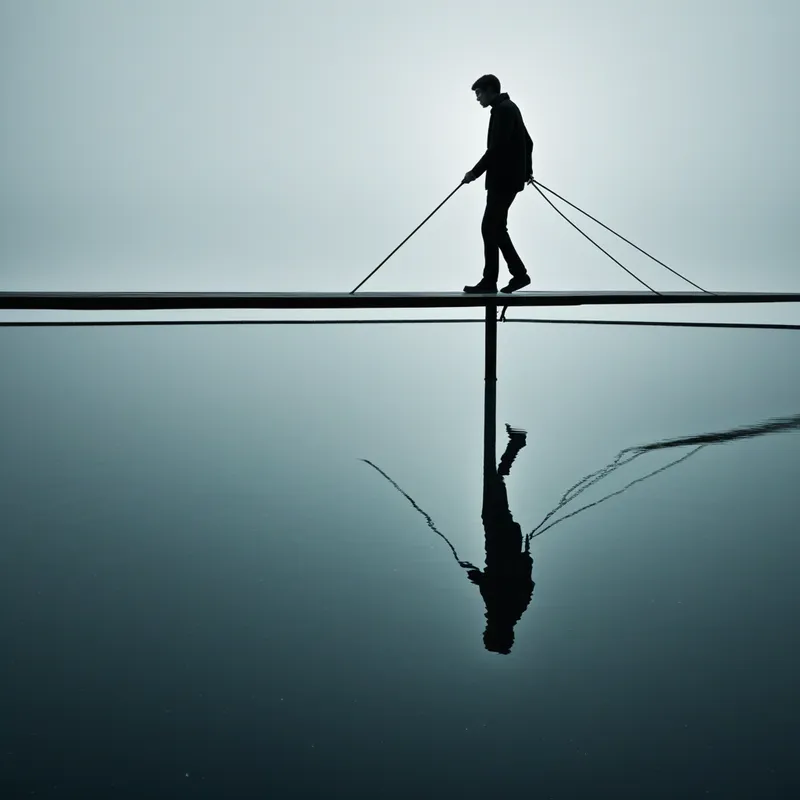
When this mythic pattern surfaces in modern dreams—as a precarious ledge, a failing rope bridge, or being judged before a tribunal—it signals a profound psychological process. The dreamer is at a somatic and psychic crossroads. This is the psyche’s innate “Bridge of Judgment” activating.
The body may feel it as anxiety, a tightness in the chest, or a sense of impending fall. Psychologically, the ego is being called to account. Perhaps a long-held self-image is cracking under the weight of contradictory actions. Maybe a life path feels unstable, built on shaky foundations of others’ expectations or personal falsehoods. The “wrathful deities” in the dream might manifest as a critical boss, a disappointed parent, or, most commonly, as the dreamer’s own overwhelming sense of guilt or shame. The dream is a stage where the soul’s internal ledger is being audited, forcing a confrontation between the [persona](/myths/persona “Myth from Greek culture.”/) ([the mask](/myths/the-mask “Myth from Various culture.”/) worn for the world) and the shadow (the denied aspects of the self).
Alchemical Translation
The alchemical journey of individuation—becoming the integrated, whole Self—is perfectly modeled by this myth. The process is one of psychic transmutation, where base elements of the personality (lead) are turned into gold (consciousness).
The first step is the [nigredo](/myths/nigredo “Myth from Alchemical culture.”/), the descent into darkness: facing the abyss and the terrifying guardians. This is the necessary shadow-work, where we must courageously look into Yama’s mirror and acknowledge our own mixed nature—our capacity for harm, our selfishness, our denied fears. To cross the bridge, we must lighten our load. This is the albedo, the whitening: the conscious effort to integrate these shadow aspects, to take responsibility for our karma without being crushed by guilt, and to cultivate the “virtues” that steady the path—authenticity, compassion, and self-honesty.
The triumph is not in avoiding the bridge, but in realizing you are both the traveler and the architect. The crossing is the act of consciousness weaving itself into a sturdier form.
The final arrival is not into a heaven “out there,” but into a state of inner alignment ([rubedo](/myths/rubedo “Myth from Alchemical culture.”/), the reddening). The peaceful fields are the psychic territory of the integrated Self, where one’s actions, thoughts, and essence are in harmony. The myth teaches that judgment is not a verdict passed upon us, but a moment of radical self-seeing. Our every choice is a step onto the hair-bridge, determining whether we walk toward greater fragmentation or toward the wholeness that was, paradoxically, our original nature.
Associated Symbols
Explore related symbols from the CaleaDream lexicon: