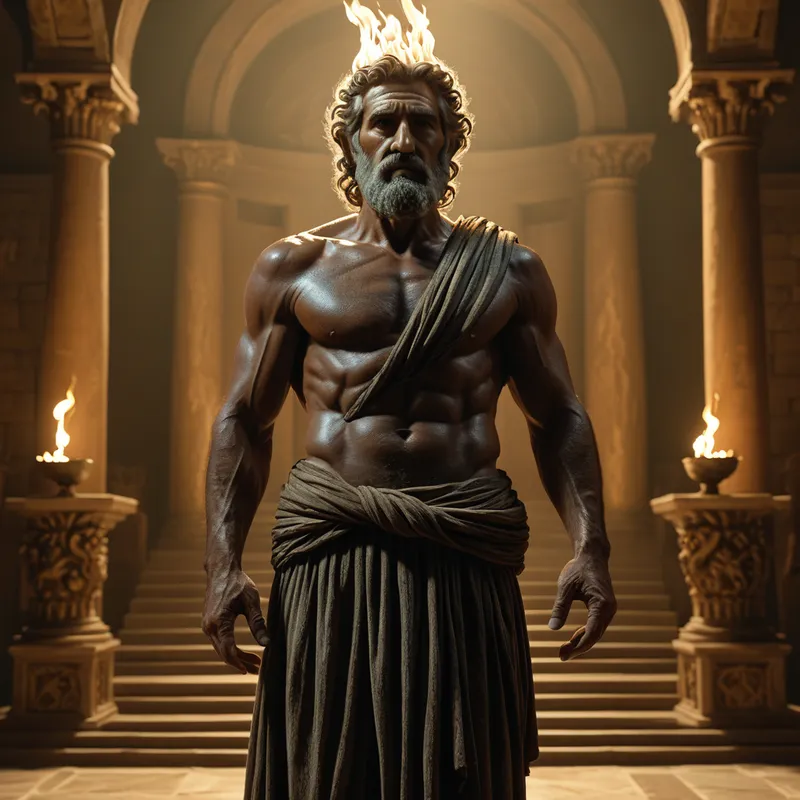
The Bowstring of Odysseus Myth Meaning & Symbolism
The impossible trial of stringing a divine bow becomes the ultimate test of a king's true identity, separating the rightful ruler from the usurping suitors.
The Tale of The Bowstring of Odysseus
The hearth-fires of Ithaca burned low, choked by the ash of disrespect. For twenty years, the great hall of Odysseus had been a den not of kings, but of carrion birds. A hundred and eight suitors, bloated on his wine and roasting his herds, clamored for the hand of his queen, Penelope, certain the master of twists and turns was food for fish. Despair, a thick wool, wrapped the heart of the kingdom.
In her cunning, a final stratagem was spun by Penelope. She brought forth from the shadowed armory the great bow of Apollo, a weapon that had once been a guest-gift from the hero Iphitus. “He among you,” she declared, her voice a thread of steel in the feasting-hall’s din, “who can string this bow of Odysseus and shoot an arrow clean through the sockets of twelve axe-heads lined in a row… him shall I follow from this house, forsaking my marriage bed of beautiful work.”
A roar of anticipation shook the timbers. One by one, the proud, soft-handed lords tried. They warmed the bow at the fire, they rubbed it with grease, they strained until the sweat poured from them like spring rain. But the bow, made of horn and sinew, a thing of power and memory, would not yield. It lay in their hands like a sleeping dragon, inert and mocking. Their strength was the strength of gluttony, not of purpose; their hands knew the feel of a cup, not the grip of destiny.
Into this scene of failure shuffled a stranger—a broken beggar, crusted with the salt and grime of the road, guided by the swineherd Eumaeus. Mocked and struck, he was but a ghost at the feast. Yet, when the bow came round, a strange light entered his eyes. He asked to try. Laughter, cruel and sharp, echoed. What harm could an old man do?
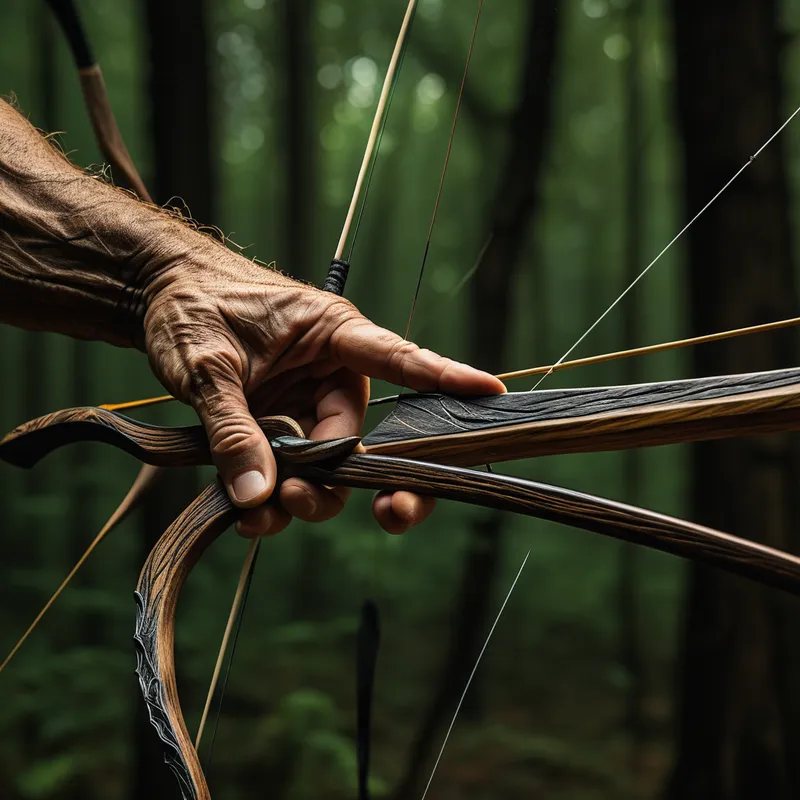
His fingers, though scarred and knotted, traced the curve of the horn as a lover traces a familiar face. He tested the bow’s weight, its balance—a master assessing an old friend. Then, without effort, as one tuning a lyre, he planted one end against the floor, bent the other, and slipped the gleaming gut string into its notch. A sound like the hum of a plucked star filled the sudden silence. He had strung the unstringable.
He plucked the string. It sang a note of vengeance, pure and terrible. In that moment, the disguise fell away not from his body, but from his essence. The beggar was gone. In his place stood the king, the sacker of cities, the man who had spoken with the dead and resisted the song of oblivion. The bow, an extension of his own sinew, had recognized its master. The final test was not of muscle, but of identity. The bowstring’s song was the first note of the reckoning to come.
Cultural Origins & Context
This pivotal scene is the narrative climax of Homer’s epic poem, the Odyssey, a foundational text of Hellenic culture composed in the 8th century BCE. It was not read, but heard, performed by a rhapsode (a singer of epic poetry) for communal audiences. The story functioned as more than entertainment; it was a cultural compass. In a society deeply concerned with xenia (the sacred law of hospitality and guest-friendship), the suitors’ violation of this code was a profound societal sin. Their inability to string the bow visually and viscerally demonstrated their moral and social illegitimacy.
The bow itself is a potent artifact from the older, heroic age of the Trojan War. It is a weapon of distance, precision, and intellect—perfectly suited to Odysseus, the “man of many ways,” whose triumphs come from cunning (metis) more often than brute force. The contest, devised by Penelope (whose own intelligence mirrors her husband’s), creates a perfect filter: only the true king, whose life and body are uniquely shaped by his twenty-year journey, can perform this specific act. It is a ritual of recognition, restoring the proper cosmic and social order to Ithaca.
Symbolic Architecture
The bowstring is the linchpin of the entire symbolic apparatus. It represents the point of maximum tension where potential is translated into kinetic action, where identity asserts itself through a definitive, irreversible act.
The unstrung bow is latent potential; the strung bow is destiny in the hand. The string is the covenant between the two.
The bow is Odysseus’s Self—his complete, kingly identity, which has been in a state of dissolution and disguise during his wanderings. The suitors represent the shadow aspects that have invaded his psychic “house”: entitlement, gluttony, disrespect, and the erosion of legacy. They can manipulate the symbol of his power (the bow) but cannot activate it, for they lack the essential connection—the right.
Stringing the bow is the ultimate act of psychic integration. It requires the strength forged in suffering (the scars), the skill earned through ordeal (the journey), and the unwavering connection to one’s own core truth (the recognition). It is not a display for others, but a private, profound moment of self-reclamation that the external world is forced to witness. The “twelve axe-heads” symbolize a seemingly impossible, linear path—the straight shot of fate that only the integrated self can navigate.
The Dreamer’s Resonance
When this myth pattern stirs in the modern unconscious, it often manifests as a dream of an impossible test centered on a personal artifact or skill. One might dream of being unable to play a familiar piece on a piano, of a key not fitting a lifelong home’s lock, or of a trusted tool breaking in one’s hand. The somatic feeling is one of profound frustration and fraudulent inadequacy—the “imposter syndrome” made literal.
This is the psyche signaling that a core aspect of identity has gone “unstrung.” The dreamer may be in a life situation—a job, relationship, or role—where they are going through the motions, surrounded by forces (internal or external) that feed on their energy without recognizing their sovereignty. The dream of successfully stringing the bow, however, is a powerful moment of breakthrough. It indicates the ego’s readiness to reclaim authority, to synthesize the lessons of a long and difficult “odyssey” of experience, and to act from a place of reassembled wholeness. The tension felt is the growing pain of integration.
Alchemical Translation
The alchemical process mirrored here is the rubedo, the reddening—the stage of culmination and empowered manifestation. Odysseus’s journey begins with the nigredo of war and loss, moves through the albedo of reflection and purification in his trials, and arrives at this moment of rubedo: the fiery, active reclamation of his kingdom.
The journey of individuation is the long labor of crafting the bow; the act of stringing it is the courageous decision to live from that integrated self, regardless of the audience.
For the modern individual, the “suitors” are the internalized voices of doubt, societal expectations, past traumas, and lazy habits that occupy the psychic house. The “disguise” is the adapted persona we wear that has outlived its usefulness. The alchemical work is to endure the journey of self-discovery, to gather the scattered pieces of one’s experience, and then, in the critical moment, to perform the simple, impossible act: to bend the arc of one’s own nature and connect the two ends. To string the bow is to say, “This, here, now, is who I am. This is my power, my truth, my shot to take.” The twang of the string is the sound of the Self, no longer latent, announcing its return to the world it must now set right.
Associated Symbols
Explore related symbols from the CaleaDream lexicon: