The Bothy Myth Meaning & Symbolism
A lone wanderer finds a mysterious hut at the world's edge, confronting the keeper of thresholds and the weight of all memory.
The Tale of The Bothy
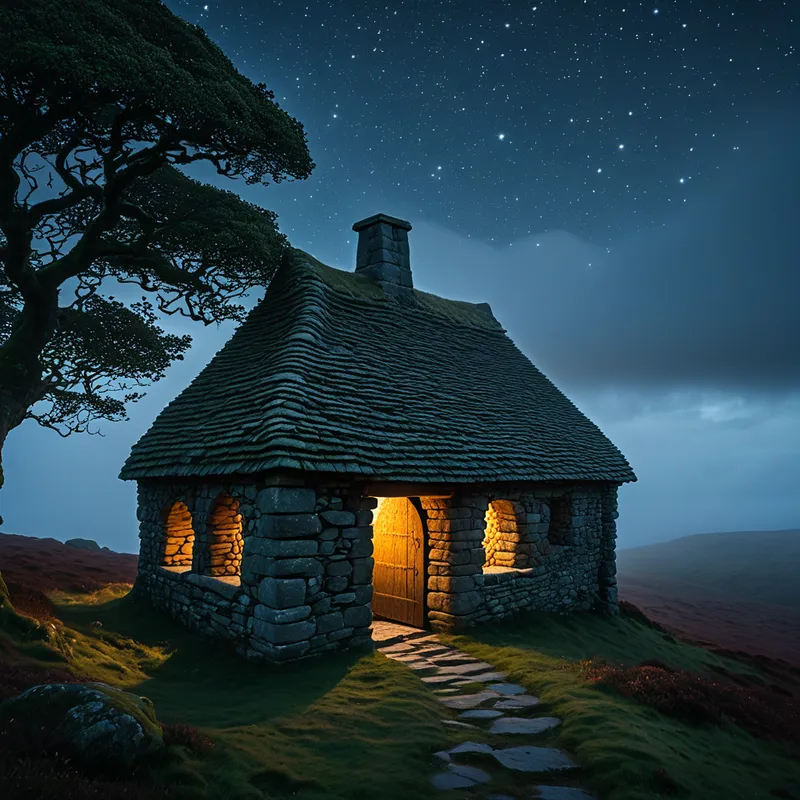
Listen. The wind does not blow here; it remembers. It carries the scent of peat-smoke from a fire long cold, and the salt-taste of tears shed for lands drowned beneath the waves. This is the edge-place, the caol áit. And here, where the path of the living frayed into mist and the track of the ancestors began its descent, stood The Bothy.
It was not built for mortal hands. Its walls were of stones found only in the beds of forgotten rivers, its roof a thatch of last year’s bracken and this year’s new growth, woven together. A single door, oak so old it was black, stood neither open nor shut. A faint, golden light, smelling of honey and damp earth, seeped from its cracks.
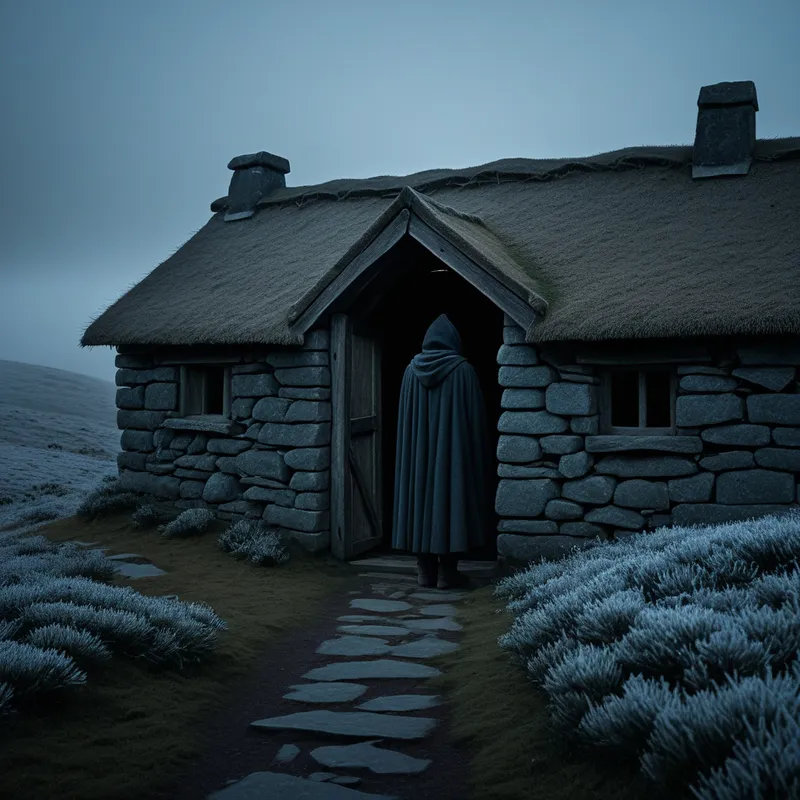
Into this silence came An Díbeartaigh, the Banished One. His feet were raw, his cloak threadbare from wandering the margins of clan lands. He carried no name, only a hollow where his story should be. He saw the light. It was not a welcome, but an acknowledgment. He pushed the door.
Inside was a space larger than the outside promised. A central hearth held a peat fire that burned without consuming. And in a chair of twisted willow sat An Coimhéadaí, the Watcher. Neither old nor young, their eyes held the patient stillness of mountains. They did not speak.
“I seek shelter,” An Díbeartaigh said, his voice cracking the immense quiet.
The Watcher gestured to the walls. They were not stone, but memory. Here, the laughter of a child from a village lost to plague. There, the final battle-sigh of a warrior whose name even the bards had forgotten. In a corner, the first green shoot piercing winter’s crust. The Bothy was not a shelter from the storm, but a vessel for it—for every joy, grief, and mundane moment that ever was and ever would be on that land. The weight of it pressed the air from the wanderer’s lungs.
“This is not shelter,” he whispered. “This is a tomb of echoes.”
For the first time, the Watcher spoke, their voice like stones settling in a stream. “It is the weight you already carry. You just did not know its shape.”
The wanderer looked at his own hands. He saw not his own life, but the ghost-impression of the ploughman who once worked this soil, the sorrow of the mother who wept here, the hope of the lover who waited there. He was not an individual, but a locus—a point where all these threads gathered. His exile was not from people, but from this knowing. The conflict was not without, but within. To stay was to be dissolved into the chorus. To leave was to remain a hollow man.
He did not flee. He walked to the hearth, and into the silent, timeless fire, he placed the only thing he owned: his loneliness. It did not burn. It unraveled. The thread of his solitude wove itself into the tapestry on the wall, becoming part of a larger, older pattern of longing. And in its place, in the hollow of his chest, grew not a new story, but a quiet resonance with all stories.
At dawn, he left. The Bothy was gone. But on the wind, he could now hear the memories, not as a crushing weight, but as a song of belonging. He was still An Díbeartaigh, the wanderer. But he was no longer banished. He was a seeker, and the path itself was home.
Cultural Origins & Context
The motif of the mysterious hut or house at the world’s edge is a scattered but potent fragment in the Celtic narrative tradition, found more in the marrow of folklore than in the codified myth-cycles. It belongs not to the grand courts of the Tuatha Dé Danann, but to the seanchas—the lore told by the hearth, concerning the edges of maps and the margins of the human experience. These stories were the province of the seanchaí, who served not just as entertainers but as psychologists of the landscape, explaining the unease one feels in a particular glen or the comfort found in another.
The Bothy myth functioned as an etiological story for the profound, often disorienting sense of place inherent to Celtic cosmology. In a worldview where every stream, hill, and stone could have an anam, a human’s relationship to land was a conversation. The Bothy narrative provided a framework for understanding moments of radical dislocation—exile, famine, emigration—and the subsequent, haunting sense of connection to a home one cannot physically reach. It taught that belonging is not a fact of residence, but a quality of memory and psychic acknowledgment.
Symbolic Architecture
The Bothy is the ultimate symbol of the axis mundi made intimate. It is not a towering world-tree, but a humble shelter that contains the cosmos. Its impossible interior speaks to the nature of the psyche itself: a seemingly confined space that holds infinities.
The threshold is not a line to cross, but a membrane through which the self is reconstituted.
An Díbeartaigh represents the conscious ego in a state of alienation, believing itself to be separate, autonomous, and story-less. His journey is not to conquer, but to remember. An Coimhéadaí is the archetypal guardian of the threshold, a personification of the Self (in Jungian terms) or the deep, impersonal psyche. They do not give answers but present the seeker with the unvarnished truth of their own composition.
The central alchemical act is not a battle, but an offering. The wanderer’s “loneliness” is the illusion of separateness. By surrendering it to the communal fire—the transformative heart of the Bothy—he exchanges a personal symptom for a transpersonal connection. He does not gain a new identity, but discovers his place in the pattern.
The Dreamer's Resonance
To dream of The Bothy is to encounter the psyche’s own archive. It often appears during life transitions—emigration, career change, the empty nest, a spiritual crisis—when the old sense of self feels hollow or “banished.” The dream Bothy might be a childhood home, a library, a data server, or a simple, glowing shed at the end of a familiar street made strange.
The somatic experience is key: a palpable pressure in the chest, a feeling of being filled with foreign yet familiar emotions, or the profound silence described in the myth. This is the unconscious presenting the dreamer with the collective and ancestral material they carry. The conflict is the same: to open the door is to risk being overwhelmed by this material; to turn away is to remain in a state of rootless anxiety. The resolution in the dream, if it comes, is rarely verbal. It is a felt sense of permission—to acknowledge the weight, to see one’s personal struggles as part of a human tapestry, and in doing so, to find a paradoxical lightness.
Alchemical Translation
The myth of The Bothy models the individuation process as one of re-membering—literally, putting the members of the psyche back together. The modern individual, like An Díbeartaigh, is often an orphan to their own depth, conditioned to believe the ego is the whole self. Our culture prizes the forging of a unique identity, often at the expense of connection to the ancestral, the instinctual, the ecological.
The journey to the edge of the known world is the necessary withdrawal from persona-driven life. The confrontation with the Watcher is the moment in analysis or deep reflection when we are shown not our personal history alone, but the archetypal patterns that shape it. The walls of memory are the contents of the collective unconscious.
The fire that does not consume is the transformative core of the psyche, where what we perceive as our private pain is transmuted into a connective tissue.
The offering is the critical step. We must sacrifice the neurotic attachment to our specialness-in-suffering, our “unique” loneliness. This is not a loss, but an expansion. When the ego surrenders its claim to absolute sovereignty and acknowledges its role as a vessel for these larger forces, it ceases to be an orphan. It becomes a dweller at the threshold, capable of moving between the inner world of archetypal truth and the outer world of daily life, carrying the song of belonging. The path home is walked with the same feet, but the traveler is forever changed, now a conscious participant in the ancient, ongoing story.
Associated Symbols
Explore related symbols from the CaleaDream lexicon: