The Bone Harp Myth Meaning & Symbolism
A goddess of sovereignty, grieving her slain son, crafts a harp from his bones and sinews, weaving a song that restores life and memory from death.
The Tale of The Bone Harp
Listen. The wind in the hollow hills does not merely blow; it keens. It remembers a time when the borders between this world and the Sídhe were thin as mist, and sorrow could shape the bones of the earth itself.
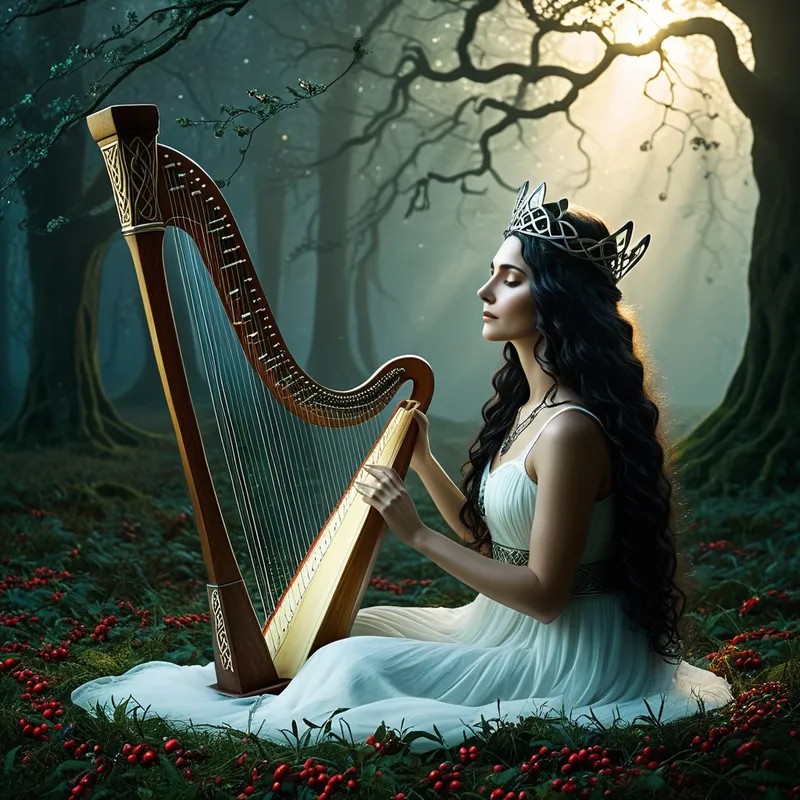
In the age when kings were wed to the land, there was a queen of the Tuatha Dé Danann. She was The Morrígan in one of her countless guises, not as the crow-battle prophetess, but as the sovereign mother, the heart of the tribe. Her name is lost to the mist, but her story is etched in the marrow. She had a son, a bright youth, a champion whose laughter was like sunlight on spear-points. In a battle against a rival clan—a skirmish over a sacred ford or a slight against the land’s honor—he fell. His body was brought to her, broken and cold, the promise of his reign spilled upon the clay.
The court wailed. The bards began composing laments. But the queen was silent. Her grief was a cold, still lake, too deep for tears. She dismissed them all. For three days and three nights, she sat in the dim, earthen silence of the royal souterrain, cradling her son’s form. She did not pray to the gods, for she was of them. She did not curse fate. She listened.
And in that listening, she heard a hum. Not from the air, but from the very bones before her. A memory of song, a vibration of life not yet fully departed. With hands that were both a mother’s and a goddess’s, she began. Not to bury, but to build. She cleaned and polished the long bones of his arms and legs, fashioning the pillar and the harmonic curve. She took the ribs, slender and strong, for the forepillar. From the chamber of his heart, she drew a resonance box of sternum and shoulder blade. Then, with infinite care, she harvested the long, resilient sinews from his limbs, drying and twisting them into strings.
Her work was not macabre, but meticulous, a sacrament of attention. Each placement was a memory: this string for his first step, this for the timbre of his voice, this for the strength in his hand. Finally, in the deep watch of the third night, it was complete. A harp, stark and beautiful, wrought from the architecture of her loss.
She took it to the highest hill, where the first grey light of dawn touched the land. She placed her fingers on the strings made of his sinew, on the frame made of his bones. And she played.
She did not play a lament. She played him. She played the rushing joy of his childhood, the stubborn pride of his youth, the fierce courage of his final stand. The music was not of this world; it was the sound of memory given form, of love refusing the finality of the grave. It swirled around her, a visible storm of light and shadow, of sorrow and essence.
And from the music, from the very vibrations in the dawn air, a form began to coalesce. Not his physical body—that was the harp now, sacred and transformed—but his fírinne, his truth, his spirit. A luminous presence, a son not of flesh but of story and song, stood before her. He smiled, a smile of understanding and peace, and then, as the last note faded, he dissolved into the morning light, woven back into the fabric of the Otherworld.
The queen descended the hill, the Bone Harp cradled in her arms. She was still sovereign, still bearing grief, but now it was a creative force. The harp became the tribe’s most sacred treasure, played only at the coronation of kings and the commemoration of heroes, a reminder that from our deepest fractures, the most enduring music can be born.
Cultural Origins & Context
The myth of the Bone Harp is not found in a single, canonical text like the Ulster Cycle or the Mythological Cycle. It exists in the liminal space of folklore, passed down in fragments through bardic traditions and local seanchaí tales, often attached to different figures—sometimes a goddess, sometimes a mortal queen of surpassing power. This very fluidity is its Celtic hallmark. The Celts held a profound, non-linear relationship with death and the body. Bones were not mere remains; they were the enduring structure, the seat of strength and lineage.
The harp itself, the cruit, was no simple instrument. It was the voice of the tribe, capable of inducing laughter, tears, or sleep. Bards were keepers of history, law, and genealogy, their music a conduit to the Otherworld. A harp made from bone, therefore, represents the ultimate fusion of these concepts: the physical lineage (bone) becomes the vessel for cultural memory and spiritual communication (harp). The myth likely served multiple societal functions: as a profound meditation on grief that transcends passive mourning for active creation, as a legitimization of the bardic art’s sacred power, and as a metaphor for the belief that the ancestors remain with us, not as ghosts, but as the resonant structure—the bone—of our identity.
Symbolic Architecture
At its core, the myth dismantles the dichotomy between life and death, destruction and creation. The harp is the ultimate symbol of alchemy: the base material of mortality is transmuted into an instrument of immortal resonance.
The most profound creation often requires the deconstruction of a previous form. The psyche, like the goddess, must sometimes dismantle its cherished identities to build the instrument that can play its true song.
The son represents a prized potential, a beloved aspect of the self or a foundational identity that is violently lost—through trauma, betrayal, or the inevitable crises of life. The mother/queen/goddess represents the sovereign, creative Self, the aspect of the psyche that can hold the tension of unbearable loss without fragmenting. Her retreat into the underground chamber is a necessary descent into the unconscious, a ritual incubation. The construction of the harp is the painstaking process of re-membering—not in the sense of recalling, but of literally putting the pieces of a shattered experience back together into a new, functional, and beautiful whole. The sinew strings are the connections of meaning we draw from our lived experience, the narratives we spin from our pain.
The Dreamer’s Resonance
When this myth stirs in the modern unconscious, it often surfaces in dreams of profound transformation following loss. One might dream of finding a strange, beautiful object in a basement or attic made from familiar, personal materials—a book bound in one’s own skin, a clockwork of family heirlooms. There is an initial shock, a somatic chill, that gives way to a deep, resonant curiosity.
The dreamer undergoing this process is at the pivotal point between being crushed by grief and being initiated by it. Somatic signs may include a tightness in the chest or bones (the literal “feeling” of the story), coupled with a sudden, creative urge—to write, to build, to compose—that seems to arise directly from the site of the pain. Psychologically, it marks the shift from asking “Why did this happen?” to “What can be built from what remains?” The dream is the psyche’s assurance that the lost person, relationship, or self-concept is not gone, but is waiting to be reconstituted as part of one’s inner treasury, one’s unique “harp.”
Alchemical Translation
The journey of the goddess is a perfect map of the individuation process, the alchemical nigredo, albedo, and rubedo.
The nigredo is the black despair of the son’s death—the crushing of the conscious attitude. The retreat into the souterrain is the necessary confrontation with the shadow, the raw, unprocessed material of the pain. The meticulous crafting of the harp is the albedo, the whitening: the conscious, patient work of analysis, therapy, or artistic expression that purifies the traumatic memory, separating its destructive charge from its essential truth. Stringing the harp with sinew is the act of finding the new narratives, the new neural pathways.
Individuation is not about becoming someone new, but about becoming a skilled musician of the self you have always been, an instrument forged in the fires of your own experience.
Finally, playing the harp on the dawn hill is the rubedo, the red gold of realization. It is the moment of synthesis where the transformed pain is reintegrated into the totality of the Self. The luminous spirit that appears is the transcendent function—the new, more complex psychic attitude born from the union of conscious and unconscious. The lost son is not resurrected in his old form; he is transfigured. He becomes an inner companion, a source of wisdom and resilience, just as the harp becomes a sacred treasure. For the modern individual, the myth instructs: do not seek to merely recover from your wounds. Listen to their strange music. Build from their very structure. Your most broken parts may become the framework for your most authentic song.
Associated Symbols
Explore related symbols from the CaleaDream lexicon: