The Body of Christ Myth Meaning & Symbolism
A myth of divine incarnation, sacrificial death, and mystical resurrection, where a fragmented world is offered a path to wholeness through a shared, sacred body.
The Tale of The Body of Christ
Listen. In the time when the heavens were silent and the earth groaned under the weight of its own forgetting, a whisper became flesh. It did not arrive with legion or flame, but in the shuddering breath of a woman in a forgotten stable, the scent of hay and animal warmth mingling with the iron-tang of hope. He was called Yeshua, and he walked not as a king upon marble, but as a healer upon dust. His hands, calloused from a carpenter’s trade, now touched the fevered brow, the withered limb, the eyes sealed shut by years of darkness. He spoke of a kingdom not of territory, but of the heart—a realm where the last were first, the hungry were filled, and the peacemakers were named children of God.
But the world of temples and taxes, of rigid law and brittle power, knows only how to break what it cannot comprehend. The whispers of love became thunderclaps of threat. In a garden slick with night sweat and betrayal, the flesh that spoke of a divine embrace was seized by mortal hands. The conflict reached its terrible crescendo on a hill of skulls. There, the body that had broken bread for thousands was itself broken. Nails tore through tendon and bone, anchoring him to the rough-hewn timber of the stauros. The sky darkened. From parched lips came a cry that seemed to tear the veil between time and eternity: a final, human breath released.
They laid that shattered body in a tomb, a cold stone chamber sealed with a stone and with despair. For three days, the world held its breath, the myth seemingly ended in the finality of decay.
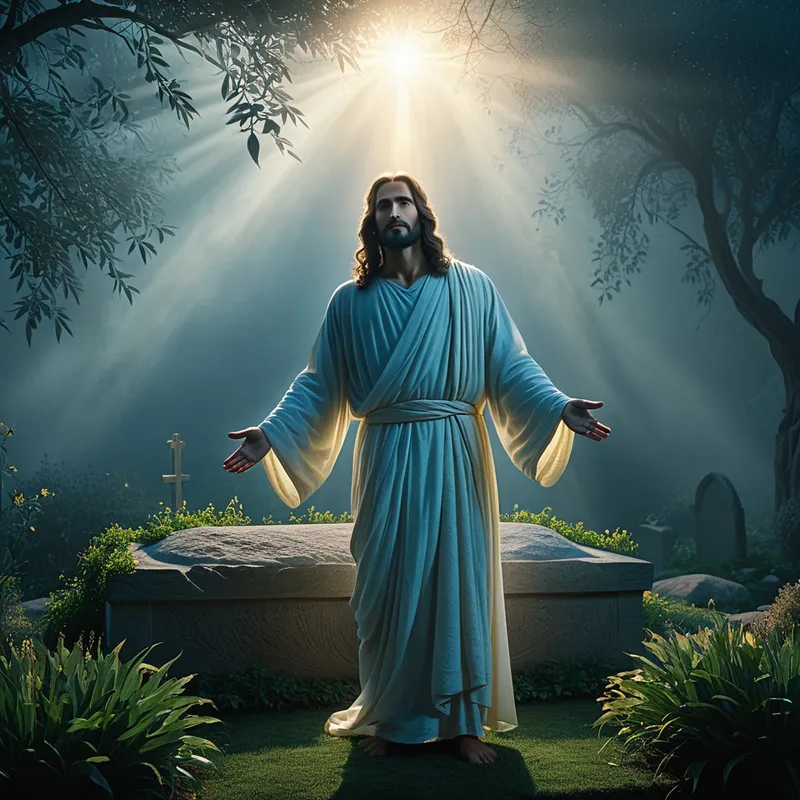
Then, at the first hint of dawn, when the myrrh-bearing women approached with heavy hearts, they found the stone rolled away. The tomb was empty—not with the emptiness of theft, but with the pregnant emptiness of a chrysalis. He appeared, not as a ghost, but more solid, more real than before. The wounds remained, but now they gleamed not as marks of defeat, but as seals of a terrible, loving passage. He ate broiled fish. He invited probing fingers into his side. This was no mere resuscitation. This was resurrection—the same body, yet utterly transfigured, the first fruit of a new creation.
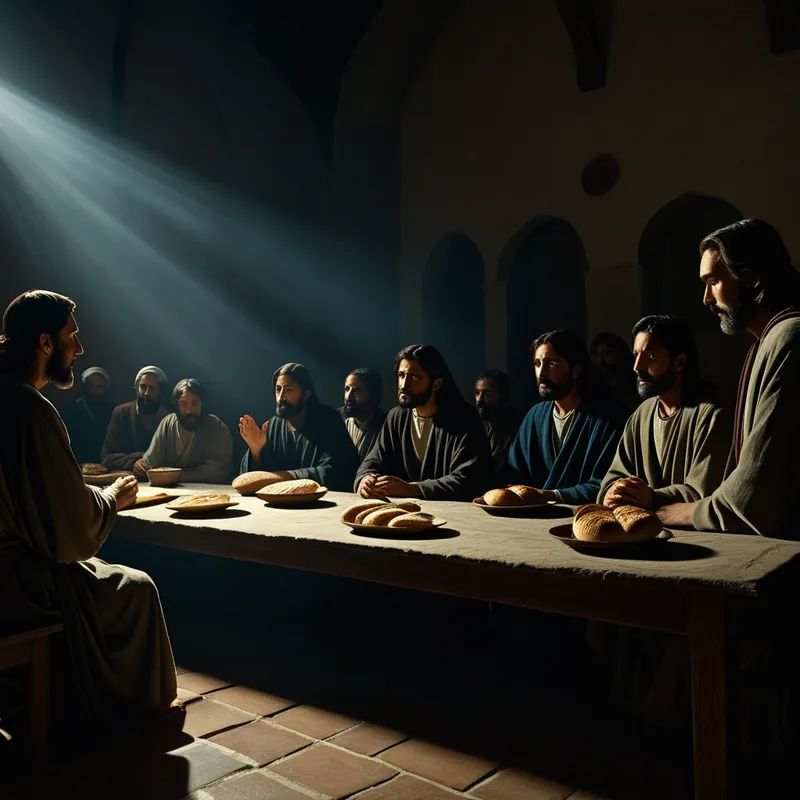
And before ascending into the mystery from which he came, he left a final, breathtaking instruction. At a shared meal, he had taken bread, blessed it, broken it, and said, “This is my body, given for you.” He took a cup of wine and said, “This is my blood of the new covenant.” He commanded them to do this, to remember. But in the remembering, something miraculous was promised: participation. They were not merely to recall a distant hero, but to ingest the myth itself, to have its substance become their own.
Cultural Origins & Context
This myth emerged from the volatile crossroads of Second Temple Judaism and the Roman Empire. It was first told not by scholars in libraries, but by fishermen, tax collectors, and women—the original witnesses—in homes, at market stalls, and in hidden gatherings. They were a persecuted minority, whispering a dangerous story of a executed criminal whom God had vindicated.
The primary vehicle for the myth’s transmission was the ritual meal, the Eucharist. In partaking of the bread and wine, each community re-membered the story, literally putting the pieces of the narrative back together in an act that made it present and potent. The letters of Paul, written before the Gospels, grapple fiercely with its meaning, showing a myth in active, contentious formation. Its societal function was dual: it created a powerful, counter-cultural identity for a scattered people (“you are one body”), and it offered a coherent theodicy, explaining suffering and evil through the lens of a loving God who enters into and transforms it from within.
Symbolic Architecture
At its core, the myth presents the ultimate alchemy of matter and spirit. The divine does not annihilate the human condition but enters into its fullness—including its agony, alienation, and mortality—and transmutes it.
The body is not a prison to escape, but the sacred vessel through which the cosmos is redeemed.
The “body” operates on three simultaneous levels. First, it is the historical body of Jesus, representing the perfection and vulnerability of incarnate life. Second, it is the Eucharistic body, the bread and wine, symbolizing how spiritual nourishment and transformation are mediated through the tangible, the communal, and the participatory. Third, it is the ecclesial body, the community of believers, representing the fragmented human family called into a new, reconciled unity.
The crucifixion is the symbolic death of the old paradigm of power—the ego’s kingdom of domination, purity, and self-preservation. The resurrection is the birth of a new consciousness, where life is found through surrender, strength through vulnerability, and identity through communion.
To eat the myth is to digest the reality that death and loss are not the final word, but are woven into a larger pattern of renewal.
The Dreamer’s Resonance
When this myth stirs in the modern psyche, it often manifests in dreams of profound fragmentation or sought-after wholeness. One might dream of their own body being broken apart, yet each piece remains alive and conscious. Or they may dream of desperately trying to assemble a scattered puzzle where the final image is a unified, luminous human form.
Somatically, this can correlate with a process of “falling apart”—a dissolution of the old personality structure during life transitions, grief, or deep therapy. The psychological process is one of ego-death. The dreamer is experiencing the crucifixion of their familiar self: the death of a cherished identity, a career, a relationship, or a worldview. The terror in the dream is the terror of the tomb. The subsequent dreams of reassembly or finding a nourishing, mysterious food point to the slow, often unconscious, work of resurrection—the psyche’s innate drive to reconstitute itself at a higher, more integrated level of being.

Alchemical Translation
For the individual on the path of individuation, the myth of the Body of Christ is a master map of psychic transmutation.
The incarnation is the first, crucial step: the descent of consciousness into the shadowy, material depths of one’s own psyche. It is the courageous act of saying “yes” to one’s full humanity—the wounds, the passions, the forgotten and rejected parts. The ministry represents the conscious work of engaging with these inner figures (the “healing” of the blind, the “feeding” of the hungry within), listening to their needs, and reconciling conflicts.
The crucifixion is the inevitable crisis. To become whole, the ruling attitude of the ego—which believes it is the sole center of the personality—must be relativized. It must endure the agony of seeing its plans fail, its certainties shattered. This is the nigredo, the dark night of the soul, where all seems lost.
The alchemical fire is not for destruction, but for distillation; it burns away the dross of illusion to reveal the golden core of the Self.
The resurrection is the emergence of the Self. It is not the old ego restored, but a new, more expansive center of personality that includes both the light and the dark, the conscious and the unconscious, in a reconciled state. Finally, the ascension and gift of the spirit symbolize the process by which this integrated consciousness no longer remains a private achievement but seeks to nourish the wider community—the “body” of relationships and the world. One becomes, in a psychological sense, a vessel through which the transformative, unifying principle of the Self is made available to the fragmented world. The myth thus charts the journey from isolated individuality to conscious participation in the great, mysterious body of being.
Associated Symbols
Explore related symbols from the CaleaDream lexicon: