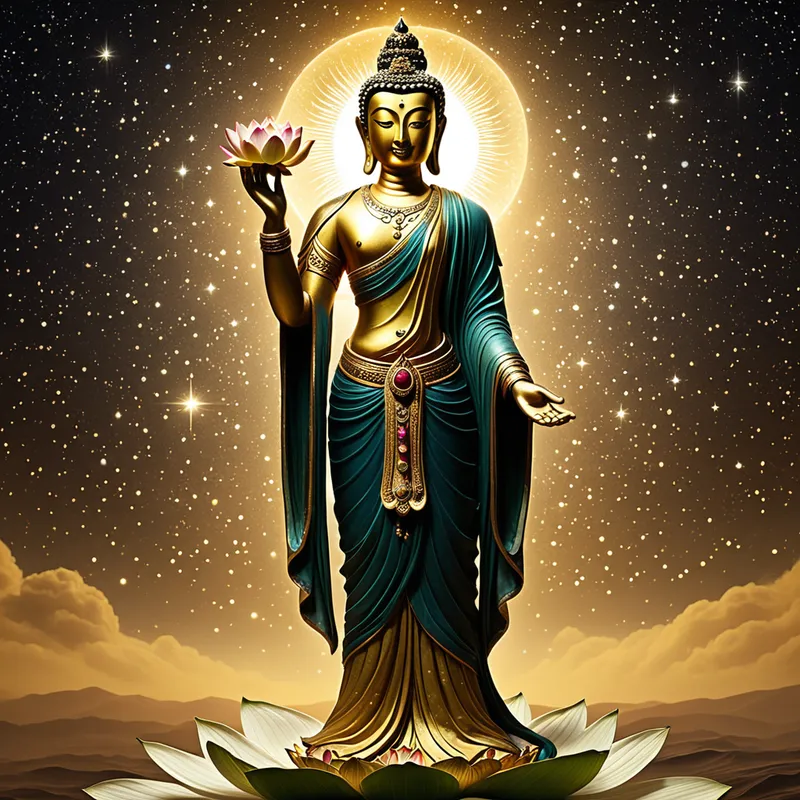
The Bodhisattva Myth Meaning & Symbolism
A being on the threshold of Nirvana makes a sacred vow to forgo final liberation, turning back to guide all others across the ocean of suffering.
The Tale of The Bodhisattva
Listen. There is a story told not of a distant heaven, but of a choice made at the very precipice of heaven’s gate.
In the immeasurable aeons of time, a being of profound wisdom and cultivated heart finally stands before the threshold. The long pilgrimage is complete. The fires of greed, hatred, and delusion are but cold ash. The great ocean of Samsara—with its relentless tides of birth, sickness, aging, and death—lies behind them, its roar now a distant whisper. Before them shines the silent, radiant peace of Nirvana, a refuge beyond all suffering, beyond all coming and going. It is the end of the road. It is the final, blissful homecoming for which every soul, knowingly or not, aches.
The being raises a foot to cross.
And then… they hear it. Not with ears, but with the very fabric of their awakened heart. It is a sound woven from a billion sighs, a chorus of confusion and anguish rising from the shore they have just left. They turn. With the eyes of one who sees things as they truly are, they gaze back across the dark waters. They see not a faceless mass, but a countless multitude of individual beings—each a mother, a father, a friend in the endless spiral of lives—trapped in the same dream of separation, clutching at phantoms of pleasure, fleeing shadows of pain, drowning in a sea of their own making. They are caught in the net, and they do not even know they are caught.
In that moment, at the apex of all spiritual achievement, the heart cracks open not in pain, but in a boundless, unbearable tenderness. The peace that beckons is real, but the cry from the shore is more real. The being lowers their foot. They turn their back to the open gate of liberation. They face the ocean once more.
And they speak a vow into the fabric of reality. It is not a whisper, but a declaration that shakes the foundations of worlds: “However innumerable sentient beings are, I vow to save them. However inexhaustible the defilements are, I vow to extinguish them. However immeasurable the Dharma is, I vow to master it. However unattainable the enlightened way is, I vow to attain it.” This is the Pranidhana. The being is now a Bodhisattva—one whose essence is awakening for the sake of all.
They do not descend as a god to rule, but as a friend to walk alongside. They take up the tools of compassion and wisdom—the Paramitas—and step back into the marketplace, the hospital, the battlefield of the world. Their Nirvana is no longer a place to reach, but an activity to perform in every moment: the act of turning towards suffering with an open hand and a fearless heart.

Cultural Origins & Context
The Bodhisattva ideal is the beating heart of <abbr title=“The “Great Vehicle” tradition of Buddhism, prevalent in Tibet, China, Japan, and Korea”>Mahayana Buddhism, emerging around the 1st century BCE as a profound evolution within the Buddhist world. It represented a democratization and radicalization of the spiritual path. While early teachings focused on the personal attainment of the Arhat, the Mahayana sutras, said to be the higher teachings of the Buddha, proclaimed a path for the many. These texts, like the Prajnaparamita literature and the Avatamsaka Sutra, were passed down by monastic communities and traveling scholars, often recited in rituals to inspire the laity.
The Bodhisattva was not merely a mythological figure but an archetypal role model for monks, nuns, and devoted laypeople. Cultivating Metta and Karuna became the central practice. The ideal served a critical societal function: it wove ethics and altruism directly into the fabric of spiritual aspiration. It transformed the spiritual journey from a private ascetic retreat into a communal project of universal salvation, fostering a culture of generosity, patience, and engaged care. Celestial Bodhisattvas like Avalokiteshvara and Manjushri became objects of devotion, providing accessible, compassionate intermediaries for everyday people.
Symbolic Architecture
The myth is not about a person, but about a fundamental reorientation of consciousness. It maps the psyche’s evolution from ego-centricity to world-centricity.
The ultimate act of self-realization is the realization that the self, as a separate entity, is the primary fiction from which all suffering springs.
The Threshold symbolizes the culmination of the ego’s project: self-perfection, self-liberation, the achievement of a pristine, isolated peace. The Turn is the critical moment of psychic death and rebirth. It is the dissolution of the spiritual ego, which discovers that its hard-won purity is just another possession, another form of separation. The Vow is the new psychic structure that emerges—a commitment sourced not from willpower, but from the recognition of fundamental non-separation. The Bodhisattva realizes that “my” liberation is inextricably woven with “yours.”
The Samsara they re-enter is not the same. It is now seen as the very field of awakening, the Buddhaksetra. The suffering of others is no longer an external problem to be solved, but the intimate cry of one’s own being. The tools of the Paramitas—generosity, ethics, patience, effort, meditation, wisdom—are the alchemical instruments for transmuting the lead of worldly engagement into the gold of enlightened activity.
The Dreamer’s Resonance
When this myth stirs in the modern dreamer, it often manifests as profound, unsettling dilemmas of responsibility and liberation. You may dream of finally reaching the mountaintop, only to be haunted by the faces of those left in the valley below. You may dream of boarding a lifeboat to safety, then seeing a stranger drowning and leaping back into the stormy sea. The somatic sensation is often a wrenching in the chest—a heart-chakra activation where personal joy feels incomplete, even guilty, when contrasted with the perceived suffering around you.
Psychologically, this marks a critical juncture in the process of Individuation. The ego has achieved a degree of competence, independence, and perhaps even hard-won peace. But the Self, the total psyche, is calling for a deeper integration. The dream signals the emergence of what Jung called the “mana personality” being challenged by the collective unconscious. The dreamer is being asked to sacrifice the inflation of being “the healed one” or “the awakened one” and to reconnect their personal achievement to the human community. It is the psyche’s rebellion against spiritual narcissism.

Alchemical Translation
For the modern individual, the Bodhisattva’s turn models the most radical phase of psychic transmutation: the sacrifice of the achieved state. Our culture glorifies the attainment—the promotion, the healed trauma, the enlightened insight. The Bodhisattva path reveals that clinging to that attainment becomes the final, most subtle prison.
The alchemical gold is not a state to be possessed, but a quality of relationship to be offered.
The process begins with Achievement (reaching the threshold). One masters a domain, integrates a complex, finds inner peace. Then comes the Echo (hearing the cry). A restless compassion arises. The personal solution feels insufficient; there is a pull to relate, to serve, to give form to the insight. This leads to the Sacrificial Pivot (the turn and vow). This is the active, often painful, choice to let go of identifying as the healed, wise, or successful person. You step down from the podium and into the crowd. Your authority no longer comes from your separation, but from your grounded connection.
Finally, there is Embodied Wisdom (the return). Your practice is no longer about cultivating a personal state of calm, but about becoming a clear, compassionate presence within the chaos. Your “Nirvana” is the unshakeable inner space from which you can hold another’s pain without being drowned by it. Your liberation is expressed as availability. You realize, as the Prajnaparamita Hrdaya teaches, that “Rupam sunyata sunyataiva rupam”—the absolute and the relative, peace and engagement, are not two. The Bodhisattva’s journey is the ultimate integration: to live in the world with all its mess and beauty, free from the world, for the sake of the world.
Associated Symbols
Explore related symbols from the CaleaDream lexicon: