The Blue Quran Myth Meaning & Symbolism
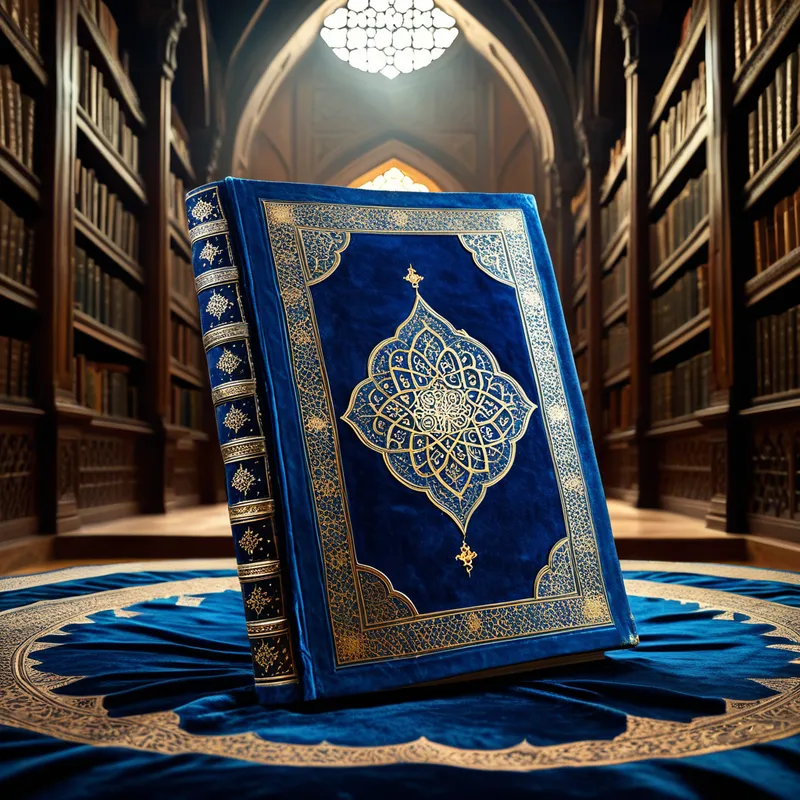
A celestial Quran of sapphire and gold is lost to the world, its divine light hidden until a seeker of pure heart can remember its forgotten script.
The Tale of The Blue Quran
Listen, and let the veils of time grow thin. Before the first minaret pierced the sky, in an age when the desert whispered secrets to the stars, there existed a scripture not of ink and paper, but of light and covenant. It was known as The Blue Quran.
Its covers were not leather, but the night sky distilled into a deep, fathomless indigo, dyed with the tears of prophets and the ink of forgotten stars. Upon pages of vellum, bleached whiter than desert bone, the Kalam was inscribed not with black gall, but with threads of molten silver and gold, as if the verses themselves were constellations captured and laid to rest. To gaze upon it was not to read, but to remember; each letter pulsed with a cool, silent luminescence, a direct echo of the Preserved Tablet in heaven. It was kept in a sanctuary of rose quartz and cedar, where the air hummed with the memory of the first command: Iqra—Read.
But the human heart, a vessel of clay, often trembles before a light too pure. A creeping forgetfulness, a ghaflah, settled upon the land. The people began to prefer the comforting shadow of their own interpretations to the blinding clarity of the direct light. They argued over the reflection in the pool, forgetting the moon above. In their neglect, the sanctuary’s guardians grew weary, their vigilance dimmed by the world's clamor.
It was then that the Great Vanishing occurred. Not with thunder or theft, but with a profound silence. One evening, the sapphire glow from the sanctuary simply… ceased. The niche was empty. No force had entered; the scripture, it was said, had withdrawn. It had folded in upon its own essence, retreating from a world that had ceased to see it, becoming potential once more. The people awoke to a terrible, hollow clarity—the light was gone, and only the memory of its illumination remained, a sharp pain in the soul. The desert winds, which once carried whispers of wisdom, now only howled the single, devastating question: Where have you placed your heart?
Generations turned to dust, and the tale became a lament, a half-remembered dream of a lost wholeness. Yet, in every age, a solitary seeker would feel the ache of that absence—a scholar in a dusty library, a mystic in a midnight vigil, a child staring at the deep blue twilight. They would feel a pull, a homesickness for a light they had never seen. These were the ones who heard the echo in the call to prayer, not just as sound, but as a map. They would journey, driven by dhikr—remembrance—following traces: a fragment of a blue-tiled wall in a ruined madrasa, a line of poetry comparing a lover’s eyes to "Quranic blue," the strange calm of a indigo-dyed robe.
Their quest was not through physical mountains alone, but through the interior mountains of the self—the peaks of pride, the valleys of despair. They were tested by mirages of dogma and the siren songs of easy answers. True finding, the old stories say, came only when the seeker’s heart became a mirror polished by longing and humility, empty of everything but the desire for the Source of the light, not the light itself.
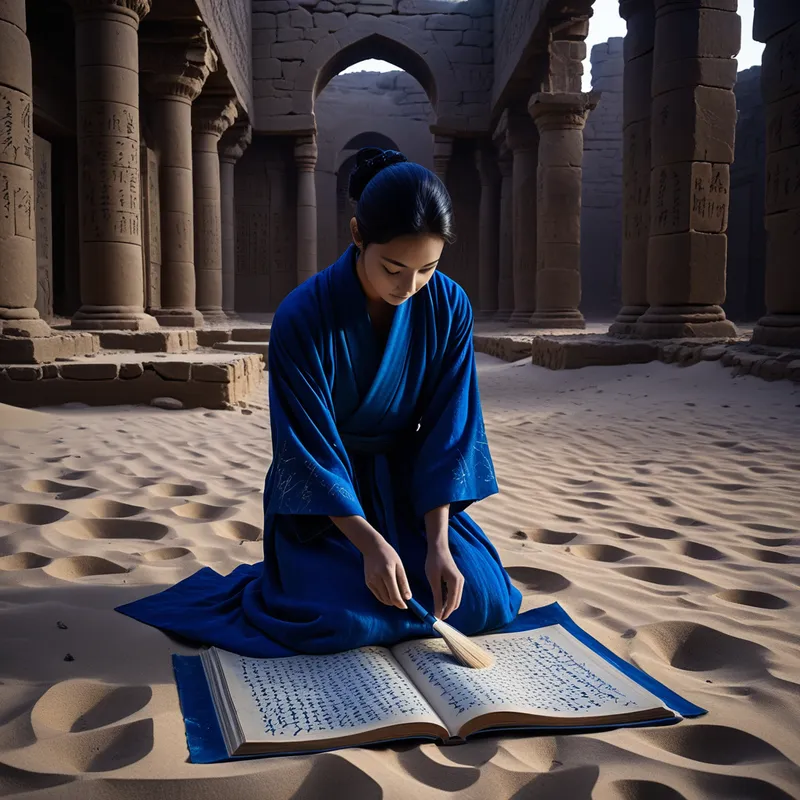
And in that moment of utter, silent surrender—often in a forgotten place, a desert cave, a hidden courtyard—the veil would thin. They would not find a physical book. Instead, the world itself would become the page. The deep blue of the evening sky would coalesce; the glittering stars would arrange themselves into familiar, divine shapes. The seeker would understand. The Blue Quran was never lost. It was hidden within the act of sincere seeking, inscribed upon the heart of the one who remembers. They would return, not with an artifact, but with a calm, unshakable light in their gaze, and the world, for a time, would feel the echo of that celestial blue once more.
Cultural Origins & Context
The myth of the Blue Quran exists in the liminal spaces of Islamic spirituality—in the allegorical teachings of Sufi orders, in the metaphorical language of poets like Rumi and Attar, and in the oral traditions of mystical storytellers. It is not a canonical hadith or a historical account of a physical manuscript (though it resonates with the historical existence of precious, indigo-dyed Qurans). Its primary function is didactic and psychological.
It belongs to the genre of hikayat (instructional narratives) used by masters (shaykhs) to illustrate the peril of spiritual complacency (ghaflah) and the nature of divine revelation as both transcendent and immanent. The tale was passed down in dhikr circles and khanqahs (Sufi lodges), serving as a map for the inner journey (suluk). It addresses a core tension in the human relationship with the divine: the scripture is given, a perfect light, yet it can be rendered invisible by the corrosion of habit, literalism, and ego. The myth thus preserves a profound truth about the living experience of faith—it is not a static possession, but a dynamic relationship that can be, and often is, lost and must be continually rediscovered through the heart's sincere orientation.
Symbolic Architecture
The symbolism here is a profound architecture of loss and return.
The deepest truth is not found in the possession of the light, but in the crucible of its absence, which forges the only organ capable of perceiving it: the awakened heart.
The Blue Color is the master symbol. It represents the infinite (al-Lahut), the divine origin, the vault of heaven. It is the color of distance, depth, and truth that is always present but often overlooked—like the sky. The Gold and Silver Ink signify the manifestation of the divine into the world of form (al-Nasut), the sacred word penetrating creation with luminous authority.
The Vanishing is not a punishment, but a necessary occultation. It symbolizes the transition from external, institutionalized religion to internal, personal revelation. The scripture retreats because it is being taken for granted, its essence obscured by its physical form. Its disappearance creates the sacred void, the khalwah (solitary retreat), within the community and the individual soul.
The Seeker represents the active intellect ('aql) and the yearning heart (qalb) working in unison. Their journey is the path of tazkiyah (purification). The final "finding" is the state of fana (annihilation in the divine), where the distinction between the seeker, the sought, and the scripture dissolves. The Quran is not read; it is lived. It becomes the very blueprint of the seeker's consciousness.
The Dreamer's Resonance
When this myth stirs in the modern unconscious, it often manifests as dreams of searching for a lost, vital, and radiant object of immense personal significance—a book, a gem, a source of light. The dreamer may wander through endless libraries, futuristic archives, or surreal landscapes, gripped by a profound sense of purpose mixed with deep anxiety.
Somnatically, this reflects a psychological process of re-membering—of trying to piece together a fragmented sense of sacred meaning, personal authenticity, or core identity that has been obscured by the "ghaflah" of modern life: routine, digital noise, and existential disconnection. The blue color in the dream may appear as a calming, deep hue or a chilling, lonely void. The search itself is the psyche's attempt to relocate its own center, its own internal "Preserved Tablet" where true nature is written. The frustration of the search mirrors the soul's anguish at feeling separated from its source of meaning.

Alchemical Translation
The myth of the Blue Quran is a perfect allegory for the Jungian process of individuation—the journey toward psychic wholeness.
The nigredo, the blackening, is the Vanishing—the devastating realization that one's inherited maps of meaning (dogmas, personas, societal scripts) have failed, leaving a desolate inner landscape.
The initial state is one of unconscious participation in a collective sacred order (the community with the Quran). The Vanishing represents the necessary nigredo of the soul: a crisis of meaning, a dark night where all former certainties dissolve. The collective scripture no longer speaks; the personal myth has broken down.
The Seeker's Journey is the albedo and citrinitas—the purification and illumination. The seeker must confront personal shadows (the mirages and sirens), integrate neglected aspects of the self (the humility of the empty heart), and persist through doubt. This is the hard work of analysis, introspection, and shadow-work.
The final Understanding is the rubedo, the reddening or culmination. It is the realization that the ultimate authority—the "blueprint" for the authentic self—was not to be found in any external doctrine or perfected artifact, but encoded within the very fabric of the psyche, awaiting activation through conscious engagement. The "Blue Quran" becomes the Self, the transcendent function within. The seeker achieves a reconciliation between the infinite blue of the unconscious (the divine, the numinous) and the golden script of conscious life, resulting in a lived philosophy that is both uniquely personal and universally connected. The myth teaches that wholeness is not given, but remembered, and the memory is etched in the soul's own, now-legible, light.
Associated Symbols
Explore related symbols from the CaleaDream lexicon: