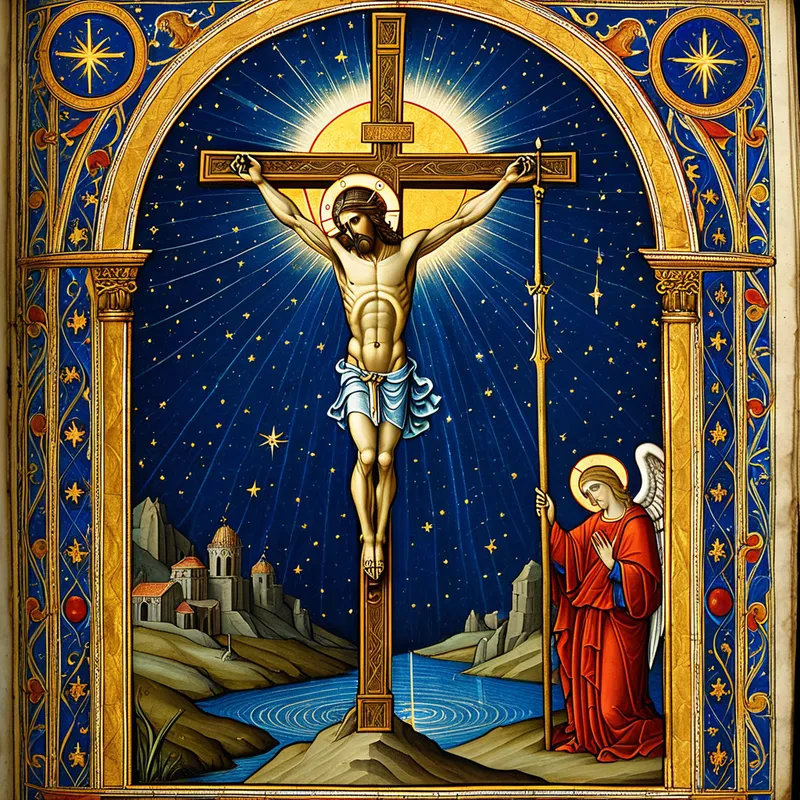
The Blood of Christ Myth Meaning & Symbolism
The myth of divine blood spilled for humanity, transforming suffering into a sacred, life-giving substance that redeems the world.
The Tale of The Blood of Christ
Listen, and hear a tale not of one death, but of a death that births life. The sky over Golgotha was the color of a deep bruise, heavy with the promise of a storm that would not break. Upon the hill, three crosses stood like gnarled teeth against the heavens. On the central tree hung a man, yet not a man—the Christ, the anointed one. His breath came in ragged gasps, a bellows pushing against the immense weight of the world.
The air tasted of iron, dust, and salt from the tears of those who watched from a distance. The Roman soldiers below cast lots for his simple tunic, the clatter of dice a profane counterpoint to the symphony of agony above. For hours, the drama unfolded in silence broken only by the wind and the creak of wood. Then, with a final utterance that was both a surrender and a command—“It is finished”—his head bowed.
In that suspended moment, a centurion, perhaps moved by a dread he could not name, stepped forward. He raised his hasta, its iron tip gleaming dully. With a practiced thrust, he pierced the side of the lifeless form. And then—it flowed. Not just blood, but water also, a clear stream following the deep crimson. The evangelist would write of this as testimony, but the poets and visionaries of later ages would see more. They saw the spear not as an instrument of final cruelty, but as a sacred key, unlocking the fountain of the world.
The blood did not merely stain the dry earth of that cursed hill. In the telling, it became a river. It soaked into the ground beneath the cross, where, legend whispered, the skull of the first man, Adam, was buried. The blood of the second Adam fell upon the bones of the first, a divine irrigation seeping back through all of time. It was caught, in other tales, by Joseph of Arimathea, in a cup that would become the seed of a thousand quests. This was no ending. It was the opening of a vein in the heart of creation itself, a sacred hemorrhage that would, they believed, heal the primordial wound.
Cultural Origins & Context
This myth, rooted in the sparse accounts of the Gospels, blossomed into full, vivid life in the soil of the Medieval European mind. It was not merely a historical footnote to the Passion; it became the central, pulsating mystery of the faith, elaborated upon in hagiographies, devotional literature, and the soaring stone and glass of cathedrals.
The primary vessel for this myth was the Eucharist. In the Doctrine of Transubstantiation, defined in the 13th century, the abstract symbol became terrifyingly concrete. The wine was the Blood. This theological pivot made the myth immediate and somatic for every believer. It was told from pulpits in vivid, visceral sermons designed to stir the emotions, and visualized in gruesome yet glorious detail in Passion Plays, where actors would simulate the flowing blood with red cloth or liquid.
Its societal function was dual: it was the ultimate symbol of hope and the ultimate instrument of cohesion. It promised redemption from sin and death, a cosmic transaction paid in divine currency. Simultaneously, the shared belief in this sacrificial blood created a powerful collective identity, binding the community and the wider Christendom into a single body, the Mystical Body of Christ, nourished by that same Blood.
Symbolic Architecture
At its core, the myth of the Blood is an alchemical narrative about the transformation of suffering into sanctity, and death into a conduit for eternal life. The blood is the ultimate symbol of life force—but here, it is life force voluntarily surrendered.
The sacred is not found by avoiding the wound, but in the conscious, transformative offering of what flows from it.
Psychologically, the figure of Christ represents the Self, the central archetype of the psyche that orchestrates individuation. The spilling of his blood symbolizes the necessary disintegration of a previous state of being—the innocent, unified consciousness—to feed a new, more complex order of existence. The blood watering the bones of Adam signifies the redemption of the personal and collective past, healing the ancestral and archetypal wounds carried within the human psyche.
The vessel that catches the blood, whether the Grail or the Eucharistic chalice, represents the vas, the container in alchemy. It is the human soul, the community, or the disciplined mind capable of receiving and holding this transformative, potent essence without being shattered by it. The blood is both poison and medicine, pharmakon, depending on the vessel and the intention.
The Dreamer’s Resonance
When this myth surfaces in modern dreams, it rarely appears as orthodox religious imagery. The dreamer may find themselves in a situation where a vital, life-giving essence is being lost—a recurring dream of bleeding from a non-physical wound, of a precious red liquid spilling onto the ground, or of trying desperately to collect such a substance in an inadequate container.
Somatically, this can correlate with feelings of profound depletion, of having given too much of one’s vital energy—one’s “life’s blood”—to a relationship, a career, or a role. Psychologically, it signals a process of sacrifice in the Jungian sense: the conscious letting go of an outmoded attitude, a cherished identity, or a compulsive behavior that, while once part of the personality, now blocks further development. The dream is an expression of the psyche’s innate intelligence, showing that a painful loss or “bleeding out” may be the prerequisite for a deeper, more authentic vitality to emerge. The dreamer is in the midst of the crucifixion phase of a psychic transformation.
Alchemical Translation
The alchemical journey mirrored in this myth is the nigredo giving way to the albedo and hinting at the rubedo. The blackness of despair, the mortificatio of the ego on the cross, is not the final word. The flowing blood represents the solutio—the dissolving of rigid forms into a fluid, potent state.
Individuation demands a crucifixion: the ego must be pierced by the spear of self-awareness for the water of spirit and the blood of soul to commingle and flow.
For the modern individual, this models the process of turning personal suffering into meaning. It is the alchemy of the wound. The “blood” is our most vital, passionate, and often painful experiences—our grief, our love, our failures. The myth instructs us not to stanch this flow prematurely, nor to let it drain away into meaningless victimhood, but to find or become the chalice. We must develop the capacity to consciously contain our experiences, to hold them with reverence and reflection, until they transmute within us. What was raw pain becomes compassion; what was private anguish becomes a source of connection to the shared human condition; what was a symbol of death becomes, paradoxically, the very substance of a more authentic and resilient life. We are invited to become both the sacrificed and the vessel, allowing our deepest experiences to be consecrated into a force that nourishes our own becoming and, potentially, the world around us.
Associated Symbols
Explore related symbols from the CaleaDream lexicon: