The Black Stone of the Ka'ba Myth Meaning & Symbolism
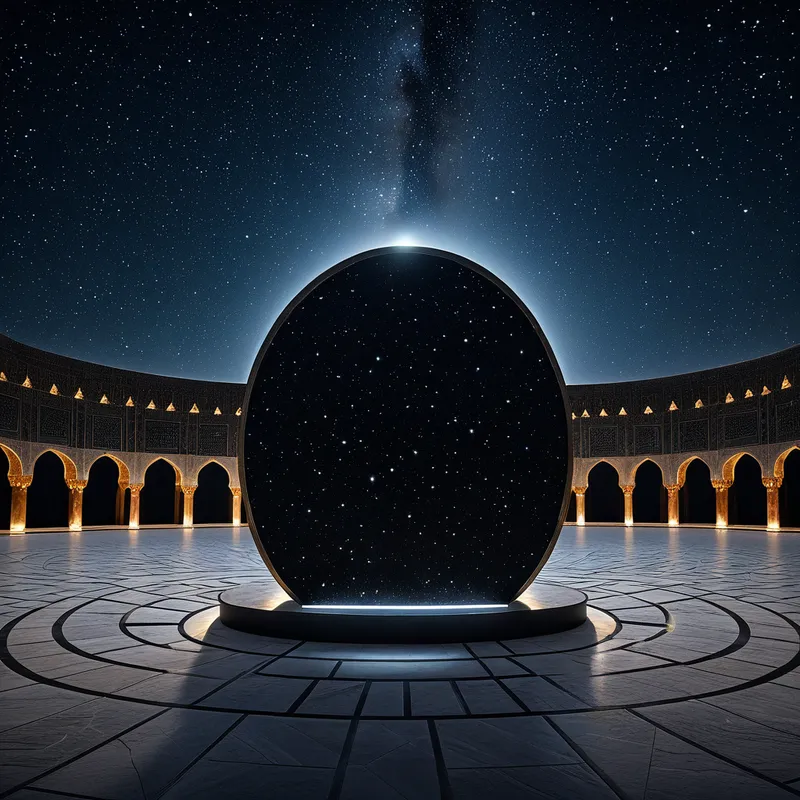
A celestial stone, fallen in radiant white, is placed at the sacred heart of the Ka'ba, becoming a fragmented touchstone of divine covenant and human longing.
The Tale of The Black Stone of the Ka’ba
In the time before time, when the desert was a sea of whispering sand and the sky a bowl of infinite, watchful stars, there existed a place of primordial silence. It was a barren valley, a hollow in the heart of the world, where the wind carried only the memory of prayers. Here, the first man, Adam, built an altar of longing—a simple structure of stone and spirit to mark the axis where heaven once touched earth. But the world turned, and the altar was lost to the ages, a forgotten dream beneath the dunes.
Centuries flowed like mirages. Then came Ibrahim, the friend of the One, cast into the wilderness with his infant son Ismail and the boy’s mother, Hajar. Left with only faith, Hajar ran between the hills of Safa and Marwah, her breath a ragged prayer until a spring, Zamzam, burst forth at her son’s feet. Life bloomed in the desolation.
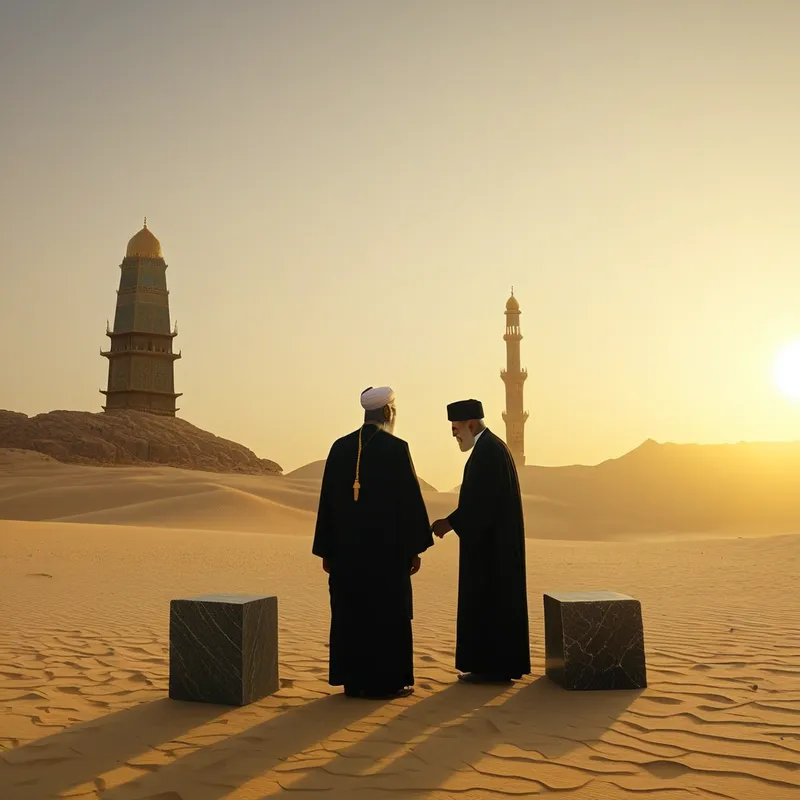
Years later, guided by a divine command, Ibrahim and his now-grown son Ismail stood on that hallowed ground. Their task was to rebuild the House—the Ka’ba. Shoulder to shoulder, they hauled rough-hewn granite from the surrounding hills. The sun burned their backs; their hands grew raw. The walls rose, a testament to covenant and obedience. But as they reached the final corner, a gap remained. The structure needed a cornerstone, a marker of divine blessing, a seal for their sacred labor.
Then, from the vault of heaven, a brilliance descended. It was the angel Jibril, bearing a stone. Not a stone of earth, but a celestial jewel, radiant and white, whiter than milk, brighter than a star. It was a piece of paradise itself, given to Adam in his loneliness and now returned. With reverence, Ibrahim set the luminous stone into the eastern corner of the Ka’ba. At that moment, the structure was complete. The House was no longer just stone and mortar; it was a beacon, a compass point for the soul, anchored by a fragment of the divine.
But the world is a place of touch, of breath, of sin. Over the slow march of generations, as hands of devotion and hands of conquest reached for it, the stone absorbed the grief of the ages. The purity of the world stained it. The white light dimmed, clouded by the tears, the hopes, and the failings of humanity, until it became the Black Stone—a dark mirror held up to the human heart, a sacred wound in the side of the sanctuary, forever beckoning the wanderer home.
Cultural Origins & Context
This narrative is woven into the foundational tapestry of Jahiliyyah and Islamic tradition. It exists not as a single, canonical text but as a living story passed down through oral histories, Hadith, and scholarly commentary (Tafsir). Its tellers were the poets, the scholars, and the pilgrims themselves, each adding a layer of meaning as they circumambulated the Ka’ba, their eyes tracing the silver-encased stone.
Societally, the myth functions on multiple levels. It sanctifies the geography of Mecca, transforming a barren valley into the Umm al-Qura (Mother of Cities). It establishes a lineage of pure, hanif worship—from Adam to Ibrahim to Muhammad—cleansing the site of its pre-Islamic idolatry while acknowledging its ancient holiness. Most powerfully, it provides a tangible, tactile link to the transcendent. In a faith that rigorously avoids idolatry, the Black Stone is an anomaly—a hajar aswad that is kissed or saluted not for itself, but as a symbol of the covenant (Mithaq) between God and humanity. It is the starting point of the Tawaf, the physical anchor for a spiritual journey.
Symbolic Architecture
The Black [Stone](/symbols/stone “Symbol: In dreams, a stone often symbolizes strength, stability, and permanence, but it may also represent emotional burdens or obstacles that need to be acknowledged and processed.”/) is a [paradox](/symbols/paradox “Symbol: A contradictory yet true concept that challenges logic and perception, often representing unresolved tensions or profound truths.”/) of profound [depth](/symbols/depth “Symbol: Represents profound layers of consciousness, hidden truths, or the unknown aspects of existence, often symbolizing introspection and existential exploration.”/). It is a fragment of the whole, a [piece](/symbols/piece “Symbol: A ‘piece’ in dreams often symbolizes a fragment of the self or a situation that requires integration, reflection, or understanding.”/) of the celestial lodged in the terrestrial. Its [journey](/symbols/journey “Symbol: A journey in dreams typically signifies adventure, growth, or a significant life transition.”/) from brilliant white to solemn black is the central [allegory](/symbols/allegory “Symbol: A narrative device where characters, events, or settings represent abstract ideas or moral qualities, conveying deeper meanings through symbolic storytelling.”/).
The stone does not change; it reveals. Its darkening is not a corruption, but an inscription—a record of every whispered prayer, every broken vow, every heart that has turned toward this center.
Psychologically, it represents the Self in the Jungian sense—the [archetype](/symbols/archetype “Symbol: A universal, primordial pattern or prototype in the collective unconscious that shapes human experience, behavior, and creative expression.”/) of wholeness and the regulating center of the psyche. Initially, this Self is perceived in its divine, pristine [origin](/symbols/origin “Symbol: The starting point of a journey, often representing one’s roots, source, or initial state before transformation.”/) (the white stone from [heaven](/symbols/heaven “Symbol: A symbolic journey toward ultimate fulfillment, spiritual transcendence, or connection with the divine, often representing life’s highest aspirations.”/)). As the ego develops and engages with the world—with its shadows, its passions, its “sins”—the Self appears to darken, to become obscured, even wounded. It becomes the Black Stone: seemingly marred, yet infinitely sacred. It is no longer “out there” in a remote heaven, but “right here,” embedded in the fabric of our lived, imperfect [reality](/symbols/reality “Symbol: Reality signifies the state of existence and perception, often reflecting one’s understanding of truth and life experiences.”/). The silver frame that holds its fragments is the conscious [structure](/symbols/structure “Symbol: Structure in dreams often symbolizes stability, organization, and the framework of one’s life, reflecting how one perceives their environment and personal life.”/) ([ritual](/symbols/ritual “Symbol: Rituals signify structured, meaningful actions carried out regularly, reflecting cultural beliefs and emotional needs.”/), tradition, the ego) that attempts to hold and honor the fractured, mysterious core of our being.
The Dreamer’s Resonance
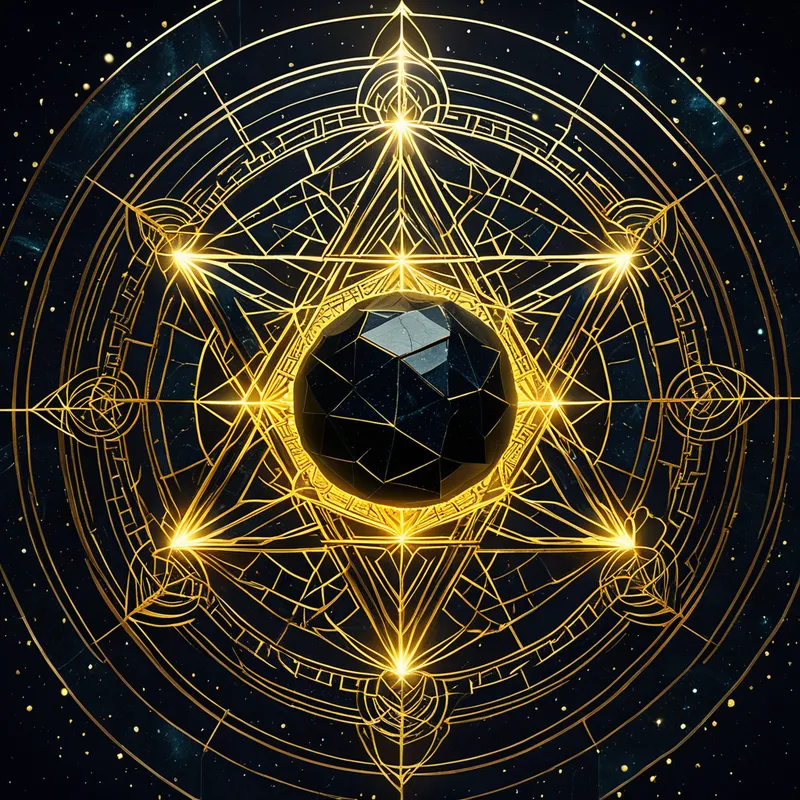
When this myth stirs in the modern unconscious, it often manifests in dreams of searching for a central, foundational object. One might dream of a lost, dark gem; a cornerstone missing from a building they are trying to complete; or a familiar object that has turned a deep, significant black.
Somatically, this can correlate with a feeling of disorientation, a loss of spiritual or psychological “north.” The dreamer may feel ungrounded, as if their internal compass is broken. The appearance of the Black Stone pattern signals a deep process of re-centering. The psyche is attempting to return to its point of origin, not to a naive innocence, but to a mature acknowledgment of its own history. The darkness of the stone in the dream is not to be feared, but touched. It represents the acceptance of one’s own lived experience—the grief, the shame, the joy—as integral to the soul’s substance. The ritual of circling it (Tawaf) translates into a psychological process of circling one’s own core issue, approaching it from all angles, gradually coming to terms with its complex, fragmented nature.
Alchemical Translation
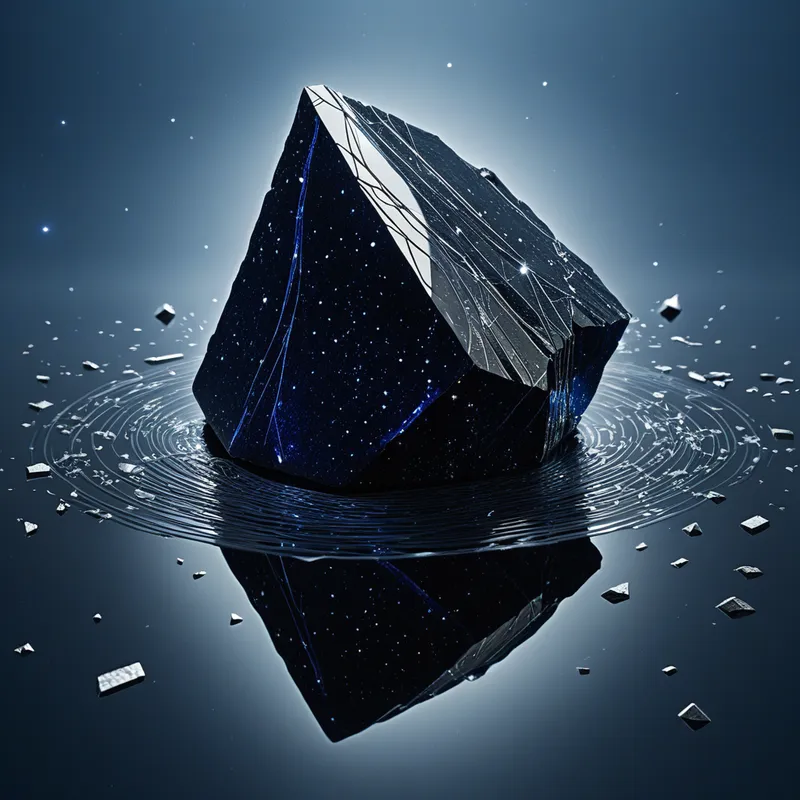
The myth models the alchemical opus of individuation—the journey from unconscious unity (paradisal white stone), through the nigredo or blackening (the stone’s darkening through human contact), to a conscious, integrated wholeness.
The initial state is the unconscious Self: perfect, radiant, but distant and unrelated to the individual life. The call to build the Ka’ba is the call to construct a conscious life, a coherent identity. The labor with Ismail is the hard, earthly work of building relationships, fulfilling duties, and developing the persona.
The cornerstone cannot be of this earth alone. The ego-structure remains incomplete until it receives and integrates the transcendent function—the mysterious, non-ego element from the unconscious.
The setting of the stone is the moment of alignment, when the ego’s project is sanctified by a connection to the deeper Self. Then comes the long alchemical stage: the blackening. This is not a fall from grace, but the necessary mortificatio. The purity of the ideal is sacrificed to the reality of human experience. The stone absorbs shadow. This is the painful but crucial process where one’s ideals, one’s self-image, are humbled and darkened by life’s complexities, failures, and moral ambiguities.
The final, enduring image—the Black Stone, kissed by millions—represents the lapis philosophorum, the Philosopher’s Stone of the completed individual. It is wholeness achieved not by avoiding darkness, but by containing it. The Self is now known as both divine in origin and human in experience. The ritual return to it is the ongoing practice of self-recollection, of touching base with the core that is both wounded and holy, fragmented and eternally complete. The individual does not become pure white again; they become the sacred, silver-encased vessel that holds the precious, dark totality of what they are.
Associated Symbols
Explore related symbols from the CaleaDream lexicon:
- Stone — The primordial symbol of permanence, foundation, and the irreducible core of being, representing the eternal Self at the center of the psychic universe.
- Circle — The ritual of Tawaf, the circumambulation of the Ka’ba, symbolizing the endless process of approaching, orbiting, and integrating the central mystery of the Self.
- Covenant — The sacred pledge between the divine and the human, embodied in the stone’s placement, representing the soul’s foundational contract with existence itself.
- Temple — The Ka’ba as the constructed sanctuary, the conscious life and personality structured around the indwelling, mysterious core of the Black Stone.
- Fragmentation — The stone’s legendary broken state, held together by its frame, symbolizing the experienced psyche—seemingly fractured by life, yet held in a sacred unity.
- Heart — The Ka’ba as the spiritual heart of the world, and the Black Stone as the literal and symbolic touchstone for the heart’s deepest longing and devotion.
- Journey — The lifelong pilgrimage (Hajj, Umrah) to the stone, mirroring the internal journey of the soul back to its point of origin and meaning.
- Door — The stone’s position at a corner of the Ka’ba, often seen as a point of entry or connection between the mundane and the sacred, the human and the divine.
- Mirror — The polished black surface of the stone, reflecting not an image of the face, but the state of the soul that approaches it.
- Sky — The celestial origin of the stone as a fragment of paradise, representing the transcendent, archetypal dimension of the psyche from which wholeness descends.
- Earth — The granite of the Ka’ba and the earthly valley, representing the grounded, material reality into which the transcendent mystery is embedded and made accessible.
- Philosopher’s Stone — The alchemical parallel to the Black Stone, the ultimate goal of psychic transmutation: a Self that has integrated all opposites, including its own darkness.