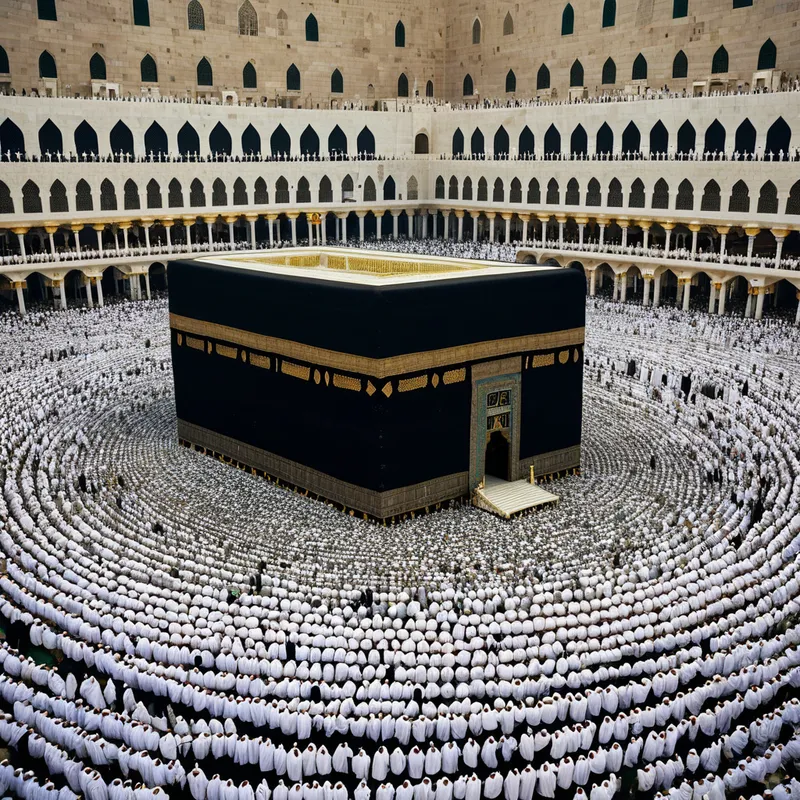
The Black Stone of Mecca Myth Meaning & Symbolism
A celestial stone, fallen from heaven and blackened by human sin, rests in the Kaaba as a sacred touchstone for divine connection and forgiveness.
The Tale of The Black Stone of Mecca
Before time was counted, when [the world](/myths/the-world “Myth from Tarot culture.”/) was still a whisper in the mind of the Divine, a stone descended from the light. It was not hewn from any earthly mountain, but was a gift, a pure white jewel from the gardens of Paradise, entrusted to the first man, Adam, as a sign of the covenant. He built the first house of worship around it, a simple structure of longing and devotion, a point where heaven met the dust.
Centuries flowed like desert winds, and the stone witnessed the rise and fall of nations, the forgetting and remembering of the One. The house fell to ruin, its purpose obscured by the idols of a thousand tribes. The stone, once radiant, was lost among the sands, its whiteness dimmed by the touch of a world adrift.
Then came Ibrahim, the friend of God, and his son Ismail. Guided by a command that echoed in the heart, they sought the foundations of that first house. They lifted stone upon stone, rebuilding the [Kaaba](/myths/kaaba “Myth from Abrahamic culture.”/) with their own hands, their prayers the mortar. But as the walls rose, a final, crowning piece was needed for the eastern corner—a cornerstone to seal their act of submission.
It was then that the angel Jibril appeared, not with a new stone, but with the ancient one, recovered from the nearby hill of Abu Qubays. Its pristine white had been transformed; it was now a deep, somber black, having absorbed the sins of humanity who had turned away from its light. Ibrahim, understanding its profound history, set it in place with trembling reverence. It became the starting point, the sacred marker for the Tawaf, the circling prayer that would forever after mimic the motion of angels around the Throne.
Generations passed, and the Kaaba was again threatened, this time by a [great flood](/myths/great-flood “Myth from Mesopotamian culture.”/). The stone was removed for safekeeping, and when the waters receded, the leaders of the Quraysh tribe quarreled fiercely over the honor of placing it back. Tensions mounted, bloodshed seemed imminent. Then a wise elder proposed a solution: let the next man to enter the gate decide. The gate opened, and in walked a young man known for his trustworthiness, Muhammad, peace be upon him. He listened to the conflict, then spread his cloak upon the ground. He placed the Black Stone upon it and instructed each clan leader to hold a corner of the cloth. Together, they lifted it to the necessary height, and Muhammad, peace be upon him, with his own hands, set the sacred stone back into the wall, uniting the people in a single, cooperative act of devotion. The stone, a witness to human strife and reconciliation, rested once more, a silent testament to unity forged from discord.
Cultural Origins & Context
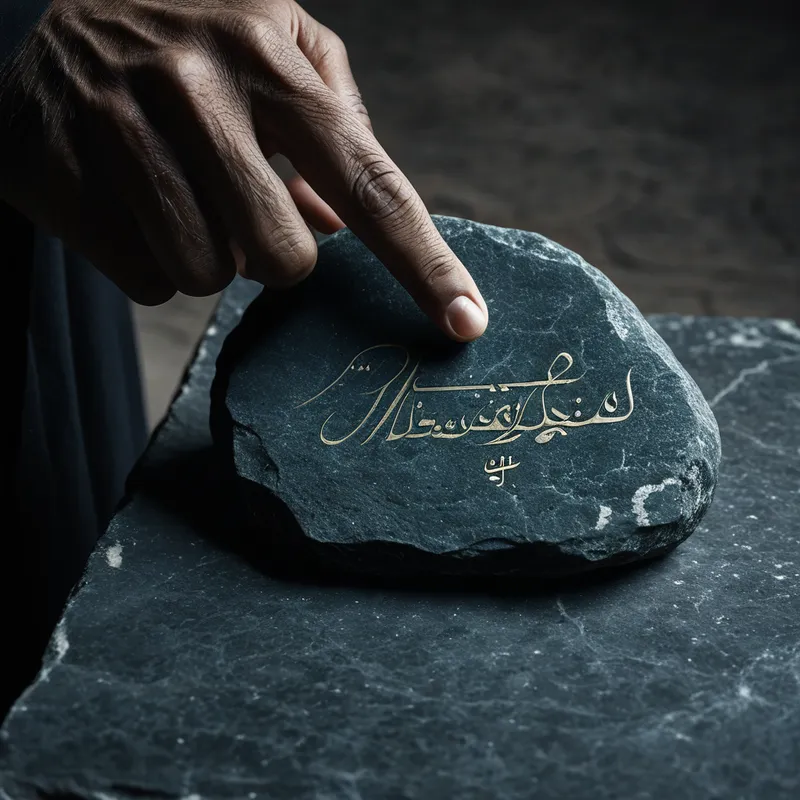
The narratives surrounding the Hajar al-Aswad are found within Hadith literature and historical chronicles. These are not a single, codified myth in the classical sense, but a tapestry of sacred reports and traditions passed down through generations of scholars and storytellers. The primary function of these narratives is not merely historical but deeply theological and social.
They anchor the Hajj ritual in a prophetic lineage stretching back to Ibrahim and Adam, framing Mecca not as a random location but as the restored center of primordial monotheism. The story of its celestial origin elevates it from a mineral to a relic, a tangible connection to the divine realm. The account of the Quraysh dispute and its resolution by the Prophet Muhammad, peace be upon him, served a critical societal function: it established his pre-prophetic character (Al-Amin, the Trustworthy) and modeled a principle of conflict resolution and communal unity that would become central to the Islamic polity. Thus, the stone’s lore operates on multiple levels: as a cosmological anchor, a validator of prophethood, and a parable for social harmony.
Symbolic Architecture
The Black [Stone](/symbols/stone “Symbol: In dreams, a stone often symbolizes strength, stability, and permanence, but it may also represent emotional burdens or obstacles that need to be acknowledged and processed.”/) is a [paradox](/symbols/paradox “Symbol: A contradictory yet true concept that challenges logic and perception, often representing unresolved tensions or profound truths.”/) made manifest. It is a [piece](/symbols/piece “Symbol: A ‘piece’ in dreams often symbolizes a fragment of the self or a situation that requires integration, reflection, or understanding.”/) of [heaven](/symbols/heaven “Symbol: A symbolic journey toward ultimate fulfillment, spiritual transcendence, or connection with the divine, often representing life’s highest aspirations.”/) that has become earthen in [appearance](/symbols/appearance “Symbol: Appearance in dreams relates to self-image, perception, and how you present yourself to the world.”/), a [symbol](/symbols/symbol “Symbol: A symbol can represent an idea, concept, or belief, serving as a powerful tool for communication and understanding.”/) of purity that wears the stain of [human](/symbols/human “Symbol: The symbol of a human represents individuality, complexity of emotions, and social relationships.”/) transgression. It does not radiate light; it absorbs darkness. This is its first profound teaching: the divine is not separate from the human [condition](/symbols/condition “Symbol: Condition reflects the state of being, often focusing on physical, emotional, or situational aspects of life.”/) but intimately bears its marks.
It is the point of contact where the absolute meets the flawed, where eternity acknowledges time.
It represents the divine [covenant](/symbols/covenant “Symbol: A binding agreement or sacred promise between parties, often carrying deep moral, spiritual, or social obligations and consequences.”/)—an unchanging, eternal promise—that persists despite human forgetfulness and sin. Its blackness is not a negation but a transformation; it is the whiteness of pure potential that has willingly taken on the [weight](/symbols/weight “Symbol: Weight symbolizes burdens, responsibilities, and emotional loads one carries in life.”/) of actual existence, with all its shadows. Psychologically, it symbolizes [the Self](/myths/the-self “Myth from Jungian culture.”/) in the Jungian sense—the central, archetypal core of the [psyche](/myths/psyche “Myth from Greek culture.”/) that is whole and sacred, yet often appears dark, obscure, or wounded due to the accumulated “sins” or complexes of a lifetime. We circle it, seeking [connection](/symbols/connection “Symbol: Connection symbolizes relationships, communication, and bonds among individuals.”/), but it does not sparkle with easy answers; it demands we confront the fact that our wholeness includes our darkness.
Furthermore, its [role](/symbols/role “Symbol: The concept of ‘role’ in dreams often reflects one’s identity or how individuals perceive their place within various social structures.”/) in the Tawaf [ritual](/symbols/ritual “Symbol: Rituals signify structured, meaningful actions carried out regularly, reflecting cultural beliefs and emotional needs.”/) is deeply symbolic. It is the fixed point around which all [motion](/symbols/motion “Symbol: Represents change, progress, or the flow of life energy. Often signifies transition, personal growth, or the passage of time.”/) revolves, the still center of the turning world of the [soul](/symbols/soul “Symbol: The soul represents the essence of a person, encompassing their spirit, identity, and connection to the universe.”/). One does not worship the stone; one uses it to orient one’s worship, to give [structure](/symbols/structure “Symbol: Structure in dreams often symbolizes stability, organization, and the framework of one’s life, reflecting how one perceives their environment and personal life.”/) to the circling [journey](/symbols/journey “Symbol: A journey in dreams typically signifies adventure, growth, or a significant life transition.”/) of return. It is the [axis](/symbols/axis “Symbol: A central line or principle around which things revolve, representing stability, orientation, and the fundamental structure of reality or consciousness.”/) mundi, the world axis, for the individual pilgrim’s [universe](/symbols/universe “Symbol: The universe symbolizes vastness, interconnectedness, and the mysteries of existence beyond the individual self.”/).
The Dreamer’s Resonance
When the image of the Black Stone surfaces in modern dreams, it often appears during a phase of profound reorientation or a crisis of faith—not necessarily religious, but faith in one’s path, principles, or self. The dreamer may find themselves in a vast, undefined space, drawn to a singular, dark object that exerts a powerful gravitational pull. They may feel a compulsion to touch it, circle it, or simply gaze upon its enigmatic surface.
Somatically, this can correlate with a feeling of seeking grounding or a tangible anchor amidst psychic chaos. The stone represents the dreamer’s own inner touchstone—a core truth or value that has become obscured or blackened by life’s experiences, disappointments, or personal failings. The act of reaching for it in the dream mirrors the psychological process of reaching for integrity. There may be anxiety: Will my touch defile it? Is it too late? This reflects [the shadow](/myths/the-shadow “Myth from Jungian culture.”/) work of acknowledging one’s own contributions to one’s “stained” condition, while simultaneously seeking forgiveness and reconnection with one’s essential, uncorrupted nature. The stone in the dream does not judge; it simply is, offering a point of focus around which the fragmented self can begin to reorganize.

Alchemical Translation
The myth of the Black Stone is a precise map of the alchemical and individuation process. The [Nigredo](/myths/nigredo “Myth from Alchemical culture.”/), the blackening, is not the initial sin but the necessary first stage of the work: the confrontation with the shadow. The stone’s descent from white to black symbolizes the descent of spirit into matter, of ideal into reality, where it becomes tarnished by the complexities of existence. This is the stage of confession, of acknowledging the full weight of one’s humanity.
The work of transformation begins not with seeking purity, but with fully embracing the stained stone of the self.
The rebuilding of the Kaaba by Ibrahim and Ismail represents the conscious effort to reconstruct a sacred inner space ([temenos](/myths/temenos “Myth from Greek culture.”/)) after a period of ruin or neglect. Placing the blackened stone at [the cornerstone](/myths/the-cornerstone “Myth from Biblical culture.”/) signifies that this rebuilt Self must integrate, not reject, the darkened experiences. They become the foundation.
Finally, the ritual of the Hajj—the journey to the stone, the circumambulation, the attempt to kiss or touch it—models the final stages of Albedo and [Rubedo](/myths/rubedo “Myth from Alchemical culture.”/). The circling (Tawaf) is the process of revolving around the central Self, viewing it from all angles, gradually clarifying and understanding it through devoted attention. The touch is the moment of coniunctio, [the sacred marriage](/myths/the-sacred-marriage “Myth from Various culture.”/) where the conscious ego makes contact with the transcendent Self. The stone does not turn white again; the integration is permanent. The blackness, now sanctified by intention and ritual, becomes the very proof of the journey. The individual achieves wholeness not by being perfect, but by having their imperfection hallowed as an essential part of their covenant with the divine within.
Associated Symbols
Explore related symbols from the CaleaDream lexicon: