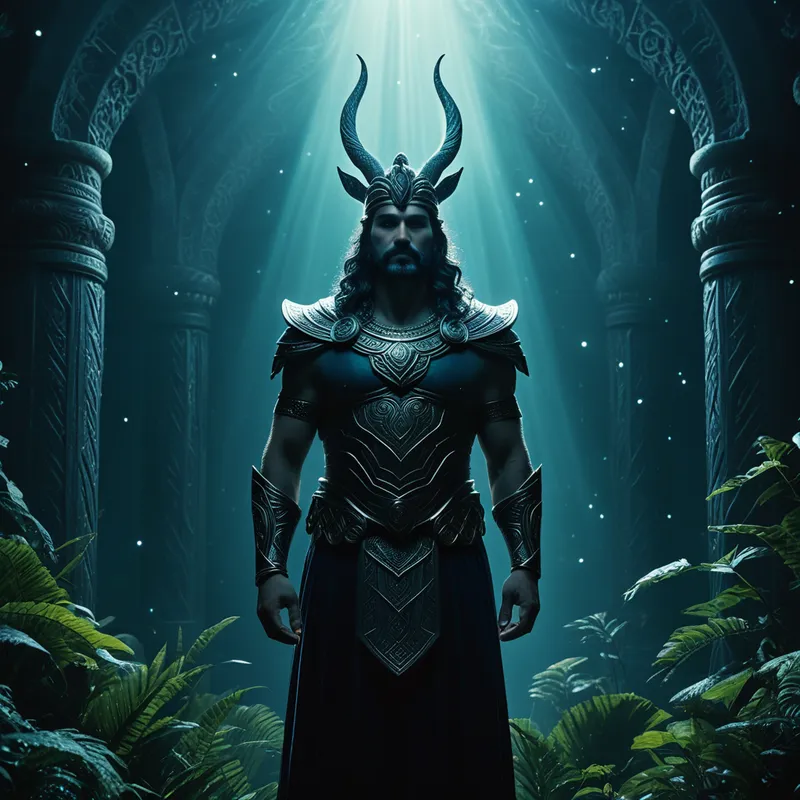
The Black and White Shamans
Two opposing shamans represent cosmic duality in Mongolian mythology, embodying the eternal balance between chaos and order in the universe.
The Tale of The Black and White Shamans
In the beginning, when [the world](/myths/the-world “Myth from Tarot culture.”/) was still a song waiting to be sung, [the Eternal Blue Sky](/myths/the-eternal-blue-sky “Myth from Mongolian/Turkic culture.”/), Tengri, breathed life into [the world](/myths/the-world “Myth from Tarot culture.”/) below. From this breath, two spirits of immense power were woven into the fabric of reality. They were not born of woman, but of necessity, emerging from the primal need for rhythm and relationship. One was the White Shaman, whose essence was spun from the first light of dawn and the unblemished snow on the sacred peaks. The other was the Black Shaman, whose spirit coalesced from the fertile darkness of [the womb](/myths/the-womb “Myth from Various culture.”/) of [the earth](/myths/the-earth “Myth from Hindu culture.”/) and the storm clouds gathering on [the horizon](/myths/the-horizon “Myth from Various culture.”/).
Their tale is not one of simple good versus evil, but of a dynamic, eternal tension. The White Shaman, qairan, is the keeper of order, the weaver of cosmic patterns. He speaks the language of the stars and listens to the whispers of ancestral laws. His rituals are precise, his chants a mapping of the celestial order onto the human realm. He maintains the sacred covenants between the people, the spirits of the mountains and rivers, and [the sky](/myths/the-sky “Myth from Persian culture.”/) above. When the herd strays, he calls them back with songs of harmony. When illness born of spiritual neglect strikes, he performs cleansing rites with [water](/myths/water “Myth from Chinese culture.”/) and milk, restoring the individual to the communal whole.
The Black Shaman, qara, is the master of raw, untamed power. He is allied with the spirits of the deep earth, the wild winds, and the fierce protectors of [the threshold](/myths/the-threshold “Myth from Folklore culture.”/). His path is one of confrontation and transformation through [chaos](/myths/chaos “Myth from Greek culture.”/). Where the White Shaman heals with light, the Black Shaman heals by wrestling the sickness itself, by journeying into the shadowlands of the soul to retrieve what was lost or to battle malevolent forces on their own terms. His drumbeat is the pulse of the thunder, his dance a mimicry of primal, untamed forces. He does not merely restore balance; he shatters stagnant order to make way for necessary change, even if that change is terrifying.
Their eternal struggle is the heartbeat of the cosmos. In one cycle, the Black Shaman might summon a blizzard to test the resilience of the people, forcing them to rely on their inner fire and communal bonds. The White Shaman would then work to calm the storm, to find the path through the whiteout, teaching endurance and faith in the returning sun. In another, a great stagnation—a spiritual plague of apathy or tyranny—might settle over the land. The White Shaman’s orderly prayers would find no purchase. Then, the Black Shaman would rise, his rituals invoking disruptive, fiery energy to break the calcified patterns, a necessary destruction that precedes renewal.
They are forever opposed, yet forever bound. One cannot exist without the other, for order without the threat of chaos becomes a dead, airless prison, and chaos without the container of order is mere annihilation. Their struggle is not for victory, but for the perpetual, dynamic tension that is life itself.
Cultural Origins & Context
This profound duality is rooted in the Mongolian worldview, shaped by the vast, unforgiving, and majestic landscape of the steppe. Life on the Eurasian plains was a constant negotiation between extreme opposites: the boundless blue sky and the enveloping earth, the searing summer sun and the deadly winter cold, the peaceful grazing of herds and the sudden violence of the hunt or tribal conflict. The cosmos was seen as a living, interactive system where human survival depended on maintaining right relationship with a host of spirits (ongon), both benevolent and demanding.
Within this animistic framework, [the shaman](/myths/the-shaman “Myth from Siberian culture.”/) (böö) was the essential intermediary. However, the spiritual ecology was understood to be complex. Not all spirits were approachable through the same means. The dichotomy of White and Black Shamanism reflects this nuanced understanding. The “white” path (chagan shashin) typically dealt with the celestial spirits of Tengri, the sun, moon, and stars, and the benevolent masters of specific localities. It was often associated with more structured, communal rituals for blessing, thanksgiving, and healing.
The “black” path (hara shashin) engaged with the powerful, chthonic spirits of the lower world, ancestors who died with unresolved rage or grief, and the fierce protectors of thresholds. This path was considered more dangerous, requiring a shaman of immense personal power to navigate these volatile forces without being consumed. Historically, the great unifying figure Chinggis Khan was said to have been protected and guided by a powerful Black Shaman, Kököchü Teb Tengri, highlighting how this raw power was seen as essential for worldly creation and conquest, not merely destruction.
Thus, the two shamans are not just mythological figures but represent two essential, coexisting strands of spiritual practice and cosmic principle within Mongolian history and consciousness.
Symbolic Architecture
The Black and White Shamans are the living embodiment of the fundamental law of duality that structures [reality](/symbols/reality “Symbol: Reality signifies the state of existence and perception, often reflecting one’s understanding of truth and life experiences.”/). They represent the archetypal poles between which all existence vibrates.
The White Shaman is the principle of Cosmos—the impulse to differentiate, name, structure, and preserve. He is the psychic function that builds the ego, establishes culture, creates ritual, and seeks meaning through order. His danger is in his potential to become rigid, to mistake the map for the territory, and to suppress the vital, chaotic energies necessary for growth.
The Black Shaman is the principle of Chaos—the undifferentiated, creative, and destructive potential that exists before form. He is the psychic function of the unconscious, the eruptive force of instinct, the catalyst for revolution and individuation. His danger is in his potential for sheer dissolution, where creativity becomes annihilation and liberation becomes madness.
Their eternal struggle is the engine of the [universe](/symbols/universe “Symbol: The universe symbolizes vastness, interconnectedness, and the mysteries of existence beyond the individual self.”/) and the [psyche](/myths/psyche “Myth from Greek culture.”/). It is the [tension](/symbols/tension “Symbol: A state of mental or emotional strain, often manifesting physically as tightness, pressure, or unease, signaling unresolved conflict or anticipation.”/) between the conscious mind and the unconscious, between civilization and [wilderness](/symbols/wilderness “Symbol: Wilderness often symbolizes the untamed aspects of the self and the unconscious mind, representing a space for personal exploration and discovery.”/), between the known self and the [shadow](/symbols/shadow “Symbol: The ‘shadow’ embodies the unconscious, repressed aspects of the self and often represents fears or hidden emotions.”/). True wholeness, or holiness, is not found in the victory of one over the other, but in the [capacity](/symbols/capacity “Symbol: A measure of one’s potential, limits, or ability to contain, process, or achieve something, often reflecting self-assessment or external demands.”/) to hold this sacred [tension](/symbols/tension “Symbol: A state of mental or emotional strain, often manifesting physically as tightness, pressure, or unease, signaling unresolved conflict or anticipation.”/), to allow each its necessary [role](/symbols/role “Symbol: The concept of ‘role’ in dreams often reflects one’s identity or how individuals perceive their place within various social structures.”/) in the great cycle of [death](/symbols/death “Symbol: Symbolizes transformation, endings, and new beginnings; often associated with fear of the unknown.”/) and [rebirth](/symbols/rebirth “Symbol: A profound transformation where old aspects of self or life die, making way for new beginnings, growth, and renewal.”/).
The Dreamer’s Resonance
To encounter these figures in the inner landscape of a dream or active imagination is to be confronted with a critical dynamic within one’s own psyche. The appearance of the White Shaman may signal a call to order—to integrate disparate parts of [the self](/myths/the-self “Myth from Jungian culture.”/), to establish healthy boundaries, or to seek healing through structure and tradition. He may appear when one’s life has become too chaotic, offering the tools of ritual, discipline, and conscious understanding.
The emergence of the Black Shaman, often a more frightening visitation, points to areas where one’s ordered life has become stagnant, oppressive, or inauthentic. He is the [herald](/myths/herald “Myth from Greek culture.”/) of the repressed shadow, the catalyst for a necessary breakdown. His chaotic energy demands that outdated structures of identity, relationship, or belief be shattered so that something more vital and true can emerge. To work with him is to consent to a kind of psychic surgery, a descent into one’s own [underworld](/myths/underworld “Myth from Greek culture.”/) to reclaim lost power or face a buried truth.
The ultimate teaching for the modern dreamer is that psychological health is not a state of static peace, but a dynamic equilibrium. It requires honoring both the inner White Shaman who tends the sacred hearth of the conscious self, and the inner Black Shaman who guards the wild, creative, and transformative powers of the deep unconscious.
Alchemical Translation
In the alchemical process of individuation, the myth of the two shamans maps perfectly onto the crucial stage of the conjunctio oppositorum—the marriage of opposites. The White and Black Shamans are the personified Sol and Luna, spirit and soul, king and queen, fixed and volatile principles.
The long struggle between them is the necessary separatio and mortificatio, the purification and “killing” of each element in its isolated, one-sided state. The White Shaman’s order must be dissolved by the Black Shaman’s chaos, and the Black Shaman’s formless power must be given shape by the White Shaman’s law. Their endless conflict is the fire of the alchemical vessel.
The goal is not for one to defeat the other, but for their opposition to become so intense that it generates a transcendent third. From their [sacred marriage](/myths/sacred-marriage “Myth from Alchemy culture.”/) emerges the [lapis philosophorum](/myths/lapis-philosophorum “Myth from Alchemical culture.”/), [the Philosopher’s Stone](/myths/the-philosophers-stone “Myth from Alchemical culture.”/)—which in psychological terms is the integrated Self. This is the state where consciousness and the unconscious are in dialogue, where discipline and spontaneity co-exist, where one can wield great power (the Black Shaman’s gift) with profound wisdom and ethical containment (the White Shaman’s gift). The shaman who has integrated this duality becomes a true walking bridge between all worlds.
Associated Symbols
Explore related symbols from the CaleaDream lexicon:
- Shaman — The archetypal intermediary who navigates the spaces between worlds, embodying the human capacity to engage with unseen forces and inner depths.
- Chaos — The primal, creative void from which all form emerges, represented by the Black Shaman’s disruptive and generative power.
- Order — The structuring principle that gives cosmos to chaos, the patterns and laws upheld by the White Shaman’s rituals and knowledge.
- Balance — The dynamic, living equilibrium achieved not through stillness, but through the respectful tension between opposing forces.
- Duality Mask — The face worn by reality itself, presenting the inseparable pair of opposites that define all experience and consciousness.
- Sky — The realm of the White Shaman, representing transcendent law, consciousness, and the vast container of existence.
- Earth — The realm of the Black Shaman, representing immanent power, the unconscious, and the raw, fertile ground of being.
- Drum — The shaman’s vehicle, whose steady heartbeat bridges the worlds and orchestrates the dance between chaos and order.
- Shadow — The personal and [collective unconscious](/myths/collective-unconscious “Myth from Jungian culture.”/) contents embodied by the Black Shaman’s allies, holding both feared darkness and untapped potential.
- Bridge — The shaman’s essential function and ultimate state of being: to connect the celestial and chthonic, the conscious and unconscious, creating passage where there was separation.
- Fire — The transformative element wielded by both shamans; for the White Shaman, a sacred purifier, for the Black Shaman, a destructive and renewing force.
- Journey — The core action of the myth and the psyche, the necessary descent into chaos and return to order that constitutes healing and wholeness.