The Biblical story of Jacob wr Myth Meaning & Symbolism
A man wrestles a divine stranger through the night, refusing to let go until he receives a blessing, emerging wounded and renamed.
The Tale of The Biblical story of Jacob wr
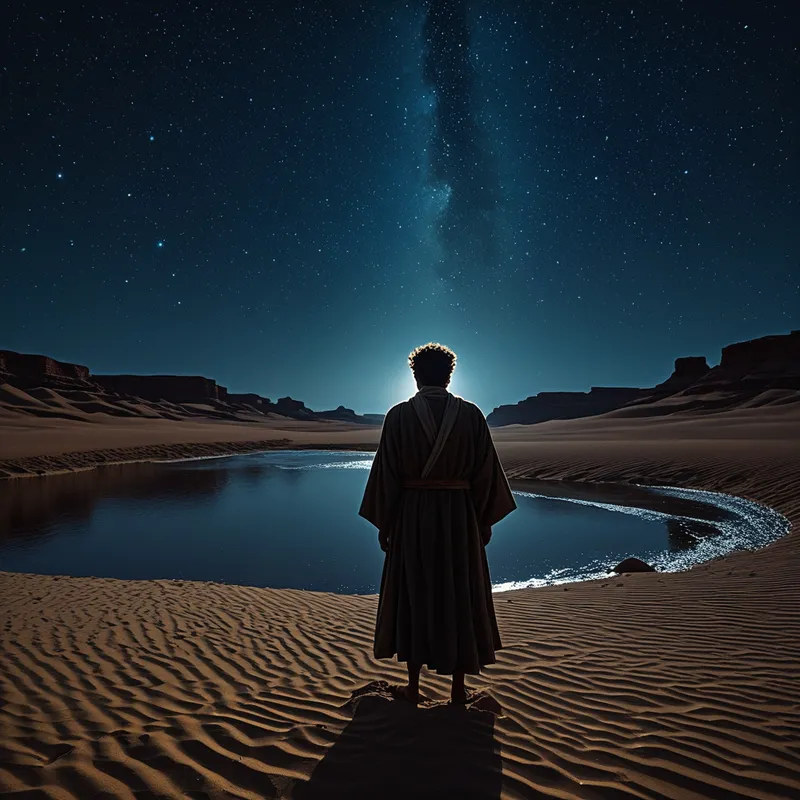
The night was a river of its own, black and cold, flowing between the banks of a man’s past and his terror of the future. Jacob stood alone at the ford of the Jabbok, having sent his family, his flocks, every possession he had schemed and labored for, across the waters ahead of him. He was a man divided, a twin who had lived his brother’s blessing, a son who had stolen a father’s touch. Now, his brother Esau approached with four hundred men, and the air tasted of vengeance.
In that liminal space, between the sending away and the facing of fate, a presence descended. It was not announced by thunder, but by a sudden density in the air, a chill that had nothing to do with the desert night. A figure emerged from the gloom—not an angel with wings of gold, but a man, yet not a man. A stranger of terrible, focused intensity. Without word or warning, the stranger grasped him, and Jacob, the lifelong wrestler—wrestler of the womb, wrestler of blessings, wrestler of fate—found his match.
They fell into the contest, there on the stony bank. This was no battle of swords or shouts, but a primal, grinding struggle of muscle, will, and spirit. The river’s murmur was their only chorus. Jacob, fueled by a lifetime of cunning and fear, found a strength he did not know he possessed. The stranger, an embodiment of the uncanny, met him move for move. They pivoted and strained, a single, heaving silhouette against the stars, locked in an embrace that was both combat and a desperate kind of communion. The dust of the earth ground into Jacob’s tunic; the heat of the struggle beaded on his skin.
The night wore on, an eternity measured in ragged breaths and trembling limbs. As the first grey hint of dawn threatened the eastern hills, the stranger saw he could not overpower this tenacious mortal. He struck—a touch not of violence, but of profound reordering—to the hollow of Jacob’s hip. The socket wrenched, a white-hot bloom of pain that traveled to the core of his being. Jacob stumbled, but his hands, slick with sweat and dust, did not release their grip. His physical strength was broken, yet his will crystallized.
“Let me go, for the dawn is breaking,” the stranger said, his voice the sound of distant waters over stone.
And Jacob, clinging now not with the strength of limbs but with the sheer force of a soul at its extremity, gasped the words that defined his entire life’s trajectory: “I will not let you go unless you bless me.”
A silence hung between them, heavier than the night. “What is your name?” asked the stranger.
“Jacob,” he whispered—the name that meant “heel-grabber,” “supplanter.”
“Your name shall no longer be Jacob, but Israel, for you have striven with Elohim and with men, and have prevailed.”
Then Jacob, daring the unthinkable, asked, “Please, tell me your name.”
But the being replied, “Why is it that you ask my name?” And with that, he blessed him there, a blessing that seeped into the marrow of Jacob’s wounded body. As the sun’s first ray crested the land, the stranger was gone. Jacob limped away from Peniel, the “Face of God,” marked forever, carrying a new name and an old, enduring pain into the dawn he had demanded to see.

Cultural Origins & Context
This myth is embedded in the foundational narrative of the Israelite patriarchs, recorded in the Book of Genesis. It functions as a national etiological myth, explaining the origin of the name “Israel” for a people defined by struggle and covenant. Passed down through oral tradition before being codified in sacred text, it was told not merely as history but as a theological and psychological cornerstone. Its societal function was profound: it framed the very identity of a nation not as one of untroubled divine favor, but as a people born from a desperate, nocturnal struggle with the divine itself. It legitimized a history of hardship and exile as part of a sacred, identity-forging contest. The storyteller, likely a priestly or wisdom keeper, wove a tale that moved from the particular (a man at a river) to the universal (the human encounter with the numinous), establishing that to be chosen is not to be coddled, but to be engaged in the most intimate and terrifying of struggles.
Symbolic Architecture
The myth is a perfect symbolic drama of the psyche’s confrontation with the Self, the totality of one’s being that transcends the ego. Jacob represents the conscious ego—the cunning, striving, anxious identity built on acquisition and deception. The river Jabbok is the threshold of the unconscious, the boundary one must cross alone to face what one has repressed.
The divine stranger is the Shadow made numinous—not merely personal darkness, but the autonomous, powerful, and ultimately sacred aspect of the psyche that the ego must engage.
The all-night struggle is the painful, protracted process of acknowledging and integrating what we have spent a lifetime avoiding: our guilt, our stolen blessings, our authentic destiny. The dislocated hip is the critical symbol. It is the necessary wounding of the ego’s locomotive power—the breaking of the old, manipulative way of “walking through the world.” One cannot wrestle God and remain intact. The blessing is contingent upon the wound; the new name, Israel, is born from a literal “wrenching” of the old foundation. To ask for the stranger’s name is to seek to rationalize and control the numinous experience, a request that is rightly refused. The mystery must remain.
The Dreamer’s Resonance
When this myth stirs in the modern dreamscape, it often manifests not as a biblical tableau, but as a relentless, exhausting struggle with an unknown figure in a liminal space—a hallway, a parking garage, a featureless plain. The somatic feeling upon waking is key: a profound fatigue in the limbs, a specific ache in the hip or thigh, or a sense of having been “through the wringer.”
Psychologically, this dream pattern signals a critical phase of individuation where the dreamer is grappling with a core, identity-shaping complex. The “opponent” may represent an unacknowledged talent, a buried trauma, a moral debt, or the sheer weight of one’s own destiny. The dreamer is in the “night” of this process, utterly engaged. The feeling of not being able to overpower the figure, yet being unable to let go, mirrors the psyche’s insistence that this confrontation must be seen through to a resolution that will fundamentally alter the dreamer’s self-conception. It is the Self demanding recognition, and the ego clinging for dear life, sensing that release means annihilation, not realizing it is the gateway to transformation.

Alchemical Translation
The alchemy here is of identity itself. Jacob’s journey models the nigredo—the blackening, the confrontation with the shadow at the dark river. The wrestling is the albedo—the whitening, the intense, purifying struggle that separates the essential from the superficial. The wounding and the new name together constitute the rubedo—the reddening, the dawn where the transformed individual emerges.
The old, leaden identity of the trickster (“Jacob”) is transmuted into the golden, authentic identity of one who strives with integrity (“Israel”).
For the modern individual, this is not about literal theophany. It is about the moments we are brought to our own Jabbok: the crisis of career, the breakdown of a relationship, the onset of illness, the confrontation with a moral failing. In that lonely space, we are invited to stop running, turn, and grapple with the terrifying, divine stranger of our own deepest truth. We must hold on through the pain of seeing ourselves clearly—the pain that dislocates our pride and our pretenses. If we have the courage to not let go, to demand a blessing from the very source of our struggle, we are renamed. We limp forward, no longer perfectly functional by the world’s standards, but authentically marked, carrying a blessing woven into our scar tissue, walking toward our brother—our own rejected past—not as a supplanter, but as a whole, if wounded, self.
Associated Symbols
Explore related symbols from the CaleaDream lexicon: