The Biblical parable of the Go Myth Meaning & Symbolism
A timeless parable of divine judgment, where the shepherd separates the sheep from the goats, symbolizing the ultimate choice between compassion and indifference.
The Tale of The Biblical parable of the Go
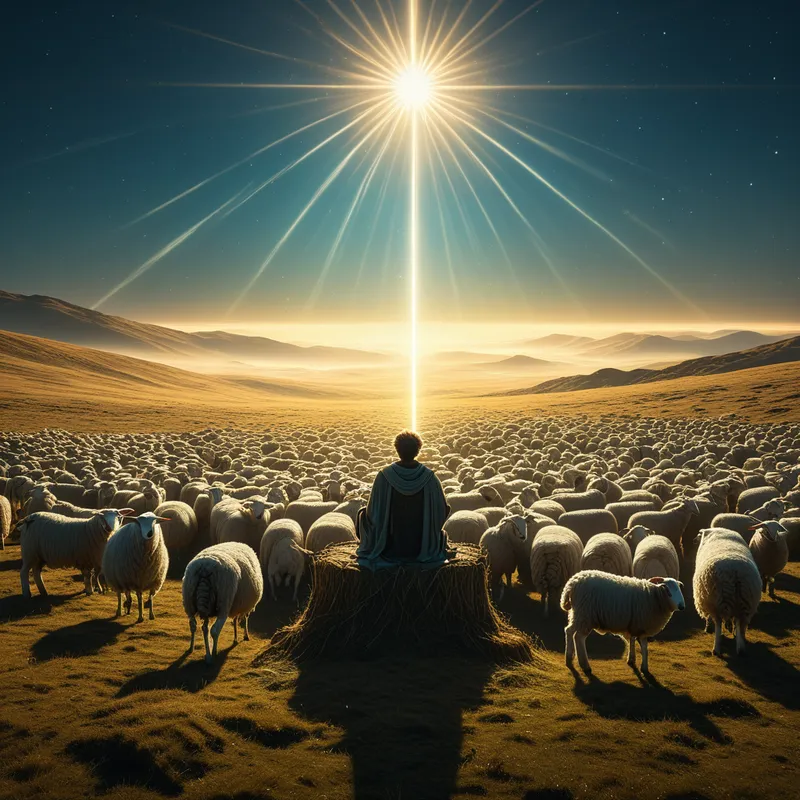
Listen. The air grows thin, the age grows old, and the sun hangs low, a great bronze disc bleeding light across the final field. All nations are gathered there, a sea of faces turned to [the horizon](/myths/the-horizon “Myth from Various culture.”/) where the Son of Man comes, not with a whisper, but with the weight of all glory, and all the holy ones with him. He sits upon the throne of his glory, and the field itself becomes the floor of heaven.
And he begins to separate them, one from another, as a shepherd who knows the very breath of his flock divides the sheep from the goats. His gaze is not of wrath, but of a terrible, perfect knowing. With a gesture that seems to pull at the fabric of the soul itself, he sets the sheep on his right hand—the side of blessing, of the morning sun—and the goats on his left.
Then the King speaks, and his voice is like the sound of many waters and also like the most intimate thought. To those on his right, he says, “Come, you who are blessed by my Father. Inherit the kingdom prepared for you from the foundation of [the world](/myths/the-world “Myth from Tarot culture.”/). For I was hungry, and you gave me food. I was thirsty, and you gave me drink. I was a stranger, and you welcomed me. Naked, and you clothed me. I was sick, and you visited me. I was in prison, and you came to me.”
And the righteous, bewildered, their eyes wide with a humility that shines, answer, “Lord, when did we see you hungry and feed you, or thirsty and give you drink? When did we see you a stranger and welcome you, or naked and clothe you? And when did we see you sick or in prison and come to you?”
The King answers, and in his words is the key to all creation: “Truly, I say to you, as you did it to one of the least of these my brothers, you did it to me.”
Then he turns to those on the left, and the same law echoes, but now as a hollow bell. “Depart from me, you cursed, into the eternal fire prepared for the devil and his angels. For I was hungry, and you gave me no food. I was thirsty, and you gave me no drink. I was a stranger, and you did not welcome me, naked and you did not clothe me, sick and in prison and you did not visit me.”
And they too, in a tremor of horrified recognition, plead, “Lord, when did we see you hungry or thirsty or a stranger or naked or sick or in prison, and did not minister to you?”
His reply is the closing of a door that was never locked from his side: “Truly, I say to you, as you did not do it to one of the least of these, you did not do it to me.” And these depart into an age-long fire, but the righteous into an age-long life. The separation is complete. The parable ends. The echo remains.
Cultural Origins & Context
This narrative is found within the Gospel of Matthew, a text central to the Christian tradition, yet its archetypal roots tap into a universal human jurisprudence. It is delivered by [Jesus of Nazareth](/myths/jesus-of-nazareth “Myth from Christian culture.”/) as part of the Olivet Discourse, a series of teachings on the end of the age. Functionally, it is an apocalyptic parable—a story about the ultimate accountability of history.
It was not a myth recited around pagan fires but a teaching preserved and transmitted by early communities who saw themselves living in [the shadow](/myths/the-shadow “Myth from Jungian culture.”/) of a coming judgment. Its societal function was dual: it was a radical ethical mandate for a marginalized community to practice unconditional charity, and it was a theodicy, explaining the moral architecture of the cosmos. The “least of these” originally referred to fellow disciples, but its interpretation rapidly expanded to encompass all suffering humanity, making it a cornerstone of universal social ethics. It was passed down not by bards, but by evangelists and scribes, its potency lying in its terrifying simplicity and its direct address to the individual conscience.
Symbolic Architecture
The myth’s power is not in its literalism but in its profound symbolic [architecture](/symbols/architecture “Symbol: Architecture in dreams often signifies structure, stability, and the framing of personal identity or life’s journey.”/). The Last Judgment is not merely an [event](/symbols/event “Symbol: An event within dreams often signifies significant life changes, transitions, or emotional milestones.”/) but a state of [revelation](/symbols/revelation “Symbol: A sudden, profound disclosure of truth or insight, often through artistic or musical means, that transforms understanding.”/), where the hidden [truth](/symbols/truth “Symbol: Truth represents authenticity, honesty, and the quest for knowledge beyond mere appearances.”/) of every [action](/symbols/action “Symbol: Action in dreams represents the drive for agency, motivation, and the ability to take control of situations in waking life.”/) is made manifest. The [sheep](/symbols/sheep “Symbol: Sheep often symbolize innocence, vulnerability, and the idea of conforming to societal norms.”/) and the [goat](/symbols/goat “Symbol: The goat symbolizes independence, resilience, and various traits associated with adaptability across diverse cultures.”/) are not arbitrary animals. In the pastoral culture of the Near East, sheep were docile, flock-oriented, and valued for their [wool](/symbols/wool “Symbol: A natural fiber representing warmth, protection, and connection to tradition. Often symbolizes comfort, labor, or spiritual purity.”/) and [meat](/symbols/meat “Symbol: Meat in dreams often symbolizes sustenance, vitality, and the primal aspects of one’s nature, as well as potential conflicts or desires.”/)—symbols of gentleness and communal provision. Goats, while also valuable, were more independent, stubborn, and often grazed separately; in biblical [ritual](/symbols/ritual “Symbol: Rituals signify structured, meaningful actions carried out regularly, reflecting cultural beliefs and emotional needs.”/), they could be the [scapegoat](/myths/scapegoat “Myth from Biblical culture.”/) for sin.
The separation is not of good people from bad people, but of integrated consciousness from fragmented consciousness. The right hand and left hand symbolize the conscious and unconscious, the accepted and the rejected parts of the self.
The “least of these” is the ultimate [symbol](/symbols/symbol “Symbol: A symbol can represent an idea, concept, or belief, serving as a powerful tool for communication and understanding.”/). It represents the marginalized, the sick, the impoverished—but psychologically, it is the [shadow](/symbols/shadow “Symbol: The ‘shadow’ embodies the unconscious, repressed aspects of the self and often represents fears or hidden emotions.”/), the part of ourselves and others we find easiest to ignore, despise, or reject. The [King](/symbols/king “Symbol: A symbol of ultimate authority, leadership, and societal order, often representing the dreamer’s inner power or external control figures.”/)’s shocking identification—“you did it to me”—collapses the [distance](/symbols/distance “Symbol: Distance in dreams often symbolizes emotional separation, unattainable goals, or the need for personal space and reflection.”/) between the divine and the degraded. It asserts that the sacred is encountered not in transcendence alone, but in the concrete, often uncomfortable, immanence of the other’s need. The core conflict is thus between recognition and neglect, between seeing [the divine spark](/myths/the-divine-spark “Myth from Gnostic culture.”/) in the mud of existence and walking past it.

The Dreamer’s Resonance
When this myth stirs in the modern dreamer, it rarely appears as a biblical scene. Instead, one dreams of being late for a crucial, unnamed examination. Of standing before a sorting machine that scans one’s heart, not one’s resume. Of trying to feed a starving figure who keeps changing faces—a parent, a stranger, a younger version of oneself—only to find the food turns to dust. Or one dreams of being perpetually on the left side of a room, unable to cross to the right where warmth and community glow.
Somatically, this may manifest as a tightness in the chest—a heart chakra constricting under the weight of unlived compassion, or a visceral anxiety about a fundamental life-choice not yet made. Psychologically, the dreamer is confronting their own internal judgment seat. The process is one of profound self-audit. Which parts of my life, my personality, my past actions belong to the “sheep”—the nurturing, connected, responsible self? And which belong to the “goat”—[the self](/myths/the-self “Myth from Jungian culture.”/)-serving, isolated, indifferent self? The dream forces a reckoning with the question: What, and whom, have I fundamentally failed to see?

Alchemical Translation
The alchemical work modeled here is the transmutation of perception. The base metal is our ordinary, fragmented sight that sees a homeless person as a problem, a difficult colleague as a nuisance, our own pain as a distraction. The parable offers the philosopher’s stone: the realization that in serving the “least,” we serve the Self, the divine totality within.
The great work is not to become a saint, but to achieve a consciousness where no part of creation is seen as separate from the sacred. The goat is not destroyed; it is recognized, integrated, and its stubborn independence transformed into conscious responsibility.
The “separation” is thus a necessary stage in individuation. We must first distinguish (separate) the sheep from the goats within our own [psyche](/myths/psyche “Myth from Greek culture.”/)—acknowledge our capacity for both profound compassion and profound neglect. The fiery punishment for the goats symbolizes the psychic torment that inevitably follows the repression and [projection](/myths/projection “Myth from Alchemical culture.”/) of our “goat-like” qualities. The eternal life for the sheep is the peace of integrity, where action and essence are aligned. The final, alchemical goal is hinted at in the King’s identity: to realize that the one sitting on the throne, the one hungry in the street, and the one making the choice are, at the deepest level, not three, but one. The parable initiates us into the mystery that salvation is found in the act of seeing, and truly serving, the other as oneself.
Associated Symbols
Explore related symbols from the CaleaDream lexicon: