The biblical figure Jonah in t Myth Meaning & Symbolism
A prophet flees his divine calling, is swallowed by a great fish, and emerges transformed after three days in the belly of the beast.
The Tale of The biblical figure Jonah in t
Hear now the tale of the man who ran from the voice of the sky. In the sun-baked kingdom of Israel, under the rule of Jeroboam the king, there lived a man named Jonah, son of Amittai. The word of Yahweh came to him, a pressure in the bones, a fire in the silence: “Arise, go to the great city of Nineveh, and cry out against it, for its wickedness has risen up before me.”
But Jonah’s heart turned to stone. Nineveh was the hammer of the east, a city of bloodied walls and chariot dust, the enemy of his people. To go there was to walk into the lion’s jaws. So he arose—but not east to Nineveh. He went west, to the port of Joppa, seeking the sea’s horizon. He found a ship bound for Tarshish, paid his fare, and went down into its hold, fleeing from the presence of Yahweh.
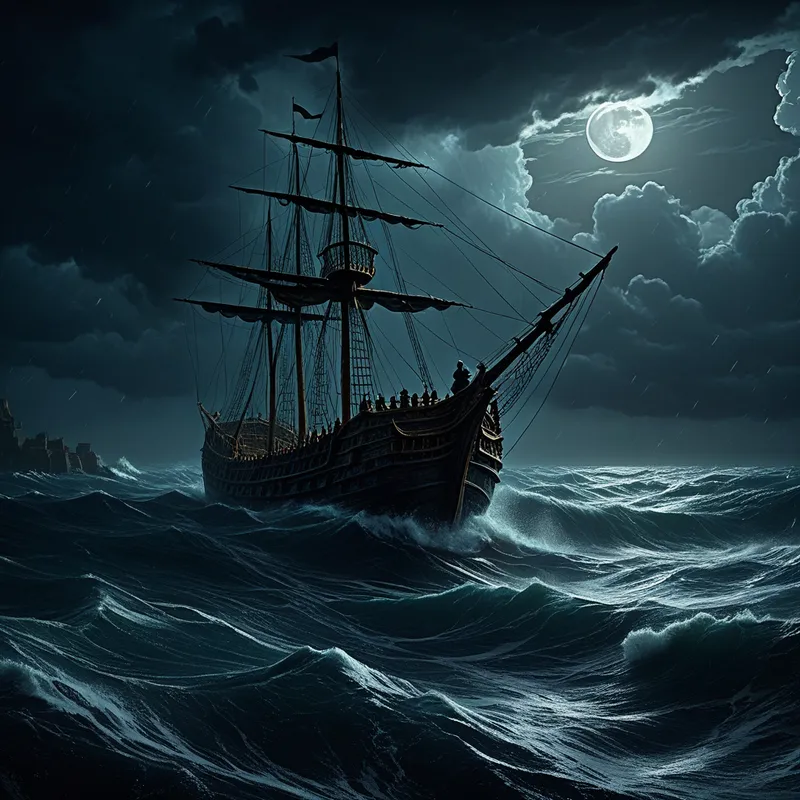
Yet the sky followed. Out on the wine-dark sea, Yahweh hurled a great wind, and a mighty tempest arose. The ship was seized, tossed like a child’s toy. The timbers groaned, the sails screamed. The seasoned mariners, faces pale with a terror deeper than any storm, cried each to his own god and cast the cargo into the sea to lighten the ship. And Jonah? He had gone down into the innermost part of the ship, lain down, and fallen into a deep, stubborn sleep.
The captain found him. “What do you mean, sleeper? Arise, call on your god!” The lot was cast to find the man on whom this calamity rested, and it fell on Jonah. The sea itself seemed to quiet to hear his confession. “I am a Hebrew,” he said, the salt spray on his lips, “and I fear Yahweh, the God of heaven, who made the sea and the dry land.” He told them of his flight. A dread fell upon the men, greater than the storm. “What shall we do to you that the sea may quiet for us?”
“Lift me up and hurl me into the sea,” Jonah said, his voice hollow with a fatal resolve. “Then the sea will become calm for you, for I know it is because of me that this great tempest has come upon you.”
The men rowed harder, straining against the inevitable, but the sea grew more violent. At last, with prayers for mercy on their lips, they took Jonah and cast him into the raging deep. The moment he struck the water, the storm ceased. A great calm swallowed the world. And as the men offered sacrifices and made vows in their awe, the waters parted not for Jonah, but for another.
Yahweh appointed a great fish to swallow Jonah. Down, down he went, into a living darkness, into the belly of the beast. For three days and three nights, Jonah was in the belly of the fish, surrounded by the pulse of a vast other life, in a chamber of gastric night, seaweed wrapped about his head, at the very roots of the mountains. And there, in that absolute interior, with death pressed on all sides, the voice of flight finally stilled, Jonah prayed. From the belly of Sheol he cried, and his voice was heard.
Then Yahweh spoke to the fish, and it vomited Jonah out upon the dry land. The sun was a shock. The sand was real. The word of Yahweh came to Jonah a second time: “Arise, go to Nineveh.” And Jonah arose and went, his skin perhaps still smelling of salt and the deep.

Cultural Origins & Context
The story of Jonah is a unique gem within the prophetic books of the Hebrew Bible. Unlike the others, which are primarily collections of oracles, the Book of Jonah is a finely crafted narrative, a didactic story about a prophet. Its origins are debated, but it is generally placed in the post-exilic period (after 539 BCE), a time of deep theological reflection for Israel. The tale functions less as a historical chronicle and more as a profound exploration of divine mercy, human obstinacy, and the universal scope of God’s concern.
It was a story told to challenge parochialism. For a people defining themselves in contrast to mighty empires, the notion that God’s compassion could extend to their brutal oppressors in Nineveh was radical, even offensive. The story was likely preserved and recited to confront this very resistance, using satire and irony (the pagan sailors and Ninevites respond to God more faithfully than the Hebrew prophet) to expand the community’s understanding of its own covenant. It served as a counter-narrative to nationalism, asserting that the human heart, in its capacity for repentance and its tendency to flee, is the true universal territory.
Symbolic Architecture
At its core, Jonah is not a story about a whale; it is a story about the container. The prophet represents the part of the psyche that, when faced with a difficult, calling, or terrifying demand from the Self, chooses dissociation and flight. Nineveh symbolizes the shadow city—the complex, messy, and feared aspect of life (or of one’s own nature) that must be confronted and integrated.
The belly of the fish is the alchemical vessel. It is the enforced container of transformation where flight is impossible and the only direction is inward.
The storm is the psychic turbulence that inevitably arises when one lives in opposition to one’s deep purpose. The sailors represent the collective, pragmatic world, which often bears the collateral damage of an individual’s refusal of their calling. The three days and nights in the belly mirror the universal motif of the night sea journey, a necessary descent into the unconscious. Jonah’s prayer from the belly is the critical moment of surrender, where the ego, having exhausted all avenues of escape, finally turns toward the source of its distress. The fish, appointed by God, is thus not a monster of punishment but an instrument of grace—a living, breathing womb that prevents dissolution (drowning) and enables a fraught gestation.

The Dreamer’s Resonance
When this myth stirs in the modern unconscious, it often manifests in dreams of constriction and unexpected salvation. To dream of being trapped in a small, dark, organic space—a cave that feels alive, a basement that pulses, the interior of a vehicle that has become a stomach—points directly to the “Jonah complex.” This is the somatic experience of having been swallowed by one’s own avoided task, repressed emotion, or unlived life.
The psychological process is one of enantiodromia—the emergence of the unconscious opposite. The frantic, outward energy of flight (to Tarshish) has run its course and collapsed into its opposite: a profound, immobilizing interiority. The dreamer is in the belly phase. The feeling is not typically of panic, but of a heavy, resigned, or contemplative imprisonment. There is a sense that the outer world is inaccessible, and all activity must cease. This is the psyche’s non-negotiable incubation period. The dream signals that a process of deep psychic reorientation is underway, often against the ego’s will, and that the only meaningful action left is to attend to the inner voice, to “pray” from the place of confinement.

Alchemical Translation
The alchemy of Jonah models the indispensable, brutal, and merciful process of individuation. The initial nigredo, the blackening, is Jonah’s refusal and the ensuing storm—the chaotic, suffering-laden conflict between conscious attitude and unconscious imperative.
The fish provides the vas, the sealed vessel. Here, in the albedo (whitening), the solitary ego is stripped of all its outer supports and agendas. It is reduced to its essence, floating in the psychic fluids of the unconscious. This is not an active, heroic labor, but a passive, necessary suffering—the solve (dissolution). The prayer represents the first conscious connection from within the dissolution, a thread of awareness that begins the work of coagulatio.
The vomiting onto dry land is the birth of a new attitude. The ego is not destroyed but returned to the world, humbled and saturated with the experience of the deep.
The final, often overlooked part of the myth—Jonah’s anger at God’s mercy on Nineveh—is crucial. It shows that the transformed individual is not perfected. The old resentments and identifications remain, but now they sit in full sunlight, exposed and debated with the divine. The integration is not complete, but the circuit of flight and containment has been established. For the modern individual, the myth teaches that one cannot think or will one’s way into wholeness. Sometimes, one must be swallowed, must endure the dark gestation, to be carried to the shore one originally fled. The destination (Nineveh) remains, but the person who arrives is no longer the one who fled.
Associated Symbols
Explore related symbols from the CaleaDream lexicon: