The Bhavacakra Myth Meaning & Symbolism
A cosmic diagram held by Yama, depicting the six realms of existence, the twelve links of dependent origination, and the path out of the endless cycle of suffering.
The Tale of The Bhavacakra
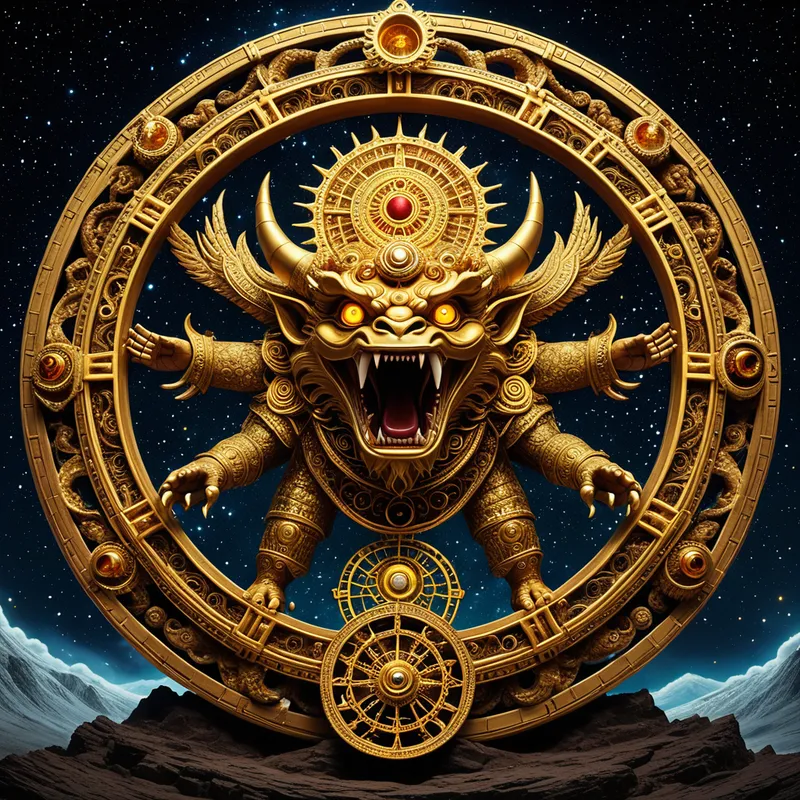
In the silent, boundless space beyond the worlds, where time itself is but a whisper, there stands a figure of terrifying majesty. He is Yama, the Dharma King. His skin is the blue of a stormy twilight, his eyes blaze with the fire of perfect discernment, and in his mighty claws, he grips not a weapon, but a truth so vast it is a cosmos unto itself: the Bhavacakra.
He does not hold it aloft in [triumph](/myths/triumph “Myth from Roman culture.”/), but in a posture of relentless, compassionate demonstration. The Wheel hums with the collective vibration of all existence. Look closer. See its three concentric circles, a universe painted in the colors of [karma](/myths/karma “Myth from Hindu culture.”/) and consequence. At the very hub, a rooster, a snake, and a pig chase each other in an endless, blind circle—the primal forces of greed, hatred, and delusion that set the whole terrible, beautiful machine in motion.
The second circle is split like a pie of fates. Here, in radiant splendor, the gods lounge in celestial gardens, their joy so intense it borders on agony. There, in grim solidarity, the titanic Asuras forge weapons for a war they can never win. Here, the human realm, a tapestry of fleeting pleasure and sharp pain, of fields and childbirth and sickness. There, the animal realm, all instinct and fear. Further down, the realm of the Preta, with their distended bellies and needle-throats, forever starving. And at the bottom, the cold, crushing realms of hell, where beings are frozen, burned, and torn apart, only to be remade for more.
Encircling it all, in the outer rim, twelve images tell the silent, inexorable story. An old, blind man stumbles forward, led by a potter shaping a vessel on his wheel. A monkey leaps from branch to branch in a fruit-laden tree. A couple embraces in a boat, a woman gives birth, a man carries a corpse to the pyre. This is the chain of Pratityasamutpada, the causal sequence from ignorance to aging and death, and back to ignorance again.
And outside the Wheel, in the luminous emptiness, stands a figure untouched by its spin. The Buddha points with one graceful finger to a shining moon—the promise of [Nirvana](/myths/nirvana “Myth from Buddhist culture.”/). His other hand rests in the mudra of teaching. He does not pull beings from the Wheel; he shows them the mechanism of its turning. Yama, the fierce holder of this truth, is not a captor but the first and most profound teacher. He holds up [the mirror](/myths/the-mirror “Myth from Various culture.”/) of reality, and in its terrifying reflection, the possibility of awakening is born.

Cultural Origins & Context
The Bhavacakra is not a myth told in linear narrative, but a visual and philosophical one, crystallized in the monastic traditions of early Buddhism. Its origins are deeply intertwined with [the Buddha](/myths/the-buddha “Myth from Buddhist culture.”/)’s own teachings on the nature of suffering (Dukkha) and its cause. While its iconic painted form became a staple on the porch walls of Tibetan Buddhist monasteries—a last teaching for monks to contemplate before entering [the temple](/myths/the-temple “Myth from Jewish culture.”/)—its conceptual architecture is found in the earliest Pali Canon.
It functioned as a pedagogical masterwork, a cosmic map for both the illiterate layperson and the seasoned monk. Lamas would use it as a teaching aid, explaining each realm and each link of causation. For the society that nurtured it, the Wheel was a radical democratization of cosmic truth. It presented a universe governed not by the whims of capricious gods, but by the immutable law of karma and causality. It placed the responsibility for one’s fate—and the key to its transcendence—squarely in the hands, and mind, of the individual. It was a societal mirror, reflecting the psychological states of all beings, from the king to the beggar, back to themselves, urging ethical conduct and mindful inquiry.
Symbolic Architecture
The Bhavacakra is the ultimate symbolic [architecture](/symbols/architecture “Symbol: Architecture in dreams often signifies structure, stability, and the framing of personal identity or life’s journey.”/) of the [psyche](/myths/psyche “Myth from Greek culture.”/) in its bound state. It is not a map of places, but of psychological conditions.
The Wheel is the mind spinning its own world into being, mistaking its projections for solid reality.
The hub’s three animals—the pig (ignorance), the snake (aversion), the rooster (attachment)—represent the core neurotic [triad](/symbols/triad “Symbol: A grouping of three representing spiritual unity, divine completeness, and cosmic balance across many traditions.”/) that fuels [the ego](/myths/the-ego “Myth from Jungian culture.”/)’s endless becoming. The six realms are not [afterlife](/symbols/afterlife “Symbol: A symbolic journey beyond death, representing transition, the unknown, and ultimate questions about existence, purpose, and what follows life.”/) destinations, but archetypal states of [consciousness](/symbols/consciousness “Symbol: Consciousness represents the state of awareness and perception, encompassing thoughts, feelings, and experiences.”/) available in any [moment](/symbols/moment “Symbol: The symbol of a ‘moment’ embodies the significance of transient experiences that encapsulate emotional depth or pivotal transformations in life.”/): the god [realm](/symbols/realm “Symbol: The symbol of ‘Realm’ often signifies the boundaries of one’s consciousness, experiences, or emotional states, suggesting aspects of reality that are either explored or ignored.”/) of manic [bliss](/symbols/bliss “Symbol: A state of profound happiness and spiritual contentment, often representing fulfillment of desires or alignment with one’s true self.”/) and pride, the asura realm of paranoid [competition](/symbols/competition “Symbol: Competition in dreams often symbolizes conflict, ambition, and the drive to succeed, reflecting personal goals and challenges.”/), the [human](/symbols/human “Symbol: The symbol of a human represents individuality, complexity of emotions, and social relationships.”/) [realm](/symbols/realm “Symbol: The symbol of ‘Realm’ often signifies the boundaries of one’s consciousness, experiences, or emotional states, suggesting aspects of reality that are either explored or ignored.”/) of mixed hope and [anxiety](/symbols/anxiety “Symbol: Anxiety in dreams reflects internal conflicts, fears of the unknown, or stress from waking life, often demonstrating the subconscious mind’s struggle for peace.”/), the animal [realm](/symbols/realm “Symbol: The symbol of ‘Realm’ often signifies the boundaries of one’s consciousness, experiences, or emotional states, suggesting aspects of reality that are either explored or ignored.”/) of unconscious habit, [the hungry ghost](/myths/the-hungry-ghost “Myth from Buddhist culture.”/) realm of addictive craving, and the hell realm of self-tormenting rage and [despair](/symbols/despair “Symbol: A profound emotional state of hopelessness and loss, often signaling a need for transformation or surrender to deeper truths.”/).
The twelve links of the outer rim are the precise, step-by-step process of psychic suffering. From the initial ignorance (Avidya) that leads to mental formations, to consciousness, name-and-form, the six senses, contact, feeling, craving, grasping, becoming, [birth](/symbols/birth “Symbol: Birth symbolizes new beginnings, transformation, and the potential for growth and development.”/), and finally, old age and [death](/symbols/death “Symbol: Symbolizes transformation, endings, and new beginnings; often associated with fear of the unknown.”/)—it is a [blueprint](/symbols/blueprint “Symbol: A blueprint represents the foundational plan or design for something, often symbolizing potential, structure, and the mapping of one’s inner self or future.”/) for how a moment of delusion crystallizes into a lifetime of patterned suffering, and how that [pattern](/symbols/pattern “Symbol: A ‘Pattern’ in dreams often signifies the underlying structure of experiences and thoughts, representing both order and the repetitiveness of life’s situations.”/) replicates itself.
Yama himself is a profound [symbol](/symbols/symbol “Symbol: A symbol can represent an idea, concept, or belief, serving as a powerful tool for communication and understanding.”/). He is the [shadow](/symbols/shadow “Symbol: The ‘shadow’ embodies the unconscious, repressed aspects of the self and often represents fears or hidden emotions.”/), the [reality](/symbols/reality “Symbol: Reality signifies the state of existence and perception, often reflecting one’s understanding of truth and life experiences.”/) principle, the part of the psyche that confronts us with the consequences of our actions. He is not evil, but fiercely truthful. The [Buddha](/symbols/buddha “Symbol: The image of Buddha embodies spiritual enlightenment, peace, and a quest for inner truth.”/) outside the wheel represents the transcendent Self, the Tathagatagarbha, which witnesses the [drama](/symbols/drama “Symbol: Drama signifies narratives, emotional expression, and the exploration of human experiences.”/) without being entangled in it. His pointing [gesture](/symbols/gesture “Symbol: A non-verbal bodily movement conveying meaning, emotion, or intention, often symbolic in communication and artistic expression.”/) is the call to self-[reflection](/symbols/reflection “Symbol: Reflection signifies self-examination, awareness, and the search for truth within oneself.”/), the spark of [awareness](/symbols/awareness “Symbol: Conscious perception of self, surroundings, or internal states. Often signifies awakening, insight, or heightened sensitivity.”/) that can interrupt the automated cycle.
The Dreamer’s Resonance
When the Bhavacakra appears in modern dreams, it rarely manifests as a literal painted wheel. Instead, one dreams of being trapped in a vast, impersonal system—a corporate ladder that is also a hamster wheel, a social media feed that scrolls infinitely through curated lives, a repetitive cycle of failed relationships following the same painful script. One may dream of suddenly shifting between psychological “realms”: feeling god-like in one moment (triumphant, above it all), then plunged into asura-like envy, then into the hollow, craving state of a hungry ghost staring into a refrigerator that is always empty.
The somatic experience is one of visceral entrapment and cyclical fatigue. The dreamer may feel the “wheel” in their body as chronic tension, a sense of being driven by unseen gears. The dream is the psyche’s way of presenting its own operating system, showing the dreamer the specific “realms” they are addicted to inhabiting and the “links” (like automatic negative thoughts leading to self-sabotaging actions) that keep them bound. It is a call to recognize the architecture of one’s own suffering.

Alchemical Translation
The alchemical work modeled by the Bhavacakra is the ultimate transmutation: turning the lead of conditioned, suffering existence into the gold of liberated awareness. The process is one of dis-identification and mindful interruption.
The first alchemical step is to stop seeing oneself as a passenger on the wheel and to recognize oneself as the wheel’s mechanic—and its potential dismantler.
This begins with “Yama’s Gaze”—the courageous act of self-confrontation. One must allow the inner Yama to hold up the mirror, to see clearly the three poisons at the center of one’s motivations, and to identify which psychological realm one is currently investing in as “reality.” Is it the striving of the human realm, the numbing habits of the animal realm, or the insatiable wanting of the hungry ghost realm?
The practical work is in the outer rim, in the links of dependent origination. [The alchemist](/myths/the-alchemist “Myth from Various culture.”/) learns to pause at critical junctures—between feeling and craving, between craving and grasping. This pause is the space of freedom, the application of the Buddha’s pointing finger. By bringing mindful awareness to these automatic links, the chain is weakened. One learns to let a feeling of lack arise without it automatically spiraling into a craving that demands immediate gratification.
The goal is not to escape to the “god realm” or any other segment, but to step out of the wheel’s spin entirely. This is the realization of the Buddha-figure outside: abiding in the witnessing consciousness that is aware of the realms, the poisons, and the links, but is not defined by them. The wheel continues to turn—sensations, thoughts, and worldly events still arise—but the core identity is no longer clutched by Yama’s claws. One has discovered the still point at the center of the turning world, and from there, the entire cosmic machine is revealed not as a prison, but as a [mandala](/myths/mandala “Myth from Buddhist culture.”/) of transformative wisdom.
Associated Symbols
Explore related symbols from the CaleaDream lexicon: