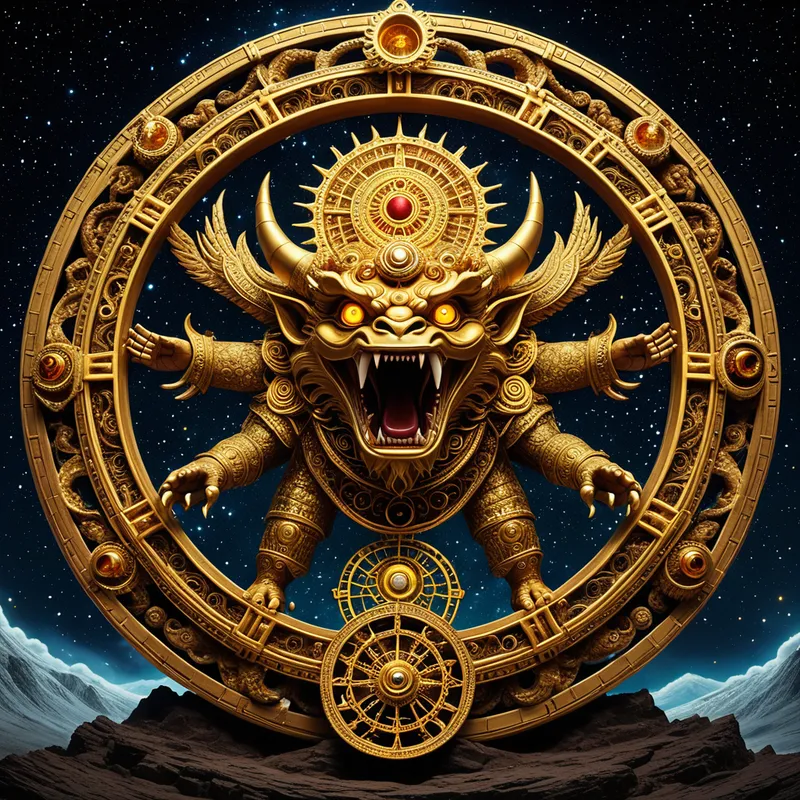
The Somatic Echo
It begins not as a thought, but as a gravity. A deep, cellular weariness, a fatigue that feels older than your bones. It’s the sigh that escapes you before you know why, the tightness in the solar plexus that speaks of a familiar, dreaded turn. This is the body’s memory of the loop—the visceral foreknowledge of a pattern about to replay. Your shoulders already know the weight they are to carry again; your breath already shortens in anticipation of the same constriction. It is the echo of a wheel turning within, a momentum that feels both inescapable and intimately, exhaustingly yours. Before any image forms in the dream, this is the ground from which samsara grows: a somatic hum of recurrence, a psychic déjà vu felt in the marrow.
The Dreamer's Log
You are walking down an endless, institutional corridor. The doors lining it are all identical, slightly ajar. You know, with a certainty that chills you, that behind each one is the same room, containing the same unresolved argument with the same person, waiting for you to enter and play your part. You wake with your heart pounding, not from terror, but from a profound, soul-crushing recognition.
This dream is the alchemical prima materia—the raw, leaden recognition of the psyche’s own recursive code, presented not as a puzzle to solve, but as a prison to feel in its full, devastating contours.

The False Lead
This is not a dream about mere "bad luck" or a run of unfortunate events. To mistake samsara for simple misfortune is to remain trapped on the wheel, blaming the road instead of the driver. The theme is not about what happens to you, but what happens within you—repeatedly, predictably, and with the haunting sense of authorship. It is the structural echo, not the circumstantial noise. The agony of samsara is not in the pain itself, but in the pre-emptive grief for the pain you know is coming, because you have, in some hidden chamber of your being, already written its return.
Psychological Architecture
The architecture of samsara is the psyche’s most fortified citadel, built not to keep threats out, but to keep a certain painful order in. This is the deep Shadow work of confronting not a monster, but a system—the internal family of exiled parts that run the same program to maintain a fragile, familiar stability. The Orphan, believing safety lies in predictable suffering, triggers the same defenses. The People-Pleaser, fearing abandonment, re-enacts the same negotiations. The Inner Critic, mistaking control for security, replays the same verdicts. Individuation here is not a heroic slaying, but a patient, terrifying disassembly. It requires you to sit in the central chamber of this citadel and, with unbearable compassion, ask each sentry, each automated protocol: What are you protecting? What are you so afraid will happen if you stop? The process feels like treason against your own survival instincts, because it is. You are dissolving the very foundations of a self built on cyclical pain.
Mythic Resonance
We see this eternal return etched into humanity’s oldest stories. It is not just the Eastern wheel of rebirth, but the Greek fate of Sisyphus, forever pushing his boulder up the hill only to watch it roll down—a punishment for the cleverness that sought to cheat death, a perfect metaphor for the ego’s exhausting efforts to solve a problem on the level it was created. More subtly, it resonates in the tale of Arachne, the weaver who challenged a goddess and was transformed into a spider, condemned to weave her web for eternity. Her genius became her cage; her defining act, her endless repetition. These myths are not about external curses, but about the moment a pattern of being becomes the totality of being. The loom becomes the universe; the path up the hill becomes the only world you know.
Symbolic Nodes
- Circular Motifs: Spinning wheels, merry-go-rounds, hamster wheels, orbiting planets, ouroboros snakes.
- Repetitive Landscapes: Identical hallways, looping roads, recurring rooms, staircases that lead back to their start.
- Broken Timepieces: Clocks with stuck hands, melting watches, hourglasses that instantly reset, calendars showing the same date.
- Mirrors and Echoes: Halls of mirrors reflecting the same image, hearing your own words repeated back to you by empty space.
- The Unchanging Other: Dream figures who, no matter what you do or say, respond with the same scripted line or gesture.
Archetypal Resonance
The core energy of the samsara dream is the cry of The Shadow Ruler. This is not the Sovereign who brings order from chaos, but the Tyrant who mistakes rigid control for sovereignty. Its regime is one of obsessive, fear-based repetition—the psyche’s attempt to govern the uncontrollable realms of emotion, relationship, and fate by forcing them into a known, even if painful, pattern. The somatic echo of weariness is the body rebelling against this internal tyranny. The alchemical potential lies in dethroning this Shadow Ruler, not through anarchy, but through the true sovereignty of conscious choice. It is the transformation from a ruler who enslaves the self to a cycle, to a ruler who liberates the self by choosing, moment by moment, to step off the wheel.
The Alchemical Process
The transmutation of samsara requires the most counterintuitive of fires: the heat of conscious endurance. It is not about breaking the cycle with force, but about staying present within it with such acute, unwavering awareness that the cycle itself begins to dissolve from the inside. This is the solve et coagula of the soul. First, the solve: you must allow yourself to fully feel the wheel’s turn without the anesthetic of blame, distraction, or the hope of a different outcome this time. You feel the familiar urge arise, the old hurt surface, the programmed response tighten in your chest—and you do not act. You simply hold the pattern in the crucible of your attention. This pressure is immense; it feels like allowing a wound to bleed without bandaging it. Then, the coagula: from that raw, witnessed experience, a new element precipitates—the element of choice. A tiny, almost imperceptible gap opens between the stimulus and your response. In that gap, that sovereign silence, the wheel misses a cog. The pattern, deprived of its unconscious fuel, begins to lose its momentum. The leaden recognition of the loop becomes the golden awareness that you are the one, and have always been the one, who can choose to stop turning it.

The Integration Protocol
Question 1: Where in my waking life do I feel the most profound sense of "here we go again"? Can I locate the very first somatic signal—the clutch in the gut, the sigh, the tension—that announces the cycle's beginning?
Question 2: What is the hidden payoff or the feared catastrophe that this cyclical pattern is desperately trying to manage or avoid? What does it believe it is protecting me from?
Question 3: If this cycle were a broken record, what is the one line of lyric, the core message, that is stuck on repeat? What is the single story it keeps telling about me, others, or the world?
Action 1 (Somatic Anchor): The next time you feel the somatic echo of the cycle begin, stop. Place a hand on the part of your body that holds the tension. Breathe into that space for three full cycles of breath, with no goal other than to feel the sensation without following it into the old story. This grounds the pattern in the present moment, robbing it of its predictive power.
Action 2 (Pattern Cartography): In a journal, draw the cycle not as a circle, but as a map. Name each "landmark": the Triggering Event, the Internal Reaction, the Automatic Thought, the Coping Behavior, the Aftermath. Then, in a different color, draw one tiny, alternative path away from just one of those landmarks. This creative act externalizes the internal system, making it something you can observe and edit.
Action 3 (Ritual of the Missed Cog): Create a simple, physical ritual to commemorate the first time you consciously notice the pattern and choose not to engage. It could be turning a small stone in your palm, lighting a candle for the new gap of awareness, or marking a symbol on a hidden piece of paper. This seals the alchemical shift from unconscious repetition to conscious sovereignty.
Final Validation
To dream of samsara is to feel the profound fatigue of a soul weary of its own footprints. This weariness is not a flaw, but a testament to your depth—a sign that a part of you has already traveled this loop a thousand times and is now, finally, screaming for a different sky. The very agony of the repetition is the fuel for its own end. You are not broken for being caught in the wheel; you are on the precise, razor-edged threshold of breaking it. The wheel turns only as long as you believe it is the whole world. The moment you realize you are the space in which the wheel turns, you are already free.