The Betwixt and Between Myth Meaning & Symbolism
A tale of a hero who is neither here nor there, navigating the sacred thresholds where worlds meet and the self is unmade and remade.
The Tale of The Betwixt and Between
Listen now, and let [the hearth](/myths/the-hearth “Myth from Norse culture.”/)-fire grow low. In the time when [the world](/myths/the-world “Myth from Tarot culture.”/) was younger and [the veil](/myths/the-veil “Myth from Various culture.”/) thinner, there was a youth named Cernonos. He was of the tribe, yet not fully. Born at the exact moment the last light of [Samhain](/myths/samhain “Myth from Celtic culture.”/) fled and the dark of the new year began, he belonged to neither day nor night. His feet knew the paths of the village, but his eyes were always drawn to the fringe of the forest, where the ordered world of posts and hearths frayed into the whispering, root-tangled unknown.
One evening, as the dimmet-light bled across [the sky](/myths/the-sky “Myth from Persian culture.”/), a silence fell—a silence so deep it had a voice. It called from the place where the great river Nith met the salt-churn of [the sea](/myths/the-sea “Myth from Greek culture.”/). It was a place of neither fresh [water](/myths/water “Myth from Chinese culture.”/) nor salt, a roiling, foaming broth of both. The elders said to shun it, for it was [the threshold](/myths/the-threshold “Myth from Folklore culture.”/) of [Tír na nÓg](/myths/tr-na-ng “Myth from Celtic culture.”/), and to step there was to be untethered from all worlds.
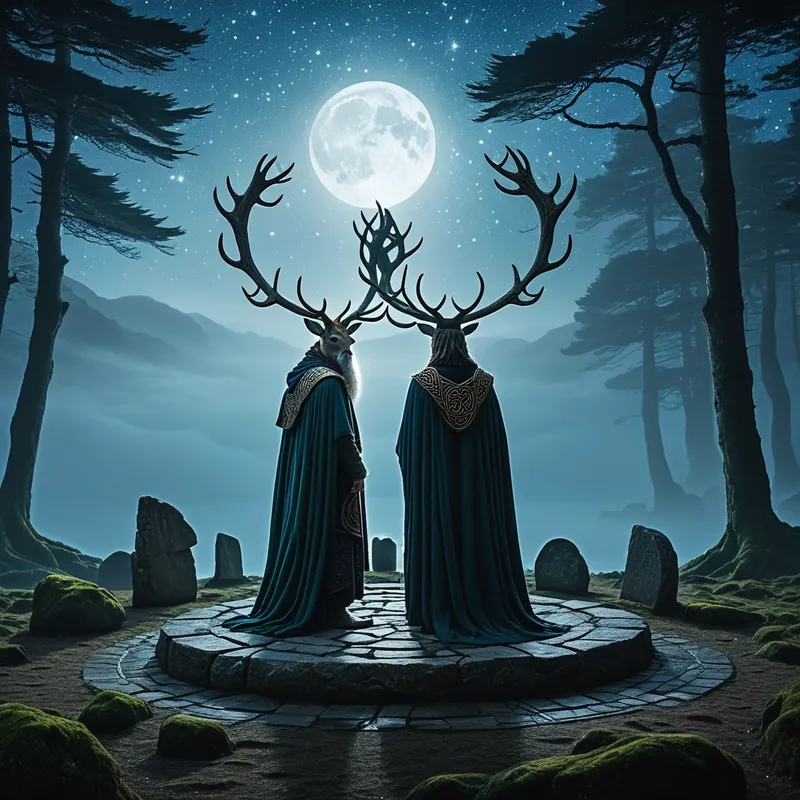
But the call was a hook in Cernonos’s soul. He walked, leaving the scent of bread and peat-smoke behind. The air grew damp and thick. He came to the estuary, a vast, grey plain of water and mist. There, upon a hummock of grass that was neither truly land nor shore, stood a figure. It was the Guardian of the Ford. Its form shifted like [the mist](/myths/the-mist “Myth from Celtic culture.”/)—sometimes an old man with eyes of deep pools, sometimes a great stag with antlers that held captured stars.
“You are the one who is neither,” the Guardian’s voice echoed, not from a mouth, but from the space between the lapping waves. “You are betwixt the clan and the wild, between the breath and the pause. To become, you must cease to be. Will you cross?”
Before Cernonos could answer, the ground beneath him liquefied. The firm village boy dissolved. He was not drowning, but unbecoming. Memories streamed from him like river-reeds. His name, his fears, his face—all washed away in the brackish water. He was pure sensation: the cold, the push, the pull. He was the threshold itself.
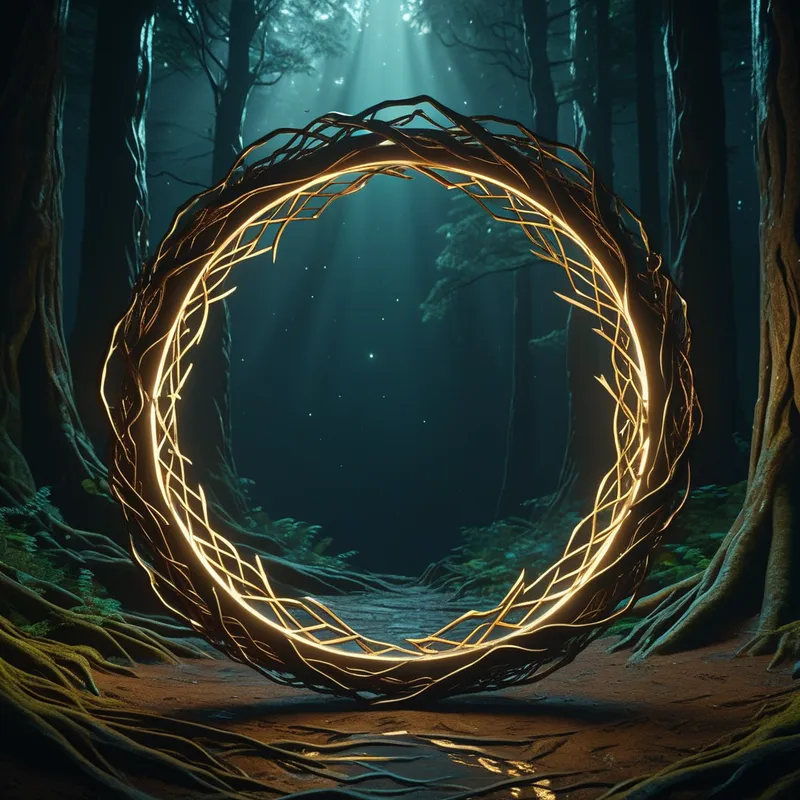
For three days and three nights, he existed in this raw state. On the fourth dawn, as first light touched the mist, he felt a new solidity. Not the old solidity of bone and name, but the firmness of purpose. He stood again on the hummock. The Guardian was gone. In his place grew a single oak sapling, its leaves one side green, the other side silver. Cernonos—though he knew that was no longer his only name—touched it. He knew the paths of the forest and the songs of the village. He was a bridge. He was the knowing of the between.
Cultural Origins & Context
The motif of the Betwixt and Between is not a single, codified myth from a specific text, but a pervasive archetype woven into the Celtic cosmological fabric. It emerges from an oral tradition maintained by the druids and bards, for whom the world was alive with spirit and meaning in every transition. This concept was crystallized in ritual and daily life.
Societies deeply attuned to agricultural and seasonal cycles—the turn of the year at Samhain, the neither-day-nor-night of dawn and dusk, the shore between land and sea—recognized these thresholds as places of immense power and danger. They were [nemeton](/myths/nemeton “Myth from Celtic culture.”/) sites, portals where the ordinary rules dissolved. Tales of heroes like Cernonos served a vital societal function: they provided a psychic map for navigating life’s inevitable crises of transition—adolescence, marriage, death, kingship. The story ritualized the disorientation, teaching that to be stripped of identity in the “between” was not annihilation, but a sacred prelude to a more integrated state of being.
Symbolic Architecture
At its [heart](/symbols/heart “Symbol: The heart symbolizes love, emotion, and the core of one’s existence, representing deep connections with others and self.”/), this myth is a master [symbol](/symbols/symbol “Symbol: A symbol can represent an idea, concept, or belief, serving as a powerful tool for communication and understanding.”/) of liminality. The [hero](/symbols/hero “Symbol: A hero embodies strength, courage, and the ability to overcome significant challenges.”/)’s [journey](/symbols/journey “Symbol: A journey in dreams typically signifies adventure, growth, or a significant life transition.”/) is not to a geographical [location](/symbols/location “Symbol: The symbol of ‘Location’ signifies a sense of place, context, and the environment in which experiences unfold.”/), but into a [condition](/symbols/condition “Symbol: Condition reflects the state of being, often focusing on physical, emotional, or situational aspects of life.”/)—the condition of being undefined.
The true self is not found in the fortress of identity, but forged in the flux of the threshold.
The [Guardian](/symbols/guardian “Symbol: A protector figure representing safety, authority, and guidance, often embodying parental, societal, or spiritual oversight.”/) of the [Ford](/symbols/ford “Symbol: The symbol ‘ford’ refers to a shallow place in a river or stream where one can cross, symbolizing transition, change, and the journey required to overcome obstacles.”/) represents the archetypal gatekeeper of the unconscious. It does not offer a test of [strength](/symbols/strength “Symbol: ‘Strength’ symbolizes resilience, courage, and the ability to overcome challenges.”/), but an [invitation](/symbols/invitation “Symbol: An ‘Invitation’ symbolizes opportunities, connections, or decisions awaiting the dreamer.”/) to surrender. The [dissolution](/symbols/dissolution “Symbol: The process of breaking down, dispersing, or losing form, often representing transformation, release, or the end of a state of being.”/) in the brackish waters symbolizes the necessary deconstruction of [the ego](/myths/the-ego “Myth from Jungian culture.”/)—the [persona](/symbols/persona “Symbol: The social mask or outward identity one presents to the world, often concealing the true self.”/) we build for society must be dissolved before a more authentic self can coalesce. The [estuary](/symbols/estuary “Symbol: A transitional zone where freshwater meets saltwater, symbolizing liminality, transformation, and the merging of different states or identities.”/), being neither fresh nor [salt](/symbols/salt “Symbol: Salt represents purification, preservation, and the essence of life. It is often tied to the balance of emotions and spiritual cleansing.”/), represents the confluence of opposites: conscious and unconscious, known and unknown, [life](/symbols/life “Symbol: The symbol of ‘Life’ represents a journey of growth, interconnectedness, and existential meaning, encompassing both the joys and challenges that define human experience.”/) and [death](/symbols/death “Symbol: Symbolizes transformation, endings, and new beginnings; often associated with fear of the unknown.”/). The final oak sapling is the symbol of [rebirth](/symbols/rebirth “Symbol: A profound transformation where old aspects of self or life die, making way for new beginnings, growth, and renewal.”/) and [integration](/symbols/integration “Symbol: The process of unifying disparate parts of the self or experience into a cohesive whole, often representing psychological wholeness or resolution of internal conflict.”/)—rooted in both worlds, a living testament that one can hold duality within a singular, resilient form.
The Dreamer’s Resonance
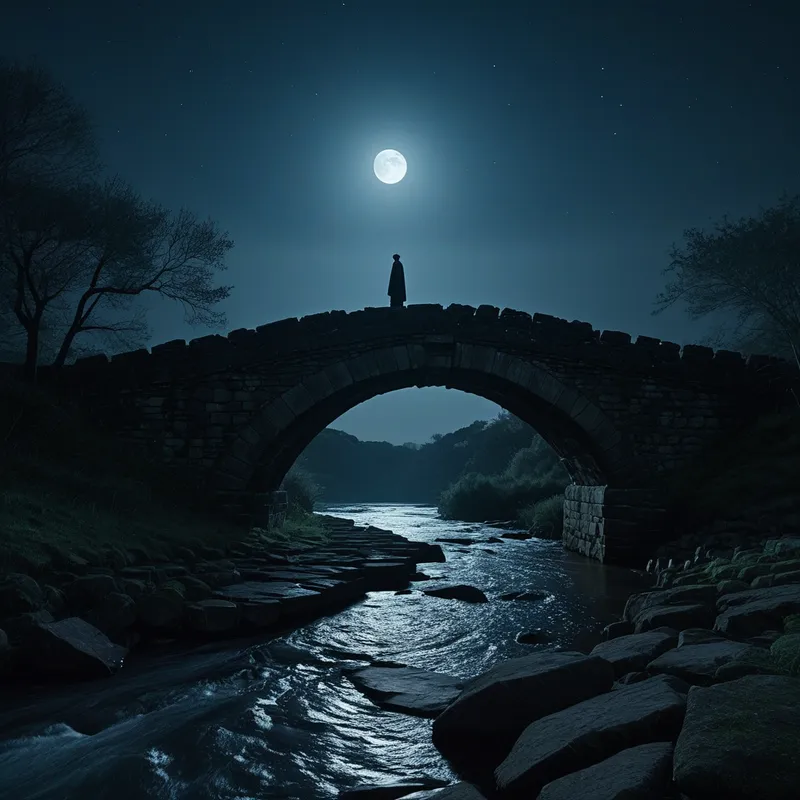
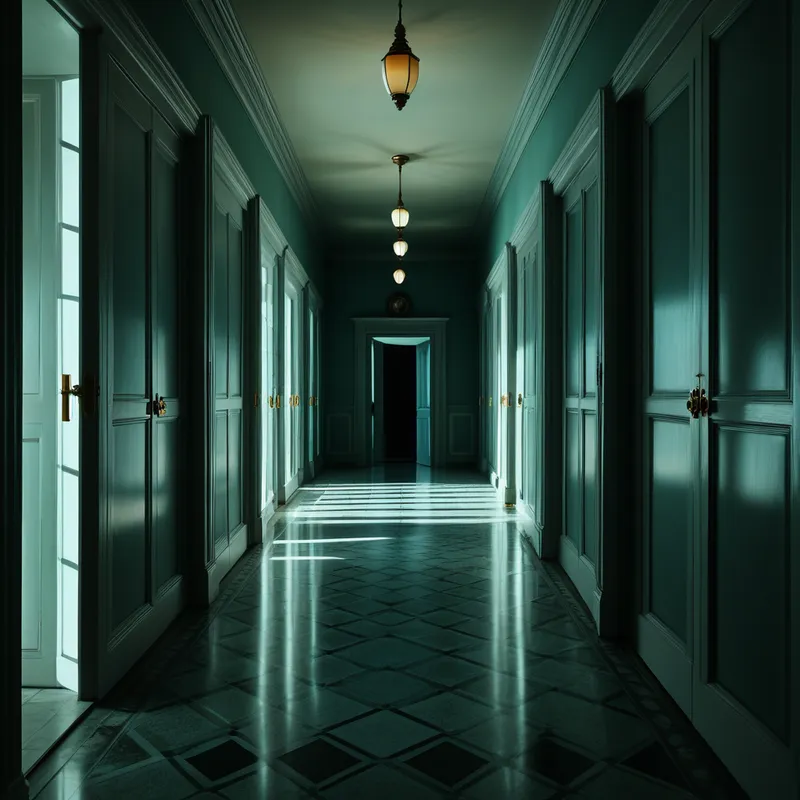
When this myth stirs in the modern [psyche](/myths/psyche “Myth from Greek culture.”/), it often manifests in dreams of profound in-betweenness. The dreamer may find themselves in endless airports, hallways with no exits, or on bridges that stretch into fog. They may be preparing for a ceremony but have forgotten their clothes, or be speaking but have no voice. These are not mere anxieties.
They are somatic and psychological echoes of an active liminal process. The psyche is announcing that the old container—a job, a relationship, a self-concept—has become too small. The conscious mind feels lost and anxious (the “betwixt”), but the unconscious is initiating a sacred dissolution (the “between”). The discomfort of the dream is the friction of transformation. The dreamer is not stuck; they are in process. The body may feel it as restlessness, a sense of floating, or inexplicable fatigue—the somatic cost of psychic unmooring.
Alchemical Translation
For the individual, this myth is a precise model of psychic alchemy, or what Jung termed individuation. The modern seeker often attempts to “find themselves” by adding more traits, achievements, or labels. The Celtic wisdom of the Betwixt and Between proposes the opposite path.
The alchemical gold is not discovered by polishing the lead of the old self, but by submitting it to the dissolving waters of the between.
The first step ([nigredo](/myths/nigredo “Myth from Alchemical culture.”/)) is the conscious entry into the liminal space—voluntarily enduring the crisis, the therapy, the creative block, the grief. The dissolution (albedo) is the surrender of control, allowing the brackish waters of the unconscious to wash away rigid identities. This feels like failure or madness to the ego. The final coagulation ([rubedo](/myths/rubedo “Myth from Alchemical culture.”/)) is the emergence of the “oak sapling” self—no longer a village youth or a wild spirit, but a third, more conscious entity that can navigate both realms. The transformed individual carries the threshold within them. They become a living bridge, capable of holding paradox, tolerating ambiguity, and recognizing the sacred potential in every transition life offers. They have learned to dwell, creatively and consciously, in the Betwixt and Between.
Associated Symbols
Explore related symbols from the CaleaDream lexicon: