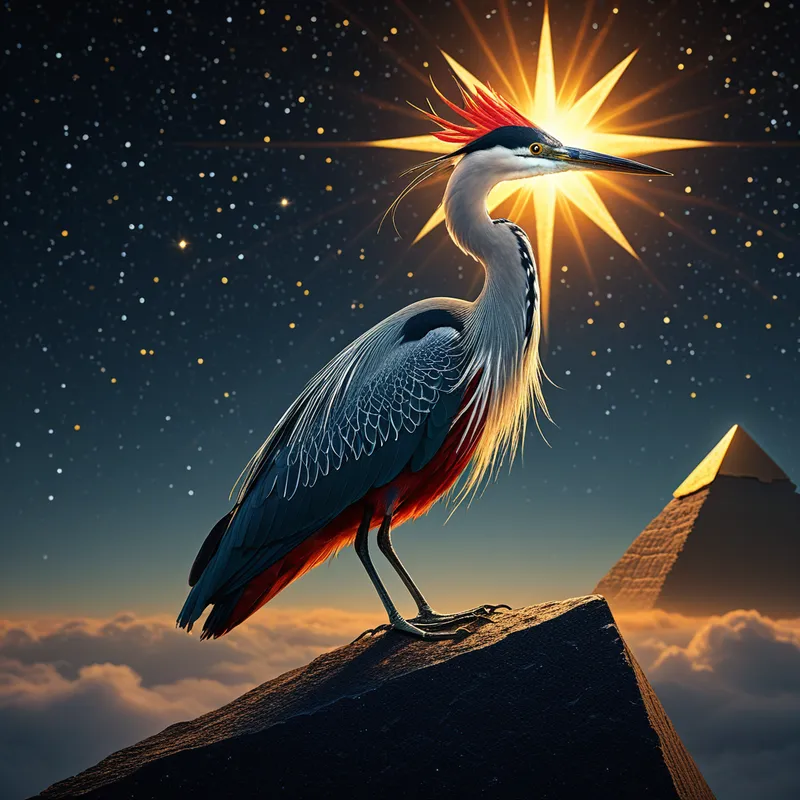
The Benu Bird Myth Meaning & Symbolism
The solitary Benu Bird, self-created from primordial chaos, heralds the dawn of time and the eternal cycle of death and fiery renewal.
The Tale of The Benu Bird
Before the sun had a name, before the land knew stone, there was only the dark, boundless, and silent water—Nun. In that eternal night, a stillness reigned so profound it was a kind of sound. Then, a disturbance. Not a ripple, but a knowing. A point of consciousness awakened within the endless black.
From the formless deep, a yearning took shape. It was a cry that was not a sound, but the first thought. And from that thought, a spark ignited in the void. It grew, not as fire grows, but as a soul remembers itself. Wings of gold and flame unfolded from the spark, and a long, graceful neck arched toward a heaven that did not yet exist. This was the Benu Bird, alone in the universe.
With a beat of its radiant wings, it stirred the waters of Nun. The chaos swirled and parted. And there, beneath its feet, the waters receded. Not land, not yet, but the idea of land—a mound, the first thing that was not water. The Benben Stone. The Benu alighted upon this dark, wet protrusion, the only solid thing in all existence. It folded its wings and let out a call.
That call was not heard, but felt. It was the vibration that set time into motion. It was the command that separated the sky from the water. The sound of its voice became the light, pushing back the endless night. Where its gaze fell, potential crystallized into form. It did not fight a monster or plead with a god, for it was the first god, the soul of the sun-god Ra himself. Its solitary act of perching, of declaring “I am here,” was the conflict, the action, and the resolution. The world began not with a clash, but with a presence. Having sung creation into being, the Benu’s form faded into the growing dawn, its work complete, yet its essence promised to return—not from an egg, but from its own ashes, in the twilight of ages, to begin the world anew.

Cultural Origins & Context
The myth of the Benu is woven into the very fabric of ancient Egyptian cosmology, originating in the theology of the sun cult at Iunu (Heliopolis). It was not a folktale told for entertainment, but a sacred narrative recited by priests to explain the incomprehensible: the moment of genesis. The Benu was the living symbol of the first sunrise, the visible manifestation of the initial creative impulse.
Its story was passed down through temple liturgies, funerary texts like the Book of the Dead, and royal inscriptions. To speak of the Benu was to invoke the principle of cyclical renewal—of the day, the year, and the Nile’s inundation. It served a profound societal function, linking the Pharaoh’s reign (and eventual rebirth) to this primordial act of creation. The Pharaoh was the living heir to the Benu’s creative power, and every commoner’s hope for life after death was mirrored in the bird’s legendary ability to rise from its own remains. The Benu was the ultimate guarantor of order (Maat) over chaos (Isfet), a promise etched into the civilization’s soul.
Symbolic Architecture
The Benu Bird is not merely a creature of myth but a complete symbolic system for the psyche’s origin and destiny. It represents the self-creating principle. It emerges not from an external womb or egg, but from the inner void of potential. This is the archetype of the Self in its most nascent, potent form.
The first act of creation is not to make something out there, but to become conscious in here.
Its association with the heron or grey phoenix is key: a bird that stands at the liminal space between water (the unconscious, Nun) and land (consciousness, the Benben). It is the mediator between chaos and order. Its perch upon the primordial mound symbolizes the emergence of the ego-complex—the first stable point of identity—from the swirling waters of the unconscious. The fiery plumage speaks of spirit and transformation, while its solitary nature underscores that the deepest creative and renewing forces within us are encountered alone. It is the myth of the individual spark confronting the collective void and, by its sheer presence, giving it meaning and form.
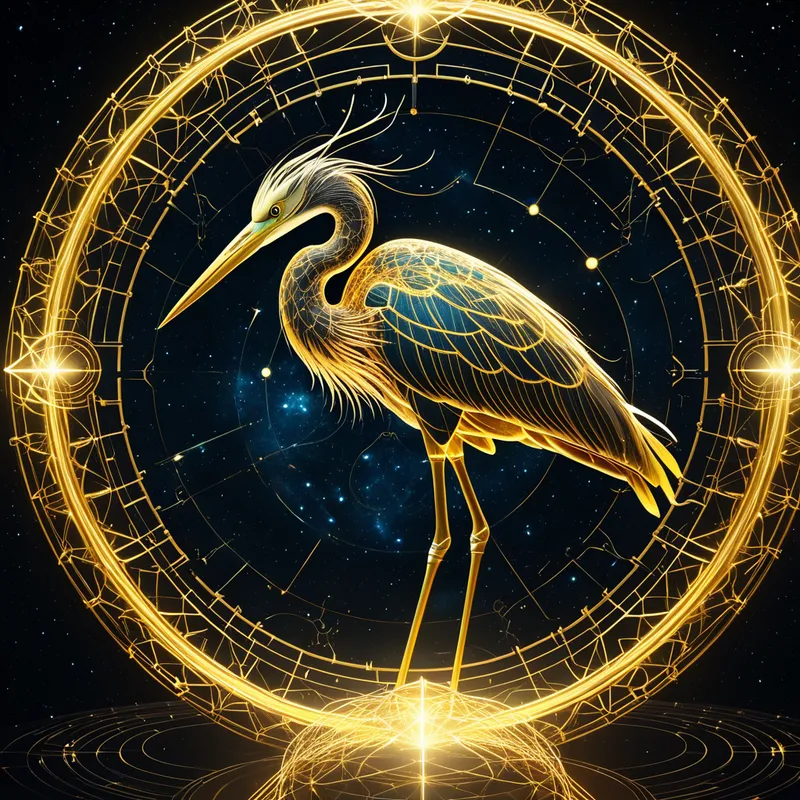
The Dreamer’s Resonance
When the Benu pattern stirs in the modern dreamer, it often signals a profound crisis of origin or renewal. One may dream of a lone, majestic bird in a barren landscape, of finding a single, luminous feather in the ashes of a burnt-down house (symbolizing the old life), or of standing at the edge of a vast, dark ocean as a light kindles within one’s own chest.
Somatically, this can feel like a gathering of energy in the solar plexus or heart center—a tight, potent coil of potential awaiting release. Psychologically, the dreamer is in the process of a “regression to the prima materia.” The structures of their life (relationships, career, identity) have dissolved into a formless, chaotic state (Nun). The dream is not a warning, but a testament: the psyche is preparing the mound. The feeling of profound isolation in the dream is not pathological loneliness, but the necessary solitude for a self-creation. The dreamer is the Benu, perched on the nascent Self, about to utter the call that will re-order their world.
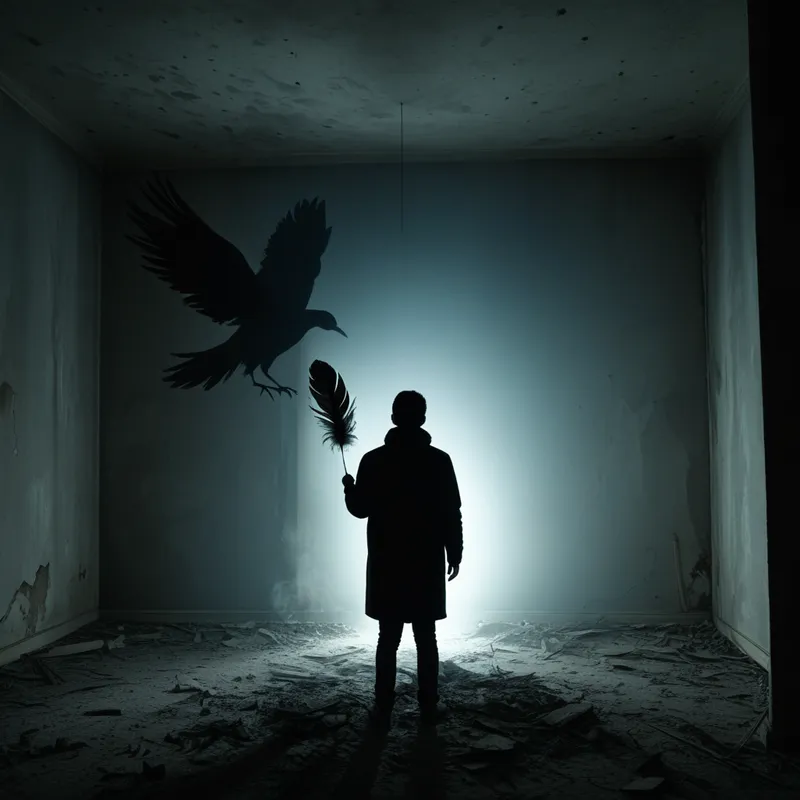
Alchemical Translation
The myth of the Benu is a perfect map for the alchemical process of individuation. The journey begins with the nigredo—the blackening, the encounter with Nun, the chaotic waters of the unconscious where all familiar forms are lost. This is the dark night of the soul, the ash from which the new must rise.
To be reduced to ash is not to be destroyed, but to be returned to your essential, transformative substance.
From this nigredo, the albedo (whitening) emerges: the spark of consciousness, the Benu itself, the first realization that “I am” even amidst the chaos. Alighting on the Benben mound is the citrinitas (yellowing), the dawn of a new understanding, the establishment of a tentative, true ego grounded in the Self, not the persona. Finally, the assumption of fiery plumage and the act of creation heralds the rubedo (reddening), the culmination where the individual, now fully integrated, brings their unique creative spirit into the world. They become a sun, a source of light and order. The cycle is complete, yet implicit in its completion is the promise of future dissolution and renewal. The modern individual undergoing this transmutation learns that true creation is always preceded by a fearless return to the void, and that the most authentic self is one that is perpetually willing to be born from its own ashes.
Associated Symbols
Explore related symbols from the CaleaDream lexicon: