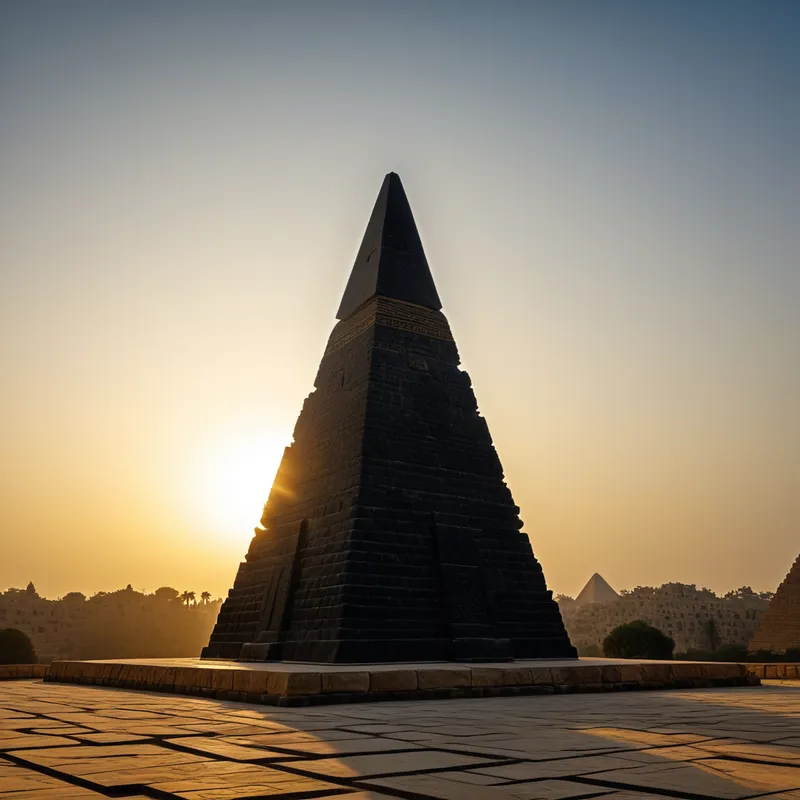
The Benben Stone Myth Meaning & Symbolism
The first land emerging from the cosmic waters, the sacred mound where the sun god Atum-Ra began the act of creation.
The Tale of The Benben Stone
In the beginning, there was only the Nun. A boundless, black, silent ocean, without light, without form, without time. It was the deep before dreaming, the potential that held everything and nothing. From this infinite, watery darkness, a stirring began. Not a sound, but a presence. A gathering of intention in the heart of [the void](/myths/the-void “Myth from Buddhist culture.”/).
And then, it rose.
A single mound of fertile, dark earth pushed its way through the surface of the Nun. It was the first [thing](/myths/thing “Myth from Norse culture.”/) that was not [water](/myths/water “Myth from Chinese culture.”/). The first island of substance in a sea of chaos. This was the Benben. Upon its damp, sloping sides, the air itself grew still, awaiting a breath.
Upon this mound, the god Atum manifested. He was alone, complete in himself, the great “He Who is Complete.” He stood upon the Benben, feeling the solidity beneath his feet, gazing out into the endless Nun. A profound loneliness, vast as the waters themselves, settled upon him. But within that loneliness was a power, a creative urge that swelled from his very core.
He knew what must be done. From his own being, through an act of will and magic (heka), he brought forth the first pair. He spat out Shu, and he vomited forth Tefnut. Air and moisture swirled from the mound into the void, the first children of the creator. The Benben was now a cradle, a birthplace. From this point, the act of differentiation cascaded: Geb and Nut were born, then the great-grandchildren [Osiris](/myths/osiris “Myth from Global/Universal culture.”/), Isis, Set, and [Nephthys](/myths/nephthys “Myth from Egyptian culture.”/). The mound witnessed the birth of the Ennead, the very family of the cosmos.
But the story of the stone does not end with the first dawn of life. For as the sun god Ra—the fiery, sustaining aspect of the creator—rose each day, it was said his first rays would touch the Benben stone, kept sacred in [the temple](/myths/the-temple “Myth from Jewish culture.”/) of Heliopolis. Each sunrise was a re-enactment of that first moment. The stone, now shaped into a pyramidion, became the capstone of [the world](/myths/the-world “Myth from Tarot culture.”/), the point where the divine fire kissed the ordered world, renewing creation with every golden morning.
Cultural Origins & Context
The myth of the Benben was central to the theology of Heliopolis, one of the most influential religious centers in ancient Egypt. It was not a single story told around a fire, but a foundational cosmological truth embedded in ritual, architecture, and kingship. The priests of Heliopolis were its primary custodians, weaving it into the liturgy that sustained [ma’at](/myths/maat “Myth from Egyptian culture.”/)—the fundamental order of the universe.
The myth functioned as an eternal “first time” (Zep Tepi), a template against which all subsequent reality was measured. [The pharaoh](/myths/the-pharaoh “Myth from Egyptian culture.”/), as the son of Ra, was intrinsically linked to this myth. His coronation mirrored Atum’s emergence; his obelisks, capped with a benbenet stone, were frozen rays of sunlight connecting earth to the divine source. Most profoundly, the pyramid itself was a massive, architectural recreation of the primordial mound, a machine for the king’s soul to ascend and rejoin the cycle of creation. The myth was thus a living doctrine of power, stability, and eternal return.
Symbolic Architecture
At its core, the Benben is the archetypal [symbol](/symbols/symbol “Symbol: A symbol can represent an idea, concept, or belief, serving as a powerful tool for communication and understanding.”/) of [emergence](/symbols/emergence “Symbol: A process of coming into being, rising from obscurity, or breaking through a barrier, often representing birth, transformation, or revelation.”/). It represents the first [moment](/symbols/moment “Symbol: The symbol of a ‘moment’ embodies the significance of transient experiences that encapsulate emotional depth or pivotal transformations in life.”/) of [consciousness](/symbols/consciousness “Symbol: Consciousness represents the state of awareness and perception, encompassing thoughts, feelings, and experiences.”/) distinguishing itself from the unconscious, [the ego](/myths/the-ego “Myth from Jungian culture.”/) forming from the undifferentiated waters of the [psyche](/myths/psyche “Myth from Greek culture.”/). The Nun is the fertile, terrifying [chaos](/symbols/chaos “Symbol: In Arts & Music, chaos represents raw creative potential, uncontrolled expression, and the breakdown of order to forge new artistic forms.”/) of potential—the [womb](/symbols/womb “Symbol: A symbol of origin, potential, and profound transformation, representing the beginning of life’s journey and the unconscious source of creation.”/) of all possibilities where nothing is yet defined. The mound is the act of definition itself.
The Benben is not merely a thing, but an event: the psychic moment where potential becomes actual, where the formless takes its first, tentative shape.
It symbolizes the foundational point of [identity](/symbols/identity “Symbol: Identity represents the sense of self, encompassing personal beliefs, cultural background, and social roles.”/), the “I am” that arises from the “I am not.” Psychologically, it maps onto the establishment of a stable center within the [personality](/symbols/personality “Symbol: Personality in dreams often symbolizes the traits and characteristics of the dreamer, reflecting how they perceive themselves and how they believe they are perceived by others.”/), a core self from which complexity can safely unfold, just as Atum generated the [Ennead](/symbols/ennead “Symbol: A group of nine deities in Egyptian mythology representing cosmic order, creation, and divine completeness.”/). Furthermore, as the point of first contact for the sun’s rays, it represents the ongoing need for that central self to be continually renewed and re-energized by a transpersonal [source](/symbols/source “Symbol: The origin point of something, often representing beginnings, nourishment, or the fundamental cause behind phenomena.”/) ([the Self](/myths/the-self “Myth from Jungian culture.”/), in Jungian terms). It is the [altar](/symbols/altar “Symbol: An altar represents a sacred space for rituals, offering, and connection to the divine, embodying spirituality and devotion.”/) within where [the divine spark](/myths/the-divine-spark “Myth from Gnostic culture.”/) is recognized and honored.
The Dreamer’s Resonance
When the motif of the Benben surfaces in modern dreams, it often signals a profound process of psychic grounding or a crisis of emergence. The dreamer may find themselves in vast, dark, or endless waters (the Nun of their own unconscious), feeling adrift and without orientation. The appearance of an island, a rock, a small hill, or even a single stone breaking the surface points to the psyche’s innate movement toward consolidation.
Somatically, this can feel like a deep, grounding pressure—a need to “come down to earth” or find one’s footing amidst emotional or mental chaos. It is the dream-ego’s search for a base of operations. Conversely, dreaming of a shining pinnacle or capstone being placed atop a structure suggests the culmination of such a process: the integration of a new level of consciousness, the “capping” of a long period of inner work, creating a stable, elevated point of view. The dream is portraying the architecture of the soul being repaired or built anew from the foundational level upward.
Alchemical Translation
The alchemical journey mirrored in the Benben myth is the opus of individuation, beginning with the [nigredo](/myths/nigredo “Myth from Alchemical culture.”/)—the black, chaotic waters of the Nun. This is the initial, often painful, stage of confronting [the shadow](/myths/the-shadow “Myth from Jungian culture.”/) and the undifferentiated contents of the personal and collective unconscious. It feels like dissolution, a return to the formless source.
The rising of the mound is the albedo, the emergence of a new, clarified consciousness from that darkness. It is the creation of the [lapis philosophorum](/myths/lapis-philosophorum “Myth from Alchemical culture.”/) ([the philosopher’s stone](/myths/the-philosophers-stone “Myth from Alchemical culture.”/)) in its initial, raw form: a stable center of awareness. Atum’s act of self-generation is the ultimate model of psychic autopoiesis—the self creating itself from itself. For the modern individual, this translates to the hard-won realization that the core of identity must be self-determined and self-sustained, not borrowed from external roles or expectations.
The ultimate alchemy is not turning lead to gold, but turning the chaos of potential within into the ordered, sacred mound of a conscious life.
Finally, the daily sunrise upon the stone is the [rubedo](/myths/rubedo “Myth from Alchemical culture.”/) and its perpetual recurrence—the ongoing, lifelong process of renewal. It signifies that individuation is not a one-time achievement but a daily ritual of reconnecting the conscious ego to the nourishing, transformative energy of the Self. We must each become the temple of Heliopolis, ensuring our inner Benben is oriented to catch the light, again and again, transforming primal chaos into conscious creation with every dawn of awareness.
Associated Symbols
Explore related symbols from the CaleaDream lexicon: