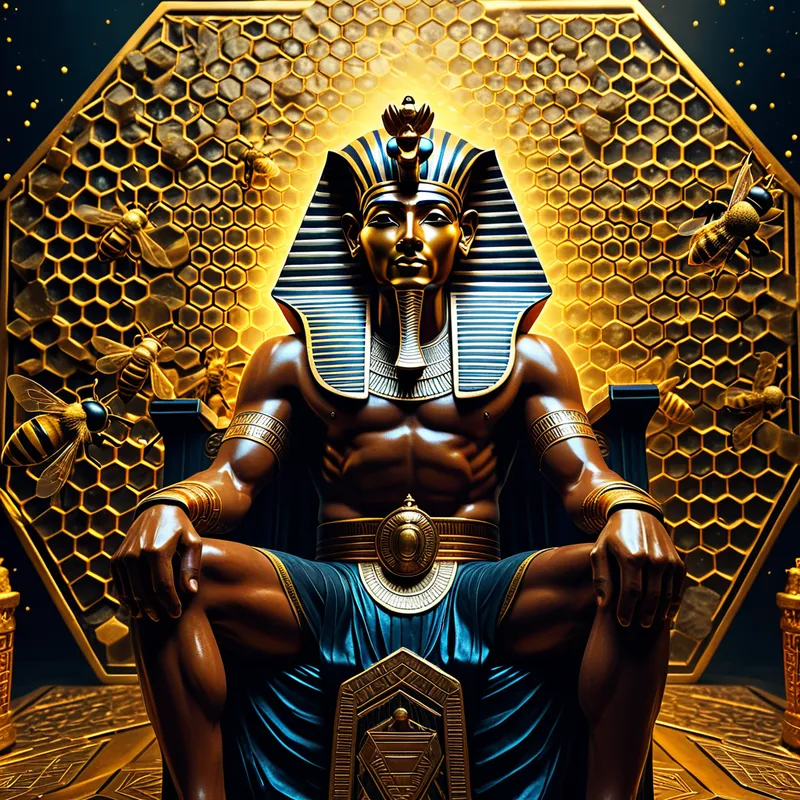
The Bee King Myth Meaning & Symbolism
A myth of the sun god's tears, falling to earth as bees, creating a sacred chaos that births a king from the swarm.
The Tale of The Bee King
In the time before time, when the sky was the belly of Nun and the sun was a single, burning thought, Ra sailed his barque across the heavens. His light was law, his gaze was order. But even a god can know weariness. One day, as he looked upon the green-black ribbon of the Nile and the red-gold expanse of the desert, a profound and ancient loneliness settled in his ka. It was the loneliness of the creator, separate from his creation.
From this loneliness, a pressure built behind his eyes—not of anger, but of a sorrow too vast for words. A single, molten tear, heavier than a mountain of gold, welled and fell from the divine eye of Ra. It did not fall as water, but as a drop of liquid sun, a distillation of his creative fire and his isolated grief. It plummeted through the layers of the air, cooling and fracturing as it fell.
When it struck the sacred soil of Kemet, it did not sink. It shattered into ten thousand thousand pieces of living gold. Each fragment grew wings, each developed a sting, each hummed with a fragment of Ra’s own vital force. They were the first bees. But this was no gentle blessing. This was a sacred chaos. The air filled with a deafening, righteous hum. The swarm was a storm of divine discontent, a cloud of buzzing, stinging purpose with no direction. It moved as one mind, a mind born of a god’s tear, and it brought not pollination, but a terrifying, chaotic fervor to the land.
The people cried out to Ra. “Great One, your tear afflicts us! The swarm knows no hive, obeys no keeper. It is creation turned to chaos!” Ra heard their pleas. He saw that his isolated sorrow, made manifest, could only destroy. The tear needed a vessel, the chaos needed a king.
From the heart of the greatest swarm, where the humming was a physical force, a form began to coalesce. Bees by the thousands pressed together, body to body, wing to wing. They built not with wax, but with their own living bodies. They formed legs, a torso, arms, and a head. From the collected gold of their carapaces, they fashioned a crown. From the collective will born of Ra’s tear, a single consciousness emerged.
He stepped forward, this king wrought from the swarm. His skin was the shimmering, segmented gold of a thousand bees at rest. His eyes held the focused, burning light of the hive-mind. He was the Bee King. He lifted a hand, and the chaotic cloud stilled, orbiting him in a respectful, humming halo. He pointed to a cleft in a limestone cliff, and the bees streamed inward, beginning the orderly work of building the first hive, transforming chaotic divine energy into structured, fertile industry. The god’s lonely tear had finally found its form: not in destruction, but in a sovereign who could translate sacred rage into sacred order.

Cultural Origins & Context
The motif of the Bee King is not a singular, canonical myth from a specific papyrus, but a powerful thematic strand woven into the fabric of Egyptian sacred symbolism. It finds its roots in the complex relationship between the Pharaoh, the gods, and the natural world. The bee was an emblem of Lower Egypt, and the Pharaoh was often titled “He of the Sedge and the Bee,” uniting the plant of Upper Egypt with the insect of the Lower Kingdom. This was not mere heraldry.
The mythic narrative of the Bee King draws from several profound sources: the concept of the “Eye of Ra” as a destructive, independent force (like the goddess Sekhmet) that must be pacified and brought back into harmony; the belief that tears of gods held creative power (mankind was said to be born from the tears of Atum or Ra); and the observable, awe-inspiring nature of the hive itself—a perfect society with a single sovereign, working in unison to create the sacred substance of honey, which was used in temple rituals and embalming.
This story would have been part of the oral and ritual teachings surrounding kingship. It served a vital societal function: it mythologically justified the Pharaoh’s absolute authority. He was not just a man; he was the living embodiment of the ordering principle that could tame the chaotic, divine forces of creation itself. He was the human hive for the “swarm” of the nation, transforming collective potential (which could be chaotic and destructive) into a productive, immortal civilization.
Symbolic Architecture
At its core, the myth of the Bee King is an allegory for the emergence of consciousness and order from the raw material of unconscious, emotional force.
The Tear of Ra symbolizes potent, undifferentiated psychic energy. It is pure affect—in this case, a god’s profound, creative sorrow. It is emotion in its raw, unprocessed state, containing immense power but no direction. It is the “divine discontent” that precedes all transformation.
The Chaotic Swarm represents this energy projected into the world. It is emotion acting out: unfocused rage, paralyzing grief, or manic inspiration that stings and disrupts without purpose. It is the shadow side of creativity, the vital force before it is harnessed by the ego.
The king is not born to suppress the swarm, but to give its furious music a hive.
The Bee King is the archetype of the Ego in its highest, most sovereign function. He does not destroy the swarm (the unconscious energy); he incorporates it. He is built from it. He is the conscious structure that emerges from the chaos to give it order, purpose, and productivity. The hive he directs is the nascent psyche itself, where raw emotion (nectar) is transmuted into lasting value and wisdom (honey).
The Dreamer's Resonance
When this mythic pattern stirs in the modern dreamer, it signals a critical juncture in individuation. To dream of a chaotic, threatening swarm of bees often points to a surge of unconscious emotional material—a “swarm” of repressed feelings, instincts, or creative impulses—breaking into conscious awareness. The experience is somatic: a humming anxiety in the body, a sense of being overwhelmed or “stung” by insights or memories.
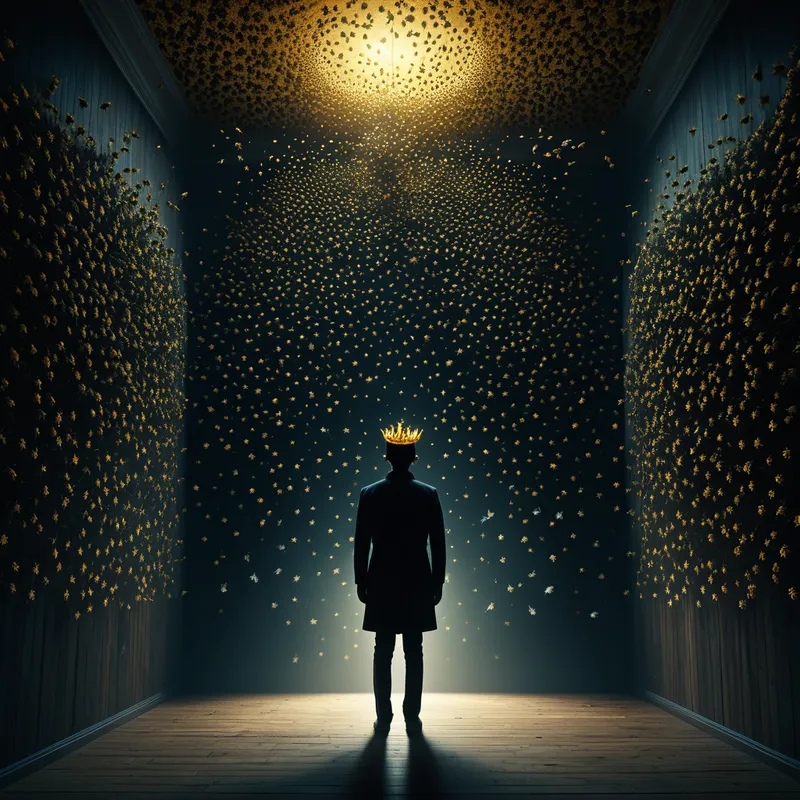
The appearance of a figure who calms or directs the swarm, or the dreamer’s transformation into such a figure, marks the beginning of the ego’s capacity to host this chaos. It is the psyche attempting to build the “Bee King” structure within. The dream may present a task: building a hive, finding the queen, or simply standing still in the center of the storm. This is the somatic process of developing a container—a stronger, more conscious sense of self—capable of holding intense emotional states without being shattered by them, instead learning to organize that energy into something purposeful.
Alchemical Translation
The alchemical journey modeled here is Solve et Coagula: to dissolve and to coagulate. First, the isolated, solar consciousness of Ra (the old, rigid state of being) is dissolved by a wave of authentic, watery emotion (the tear). This dissolution creates the prima materia—the chaotic swarm, the dark, buzzing mess of the unconscious now in the open.
The miracle of the myth is the coagulation. The swarm does not simply disperse or get destroyed. It self-organizes. From within its own substance, a new, more complex order emerges. This is the alchemy of individuation.
The gold is not in avoiding the sting, but in becoming the architecture that makes the sting purposeful.
For the modern individual, the process is this: First, one must allow the sacred, lonely, or raging “tear”—the deep, authentic emotion—to fall. One must acknowledge the chaotic inner “swarm” it creates. The temptation is to flee this swarm or to let it attack others (projection). The alchemical work is to stay present, to let the chaotic elements of the psyche reveal their own latent order. It is to allow a new, more sovereign part of the self to coalesce from the conflict, not in spite of it. This new “king” is not a tyrant suppressing feeling, but a master architect who builds a life (the hive) where raw, emotional truth can be processed, stored, and transformed into the nourishing, immortal “honey” of wisdom, art, or authentic action. The goal is to become the ruler of your own divine chaos.
Associated Symbols
Explore related symbols from the CaleaDream lexicon: