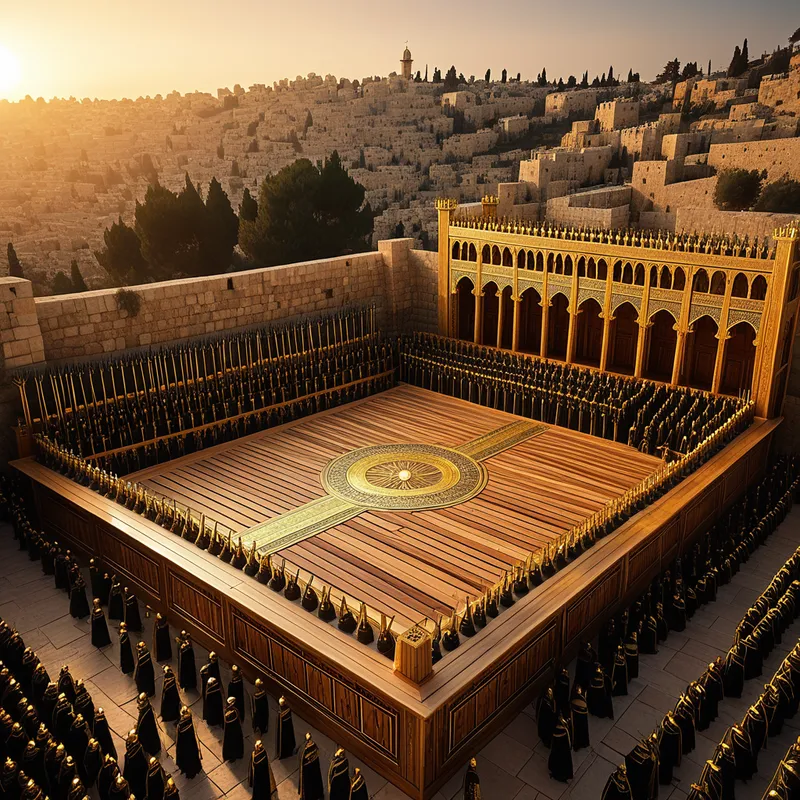
The Bed of Solomon Myth Meaning & Symbolism
A mythic vision of a king's bed as a sacred fortress of wisdom, a throne of judgment, and a vessel for divine encounter.
The Tale of The Bed of Solomon
Hear now, a tale not of battlefields, but of a chamber. A tale whispered on the perfumed winds from the south, carried on the trade routes of spice and gold, sung by the daughters of [Jerusalem](/myths/jerusalem “Myth from Biblical culture.”/). It is the tale of the bed of [Solomon](/myths/solomon “Myth from Biblical culture.”/).
Behold the King, upon whose brow rests a crown of wisdom granted by the Lord Himself. His name is peace, and his reign is a [golden age](/myths/golden-age “Myth from Universal culture.”/). But this story unfolds not in the throne room of echoing judgments, nor in [the temple](/myths/the-temple “Myth from Jewish culture.”/) of silent prayers. It unfolds in the secret heart of the palace, in the place of his rest.
He built for himself a palanquin—a portable throne of rest, a bed for procession and for privacy. Its posts he made of the cedars of Lebanon, wood that smells of eternity and resilience. Its canopy he adorned with purple, the color of twilight and empire, a fabric dyed with the blood of sea snails from distant shores. Its interior he inlaid with love, with pieces of silver and gold, a mosaic of devotion.
But this was no ordinary bed of repose. This was a fortress of [the self](/myths/the-self “Myth from Jungian culture.”/). Around it, he stationed a guard of sixty valiant men of Israel, the mightiest of the mighty. Each man bore a sword upon his thigh, trained for war, their eyes watchful in the night. For this bed was defended against the terrors of the night, against the chaos that seeks to invade the sanctum of the integrated soul.
And from this bed, this mobile throne of cedar and love, Solomon the King would rise. He would ascend to the seat of judgment, where the wisdom of the Lord would flow through him to untangle the knotted disputes of his people. The same heart that rested in a bower of devotion would awaken to wield the sword of discernment. The chamber of intimacy became the antechamber to sovereignty. The place of receiving love became the wellspring from which just law poured forth.

Cultural Origins & Context
This evocative imagery springs from the Song of Solomon, also known as the Song of Songs. Its placement within the biblical canon has long been a subject of contemplation—a lush, sensual poem of yearning and union nestled among books of law, prophecy, and history. It is attributed to Solomon, the archetypal wise king, though its precise origins are woven into the tapestry of ancient Near Eastern love poetry.
The Song was likely performed, perhaps as a lyrical drama during wedding festivities, celebrating the sacred and erotic love between a bride and groom, interpreted allegorically by Jewish and later Christian traditions as depicting the love between God and Israel, or Christ and the Church. The “bed of Solomon” is a central, recurring symbol within this song. It was not merely a piece of furniture but a cultural cipher for the king’s authority, his wealth, his capacity for love, and his sacred person, which required protection. The detailed description of its construction from the finest materials (cedar, precious metals, purple dye) rooted it in the tangible reality of Solomon’s legendary opulence and international reach, while its poetic treatment elevated it to the realm of myth and symbol.
Symbolic Architecture
The bed is a profound [symbol](/symbols/symbol “Symbol: A symbol can represent an idea, concept, or belief, serving as a powerful tool for communication and understanding.”/) of the [temenos](/myths/temenos “Myth from Greek culture.”/)—the sacred, protected precinct. It represents the integrated center of the [personality](/symbols/personality “Symbol: Personality in dreams often symbolizes the traits and characteristics of the dreamer, reflecting how they perceive themselves and how they believe they are perceived by others.”/), what [psychology](/symbols/psychology “Symbol: Psychology in dreams often represents the exploration of the self, the subconscious mind, and emotional conflicts.”/) might call the Self.
The throne of the soul is also its bed; the place of ultimate judgment is the same as the place of deepest receptivity.
The [cedar](/symbols/cedar “Symbol: Aromatic wood symbolizing purification, protection, and sacred connection, often associated with spiritual cleansing and enduring strength.”/) posts from Lebanon symbolize unwavering [strength](/symbols/strength “Symbol: ‘Strength’ symbolizes resilience, courage, and the ability to overcome challenges.”/), rootedness in the enduring truths of the [earth](/symbols/earth “Symbol: The symbol of Earth often represents grounding, stability, and the physical realm, embodying a connection to nature and the innate support it provides.”/) and the divine. They are the pillars of [character](/symbols/character “Symbol: Characters in dreams often signify different aspects of the dreamer’s personality or influences in their life.”/). The inlay of love with silver and gold represents the alchemical [fusion](/symbols/fusion “Symbol: The merging of separate elements into a unified whole, often representing integration of self, relationships, or conflicting aspects of identity.”/) of different values: silver (the lunar, intuitive, feminine) and gold (the solar, discerning, masculine). This is not a bed of simple pleasure, but one where love itself is refined into a precious, enduring substance. The sixty warriors with swords are the vigilant faculties of the [psyche](/myths/psyche “Myth from Greek culture.”/)—discernment, discipline, moral courage—that protect the inner sanctum from [dissolution](/symbols/dissolution “Symbol: The process of breaking down, dispersing, or losing form, often representing transformation, release, or the end of a state of being.”/), from the incursions of unconscious [chaos](/symbols/chaos “Symbol: In Arts & Music, chaos represents raw creative potential, uncontrolled expression, and the breakdown of order to forge new artistic forms.”/), doubt, or profane influences. The bed’s dual function as a place of rest and the [origin](/symbols/origin “Symbol: The starting point of a journey, often representing one’s roots, source, or initial state before transformation.”/) point of judicial [authority](/symbols/authority “Symbol: A symbol representing power structures, rules, and control, often reflecting one’s relationship with societal or personal governance.”/) signifies the essential unity of inner and outer sovereignty. True wisdom and just rule flow from a [heart](/symbols/heart “Symbol: The heart symbolizes love, emotion, and the core of one’s existence, representing deep connections with others and self.”/) that has known sacred union and defended its own integrity.
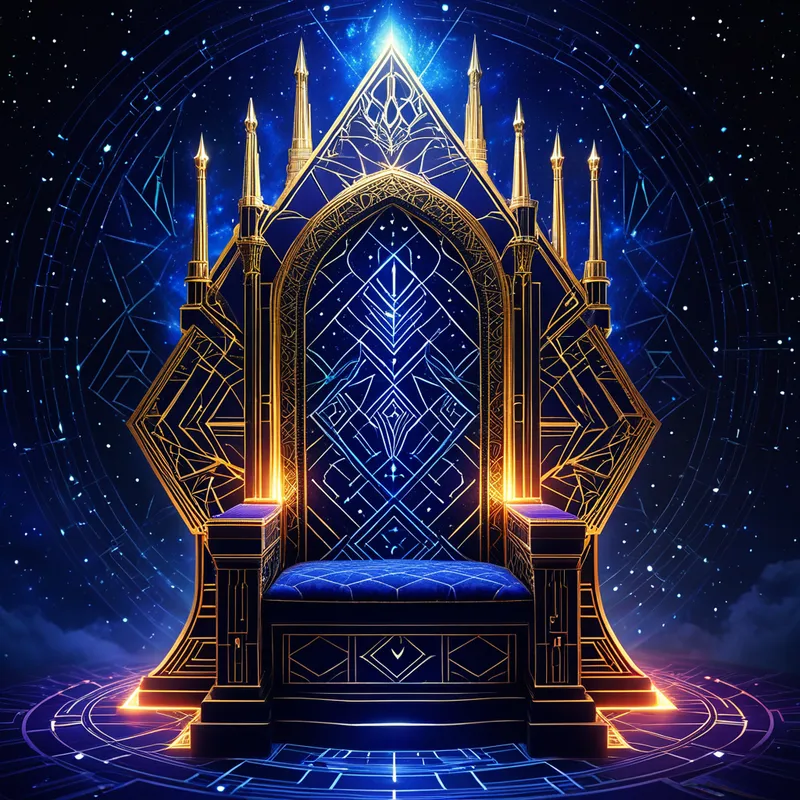
The Dreamer’s Resonance
When this mythic pattern stirs in the modern dreamer, it often signals a profound process of inner consolidation. To dream of a magnificent, guarded bed may point to the psyche constructing its own inner temenos. The dreamer may be in a phase of life requiring deep introspection, a withdrawal to a protected inner space to integrate conflicting aspects of the self (the silver and gold).
The warriors might manifest as a sense of necessary boundaries being erected, a healthy defensiveness against external demands or internal critics. Alternatively, if the bed in the dream is attacked, inaccessible, or poorly guarded, it may reflect a vulnerability in the dreamer’s core sense of self, a feeling that one’s inner sanctuary or capacity for deep relationship is under threat. The somatic experience can be one of either profound, anchored peace (resting in the completed bed) or of alert, charged tension (identifying with the guarding warriors). The dream asks: What are the pillars of your being? What are you refining in [the crucible](/myths/the-crucible “Myth from Alchemical culture.”/) of your most intimate self? And what forces must you rightfully keep at sword’s point to preserve your inner sovereignty?

Alchemical Translation
The myth of Solomon’s Bed models the alchemical Coniunctio and the ensuing stage of Albedo and [Rubedo](/myths/rubedo “Myth from Alchemical culture.”/), fixed into a permanent inner structure.
The individuation journey often begins with the search for the lost or missing other (the beloved in the Song). The “bed” is the symbolic vessel where this union is achieved—not a literal union with another person, but the internal marriage of conscious and unconscious, logic and intuition, power and love (the silver and gold inlay). This is the Coniunctio. But the process does not end in a blissful, dissolved state.
The ultimate goal is not dissolution in the union, but the creation of a durable throne from which the newly sovereign Self can govern a life.
The guarding warriors represent the necessary, often challenging, work of fixation. The precious insights and unifications achieved in the inner sanctum must be protected, given permanent form in one’s life structure, ethics, and choices. They must be defended against the regressive pull of old habits or the erosive forces of cynicism. From this fortified, integrated center (the bed-throne), the individual can then “go forth in judgment”—that is, engage with [the world](/myths/the-world “Myth from Tarot culture.”/) from a place of authentic authority, discernment, and creative action. The bed is the crucible; the life lived wisely and lovingly is [the philosopher’s stone](/myths/the-philosophers-stone “Myth from Alchemical culture.”/) it produces.
Associated Symbols
Explore related symbols from the CaleaDream lexicon: