The Beckoning Cat of Gotokuji Temple Myth Meaning & Symbolism
A poor monk's kindness to a stray cat is repaid when the cat beckons a wealthy lord into the temple, bringing prosperity and birthing a legendary symbol.
The Tale of The Beckoning Cat of Gotokuji Temple
Listen, and let the rain of a long-ago afternoon fall upon your memory. In the Edo period, in a quiet, wooded part of Edo, there stood a temple so poor the moss on its stones seemed richer than its monks. Its name was Gotokuji. The head priest, an old man whose robes were more patch than cloth, lived there with his sole companion: a slender, white cat with eyes like polished river stones. He named her Tama, which means “Jewel,” for she was the only treasure his poverty afforded.
Though his own bowl was often empty, the priest shared his scant meals with Tama. He would speak to her of sutras as she sat in a sunbeam, her tail curling like a question mark. One day, a storm gathered on [the horizon](/myths/the-horizon “Myth from Various culture.”/), bruising [the sky](/myths/the-sky “Myth from Persian culture.”/) purple and grey. The priest sighed, looking at his empty offering box. “Little Tama,” he said, his voice as thin as [the temple](/myths/the-temple “Myth from Jewish culture.”/) paper, “I have nothing. Soon, we may have to close these gates forever.”
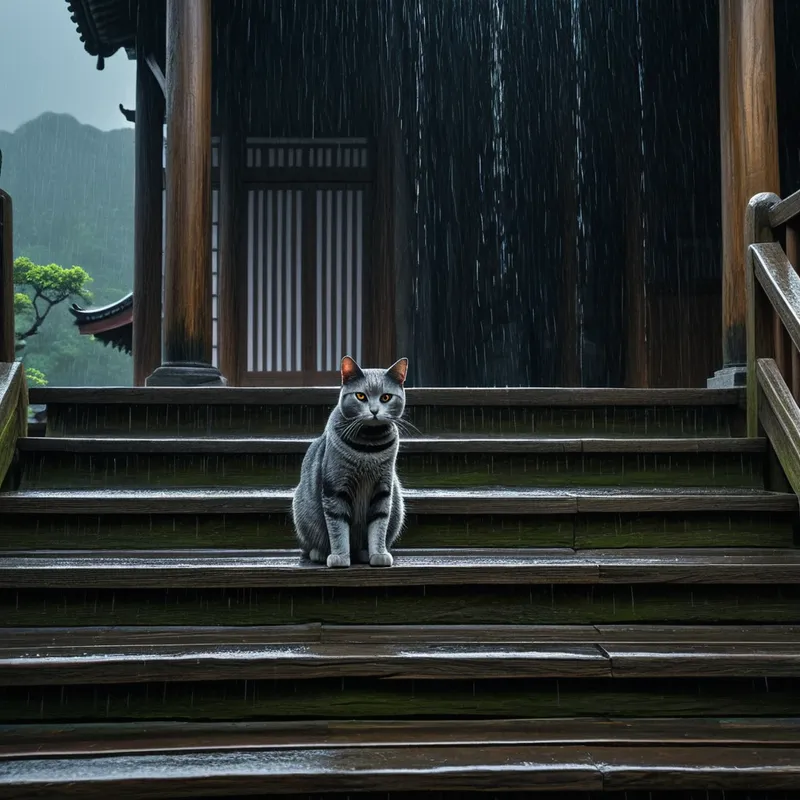
As the first heavy drops began to fall, lashing the temple grounds, Tama walked to the front gate. She sat on her haunches on the worn wooden step, the rain plastering her fur. Then, with a deliberate grace, she lifted one front paw and began to groom it, drawing it over her ear again and again. To any passing soul, it looked as if she were beckoning.
And a soul was passing. Lord Ii Naotaka of the Hikone domain was returning from a hunt with his retinue when the sky broke open. Thunder roared like dragon anger. Seeking shelter under a large tree, the lord noticed a strange sight through the sheeting rain: a white cat at a temple gate, seemingly waving him inside. Intrigued, he urged his horse toward the temple.
The moment he and his [samurai](/myths/samurai “Myth from Japanese culture.”/) dismounted and stepped under the temple’s narrow eaves, a cataclysm struck. A bolt of lightning, white-hot and furious, split the very tree where they had just stood, reducing it to splinters and smoke. The lord stood in stunned silence, the scent of ozone and burnt wood sharp in the air. He turned to the cat, who had ceased her beckoning and now sat serenely, watching him with those deep, knowing eyes.
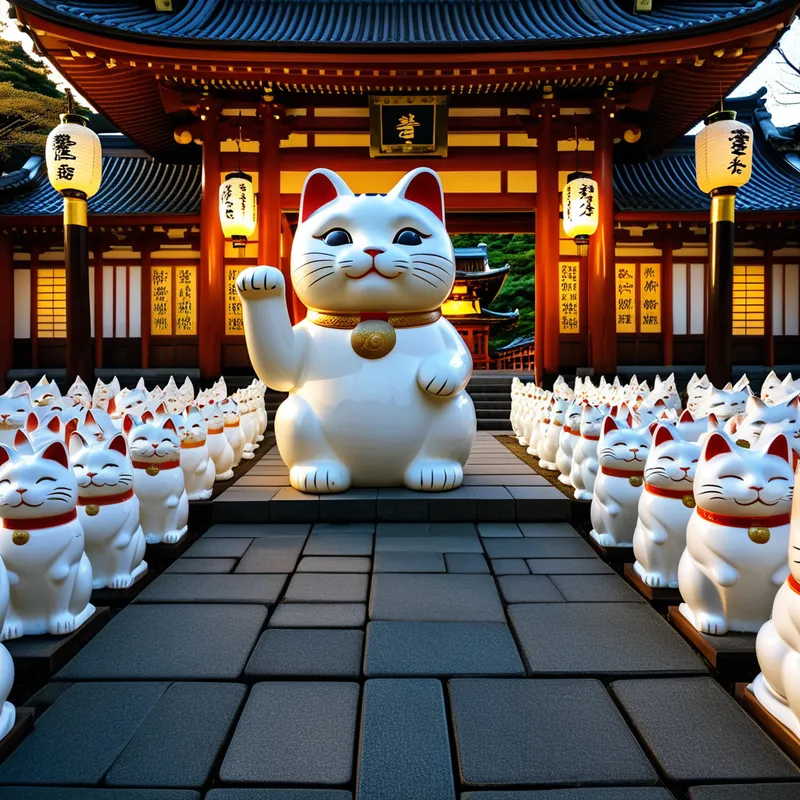
Inside, the humble priest received the dripping lord with astonishment. Lord Ii Naotaka, his life saved by a feline omen, saw not a poor temple, but a sacred place of powerful guardianship. He became the temple’s patron, pouring his wealth into its restoration, transforming Gotokuji into a flourishing, respected sanctuary. When Tama died of old age, she was buried with great honor in the temple cemetery. The priest, his heart full of gratitude and grief, commissioned the first [Maneki-neko](/myths/maneki-neko “Myth from Japanese culture.”/)—a ceramic cat with one paw raised in eternal invitation—in her exact likeness, so that her benevolent spirit would forever call fortune to that hallowed ground.
Cultural Origins & Context
The legend of the Gotokuji cat is a mukashibanashi, a “tale of long ago,” rooted in the specific locale of Setagaya in Edo. Unlike grand Kojiki cycles, this is a folk narrative, emerging from the collective imagination of common people and likely propagated by traveling monks, merchants, and the temple itself. Its historical anchor, Lord Ii Naotaka, provides a veneer of plausibility, a common technique to lend authority to a folk tale.
Societally, the myth functions on multiple levels. At its simplest, it is an origin story for the ubiquitous Maneki-neko, explaining how a symbol of commercial luck entered [the world](/myths/the-world “Myth from Tarot culture.”/) through an act of compassion. On a deeper level, it reflects engi, or “karmic connection.” The story models ideal relationships: the priest’s jihi (compassion) toward a vulnerable creature creates a karmic chain that ultimately saves a lord and secures the temple’s future. It reinforces the Buddhist-syncretic idea that kindness, even (or especially) when given from a position of lack, generates unforeseen merit and protection. The tale was a moral instruction, a piece of local pride, and a potent piece of spiritual marketing, ensuring pilgrims would visit Gotokuji to seek their own summoned fortune.
Symbolic Architecture
The myth’s power lies in its elegant, tripartite [symbolism](/symbols/symbolism “Symbol: The use of symbols to represent ideas or qualities, often conveying deeper meanings beyond literal interpretation. In dreams, it’s the language of the unconscious.”/). The [Priest](/symbols/priest “Symbol: A priest symbolizes spirituality, guidance, and the quest for understanding the deeper meanings of life.”/) represents the archetypal [Caregiver](/symbols/caregiver “Symbol: A spiritual or mythical figure representing nurturing, protection, and unconditional support, often embodying divine or archetypal parental energy.”/) in a state of depletion. His kindness is not from [abundance](/symbols/abundance “Symbol: A state of plentifulness or overflowing resources, often representing fulfillment, prosperity, or spiritual richness beyond material needs.”/) but from essence; he gives the last of his rice, embodying [the principle](/symbols/the-principle “Symbol: A fundamental truth, law, or doctrine that serves as a foundation for a system of belief, behavior, or reasoning, often representing moral or ethical standards.”/) that true [compassion](/symbols/compassion “Symbol: A deep feeling of empathy and concern for others’ suffering, often involving a desire to help or alleviate their pain.”/) is a state of being, not a calculation of resources.
The Cat, Tama, is the liminal [psychopomp](/myths/psychopomp “Myth from Greek culture.”/)—a [creature](/symbols/creature “Symbol: Creatures in dreams often symbolize instincts, primal urges, and the unknown aspects of the psyche.”/) straddling the mundane and spiritual worlds. In [Japanese](/symbols/japanese “Symbol: The term ‘Japanese’ often symbolizes culture, tradition, and identity associated with Japan, reflecting its rich history and unique societal values.”/) folklore, cats are often seen as mysterious, sometimes perilous beings with supernatural [sight](/symbols/sight “Symbol: Sight symbolizes perception, awareness, and insight, representing both physical and inner vision.”/). Here, Tama’s [nature](/symbols/nature “Symbol: Nature symbolizes growth, connectivity, and the primal forces of existence.”/) is alchemized by kindness. She becomes an agent of kamisama no tasuke (divine aid), a living [talisman](/myths/talisman “Myth from Global culture.”/). Her beckoning paw is a symbolic threshold [gesture](/symbols/gesture “Symbol: A non-verbal bodily movement conveying meaning, emotion, or intention, often symbolic in communication and artistic expression.”/). It does not grab or demand; it invites. It represents an [open door](/symbols/open-door “Symbol: The open door symbolizes new opportunities and the potential for change, inviting individuals to step into new experiences.”/), a potentiality, a signal from the unconscious that [guidance](/symbols/guidance “Symbol: The act of receiving or seeking direction, advice, or leadership in a dream, often representing a need for clarity, support, or a higher purpose on one’s life path.”/) is available if one has the eyes to see it.
The Storm and [Lightning](/symbols/lightning “Symbol: Lightning symbolizes sudden insights or revelations, often accompanied by powerful emotions or disruptive change.”/) symbolize sudden, catastrophic [fate](/symbols/fate “Symbol: Fate represents the belief in predetermined outcomes, suggesting that some aspects of life are beyond human control.”/)—the unpredictable turns of [life](/symbols/life “Symbol: The symbol of ‘Life’ represents a journey of growth, interconnectedness, and existential meaning, encompassing both the joys and challenges that define human experience.”/) that can obliterate one’s [path](/symbols/path “Symbol: The ‘path’ symbolizes a journey, choices, and the direction one’s life is taking, often representing individual growth and exploration.”/) in an instant. The cat’s gesture intervenes in this [chaos](/symbols/chaos “Symbol: In Arts & Music, chaos represents raw creative potential, uncontrolled expression, and the breakdown of order to forge new artistic forms.”/), not by stopping the storm, but by guiding the [traveler](/symbols/traveler “Symbol: A person on a journey, representing movement, transition, and the search for new experiences or self-discovery.”/) to the correct shelter. The saved [Lord](/symbols/lord “Symbol: The symbol of ‘Lord’ represents authority, mastery, and control, along with associated power dynamics in relationships.”/) represents the reciprocating force of the [universe](/symbols/universe “Symbol: The universe symbolizes vastness, interconnectedness, and the mysteries of existence beyond the individual self.”/)—gratitude made manifest as sustenance and [legacy](/symbols/legacy “Symbol: What one leaves behind for future generations, encompassing values, achievements, possessions, and memory.”/).
The beckoning is not a summons to ease, but an invitation to cross the threshold where disaster transforms into destiny.
The Dreamer’s Resonance
To dream of a beckoning cat is to encounter a moment of profound inner signaling. The dreamer is often at a personal “crossroads in the rain”—feeling exposed, facing potential loss, or awaiting a decisive change. The cat appears at the periphery of the dream’s action, often in a doorway, at the end of a hall, or at a path’s fork.
Somatically, this dream can evoke a feeling of being pulled or oriented without force—a gentle magnetic attraction. Psychologically, it signifies the activation of the transcendent function. The cat is an emissary from the dreamer’s own deeper Self, indicating that a protective, guiding intelligence is active within their situation, even if their conscious mind (the priest, worried and poor) cannot perceive the solution. The dream is an assurance: an act of past or potential kindness (to oneself or another) has set a protective mechanism in motion. The conflict lies in whether the dreamer, like the lord, will heed the subtle, seemingly mundane gesture and change course, or ignore it and remain under the threatening tree of their old choices.
Alchemical Translation
The individuation process modeled here is one of trust in reciprocal grace. The myth outlines an alchemical sequence: Lead of Poverty (Priest’s state) → Quicksilver of Compassion (Feeding the cat) → Silver of Observation (Lord seeing the gesture) → Gold of Reciprocal Transformation (Temple’s prosperity).
The modern individual often feels like the impoverished priest: resource-drained, tending to inner vulnerabilities (the “stray cat” aspects of [the self](/myths/the-self “Myth from Jungian culture.”/)—neglected instincts, wounded creativity, simple needs) without seeing any return. The myth instructs that this very act of inner care is [the prima materia](/myths/the-prima-materia “Myth from Alchemical culture.”/). The “cat” is that neglected self-part. By attending to it—feeding it attention, granting it sanctuary in our awareness—we unknowingly empower it to become a psychopomp for our own salvation.
The storm is the inevitable crisis of life—job loss, illness, heartbreak. The raised paw is the subtle, intuitive nudge that arises during such times: a sudden thought, a synchronicity, a remembered kindness, a chance encounter. The alchemical work is to recognize the beckoning and to follow it, even if it leads away from the apparent shelter of old habits. The lord’s patronage represents the Self’s reward: when we heed the call from the cared-for depths, the [psyche](/myths/psyche “Myth from Greek culture.”/) reorganizes. What was a struggling, impoverished inner state (the temple) becomes a supported, integrated sanctuary.
The fortune that enters is not merely external wealth, but the internal realization that compassion is an unbreakable circuit—what is given to the depths returns from the world, transformed.
Thus, the Maneki-neko on a modern shop shelf is not just a commercial charm. It is a frozen moment of this eternal alchemy, a reminder that in the gesture of giving—especially from a place of perceived lack—lies the seed of the call that will summon our own deliverance through the storm.
Associated Symbols
Explore related symbols from the CaleaDream lexicon: