The Battle of Vertières Flag Myth Meaning & Symbolism
A Vodou myth where the spirit of a sacred flag rallies the enslaved to final victory, weaving divine will into the fabric of a new nation.
The Tale of The Battle of Vertières Flag
Listen. The air is thick with the smell of burnt powder, iron, and fear. It is November 18, 1803. The last mountain before the colonial port. The ground at Vertières trembles not just from cannon fire, but from a deeper, older vibration—the heartbeat of the island itself, drumming through the soil.
For thirteen years, the war has raged. Bones have fertilized the cane fields. Promises have been broken on the altars of empires. Now, before the fortress walls of the final French stronghold, an army stands. They are not an army of kings, but of the formerly enslaved. Their uniforms are rags and pride. Their weapons are hope and desperation. And in their center, a different standard is being prepared.
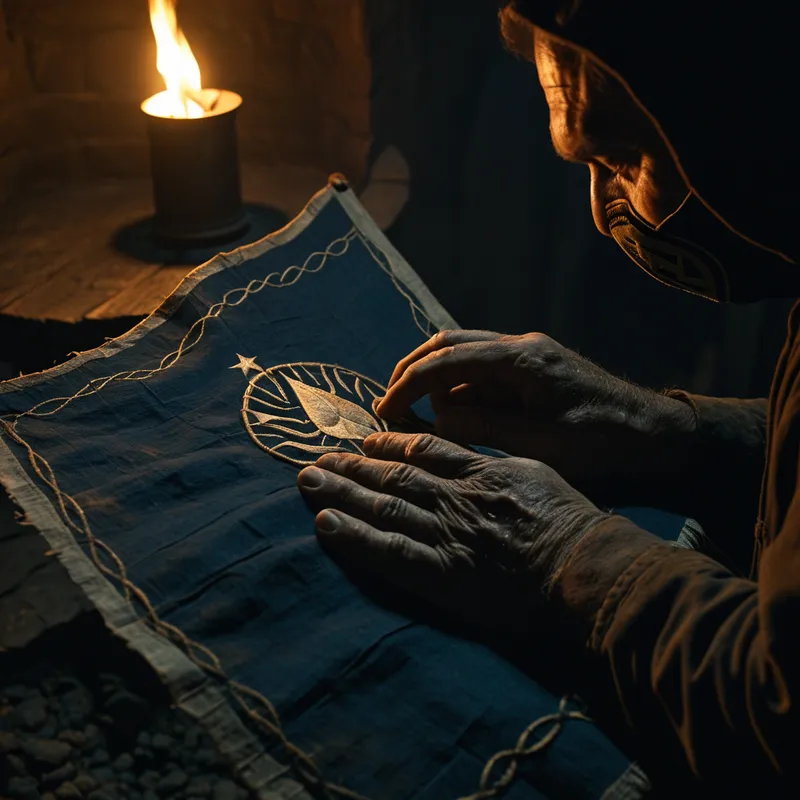
It is not a flag of silk, but of spirit. A houngan, his face etched with the lines of countless midnights spent in communion, works not with needle and thread alone, but with intention and invocation. He calls upon Papa Legba to open the way. He calls upon Ogou to fill the cloth with his unyielding iron. He calls upon the Gede, the spirits of the dead, to weave their memory into the very fibers. Each stitch is a prayer, each fold a covenant.
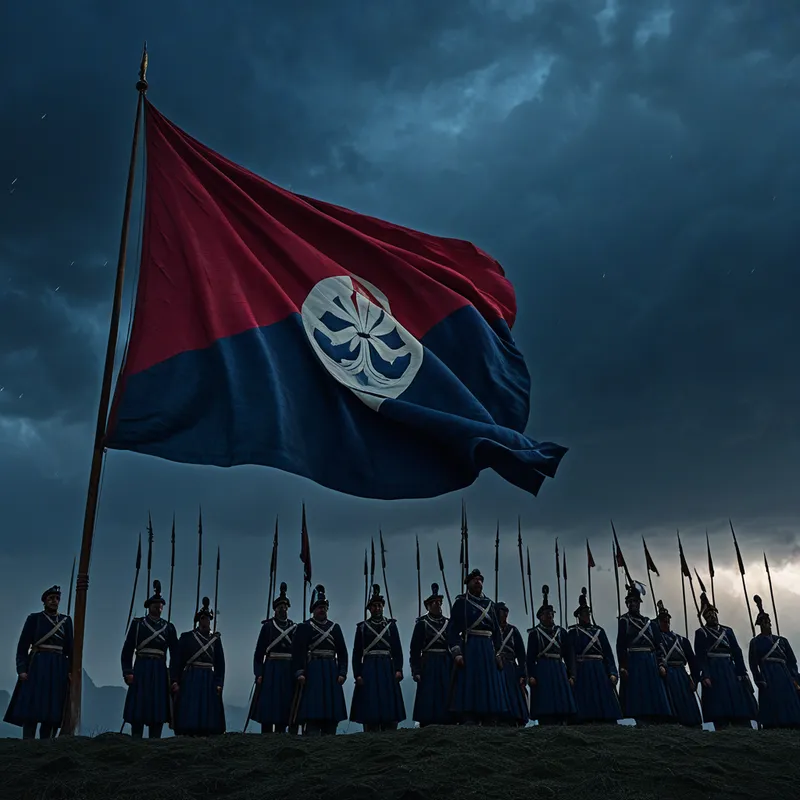
As the colonial cannons roar, a strange silence falls over the revolutionary lines. The houngan raises the standard. It is a simple thing, yet it holds the weight of worlds. And in that moment, the myth says the flag breathes. It does not flutter in the wind; it generates the wind. A hot, dry wind from the savannas of Guinea. A cool, carrying wind from the mountains of Kongo.
The soldiers do not see just cloth. They see in its colors the indigo of the deep night ocean they crossed, the crimson of the blood that nourished the bitter cane, and a gold not of empire, but of the promised sun of freedom. They hear, not a commander’s shout, but a chorus. The voices of Ezili Dantò singing a lullaby of fierce protection. The roar of Danbala Wedo coiling around them as strength.
The charge begins not as a military maneuver, but as a sacred procession. The flag moves forward, and they move with it, a single organism of liberation. Bullets seem to bend around its aura. Fear dissolves into a collective trance of purpose. They fight not merely for territory, but for a metaphysical truth: that a person cannot be property. The flag becomes the focal point where spirit and history collide, where the will of the Lwa and the will of the people become one.
When the last French soldier retreats to the sea, the flag is planted in the blood-soaked earth of the hill. It does not wave in triumph, but stands sentinel. It is no longer just a symbol of victory, but a living testament. A pact made visible: that this land, this freedom, was bought not only with muscle and gunpowder, but with an unbreakable covenant between the visible and the invisible worlds.
Cultural Origins & Context
The myth of the Vertières Flag is not a folktale separated from history; it is the spiritual biography of the Haitian Revolution itself. Emerging from the crucible of the late 18th and early 19th centuries, this narrative exists in the oral traditions of Vodou communities, passed down not in books, but in peristyles (temple courtyards) during ceremonies, in family stories, and in the revolutionary songs that became national anthems.
Its tellers were the houngans and mambos who served as the revolution’s spiritual architects. For them, the war was never a purely political or military event. It was the manifest destiny of the Lwa, a necessary correction to a profound spiritual disorder—the abomination of slavery. The flag myth served a critical societal function: it sacralized the founding of the nation. It answered the “how” of a seemingly impossible victory against a global superpower. The answer was not merely tactical genius, but divine alliance.
This narrative cemented the idea that Haiti was born under a spiritual sign, a nation whose sovereignty was recognized and fought for by the spirits of Africa and the new ancestors made in Saint-Domingue. It provided a foundational identity: we are a people whose freedom is spiritually mandated and protected. The myth thus acts as a core pillar of cultural memory, ensuring that the revolutionary spirit is understood as a living, spiritual force, not a closed historical chapter.
Symbolic Architecture
At its core, the myth is a profound symbol of the consecration of collective will. The flag is the physical object where the intangible—prayer, ancestral memory, the desire for liberty—becomes tangible and effective in the material world.
The true banner of any revolution is not cloth, but the moment individual suffering is woven into a collective destiny.
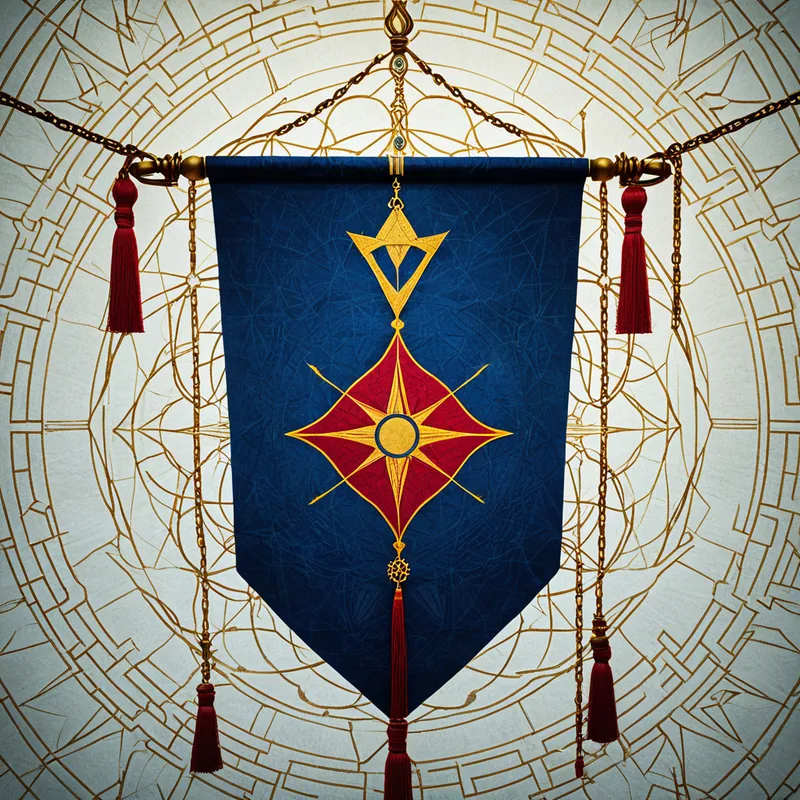
The flag itself is an alchemical vessel. Its indigo represents the depths of the unconscious, the Middle Passage, and the wisdom of the night. The crimson is the blood of sacrifice, the pain of labor, and the fierce, life-giving force of Ogou. The emerging gold is the dawn of consciousness, a new self-identity forged in the fire of struggle. It symbolizes the transformation of raw, brutalized experience into a sovereign identity.
The battlefield of Vertières is the ultimate vèvè drawn on the land itself—a ritual space where the fate of worlds is decided. The soldiers, moving as one with the flag, represent the ego surrendering to and aligning with a larger, transpersonal power—the Self, in Jungian terms. Their victory is the triumph of a whole, integrated psyche (the nation/self) over a tyrannical, exploitative complex (the colonial power).
The Dreamer’s Resonance
When this mythic pattern stirs in the modern dreamscape, it signals a profound internal uprising. To dream of a tattered, powerful flag you must raise, or of preparing for a final, decisive confrontation on symbolic high ground, is to experience the psyche mobilizing for liberation.
Somatically, the dreamer may feel a surge of energy—a hot wind, a rhythmic drumming in the chest, or a feeling of being “filled” with a strength not their own. Psychologically, this marks the culmination phase of confronting a deep, entrenched inner “colonizer.” This could be an internalized critical voice, a toxic pattern of self-abnegation, or a life structure built on the exploitation of your own vitality. The dream-flag represents the new standard of the Self you are struggling to embody. The battle is not against an external enemy, but against the last, desperate strongholds of an old order within your own psyche that refuses to acknowledge your sovereignty. The dream is an assurance: you are not fighting alone. Your “ancestors”—past experiences, inner guides, core values—are rallying to your cause.
Alchemical Translation
The myth of Vertières Flag provides a masterful model for the process of psychic individuation—the battle for self-liberation from internal tyranny.
The first stage is The Consecration of Intent (Crafting the Flag). This is the conscious, often solitary work of the houngan/dreamer. It involves going into the depths of your history (the indigo), acknowledging your wounds and sacrifices (the crimson), and deliberately calling upon all your inner resources—your courage (Ogou), your resilience (Gede), your deep, guiding wisdom (Danbala). You stitch together a new declaration of who you are, not who you were told to be.
Individuation begins when you plant the flag of your own authority in the soil of your soul, defying every internal voice that claims you are not free.
The second stage is The Sacred Charge (The Battle Itself). This is the terrifying, exhilarating action. You must advance your new truth (“I am sovereign”) into the heart of your old life patterns. The myth assures us that in this charge, you are supported by your entire psychic ecology. The “bullets” of doubt, fear, and old conditioning may fly, but when aligned with the Self (the flag), they lose their lethal power. The victory at Vertières is the moment the ego fully aligns with the Self, creating an unassailable inner authority.
Finally, there is The Sentinel Peace (Planting the Flag). Victory is not the end. The flag is planted. This symbolizes the ongoing, vigilant maintenance of your hard-won freedom. It becomes a permanent part of your inner landscape, a reminder of the covenant you made with your deepest self. The work shifts from revolution to governance—ruling your inner nation with the wisdom, justice, and spiritual connection that you fought to establish. The myth teaches that true freedom is not a one-time event, but a sustained state of being, guarded by the spirits of your own past struggles and consecrated by your will.
Associated Symbols
Explore related symbols from the CaleaDream lexicon: