The Battle of Ragnarök Myth Meaning & Symbolism
The twilight of the gods, a final cataclysmic battle where the old world is destroyed, paving the way for a new, green earth to rise from the sea.
The Tale of The Battle of Ragnarök
Listen. The air grows thick and cold, a silence deeper than the grave settles over [the nine worlds](/myths/the-nine-worlds “Myth from Norse culture.”/). This is [the Fimbulwinter](/myths/the-fimbulwinter “Myth from Norse culture.”/), three winters with no summer between, a breath held for too long. Brothers turn to killing brothers for a crust of bread. The sun and moon, forever chased, are finally swallowed by the wolves Sköll and Hati. Stars gutter out like spent candles.
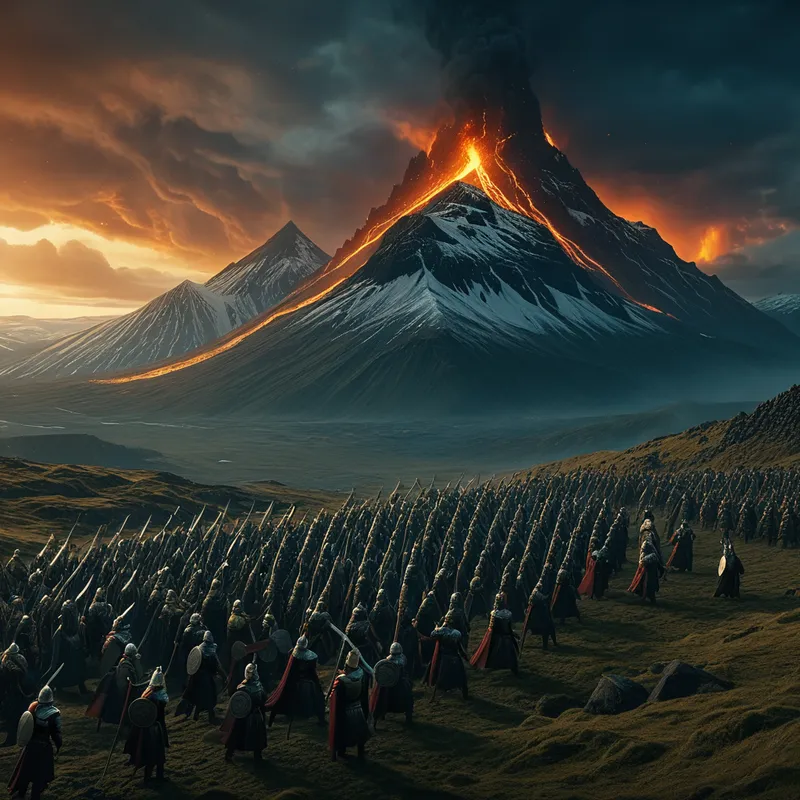
Then, a sound. A low, shuddering groan as [the earth](/myths/the-earth “Myth from Hindu culture.”/) itself convulses. The great bound ones stir. [Fenrir](/myths/fenrir “Myth from Norse culture.”/) breaks his magical fetter, Loki slips his poisonous bonds. From the east, the ship [Naglfar](/myths/naglfar “Myth from Norse culture.”/), its hull a tapestry of untrimmed fingernails, slides free from the icy shore, carrying a host of giants. From the south, fiery [Muspelheim](/myths/muspelheim “Myth from Norse culture.”/) vomits forth its sons, led by the blazing [Surtr](/myths/surtr “Myth from Norse culture.”/), a living volcano with a sword brighter than the sun.
The watchman [Heimdallr](/myths/heimdallr “Myth from Norse culture.”/) stands on [the rainbow bridge](/myths/the-rainbow-bridge “Myth from Global/Universal culture.”/) Bifröst. He sees it all. He lifts the [Gjallarhorn](/myths/gjallarhorn “Myth from Norse culture.”/) to his lips and blows a note that shatters the silence of the worlds. It is the last call. The gods, knowing their doom, don their armor. Odin rides to the field of Vígríðr on his eight-legged steed [Sleipnir](/myths/sleipnir “Myth from Norse culture.”/), his spear [Gungnir](/myths/gungnir “Myth from Norse culture.”/) in hand. He seeks the maw of Fenrir.
The battle is joined. It is not glorious. It is cacophony and terror. Thor, protector of mankind, strides forth to meet his ancient foe, [the world](/myths/the-world “Myth from Tarot culture.”/)-serpent [Jörmungandr](/myths/jrmungandr “Myth from Norse culture.”/). Their struggle shakes the mountains. The one-armed god Týr faces the hound [Garmr](/myths/garmr “Myth from Norse culture.”/) of Hel’s gate. Loki and Heimdallr, eternal adversaries, find each other in the fray and fall together.
Odin fights Fenrir with all his wisdom and power, but the wolf’s jaws are fate itself. They close upon the All-Father. His son Vidar, the silent one, steps forward. Placing his foot on the wolf’s lower jaw, his hand on the upper, he rends the beast apart, avenging his father. Thor slays the serpent with his hammer [Mjölnir](/myths/mjlnir “Myth from Norse culture.”/), takes nine steps back, and falls, drowned in the monster’s venom.
And then, Surtr swings his flaming sword. The fire consumes everything. Bifröst breaks. The nine worlds become a roaring furnace. The earth sinks into the boiling sea.
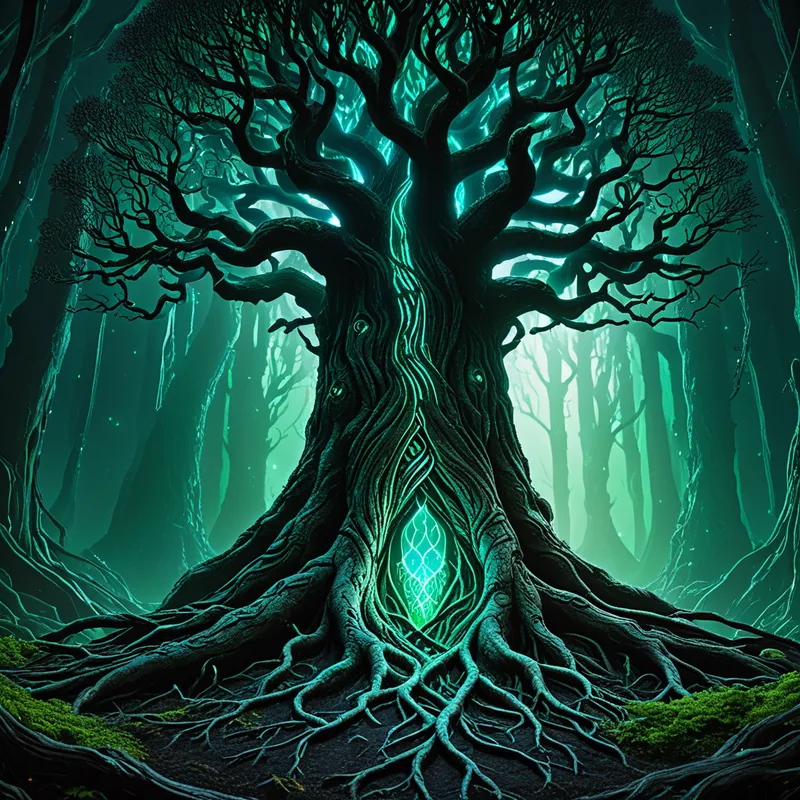
Silence returns, but it is a different silence. The waters recede. A new earth rises from the waves, green and fair, where unsown wheat grows. In the high heavens, the hall Gimlé stands, roofed with gold. There, the surviving gods—Vidar, Baldr returned from Hel, Thor’s sons—gather. Two humans, Líf and Lífþrasir, hidden in the wood of [Yggdrasil](/myths/yggdrasil “Myth from Global/Universal culture.”/), emerge. They will repopulate this cleansed world. And in the grass, glinting, are the golden chess pieces the gods once played with, waiting to be found again.
Cultural Origins & Context
The myth of [Ragnarök](/myths/ragnark “Myth from Norse culture.”/) is preserved primarily in two 13th-century Icelandic texts: the Poetic Edda, a collection of older mythological poems, and the Prose Edda, compiled by Snorri Sturluson. It is crucial to remember these were written down in Christianized Iceland, yet they echo a far older, pre-Christian Germanic worldview. This was not a scripture, but a living tradition recited by skalds (poets) and informed by a culture intimately acquainted with harsh cycles, where winter’s victory seemed absolute before the stubborn return of spring.
Its societal function was multifaceted. It was a cosmological explanation for natural cycles of destruction and rebirth, from the seasonal death of crops to volcanic eruptions. It was also a profound ethical narrative, emphasizing courage in the face of certain doom (ørlög, fate), the importance of oath-keeping (the breaking of which sets the doom in motion), and the bittersweet reality that even the most glorious order contains the seeds of its own end. The gods fight knowing they will fall, making their valor not a quest for victory, but a defiant affirmation of their nature and duty.
Symbolic Architecture
Ragnarök is not merely an end; it is the necessary [dissolution](/symbols/dissolution “Symbol: The process of breaking down, dispersing, or losing form, often representing transformation, release, or the end of a state of being.”/) of a crystallized order. The Odin-led [pantheon](/myths/pantheon “Myth from Roman culture.”/) represents a psychic [structure](/symbols/structure “Symbol: Structure in dreams often symbolizes stability, organization, and the framework of one’s life, reflecting how one perceives their environment and personal life.”/)—a reigning [consciousness](/symbols/consciousness “Symbol: Consciousness represents the state of awareness and perception, encompassing thoughts, feelings, and experiences.”/), a [kingdom](/symbols/kingdom “Symbol: A kingdom symbolizes authority, belonging, and a sense of identity within a larger context or community.”/) of [the ego](/myths/the-ego “Myth from Jungian culture.”/) and its ruling principles (law, war, poetry, craft). But this [structure](/symbols/structure “Symbol: Structure in dreams often symbolizes stability, organization, and the framework of one’s life, reflecting how one perceives their environment and personal life.”/), over time, becomes rigid. Its suppressed elements—the chaotic, the instinctual, the untamed (represented by Loki, the giants, the bound monsters)—grow in power until they must erupt.
The apocalypse is the psyche’s ultimate act of integrity, destroying a world that can no longer contain its own truth.
The binding of monsters like Fenrir symbolizes the repression of immense, wild energies (perhaps raw rage, boundless [hunger](/symbols/hunger “Symbol: A primal bodily sensation symbolizing unmet needs, desires, or emotional voids. It represents craving for fulfillment beyond physical nourishment.”/), instinctual power). The binding is a temporary [solution](/symbols/solution “Symbol: A solution symbolizes resolution, clarity, and the overcoming of obstacles, often representing a sense of accomplishment.”/), but the [energy](/symbols/energy “Symbol: Energy symbolizes vitality, motivation, and the drive that fuels actions and ambitions.”/) does not disappear; it accumulates, waiting for the [Fimbulwinter](/symbols/fimbulwinter “Symbol: Fimbulwinter represents a cataclysmic winter preceding the end of the world, embodying themes of destruction, transformation, and renewal.”/) of the [soul](/symbols/soul “Symbol: The soul represents the essence of a person, encompassing their spirit, identity, and connection to the universe.”/), when defenses are weakened. The battle, then, is the catastrophic, yet inevitable, confrontation between the ruling ego-complex and the fully mobilized [Shadow](/symbols/shadow “Symbol: The ‘shadow’ embodies the unconscious, repressed aspects of the self and often represents fears or hidden emotions.”/).
The survival of gods like Vidar and the return of Baldr signify elements that were present but not central in the old order: silent, grounded [strength](/symbols/strength “Symbol: ‘Strength’ symbolizes resilience, courage, and the ability to overcome challenges.”/) and innocent, reconciling love. They are the seeds of the new consciousness.
The Dreamer’s Resonance
When this myth stirs in modern dreams, it rarely appears as [Vikings](/myths/vikings “Myth from Norse culture.”/) and giants. It manifests as dreams of overwhelming natural disasters: tsunamis swallowing cities, the sun turning black, the ground splitting open. It appears as dreams of final battles against faceless, unstoppable hordes, or of being on a ship (Naglfar) heading toward an inevitable, terrifying confrontation.
Somatically, this can coincide with periods of intense anxiety, a feeling of “everything falling apart,” or profound depression—the [Fimbulwinter](/myths/fimbulwinter “Myth from Norse culture.”/) of the soul. Psychologically, the dreamer is in a process where an old identity, a long-held way of being in the world (a career, a relationship, a core belief), has reached its expiration date. The psychic system knows a great clearing is necessary, but the conscious ego experiences it only as impending doom and catastrophic loss. The dream is the unconscious affirming the scale of the transformation underway.
Alchemical Translation
The alchemical process mirrored in Ragnarök is [nigredo](/myths/nigredo “Myth from Alchemical culture.”/) followed by albedo—the blackening, putrefaction, and dissolution of the old matter, leading to whitening and purification. For the individual, this is the harrowing journey of individuation where the [persona](/myths/persona “Myth from Greek culture.”/) must be shattered for [the Self](/myths/the-self “Myth from Jungian culture.”/) to emerge.
The conscious task is not to “win” the battle or avoid the fire, but to find the equivalent of the wood of Yggdrasil—that core, axial part of the [psyche](/myths/psyche “Myth from Greek culture.”/) that connects the deepest roots to the highest branches and can survive the conflagration. This is the individual’s essential, non-negotiable truth or vitality. Like Líf and Lífþrasir, we must retreat to and protect this inner sanctum while the old world burns.
The goal is not to rebuild the old Asgard, but to inhabit the new, green earth that was always waiting beneath the foundations of the old.
The [triumph](/myths/triumph “Myth from Roman culture.”/) is in the return of Baldr—the integration of a quality previously lost, wounded, or exiled (innocence, joy, trust). It is the discovery of the “golden chess pieces” in the new grass: the valuable patterns and wisdom from the old life, now freed from their former, doomed context, available to inform a more conscious, more whole existence. Ragnarök models the ultimate psychic truth: that sometimes, creation requires not just growth, but a willing descent into the fire of utter dissolution.
Associated Symbols
Explore related symbols from the CaleaDream lexicon: