
The Bard Myth Meaning & Symbolism
A mythic journey where a poet, through harrowing trials, wins the power of true speech from the Otherworld, becoming a vessel for ancestral memory and prophecy.
The Tale of The Bard
Listen. The fire is low, and the night is a cloak of deepest blue. Beyond the warmth of this hall, the wind speaks in the tongues of the ancient oaks. I will tell you not of kings and their battles, but of the first battle that matters—the battle for the word that is true.
In the days when the world was younger and the veil between here and the Sídhe was thin as morning mist, there lived a youth. He was no warrior, his hands knew no sword-calluses, only the tentative touch on a harp’s gut string, the fumbling for a phrase. He had a hunger, a hollow in his chest no food could fill. It was the hunger for the imbas, the true and flowing knowledge, the poetry that does not describe, but is.
Driven by this longing, he left the safety of the tribe. He walked into the forest where the paths are made by deer and memory. For nine days and nine nights, he walked, sustained only by water and the driving need. He came at last to a place where the world turned strange. The trees were silver-barked, their leaves whispering secrets in a language just beyond hearing. In the heart of this grove was a mound, a sídhe mound, its entrance dark and exhaling air colder than winter.
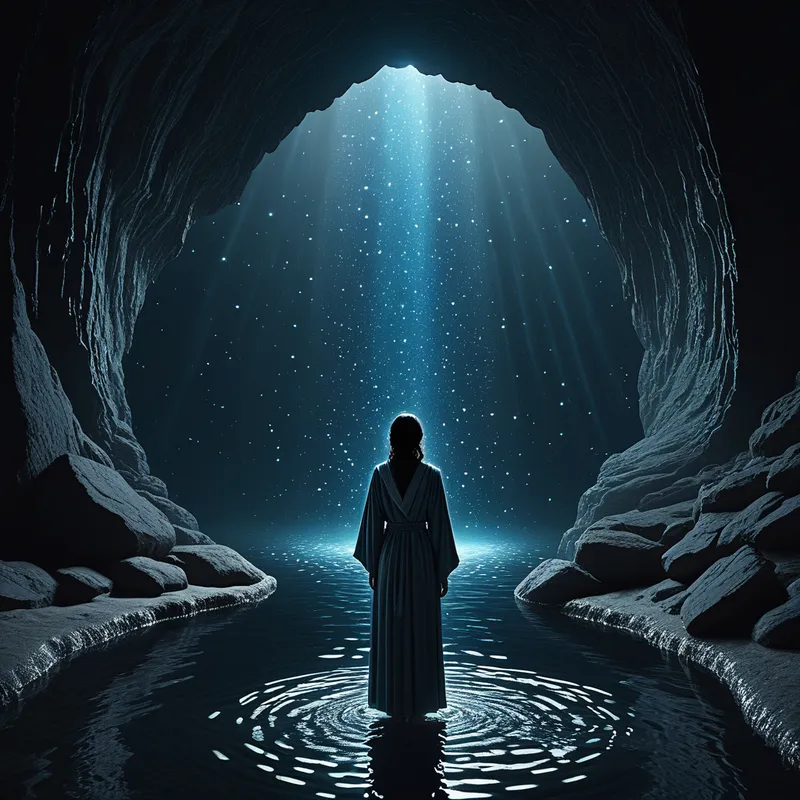
He entered. The darkness was not empty; it was full of pressure, like water at great depth. He felt his way down a spiraling passage, the stone slick under his palms, until he emerged into a cavern lit by a light with no source. At its center was a well, its waters black yet holding the shimmer of stars. Beside it sat a woman. She was neither young nor old, clad in grey, her face the colour of stone and her eyes the colour of the well’s depths. She was the Cailleach of this place, the keeper of the spring of Awen.
“You seek the draught that steals sleep and grants vision,” she said, her voice the sound of stone grinding deep in the earth. “The price is your comfort. The price is your simple life. To drink is to remember all that has been forgotten, to feel the joy and the sorrow of every soul that has walked this land. It is a burden heavier than any chieftain’s torc.”
The youth’s throat was parched, his hollow aching. He nodded, unable to speak. She lifted a cup carved from a single dark gem and filled it from the well. The liquid within was like liquid shadow, moving of its own accord. He drank.
It was not water. It was fire and ice. It was the scream of the first battle and the sigh of the first lover. It was the taste of ripe berries and the salt of endless tears. Visions tore through him—the rise and fall of kingdoms he would never see, the private griefs of strangers long dust, the secret names of the stars. He fell to the cavern floor, his body wracked, his mind aflame. He was not a man, but a vessel being filled to breaking with the memory of the world.
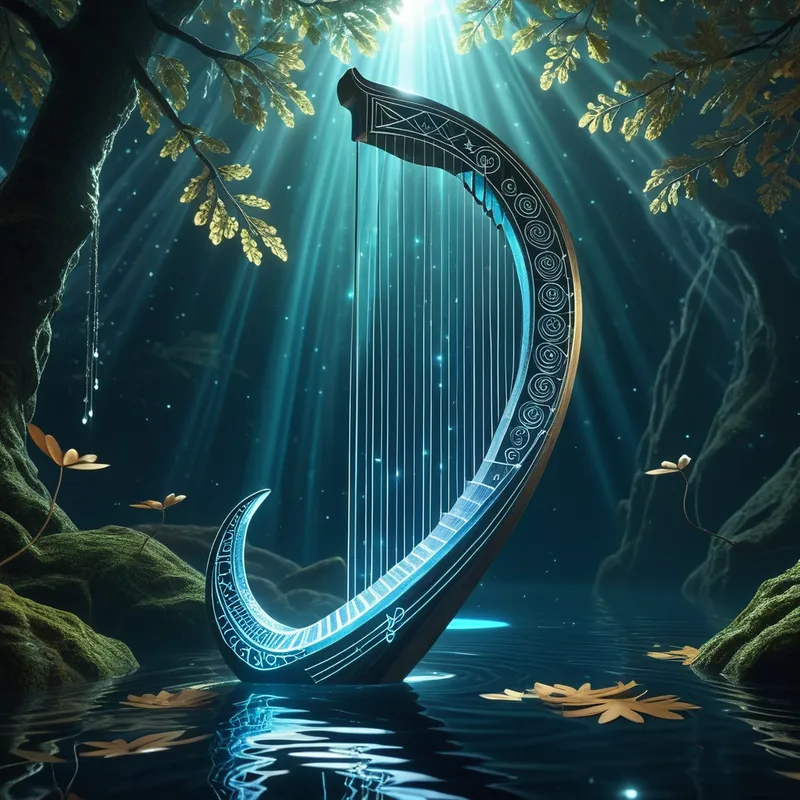
When the storm within him subsided, he was changed. The hollow was gone, replaced by a terrible, beautiful fullness. The Cailleach placed a harp in his hands—not his old, simple instrument, but one of pale wood strung with silver. “Go,” she said. “Your tongue is now a key. Your song will open doors in the hearts of men and in the hills of the Sídhe. Speak only what is true. Remember all.”
He emerged from the mound. When he opened his mouth to speak to the first dawn bird, what came out was not speech, but poetry that made the dew shimmer brighter. He had become the Bard. His journey was over, and his true work had just begun.
Cultural Origins & Context
The figure of the Bard is not merely a poet or entertainer in Celtic tradition; he is a pillar of the social and cosmic order. In early Irish and Welsh societies, the Bard (or fili in Ireland, a higher grade of poet-seer) underwent rigorous training that could last decades, memorizing vast tracts of history, law, genealogy, and complex poetic forms. This mythic narrative of the perilous quest for inspiration reflects that arduous initiation.
The story was not written down by its original bearers. It lived in the oral tradition, passed from master to apprentice in the poetic schools. Its telling was itself a ritual, a reaffirmation of the poet’s sacred function. Societally, the Bard was the memory of the people, the legitimizer of kings (whose authority he could satirize into nothingness), and the mediator between the human community and the numinous, animistic world. The myth served to sanctify this role, grounding the Bard’s authority not in human institutions, but in a direct, traumatic encounter with the divine source of truth itself.
Symbolic Architecture
At its core, this is a myth of vocation and the terrifying gift of consciousness. The hollow the youth feels is the call of the Self, the psychic imperative toward a destiny that feels larger than the personal ego.
The quest for true speech is the journey from the ego’s chatter to the voice of the Self.
The forest represents the unconscious, and the sídhe mound is the archetypal symbol of descent into the deepest layers of the psyche—what Jung termed the collective unconscious. The Cailleach is the archetypal Great Mother in her transformative, chthonic guise. She is not a nurturer but a tester and initiator. She guards the well of Awen, the undifferentiated source of creative and psychic life-force.
The draught is the symbolic ingestion of totality. It is the burden of awareness, the painful awakening to the full spectrum of human and trans-human experience—joy, sorrow, history, and cosmic connection. The transformation is not gentle; it is a psychic death and rebirth. The old, personal identity is shattered to make room for the archetypal function of the Bard, who becomes a conduit for something far greater than himself.
The Dreamer's Resonance
When this mythic pattern stirs in the modern psyche, it often manifests in dreams of profound seeking and ordeals of expression. You may dream of being mute in a crucial moment, of finding a hidden spring or book in a basement, or of being force-fed a strange substance that alters your perception.
Somatically, this can correlate with tension in the throat chakra—a feeling of constriction, a chronic sore throat, or conversely, a powerful, unexpected urge to sing or speak a difficult truth. Psychologically, the dreamer is in the grip of what James Hillman called the “acorn theory”—the pull of one’s daimon, or innate destiny. The process is one of wrestling with one’s authentic voice. The “hollow” is felt as existential anxiety, a sense of potential unlived. The ordeal represents the resistance—the fear of the responsibility, the exposure, and the alienation that often accompanies true creative or spiritual awakening.
Alchemical Translation
For the modern individual, the Bard’s myth maps the alchemical process of individuation—the journey toward psychological wholeness. The “base metal” of the uninitiated ego, with its small concerns and borrowed identities, must be dissolved in the nigredo of the descent. The dark well and the draught represent this dissolution, the confrontation with the shadow and the contents of the collective unconscious.
The harp strung with silver is the reconstituted personality, the ego now in service to the Self, capable of translating archetypal energies into a form that can be heard in the human world.
The albedo (whitening) is the emergence with the clarified, silver voice. The Bard does not sing his own petty praises; he sings the world into being, he remembers what the culture has forgotten, he speaks the soul of things. In our lives, this translates to finding one’s unique vocation—not just a job, but a mode of being through which the personal psyche aligns with and expresses transpersonal truths. It is the artist who finally paints from the dream, the therapist who learns to listen for the archetypal story beneath the client’s narrative, the anyone who dares to speak the raw, complex truth of their experience, thereby giving voice to a fragment of the world’s unspoken memory. The myth tells us that true creativity is never just personal; it is an act of sacred remembrance.
Associated Symbols
Explore related symbols from the CaleaDream lexicon: